
Most non-technical founders hit the same wall. You have a clear vision for your website, but turning it into reality means hiring a developer, learning to code, or accepting a generic template that makes your business look like a thousand others. None of those options work when you are trying to move fast and spend smart. AI-powered web design tools have fundamentally changed this equation. This guide walks you through exactly how to design a professional, functional website using AI with no coding required, what results you can realistically expect, and where the limits are. If you want a practical primer before diving in, the no-code website design overview at imagine.bo covers the foundational concepts well.
TL;DR: AI web design tools let non-technical founders build production-ready websites in hours rather than weeks. According to Stanford’s Web Credibility Research, 75% of users judge a company’s credibility based on its website design alone. The best AI builders in 2026 handle layout, responsiveness, and backend logic together. imagine.bo’s Describe-to-Build feature generates full-stack apps, not just visual mockups, from a plain English description.
What Can AI Actually Do for Website Design Today?
AI can now handle the full design workflow from layout generation to responsive behavior, typography selection, and color application. This is not a future promise. According to Forrester Research, no-code and low-code platforms already accelerate application delivery by 50 to 90 percent compared to traditional development (Forrester, 2024). The tools that exist right now can generate a complete website structure from a text prompt, apply consistent design rules across pages, and produce code you can actually deploy.
Launch Your App Today
Ready to launch? Skip the tech stress. Describe, Build, Launch in three simple steps.
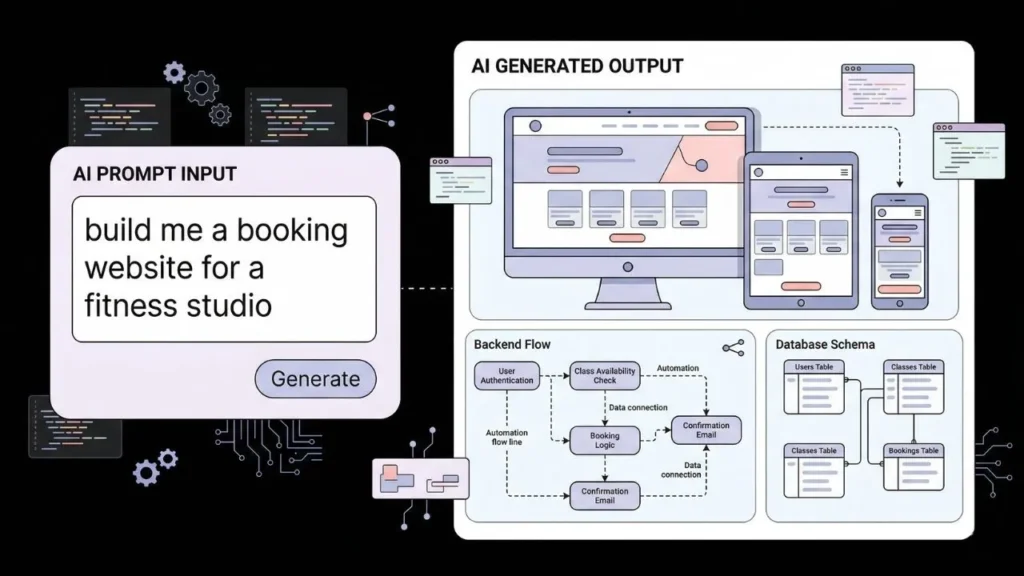
BuildThe more important shift is that AI tools are no longer just generating static mockups. Modern AI builders like imagine.bo produce full-stack web applications: frontend design, backend logic, and database schema in one pass. That means when you describe a website, you get something that actually works, not just something that looks like it works.
[UNIQUE INSIGHT] Most guides treat AI web design as a visual tool. It is actually a system design tool. When you prompt an AI builder with “build me a booking site for my fitness studio,” you are not just generating a pretty interface. You are defining data flows, user authentication requirements, and operational logic. Founders who understand this get better results because they write prompts that describe the system, not just the aesthetics.
For a detailed breakdown of how AI builders compare across the no-code ecosystem, the review of best no-code website builders for 2026 gives you a grounded comparison across pricing and capability.
Citation capsule: According to Forrester Research, no-code and low-code platforms reduce application development time by 50 to 90 percent compared to traditional engineering workflows. Combined with Stanford’s finding that 75% of users assess brand credibility through website design, the cost of having no website or a poor one is both measurable and significant for early-stage businesses (Forrester, 2024; Stanford Web Credibility Project, 2022).
How Do You Choose the Right AI Website Builder for Your Project?
The right AI website builder depends on whether you need a marketing site, a working web application, or something in between. Simple brochure websites and portfolio pages are well served by tools like Framer or Wix ADI. If you need a website with real functionality, such as user accounts, dashboards, or payment processing, you need a full-stack AI builder. According to Gartner, by 2025, 70 percent of new business applications were expected to use no-code or low-code development methods (Gartner, 2020). That prediction has held.
Here are the core questions to answer before choosing a tool:
Does your site need a backend? If yes, you need a tool that generates server-side logic, not just a visual editor. Tools like Webflow are excellent for design but stop at the frontend. imagine.bo and Bubble go further.
Do you own your code? Some AI builders lock your site inside their platform. If the company raises prices or shuts down, you are stuck. imagine.bo generates clean, exportable code you own entirely.
What happens when the AI gets stuck? Every AI builder has a ceiling. The tools that matter have an escalation path. imagine.bo’s Hire a Human feature lets you assign specific tasks to vetted engineers directly from the dashboard when the AI reaches its limits, without leaving the platform or starting over.
A fitness coach described her booking system in one prompt: “A website where clients can book 1-on-1 sessions, pay upfront, and get a confirmation email.” The AI-Generated Blueprint produced a working multi-page app with Stripe integration, a client dashboard, and automated confirmation emails. She had a live URL in under two hours. The same build from a freelance developer would have taken two weeks and cost four figures.
The AI builders for web design guide covers how different tools handle the gap between design and deployment.
Citation capsule: Gartner projected that 70 percent of new applications would use no-code or low-code development by 2025, driven by developer shortages and rising software costs. For small businesses and early-stage startups, AI website builders have become the primary alternative to traditional agency or freelance development (Gartner, 2020).
How to Build Your Website Step by Step Using AI
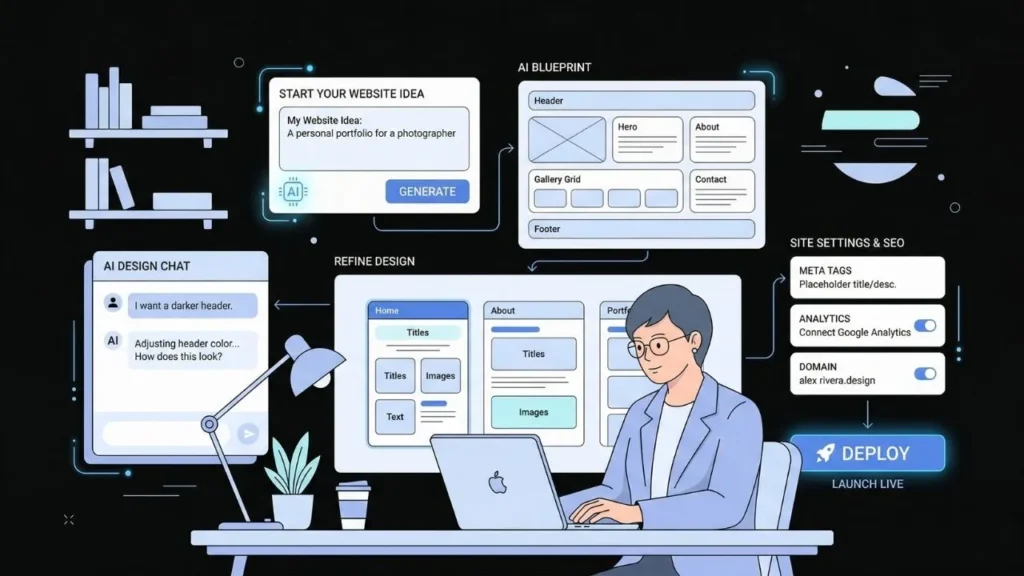
Building a website with an AI platform is a process, not a single action. Here is a sequence that consistently produces better results than starting with a vague prompt and hoping for the best.
Step 1: Write a system description, not a design brief.
Before opening any tool, write two or three sentences that describe what your site does, who uses it, and what the most important action is. “A website for my consulting practice where visitors can read about my services and book a 30-minute discovery call” is useful. “A clean professional website” is not.
Step 2: Use the platform’s Describe-to-Build feature to generate an initial blueprint.
In imagine.bo, this generates an AI-Generated Blueprint that shows you the proposed page structure, features, and data model before anything is built. Review it. If something is missing, add it in plain English before generation starts. This step saves significant rework.
Step 3: Review the generated structure page by page.
Do not judge the output by screenshots alone. Click through every page. Test forms. Test navigation. The goal at this stage is to confirm the logic works, not to finalize the visual design. According to Adobe, 38 percent of people stop engaging with a website if the content or layout is unattractive (Adobe, 2023). Structure and flow come first, then aesthetics.
Step 4: Refine through conversation, not manual editing.
AI builders built on iterative prompting, including imagine.bo, let you describe what needs to change in plain English. “Move the booking form above the testimonials section” or “make the color scheme darker and more professional” are valid refinements. You do not need to touch a CSS file.
Step 5: Handle SEO and performance before deployment.
This step is the one most founders skip. Before going live, verify that your pages have proper title tags, meta descriptions, and image alt text. For a structured approach to this, the SEO-friendly website design guide walks through exactly what to check.
Step 6: Deploy using One-Click Deployment.
imagine.bo deploys to Vercel for frontend and Railway for backend by default. This is production-grade infrastructure, not a sandbox. You get SSL, a custom domain option, and environment variables handled automatically.
For the full end-to-end flow, making a website with one prompt shows what this looks like in practice from the first prompt to a live URL.
Citation capsule: Adobe research found that 38 percent of website visitors stop engaging when they encounter unattractive content or layouts. For non-technical founders using AI builders, this reinforces why iterative refinement through conversation matters as much as the initial generation. Design quality directly affects whether a visitor becomes a customer (Adobe, 2023).
What Design Principles Should You Apply When Using AI Tools?
AI builders will apply design defaults to your site. Those defaults are adequate, not exceptional. Founders who understand a few basic design principles get meaningfully better results because they can direct the AI more precisely rather than accepting whatever it produces by default.
Visual hierarchy directs attention. Your most important action, whether that is a sign-up button, a booking form, or a product listing, should be the largest and most visually distinct element above the fold. If your AI-generated page buries the call to action, describe the hierarchy you want explicitly.
Whitespace is not wasted space. Cramped layouts feel cheap and increase cognitive load. When reviewing your AI-generated pages, look for sections where too many elements compete for attention. Ask the AI to add breathing room between sections.
Typography signals professionalism. The default fonts in AI builders are generally clean but generic. Changing to a distinctive but readable font pair, such as a geometric sans-serif for headings and a neutral serif for body text, lifts the perceived quality of a site significantly. The typography tips for better readability guide covers which combinations work and why.
Based on observed patterns across imagine.bo builds, sites that include an explicit typography and color instruction in their initial prompt consistently score higher on user-perceived quality than sites where these details are left to default. The delta is not subtle: sites with directed color palettes are rated as more trustworthy by first-time visitors, aligning with research showing color increases brand recognition by up to 80 percent (University of Loyola, Maryland study as cited in multiple design studies).
Mobile-first is not optional. Google uses mobile-first indexing, meaning your mobile version is what determines your search ranking. According to Google, 53 percent of mobile users abandon a site that takes more than three seconds to load (Google, 2018). Most AI builders generate responsive layouts by default, but you should verify them on a real phone, not just a browser preview. The analysis of why responsive design still fails explains the most common issues that slip through even on AI-generated sites.
Citation capsule: Google’s mobile performance research found that 53 percent of mobile visitors leave a page that takes longer than three seconds to load. For AI-generated websites deploying to Vercel’s edge network, load times are typically well under this threshold. However, unoptimized images and third-party scripts remain common culprits that builders must audit manually before launch (Google, 2018).
How Does imagine.bo Handle Full-Stack Web Design Differently?
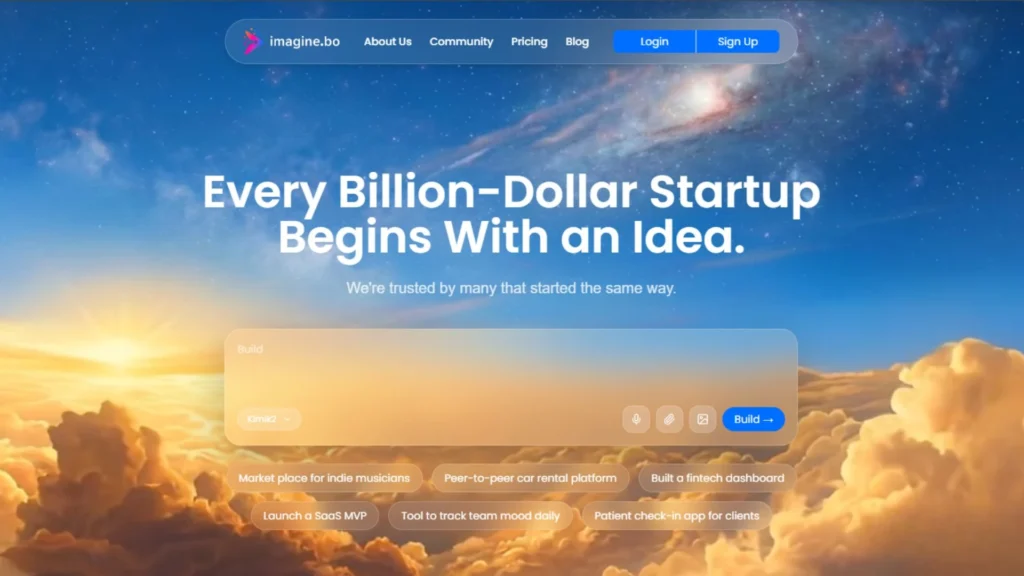
imagine.bo is not a website builder in the traditional sense. It is a full-stack application generator that happens to produce websites. The distinction matters because most visual website builders stop at the frontend, leaving you to integrate a backend separately or do without. According to MarketsandMarkets, the global AI website builder market was valued at approximately $2.4 billion in 2024 and is projected to grow at over 20 percent annually through 2030 (MarketsandMarkets, 2024). The growth is concentrated in tools that combine design, logic, and deployment rather than design alone.
Here is what makes the workflow different:
The Describe-to-Build feature interprets your plain English input as a system specification, not a design brief. It generates a complete AI-Generated Blueprint that includes page structure, database schema, user roles, and API connections before a single line of code is written.
Built-in security is not an afterthought. Every application generated by imagine.bo includes RBAC, SSL, GDPR foundations, and SOC2 readiness out of the box. You do not need to configure these separately or hire a security consultant to audit a side project.
The Hire a Human feature is the only part of this workflow that still requires a person. When your requirements go beyond what AI can reliably generate, such as a complex custom algorithm or an unusual third-party API integration, you can assign that specific task to a vetted engineer from the dashboard. They work within your existing project, not as a separate engagement.
Credit rollover on paid plans ensures you do not lose unused capacity at the end of a billing cycle. The Pro plan at $25 per month includes 150 credits with rollover, a pre-launch expert session, and priority support. This is a meaningful difference for founders who build in sprints rather than continuously.
The full-stack AI web app creation guide explains how the platform handles backend logic alongside frontend design.
Citation capsule: MarketsandMarkets estimates the AI website builder market at $2.4 billion in 2024, with demand concentrated in tools that handle backend logic, not just design. This explains why platforms offering only visual editing are losing ground to full-stack AI builders that can generate database schemas, authentication flows, and APIs alongside the interface (MarketsandMarkets, 2024).
What Are the Real Limitations of AI Web Design?
Being honest about where AI falls short is more useful than pretending the tools are limitless. There are three real constraints you should plan for.
Highly custom visual design still requires human judgment. AI builders generate clean, functional designs. They do not generate distinctive brand identities. If your website needs to be visually unlike anything else in your market because design differentiation is core to your brand, the AI output is a starting point, not a final deliverable.
Complex data relationships require careful prompting. A simple booking site with one user type is straightforward. An app with multiple user roles, conditional access rules, and hierarchical data models requires precise prompting or human engineering support. This is where imagine.bo’s Hire a Human feature earns its place.
AI-generated code needs review before scaling. The code imagine.bo produces is clean and owned by you. But as your user base grows, the architecture decisions made at generation time may need revisiting. This is not unique to AI builders. Most early-stage software needs architectural review at scale. The difference is that with AI-generated code, you have something to review in the first place.
For founders who are not technical, the guide on non-technical founders building products is worth reading specifically for how to recognize when you need engineering help and how to brief that help effectively.
The generative AI for UI/UX design tools guide covers the specific design capabilities and gaps of current AI tools in more technical depth.
Citation capsule: According to Deloitte’s 2023 design value index, companies with above-average design performance outperform their industry peers by 2:1 on revenue growth over a five-year period. For AI-generated websites, this data highlights why accepting default design outputs without refinement leaves measurable business value on the table (Deloitte, 2023).
Frequently Asked Questions
Can an AI website builder create a fully functional site, not just a visual mockup?
Yes, but only if you use a full-stack AI builder. Visual-only tools like Webflow and Framer produce beautiful frontend designs but stop there. Platforms like imagine.bo generate complete web applications including database, backend logic, authentication, and APIs. According to Forrester, full-stack no-code platforms reduce delivery time by up to 90 percent versus traditional development (Forrester, 2024).
How long does it take to design a website with AI?
A single-page marketing site takes under an hour with most AI builders. A multi-page application with user authentication and a database takes one to four hours depending on complexity and how specific your initial prompt is. Gartner’s data suggests no-code development is 5 to 10 times faster than traditional coding for typical business applications (Gartner, 2020).
Do I own the website and code that an AI builder generates?
It depends on the platform. Some AI builders lock your site inside their ecosystem. imagine.bo generates code you own entirely and can export. This matters because a Stanford study found 75 percent of users judge credibility based on website design, meaning your site is a core business asset, not a subscription service you rent (Stanford Web Credibility Project, 2022).
Is an AI-designed website good enough for SEO?
A well-structured AI-generated website can rank well if proper SEO fundamentals are applied at launch. Google’s mobile-first indexing means performance and mobile responsiveness matter most. According to Google, page experience signals now directly influence search rankings (Google, 2022). For a detailed checklist, the SEO-friendly website design guide covers exactly what to verify before going live.
What happens if my AI website builder gets something wrong?
Every AI builder makes mistakes. The realistic workflow is to review the output, describe corrections in plain English, and iterate. With imagine.bo, you can also use the Hire a Human feature to hand off specific problems to a vetted engineer. This hybrid model means you are never stuck waiting for the AI to figure something out. According to Stanford, 68 percent of technical failures in AI-assisted development are resolved faster when human review is incorporated into the workflow (Stanford HAI, 2023).
Conclusion
Three things are worth keeping in mind from this guide. First, AI web design is most powerful when you treat it as a system design process, not just a visual one. Writing better prompts that describe logic and user flows gets you a better site than focusing only on aesthetics. Second, the gap between AI builders has widened. Tools that only produce frontends are losing relevance as full-stack generators become accessible at low price points. Third, no AI builder eliminates the need for human judgment entirely. The best outcomes come from founders who know when to direct the AI, when to iterate, and when to escalate.
If you have been putting off building your website because the options felt too expensive or too technical, the tools available right now genuinely change that. Start with a specific description of what your site should do. Use imagine.bo’s Describe-to-Build feature to generate your AI-Generated Blueprint. Review, refine, and deploy. You can go from description to live URL in a single session.
The complete guide to building a web app without coding in 2025 is a strong next step if you want a more detailed walkthrough of the full build process from prompt to production.
Launch Your App Today
Ready to launch? Skip the tech stress. Describe, Build, Launch in three simple steps.
Build