

Web development used to require two things that most people do not have: years of learning to code and a budget large enough to pay someone who did. Both of those requirements are dissolving. According to GitHub’s 2024 State of the Octoverse, AI-assisted development tools have reduced the time required to complete common web design and development tasks by an average of 55% even for experienced engineers, with even larger proportional gains for non-technical builders (GitHub, 2024). The tools have crossed a threshold. No-code website design is no longer a compromise for people who cannot code. It is the primary design methodology for a growing share of professional builders who have concluded that the output justifies abandoning traditional workflows entirely. This article examines what that shift means, why it is structural rather than cyclical, and what it implies for how websites and web applications will be designed and built through the rest of the decade. For the practical overview of how no-code website design works with current tools, this post on no-code website design and the platforms enabling it covers the current tool landscape.
TL;DR No-code website design has moved from a workaround to the primary build methodology for a significant and growing share of professional builders. AI-generation tools produce complete full-stack web applications from plain English descriptions, not just static layouts. According to Gartner, 70% of new applications will use no-code or low-code by 2025 (Gartner, 2021). The future of web development is not about replacing every developer. It is about making the design and build of web products accessible to the people with the clearest domain knowledge, regardless of their technical background.
What No-Code Website Design Actually Means in 2025
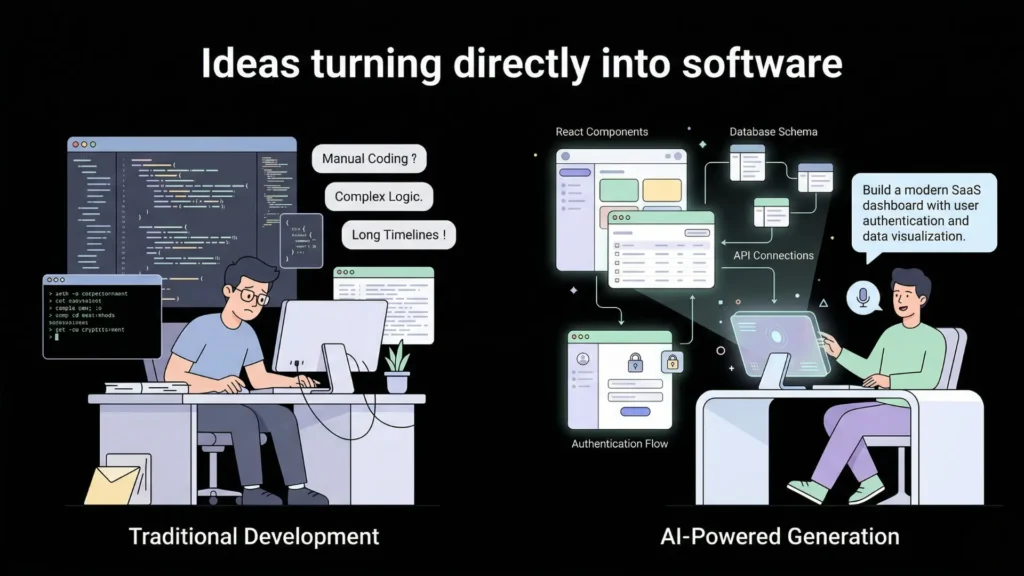
The term “no-code website design” meant something different in 2020 than it does in 2025. In 2020 it meant dragging pre-built components onto a canvas and publishing to the tool’s own subdomain. The output was limited to whatever the platform’s template library supported. Real backend logic, custom databases, and user authentication required a developer regardless.
Launch Your App Today
Ready to launch? Skip the tech stress. Describe, Build, Launch in three simple steps.
BuildIn 2025 it means describing a complete web product in plain English and having an AI-generation platform produce the full stack: the frontend React components, the database schema, the backend API endpoints, the authentication system, and the deployment configuration. The design and the infrastructure are generated together from the same description.
The most significant design implication of this shift is that the constraint on website quality has changed from technical skill to descriptive clarity. A traditional web developer’s quality is limited by their coding ability. A no-code designer’s quality in 2025 is limited by their ability to describe what they want with specificity. A non-technical founder who understands their users, their data, and their workflows in detail produces a more accurate generated output than a developer who receives an ambiguous brief. Domain expertise has become a direct design asset in a way it never was when code was the medium.
This represents a genuine inversion of the traditional web development dynamic. For context on how AI tools have specifically changed the role of the developer and the designer in this new model, this post on how AI builders are changing UX design covers the shifting responsibilities in the design process.
Three Forces Driving No-Code to the Mainstream
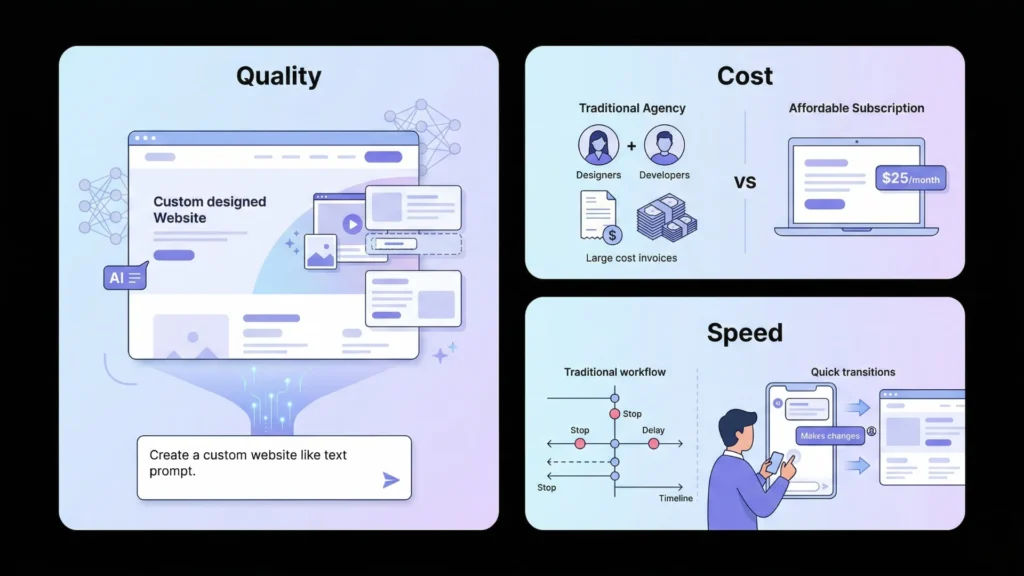
The quality gap has closed. The most common objection to no-code tools in 2020 was that the output looked like a template. That criticism applied because the output was a template. AI-generation tools produce unique, structured designs based on the specific description they receive. A well-described prompt on imagine.bo produces a website that looks custom-built, because functionally it is. The visual design system, the component structure, and the page layout are all generated from the description rather than copied from a library. For what generated designs look like with current tools, this post on AI website design for no-code beginners covers the output quality in practice.
The cost gap has closed. A professionally designed and developed website from an agency costs $5,000 to $50,000 depending on scope. An equivalent website generated on imagine.bo’s Pro plan costs $25 per month with no design fees and no development invoice. According to Clutch’s 2025 web development survey, the average small business website from a freelance developer costs $3,000 to $8,000 with a turnaround of four to eight weeks (Clutch, 2025). imagine.bo delivers the same functional output in days. The cost argument for traditional development at this scope no longer holds.
The speed gap has closed. Speed of iteration matters as much as speed of initial build. A traditional development process makes changes expensive because each change requires a developer’s time and a new deployment cycle. No-code website design on imagine.bo iterates through conversation: describe the change, review the impact, confirm. The turnaround from idea to live change is hours rather than weeks. For businesses competing on responsiveness to market feedback, that speed difference is a competitive advantage.
How AI Generation Has Changed the Design Workflow
Traditional web design had a defined sequence. A designer produced wireframes. A developer translated wireframes into code. The two communicated through briefs, revisions, and handoff documents. The process was sequential, slow, and expensive in its use of specialised time.
AI-generation design collapses that sequence. The description of intent produces both the design and the implementation simultaneously. There is no wireframe phase distinct from a development phase. There is no handoff. The person who understands the product builds the product.
The workflow change that surprises first-time users of imagine.bo most consistently is the blueprint review step. Before the platform builds anything, it surfaces a complete architectural map: the database schema, the page structure, the user roles, the backend endpoints. A designer reviewing this blueprint is doing the work that previously required a technical architect. They are confirming that the data model matches the design intent before any code is written. That responsibility shift, from technical specialist to domain expert, is the practical experience of the future of web development in action.
The design skill that becomes more valuable in this model is systems thinking: the ability to describe what data an interface needs to display, what actions it needs to support, and what rules govern who can do what. Visual taste still matters, but it is exercised through description rather than direct manipulation. For how conversational prompts replace traditional design tools in the production workflow, this post on designing workflows with conversational prompts covers the methodology in detail.
What No-Code Design Can and Cannot Do in 2025
No-code website design in 2025 is genuinely capable of producing a wide range of professional products. Being honest about its limits matters because overclaiming creates disappointment and appropriate scoping creates satisfaction.
What it handles well: Multi-page business websites with contact forms and SEO-ready structure. Full-stack SaaS products with user authentication, role-based access, database logic, and subscription billing. Client portals, booking systems, marketplaces, internal tools, and community platforms. Mobile-responsive layouts deployed to production infrastructure with SSL and global edge performance. Iterative feature additions through conversational prompts post-launch.
Where human engineering adds value: Real-time collaborative features requiring WebSocket connections. Complex third-party API integrations with non-standard authentication. Custom machine learning inference at the application layer. Performance optimisation at scale for applications serving millions of concurrent users. These are not scenarios where no-code tools fail. They are scenarios where the Hire a Human feature on imagine.bo, connecting you with a vetted engineer at $25 per page, produces more reliable outcomes than prompt iteration alone.
According to imagine.bo’s platform documentation, the Hire a Human feature is the mechanism that extends the no-code ceiling beyond what any single AI generator handles perfectly, by combining AI-generated foundations with precise human engineering for the specific modules that require it (imagine.bo, 2026). That hybrid model is what makes imagine.bo different from both pure no-code tools and pure AI generators.
Citation capsule: According to Gartner’s 2025 analysis of no-code and low-code platforms, the most significant productivity gains from no-code design tools are concentrated in the initial build phase, where AI generation reduces time-to-first-deployment by an average of 60 to 80%. Post-launch iteration and complex integration work show smaller but still significant gains, averaging 30 to 40% time reduction compared to traditional development cycles (Gartner, 2025).
The Role of the Designer and Developer in the No-Code Future
The future of web development does not eliminate designers or developers. It changes what each role spends its time on.
Designers who embrace no-code generation tools spend less time on repetitive component construction and more time on the design decisions that require taste, user empathy, and strategic thinking. The baseline of professional design quality has risen because generated tools produce consistent, well-structured output as a starting point. The value of a skilled designer comes from raising above that baseline, not from building at it.
Developers who work alongside no-code tools spend less time on routine CRUD operations, standard authentication systems, and common page patterns. That time redirects to the genuinely complex engineering: the algorithms, the performance optimisation, the security architecture, the integrations that require specialised knowledge. According to Stack Overflow’s 2024 developer survey, 72% of professional developers report using AI-assisted coding tools in their regular workflow, with the majority citing time savings on routine tasks as the primary benefit (Stack Overflow, 2024).
The designers and developers who are most negatively affected by no-code tools are those whose primary value was executing technically simple work at professional quality. That category of work is now largely automated. The designers and developers who create the most value are those whose work requires judgment, systems thinking, and the ability to operate at the intersection of technical and human complexity.
For the full analysis of how developer roles are evolving in response to AI and no-code tools, this post on the evolution of developer roles in the AI era covers the structural role changes in detail.
What This Means for Non-Technical Founders and Small Businesses
The most direct beneficiaries of no-code website design’s maturation are the founders and small business owners who previously had to choose between paying for professional design and development or accepting amateur-looking digital presence. That choice no longer exists.
According to Stanford’s Web Credibility Research, 75% of people judge a business’s credibility based on its website design (Stanford, 2023). A professionally designed, fast-loading, mobile-responsive website is not a luxury for small businesses. It is the credibility signal that determines whether a visitor stays or leaves. No-code tools have made that signal accessible at a price point that any serious business can justify.
For founders building products rather than marketing sites, the implication is larger. A non-technical founder who can articulate their product clearly in plain English can now build that product in days and put it in front of real users before spending any significant capital. The risk profile of building a software product has changed structurally. For what that change means for the economics of startups specifically, this post on why prompt-driven development transforms the startup equation covers the full competitive implication.
FAQ
Is no-code website design good enough for professional use?
Yes, for most professional website and web application use cases. imagine.bo generates applications deployed to Vercel’s global edge network with SSL, RBAC, and GDPR foundations applied by default. The output quality is production-grade, not prototype-grade. According to Gartner, 70% of new applications will use no-code or low-code by 2025 (Gartner, 2021), which indicates that professional use is already the primary context for these tools. The question of whether no-code is professional enough has been settled by volume: the majority of new web products are built this way. This post on AI tools replacing traditional web development covers the specific quality thresholds where no-code tools meet professional standards.
Will no-code website design replace traditional web development?
It will replace the commodity tier of traditional web development: the routine page-building, template customisation, and standard feature implementation that constitutes a large share of typical agency and freelance workloads. It will not replace engineering work that requires specialised knowledge, complex problem-solving, and the kind of judgment that comes from deep technical experience. The realistic future is not replacement but stratification: no-code tools handle the base of the pyramid while skilled engineers focus on the work at the top. For a grounded view of how no-code and traditional development coexist, this post on the no-code future for lean startups covers the boundary between the two.
What skills matter most for no-code website design in 2025?
The skill that produces the best no-code design outcomes is systems thinking expressed through clear description. Specifically: the ability to articulate who uses the interface, what data they need to see and create, what actions they take on that data, and what rules govern access and behaviour. Visual taste, user empathy, and understanding of what makes an interface useful remain valuable. Coding ability is not required. For the specific techniques that turn systems thinking into accurate generated outputs, this post on turning ideas into apps with AI prompts covers the prompting methodology that produces professional results.
Conclusion
Three things define the current state of no-code website design and its trajectory. First, the quality, cost, and speed gaps between no-code and traditional development have closed sufficiently that no-code is the rational default choice for most new website and web application projects. Second, the primary design skill in this model is descriptive clarity rather than technical execution, which means domain experts are better positioned to produce accurate results than they have ever been. Third, the tools that combine AI generation with on-demand human engineering, specifically imagine.bo’s Hire a Human model, produce the most complete outcomes because they do not pretend that AI generation is sufficient for every design and development requirement.
The future of web development is not a world without developers. It is a world where the first 80% of a product is generated rather than hand-coded, where iteration happens through conversation rather than tickets, and where the value of expert engineering is concentrated in the 20% of the work that genuinely requires it. imagine.bo’s free plan provides 10 credits to experience that model at zero cost. For the most complete guide to what building a web application with AI-generation design looks like from first prompt to live product, this post on building a web app without coding in 2025 walks through the entire workflow.
Launch Your App Today
Ready to launch? Skip the tech stress. Describe, Build, Launch in three simple steps.
Build