Three years ago, if you had a software idea and no coding skills, you had two realistic options: find a technical co-founder willing to work for equity, or spend $30,000 to $150,000 on a development agency and wait four to six months to see a working product. Both paths were slow, expensive, and gave someone else control over your own vision. That dynamic has fundamentally changed. Today, non-technical founders are building and shipping full-stack web applications in days. This article shows you exactly how they are doing it, what tools make it possible, and where the real learning curve actually sits. For a full breakdown of your options before you start, the cost to build an app in 2026 across developer, AI, and no-code routes is worth reading first.
TL;DR: Non-technical founders can now build production-ready products in days using AI-powered no-code platforms. According to Gartner, by 2026, 75% of new applications will be built using low-code or no-code technologies, with 80% of users coming from outside traditional IT departments (Gartner, 2026). The bottleneck is no longer technical skill. It is the clarity of your thinking about what you want to build.
What Has Actually Changed for Non-Technical Founders?
The shift is not just about better tools. It is about a fundamental change in what the primary bottleneck is. For most of the internet era, the gap between a business idea and a working product was technical. You needed to know how to write code, or you needed to pay someone who did. That is no longer true. According to Gartner, by 2026, 75% of new applications will use low-code or no-code platforms, up from under 25% in 2020 (Gartner, 2026). The fastest-growing segment of that user base is non-technical founders and operators, not developers.
Launch Your App Today
Ready to launch? Skip the tech stress. Describe, Build, Launch in three simple steps.
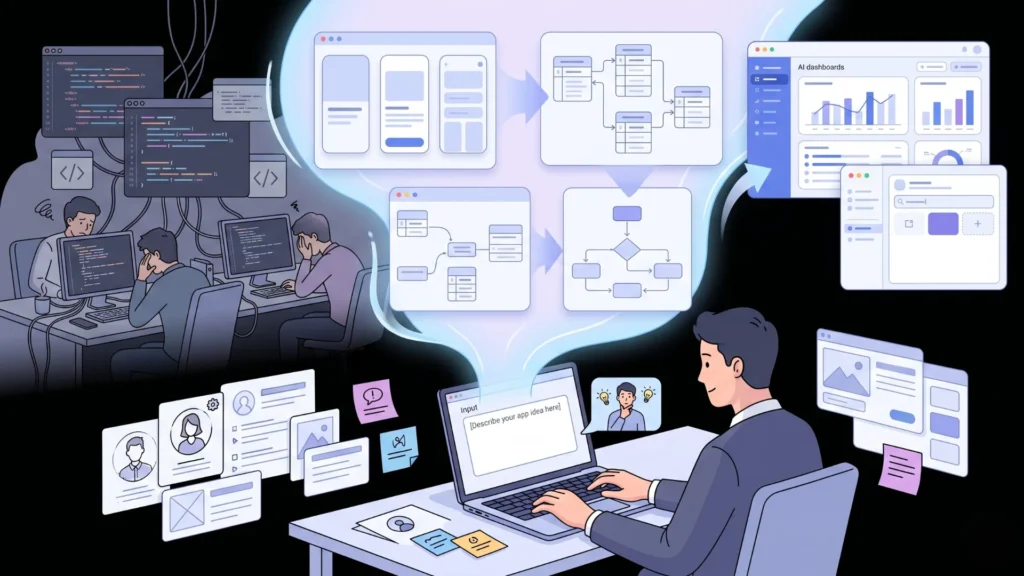
BuildWhat changed is the abstraction layer. Earlier no-code tools like early Bubble or Webflow gave non-developers drag-and-drop interfaces. Better than raw code, but still required significant design and logic knowledge. Today’s AI-powered platforms like imagine.bo take a plain-English description and generate the entire application: frontend, database schema, backend logic, and deployment. The mental work required is not “how do I configure this widget” but “what do I actually want this product to do?” That is a shift most founders can make immediately. The founders who move fastest are those who can describe what they want to build with the specificity a generator needs. Not those with the deepest technical knowledge.
The real unlocking is a cognitive one. Non-technical founders often have sharper product instincts than technical ones because they think from the user’s perspective first and the implementation second. AI app builders reward that instinct directly. The better you can articulate the problem, the user, and the constraints, the better your output. Technical co-founders often think in implementation terms first, which is a different and sometimes slower path to a well-defined product.
Citation capsule: According to Gartner data cited by Hostinger (2026), 72% of IT leaders report being blocked from strategic work due to project backlogs, which is driving organizations and founders to build their own solutions. By 2026, developers outside formal IT departments are expected to account for 80% of the low-code user base, up from 60% in 2021 (Gartner, 2026).
How Do You Actually Build a Product Without Coding?
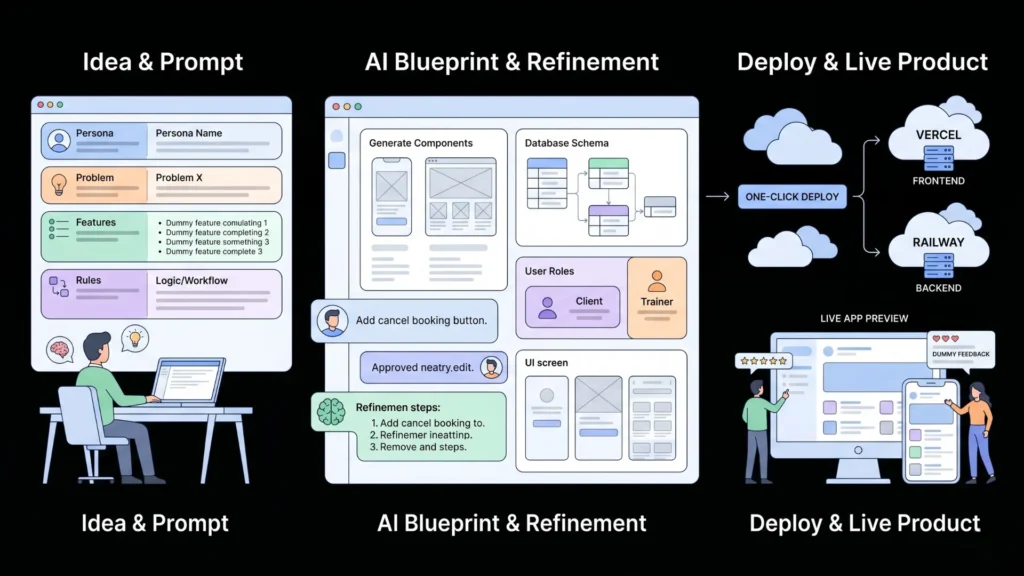
You build it by describing it precisely, iterating through conversation, and deploying with one click. That is the full workflow. The execution is what separates founders who ship in days from those who stay stuck. The no-code tech stack guide for founders in 2026 covers the full toolkit, but here is how the core build process works on a platform like imagine.bo.
Step 1: Write Your Prompt Before You Open the Platform
Spend ten minutes writing down the answers to five questions. Who is this app for? What is the single core problem it solves? What are the three to five features required for a working MVP? Are there user roles, and what can each role do? Does the app need authentication, payments, or external connections? The more specific your answers, the better your first generation. A vague prompt produces a generic app. A specific prompt produces something close to what you actually want.
A well-structured prompt for imagine.bo’s Describe-to-Build feature follows this pattern: persona, problem, features, rules. “Build a booking app for independent personal trainers. Clients can browse trainer availability, book 60-minute sessions, and receive email confirmations. Trainers can manage their schedule, view upcoming bookings, and mark sessions as completed. Clients cannot see other clients’ bookings.”
That single paragraph generates the full-stack architecture: the database schema, the authentication system, the API endpoints, and the UI components for each role. The AI-Generated Blueprint shows you the complete structure before a single line of code is deployed.
Step 2: Review the Blueprint, Then Refine Through Conversation
After generation, review what was built. Check that all core screens exist. Verify the database models match your data needs. Confirm user roles are correctly structured. Then iterate through conversation, not by restarting. “The client dashboard is missing a button to cancel a booking. Add that with a confirmation prompt.” “Move the trainer’s weekly earnings summary to the top of their dashboard.” The AI understands intent and updates in real time.
Step 3: Deploy and Get Real User Feedback
imagine.bo’s One-Click Deployment pushes your frontend to Vercel for global edge caching and fast load times, and your backend to Railway for automatic scaling. SSL, HTTPS, and security configuration are handled automatically. You go from working prototype to live URL in seconds, not days. That live URL is what you share with your first ten users. Their feedback is worth ten times any internal review.
The pattern that consistently produces the fastest results for non-technical founders using imagine.bo is this: spend more time on the prompt than feels necessary, generate once, review the blueprint carefully, then make targeted follow-up prompts rather than rebuilding. Founders who try to pack everything into one giant prompt or who restart when they see something off lose hours. Those who treat the AI as a conversation partner and iterate incrementally ship in a day or two.
Citation capsule: According to a 2024 Gartner report cited by American Chase (2025), businesses using low-code and no-code platforms delivered MVPs 50 to 70% faster with an average cost reduction of 50 to 65% compared to traditional development methods. For solo founders, this translates directly to weeks of shipping time saved and tens of thousands of dollars not spent on agency fees (Gartner / American Chase, 2025).
What Can Non-Technical Founders Actually Build?
More than most people assume. The honest answer is: anything that does not require deeply custom algorithms, hardware integration, or highly regulated compliance architecture. That still leaves a very large category of real, valuable software. For a practical starting point, the 40 real app prompts copy-paste library by app type shows exactly what other founders are building across dozens of categories.
The categories where non-technical founders are shipping with no-code tools in 2026 include:
- SaaS tools and subscription products: Multi-tenant platforms, client portals, admin dashboards, workflow tools.
- Marketplaces: Two-sided platforms connecting buyers and sellers with booking, listing, and payment logic.
- Internal business tools: CRMs, inventory trackers, HR management systems, operational dashboards.
- Customer-facing portals: Self-service account management, appointment booking, onboarding flows.
- Consumer web apps: Community platforms, content feeds, social tools, membership sites.
- E-commerce back-ends: Custom ordering systems, subscription management, loyalty programs.
What non-technical founders should not attempt to build alone on a no-code platform: a high-frequency trading engine, a real-time video processing system, a custom ML model pipeline, or a HIPAA-compliant healthcare record system. These require engineering depth that belongs in the hands of specialists. The good news is that building a tech startup without a developer covers this distinction clearly, including where the line sits and when to bring in human engineering support.
Based on imagine.bo’s pricing structure, a non-technical founder can build a fully functional, production-deployed SaaS MVP with authentication, user roles, a database, and a custom domain on the Pro plan at $25 per month. Compare that to the median traditional MVP cost of $55,000 to $140,000 for a standard SaaS build (Softermii, 2025). That is a 99%+ reduction in upfront capital cost for the validation phase of a product.
Citation capsule: According to UserGuiding’s 2026 analysis of no-code adoption data, the average company that adopted no-code tools avoided hiring two IT developers, resulting in approximately $4.4 million in increased business value over three years. The average citizen developer manages 13 production applications, with web apps being the most common type (UserGuiding, 2026).
Why Does Speed Matter So Much for Non-Technical Founders?
Speed matters because validation is everything before product-market fit. Founders who wait six months to show their product to real users often discover the wrong thing was built. Founders who ship in days can run three or four validation cycles in the same period. According to Startup Genome data cited by Softermii (2025), most successful startups spend about 50% of their initial development budget on improvements in the first year after launch. That money is much better spent after validation, not before.
The low-code MVP strategies for validation and user feedback post covers the validation loop in detail. The short version is: ship the smallest thing that tests your core assumption, put it in front of real people, and iterate based on what they actually do, not what they say they would do. With no-code tools, that first ship happens in days. With traditional development, it happens in months.
Speed also changes how investors evaluate founders. As Softermii noted in their 2025 MVP guide, companies that bootstrap to $50,000 to $100,000 ARR before raising can command two to three times higher valuations than those raising at the idea stage. Non-technical founders using no-code tools can reach that ARR milestone without giving away equity to a development agency or a technical co-founder in exchange for execution.
There is also a competitive reality. Every week your product is not live is a week a competitor might be learning from real users. The market does not wait for you to feel ready. Why prompt-driven development is a startup advantage explains the structural reason this speed advantage compounds over time, not just at launch.
Citation capsule: According to McKinsey (2024) cited by imagine.bo, businesses that adopt AI and automation tools are 2.5 times more likely to report above-average revenue growth than those that do not. For non-technical founders, the competitive edge is not just the product itself. It is the rate at which they can learn, iterate, and improve based on real market feedback.
What Happens When You Hit the Limits of AI?
AI-powered no-code platforms handle the first 80% of most product builds well. The remaining 20% often includes complex third-party integrations, custom payment gateway configurations, performance optimization under heavy traffic, or security-sensitive features that require hands-on engineering review. This is where most founders on other platforms get stuck. On imagine.bo, it is where the Hire a Human feature becomes your safety net.
From the dashboard, you click Hire a Human, describe the task with the same specificity you used in your original prompt, and a vetted imagine.bo engineer picks it up. They write the custom code for that specific module and push it directly to your project’s repository. You get the speed of AI generation for the majority of the build and the quality assurance of a senior engineer for the parts that need it. This hybrid model is what separates imagine.bo from tools that leave you stuck at the 80% mark.
The cost of a single-page engineering intervention at $25 per page is a fraction of what a freelancer or agency would charge for the same task. And because the engineer is working within your existing codebase rather than starting from scratch, the turnaround is days, not weeks. Before you build, reading through 5 critical lessons before launching a no-code startup will help you anticipate exactly which parts of your build are likely to need human engineering support, so you can plan for them upfront rather than discovering them mid-build.
Citation capsule: According to WifiTalents’ 2026 industry data, 84% of businesses adopted no-code or low-code tools to fill the technical gap created by the shortage of developers. The number of people regularly building business applications in no-code platforms now sits between 100 and 120 million globally, compared to approximately 27.7 million professional software developers worldwide (WifiTalents / Kissflow, 2026).
FAQ
Can a non-technical founder really build a production-ready app without any help?
Yes, for most standard web application types. imagine.bo’s Describe-to-Build feature generates the full stack including authentication, database, and deployment from a plain-English prompt. For complex integrations or custom logic, the Hire a Human feature brings in a vetted engineer for specific tasks. According to Gartner (2026), 80% of low-code users will be outside IT departments by 2026, meaning non-developers are already building production apps at scale.
How long does it actually take to build an MVP with no-code tools?
For a standard SaaS MVP with authentication, user roles, and core workflows, expect one to three days on an AI-powered platform like imagine.bo. Traditional development for an equivalent product takes 5 to 8 weeks at minimum and costs $55,000 to $140,000 according to Softermii (2025). The difference is not just cost. It is the speed at which you can get real user feedback and start learning.
What is the best type of product for a non-technical founder to build first?
Start with the type of product that solves a problem you understand deeply from your own experience. The best no-code products are specific, not generic. A booking tool for a specific industry, an internal CRM for a specific workflow, or a client portal for a specific service type will outperform a broad, generic product every time. The launch a production app without hiring developers guide walks through product selection criteria in detail.
Do I need to know anything about databases or backend architecture?
Not to get started. imagine.bo’s AI-Generated Blueprint handles database schema, API endpoints, and backend logic automatically. You need to understand your data at a conceptual level: what information needs to be stored, who can see it, and what users can do with it. You do not need to know how a PostgreSQL schema works. You need to know that trainers should only see their own clients, not other trainers’ clients.
Is the code I build on no-code platforms actually mine to keep?
Yes, on imagine.bo. You own the code entirely and can export it at any time. This is a critical distinction from many no-code platforms that lock you into their ecosystem. Clean, exportable code means you are never dependent on a single platform’s continued existence or pricing decisions. For a direct comparison of ownership models across tools, the imagine.bo vs Replit Agent comparison for non-tech founders breaks down the differences clearly.
Conclusion
Three things are worth holding onto from this article. First, the bottleneck for non-technical founders is no longer access to engineering. It is the clarity and specificity of product thinking. The founders who ship fastest are those who describe their product with precision before they touch a platform. Second, the cost and time gap between no-code and traditional development is not marginal. It is two to three orders of magnitude on cost and ten times faster on speed for MVP-grade products. That gap changes the economics of starting a company entirely. Third, the 80% the AI handles well is enough to validate most ideas. You do not need a perfect product to get your first users. You need a working one.
If you are a non-technical founder sitting on an idea right now, the right next move is to write out your product description using the persona-problem-features-rules structure from this article, then open imagine.bo and paste it into the Describe-to-Build prompt. The Pro plan at $25 per month gives you 150 credits, rollover on unused credits, and a one-hour expert session before you launch. That is less than the hourly rate of a junior developer. For a deeper look at the hybrid model that takes you from AI-generated prototype to production-ready product, the full guide to building a tech startup without a developer is the logical next read.
Related Articles
- How Non-Technical Founders Are Building Products in Days
- The AI Accelerator: Inspiring Case Studies of Founders Building Empires at Lightning Speed
- This No-Code Platform Changed How I Build Products (For the Better)
- Can You Build a Tech Startup Without a Developer?
- Can You Build a Tech Startup Without a Developer?
Launch Your App Today
Ready to launch? Skip the tech stress. Describe, Build, Launch in three simple steps.
Build