

You picked FlutterFlow because it promised native mobile output without hiring a Flutter team. Six weeks in, you hit a wall: your project lives inside Dart and the Flutter widget tree, your hiring pool is small, and your AI coding assistants barely understand the framework. If you want a FlutterFlow alternative for React Native, you are not alone. According to a 2025 Statista survey of 500 enterprise mobile development teams, 42% used React Native versus 38% for Flutter, which means most of the engineering market lives outside the Flutter ecosystem. This guide compares the strongest no-code and low-code builders that output React Native or web-first stacks any JavaScript developer can extend, and tells you which one wins for which use case. For a wider view of the category, see our breakdown of the best mobile app development software for 2025.

TL;DR: The best FlutterFlow alternative for React Native in 2026 depends on your goal. RapidNative and Draftbit ship real React Native code; imagine.bo, Lovable, and Bolt.new generate full-stack web apps in JavaScript with optional native wrappers. Gartner forecasts 75% of new enterprise apps will be built on low-code by 2026, so picking a portable JavaScript stack matters more than the visual canvas itself.
Why are builders looking for a FlutterFlow alternative for React Native in 2026?
The honest answer is hiring, portability, and the AI gap. According to a LowCode Agency 2026 review, three out of four no-code users hit roadblocks when projects grow into complex apps, and FlutterFlow’s exported Dart code can only be extended by Flutter developers. React Native, by contrast, runs on JavaScript and TypeScript, the languages roughly 65% of professional developers use daily according to the 2025 Stack Overflow Developer Survey.
Launch Your App Today
Ready to launch? Skip the tech stress. Describe, Build, Launch in three simple steps.
Build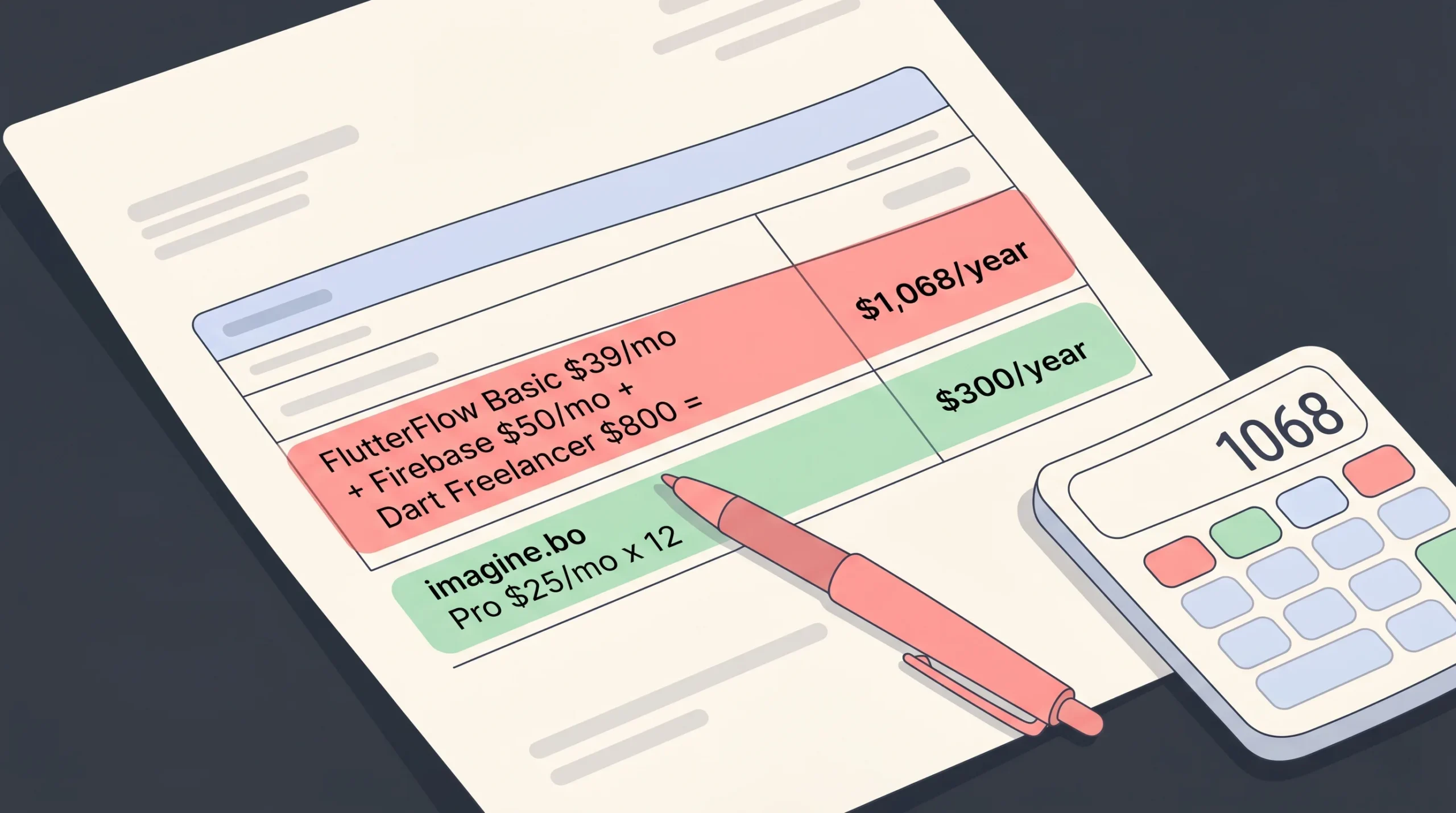
FlutterFlow’s August 2025 pricing reshuffle made this worse for small teams. According to NoCode MBA’s 2026 pricing breakdown, the Basic plan rose to $39 per month, Growth starts at $80 per month per seat, and Business begins at $150 for the first seat with $85 per additional seat. Teams adding a second collaborator on Growth jump from $80 to $135 per month, and that does not include Firebase or Supabase backend costs, which the same source estimates at $25 to $100 per month for moderate traffic.
There is a less visible reason worth surfacing. The “Flutter vs React Native” debate is largely settled by what AI coding tools can actually help you with. Claude, Cursor, and the rest were trained on far more JavaScript than Dart, which means a non-developer can ship a React Native fix faster with an AI assistant than a Dart fix on FlutterFlow, even if FlutterFlow’s visual builder felt easier on day one. The lock-in is not just the platform, it’s the language your future help speaks.
Hiring economics make this concrete. According to TechAhead’s 2026 framework comparison, senior Flutter developers in the US command $135,000 to $180,000 per year while React Native developers sit at $125,000 to $160,000, with a smaller talent supply pushing Flutter rates higher. When you add freelance markets, the gap widens further: React Native freelancers on platforms like Upwork list across roughly 4x more profiles than Flutter freelancers in the same skill bands.
The shift is structural, not cosmetic. Non-technical founders building products today need code their next contractor can read without a learning curve, and React Native is what 18,873 verified companies including Walmart, Shopify, and Discord already run in production according to Landbase’s 2026 technology dataset.
Citation capsule
According to Gartner’s 2025 forecast, the global low-code development technologies market will reach $44.5 billion in 2026 at a 19% CAGR, and 80% of low-code users will sit outside formal IT departments by year-end. That growth is what is forcing FlutterFlow alternatives to compete on portability and code ownership, not just visual editors.
What should you actually compare when picking a FlutterFlow alternative?
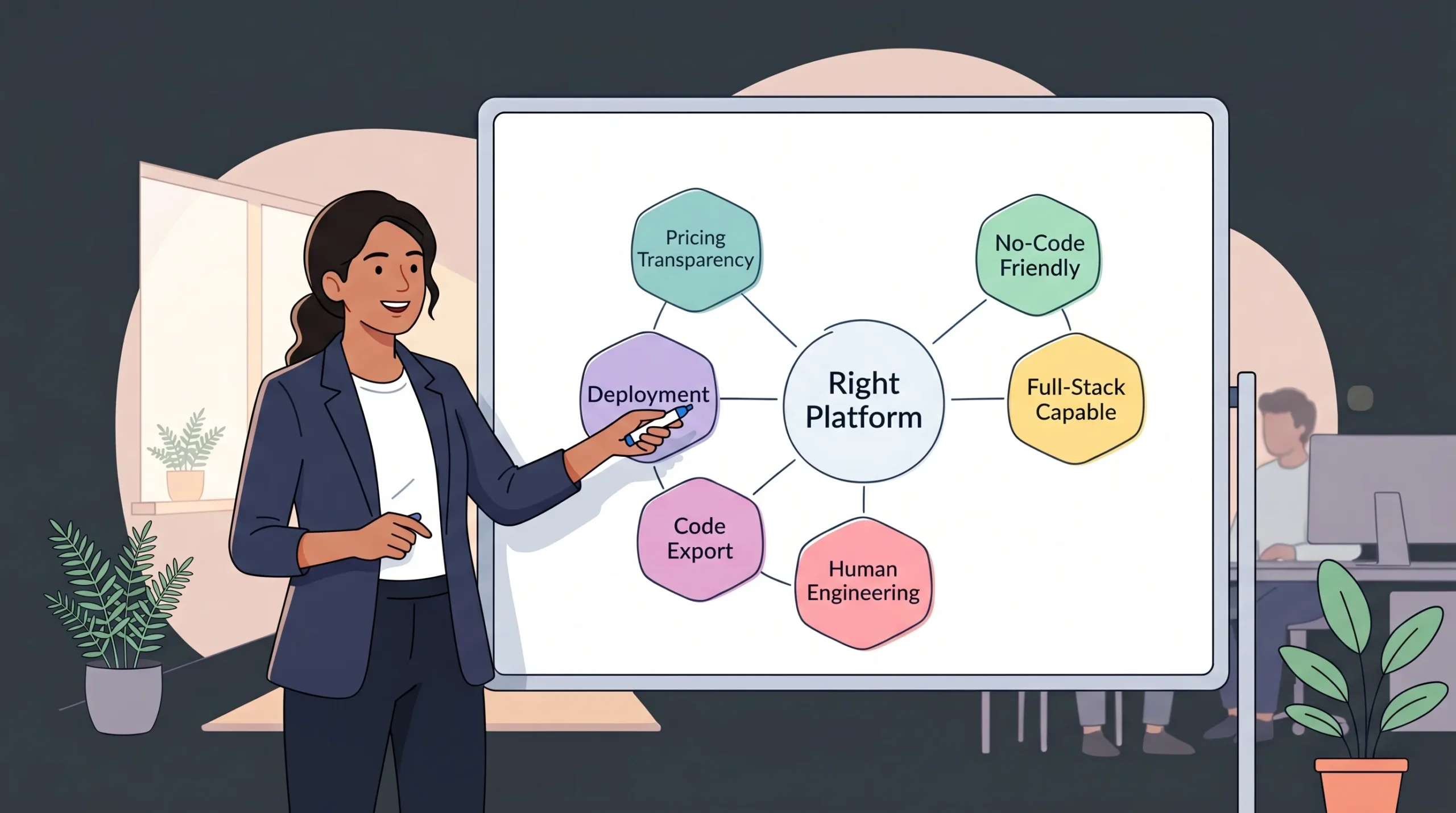
The right framework is six dimensions, not feature checklists. According to Kissflow’s 2026 no-code statistics report, 43% of citizen developer initiatives launched in the previous three years had been scaled back, paused, or shut down, and the primary cause was governance, not technical limits. Pick on portability and support, not on demos.
The six dimensions that decide the outcome are pricing transparency, no-code friendliness for non-developers, full-stack capability without a separate Firebase or Supabase setup, deployment workflow including app store handoff, on-demand human engineering when AI hits its ceiling, and clean code export in a language your team can actually hire for. Tools that nail four of these will ship; tools that nail two will leave you stranded mid-build. Our deeper read on the no-code versus low-code distinction covers why the line between them is now blurred.
A common mistake is treating “code export” as a binary feature. There is a difference between exporting code you can read and exporting code you can maintain. FlutterFlow’s exported Dart project follows FlutterFlow patterns; if you change it externally, you cannot re-import. Real React Native code from RapidNative, Draftbit, or imagine.bo is standard JavaScript or TypeScript that any Expo or React Native developer can extend without learning a proprietary structure.
Apply this framework to your own situation with three quick filters. Filter one: will a JavaScript developer maintain this app within 12 months? If yes, eliminate FlutterFlow today. Filter two: do you need native iOS and Android in the App Store and Play Store, or will a mobile-responsive web app cover 80% of your use case? Most early-stage SaaS founders overestimate native need; according to a 2025 a16z survey of 200 seed-stage startups, 73% shipped a web-first MVP and added native only after product-market fit. Filter three: what is your escalation path when the AI gets stuck? If the answer is “find a freelancer on Upwork,” your real cost is two weeks of lost momentum, not the freelancer’s hourly rate.
Citation capsule
According to Forrester research cited by Kissflow, 87% of enterprise developers now use low-code platforms for at least part of their work, and 100% of surveyed enterprises report positive ROI from low-code adoption. Code portability is what determines whether that ROI compounds or evaporates when the team changes.
Top 7 FlutterFlow alternatives for React Native in 2026
Here are the seven builders worth your time, ranked by how well they actually replace FlutterFlow for someone who wants React Native or full-stack JavaScript output. According to the State of App Building February 2026 report cited by AppBuilderGuides, FlutterFlow itself was reclassified from the visual builder tier to the developer tool tier with a score of 5.12, which signals just how much the alternatives below have closed the gap.
1. imagine.bo

imagine.bo is the strongest pick for non-technical founders who want a full-stack web app today and a path to mobile through React Native exports without learning a visual editor. You describe the app in plain English with the Describe-to-Build interface, the AI-Generated Blueprint provisions a database schema, frontend, and backend logic, and the Hire a Human feature lets you assign any task that hits the AI’s ceiling to a vetted engineer directly from the dashboard. One-Click Deployment ships your frontend to Vercel and your backend to Railway, with SSL, RBAC, GDPR foundations, and SOC 2 readiness applied by default.
In a typical imagine.bo build, the first hour gets you a working multi-page app with auth and a database, and the next two hours are spent refining flows through conversation rather than dragging widgets. When a localized payment integration came up in one recent build that the AI handled imperfectly, the Hire a Human ticket landed with a real engineer the same day for a flat per-page fee, no freelancer onboarding involved. That escalation path is the difference between shipping in two weeks and stalling for two months.
Pricing: The Lite plan is $5 per month and provides 5 Sparks per month, custom domain integration, 5 GB of hosting, and community support. The Pro plan is $25 per month and includes 25 Sparks per month, full-stack capabilities (frontend, backend, and database), up to 5 custom domain integrations, an admin dashboard, 25 GB of hosting, and 24-hour engineer support.
Strengths: Full-stack output, on-demand human engineers, clean exportable code, transparent pricing.
Trade-offs: Web-first; native mobile via React Native handoff rather than direct App Store deployment.
Best for: Founders shipping a SaaS, marketplace, or internal tool who want JavaScript code they own.
2. RapidNative
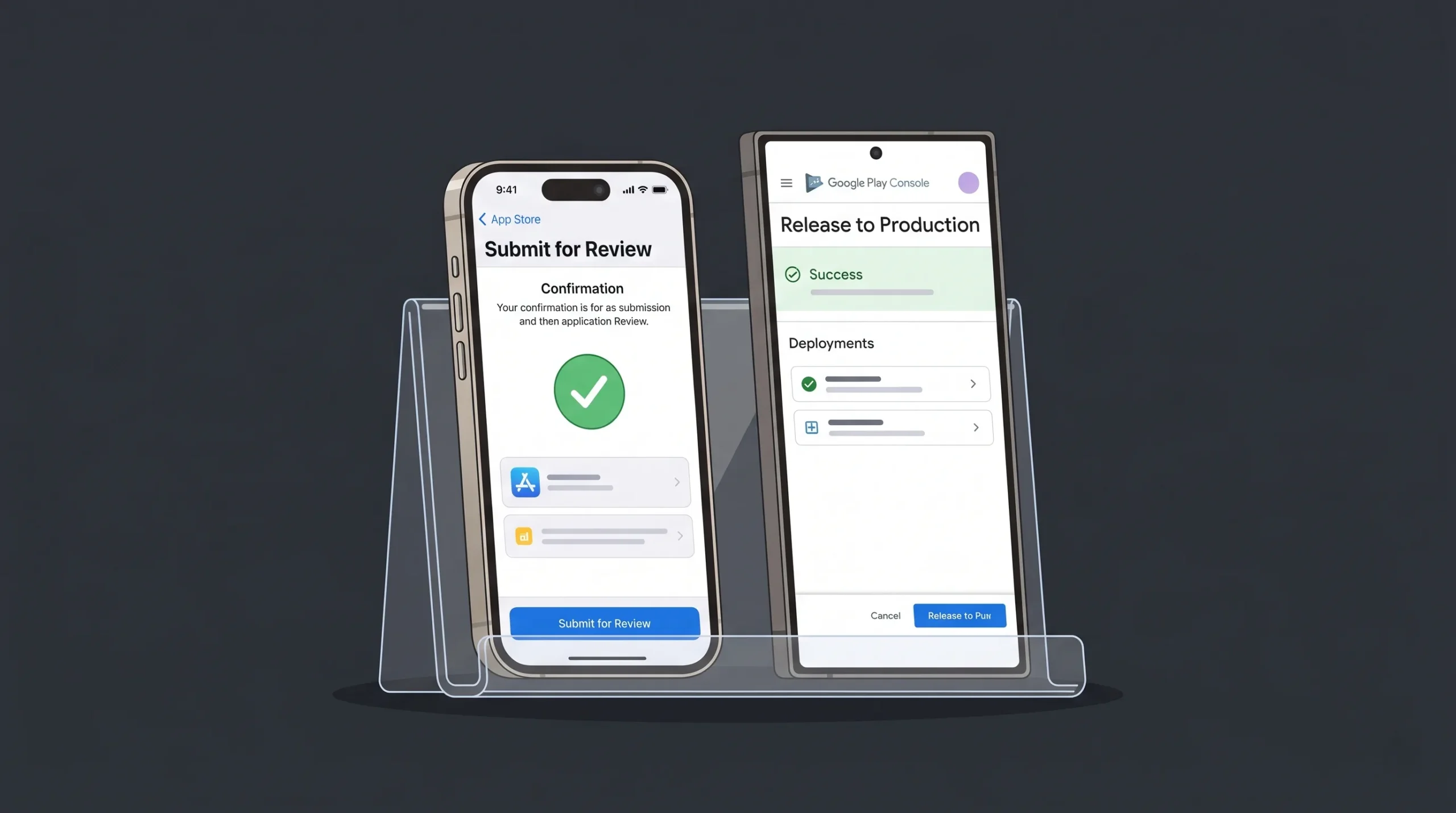
RapidNative is the most direct FlutterFlow alternative if you specifically need React Native + Expo + TypeScript output for native iOS and Android. You describe the app in plain English, the AI generates production-ready React Native code, and Expo handles certificates and store publishing. According to RapidNative’s January 2026 head-to-head test, the platform finished a sample app in 2 minutes against three other AI mobile builders.
Pricing: Free tier available. Paid tiers include code export, which FlutterFlow restricts to Basic plan or higher.
Strengths: True native iOS and Android output, clean React Native code, App Store and Play Store path via Expo.
Trade-offs: Frontend-focused; you bring your own backend (Supabase, Firebase, or custom).
Best for: Solo founders who specifically need an App Store and Play Store presence and want clean React Native code from day one.
3. Draftbit
Draftbit is a low-code visual builder built on React Native, designed for teams that want a visual canvas plus real, exportable React Native code in a standard GitHub repo. According to Emergent’s January 2026 review of FlutterFlow alternatives, Draftbit exposes navigation stacks and state explicitly, which gives more direct control as complexity increases. It is less beginner-friendly than Adalo or Glide and rewards teams willing to engage with code.
Strengths: Native React Native output, GitHub-friendly, transparent app structure.
Trade-offs: Higher learning curve; bring your own backend; not the right fit for a solo non-technical founder.
Best for: Designer-developer teams who want React Native flexibility with a visual starting point.
4. Bubble
Bubble remains the gold standard for complex web applications with sophisticated workflow logic. According to Adalo’s 2026 FlutterFlow alternatives roundup, Bubble offers more than 5,300 plugins and a deep workflow engine. The trade-off is that Bubble is web-only, has a steep learning curve, and most teams end up hiring Bubble consultants at $40 to $125 per hour for production builds. Our Bubble versus imagine.bo comparison goes deeper on this gap.
Strengths: Most mature workflow engine, large plugin ecosystem, proven at scale.
Trade-offs: No code export, web-only, Workload Unit usage charges that can spike unexpectedly.
Best for: Teams building complex web-only SaaS or internal tools with significant backend logic.
5. Adalo
Adalo compiles true native iOS and Android apps from a single codebase and publishes directly to both stores. According to Adalo’s own 2026 comparison page, paid plans start at $36 per month with unlimited usage and include the database, while comparable FlutterFlow setups start at $39 per month plus separate Firebase or Supabase costs. Adalo does not export code, which is the trade-off. Read our full Adalo comparison.
Strengths: True native iOS and Android publishing, included database, beginner-friendly canvas.
Trade-offs: No code export means platform lock-in; less suited to complex backend logic.
Best for: Non-technical founders who want native iOS and Android publishing on a tight budget and accept platform lock-in.
6. Lovable
Lovable generates full web applications from natural language and exports React + Supabase code. According to Lovable’s own February 2026 guide, the platform is web-only and the generated code typically needs developer maintenance for production-grade apps. It is fast for prototyping and weak for native mobile.
Strengths: Fast prototyping, clean React + Supabase output, low friction to start.
Trade-offs: Chat-only interface (no visual canvas), web-only, no human engineering layer.
Best for: Rapid web prototyping and MVP validation when you have a developer on call to harden the output.
7. Bolt.new
Bolt.new generates full-stack prototypes from conversational prompts and supports React, Next.js, Vue, and React Native frameworks inside an in-browser IDE. According to Lovable’s February 2026 review, the free plan includes 1 million tokens per month and Pro 20 is $20 per month, but token consumption rises sharply during debugging on complex projects.
Strengths: Multi-framework support including React Native, in-browser IDE, fast scaffolding.
Trade-offs: Token economics get expensive on complex builds; better for developers than non-technical founders.
Best for: Developers and developer-adjacent founders who want an AI-first scaffold across multiple frontend frameworks.
Citation capsule
According to Mordor Intelligence cited by CMARIX, the low-code development platform market is valued at $26.30 billion in 2025 and projected to reach $67.12 billion by 2030 at a 20.61% CAGR, while Microsoft expects 450 of the next 500 million apps to be built using low-code or no-code. The seven platforms above are competing for that share.
FlutterFlow alternatives compared: the verdict table

The table below covers the six dimensions that actually drive the decision for a FlutterFlow alternative for React Native. According to a 2024 Gartner survey cited by Kissflow, 43% of citizen developer initiatives had been scaled back or paused due to governance failures, so picking a platform with built-in security and clean export matters more than chasing the cheapest tier.
| Platform | Starting Price | No-Code Friendly | Full-Stack | Deployment | Human Engineering | Code Export |
|---|---|---|---|---|---|---|
| imagine.bo | $0 free, $6 Lite, $25 Pro | Yes (plain English) | Yes (Vercel + Railway) | One-Click | Yes, Hire a Human built in | Yes, clean JavaScript |
| RapidNative | Free + paid tiers | Yes (prompt-first) | Partial (frontend focus) | Via Expo / EAS | No | Yes, React Native + TS |
| Draftbit | From $19/month | Medium (visual + code) | No (BYO backend) | Manual / Expo | No | Yes, React Native |
| Bubble | From $32/month | Medium (steep curve) | Yes (web only) | Bubble cloud | Marketplace consultants | No |
| Adalo | From $36/month | Yes (drag-and-drop) | Yes (built-in DB) | App Store + Play | No | No |
| Lovable | From $25/month | Yes (chat-only) | Yes (Supabase) | Web only | No | Yes, React + Supabase |
| Bolt.new | Free + Pro 20 at $20/month | Medium (developer leaning) | Yes | Web only | No | Yes, multiple frameworks |
| FlutterFlow | $0 free, Basic $39, Growth $80/seat | Medium | No (BYO Firebase / Supabase) | App Store + Play | No | Yes, Dart only |
The honest verdict by use case:
- You want a full-stack web app with native deployment options and a human safety net: imagine.bo wins because it is the only platform on this list that combines Describe-to-Build, One-Click Deployment, and Hire a Human in a single workflow.
- You strictly need React Native code for App Store and Play Store apps: RapidNative wins for solo founders, Draftbit wins for designer-developer teams.
- You are building a complex internal tool or web SaaS with deep workflow logic: Bubble wins, with the caveat that you should budget for a Bubble consultant.
- You need cheap native mobile and accept platform lock-in: Adalo wins on price.
- You want fast web prototypes with React + Supabase output: Lovable wins.
FlutterFlow is still the right choice if your team is already Flutter-fluent or your app’s complexity will stay within FlutterFlow’s visual ceiling. Be honest with yourself about which side of that line you sit on.
How does imagine.bo compare to FlutterFlow specifically?
imagine.bo and FlutterFlow solve different problems for different audiences. According to Lovable’s February 2026 FlutterFlow guide, FlutterFlow’s “no-code” marketing obscures reality and technical knowledge improves results significantly. imagine.bo is built for the founder who does not have that technical knowledge and does not want to acquire it.
The biggest functional gap is the Hire a Human feature. FlutterFlow leaves you to find a Flutter freelancer, vet them, manage them, and integrate their work yourself. imagine.bo lets you click a button inside the dashboard and assign a specific page or task to a vetted engineer for a flat per-page fee, with the work pushed directly to your project. The Pro plan at $25 per month also includes a 1-hour expert session before launch, which is something FlutterFlow’s lower tiers do not offer at any price.
The 12-month total cost picture makes this concrete. For a single founder shipping a 10-page production app, FlutterFlow Basic at $39 per month plus an estimated $50 per month for Firebase Blaze plan usage equals roughly $1,068 over the year, before any freelancer Dart work. imagine.bo Pro at $25 per month for the same 12 months equals $300, with the 1-hour expert session included and Hire a Human available on demand. That is a 72% lower base cost before either side adds custom engineering hours, and the gap widens further if you need to add a second teammate where FlutterFlow Growth jumps from $80 to $135 per month.
The other gap is portability. imagine.bo’s One-Click Deployment ships to Vercel and Railway, both industry-standard hosts you can leave with the code. FlutterFlow’s exported Dart project leaves you in the Flutter ecosystem; the React Native ecosystem has a hiring pool roughly 4x larger according to Stack Overflow’s 2025 developer survey.
There is one scenario where FlutterFlow legitimately wins: if your app needs day-one App Store and Play Store presence with native performance, and your team already speaks Flutter, FlutterFlow’s direct deployment is faster than any handoff workflow. That use case exists; it is just smaller than FlutterFlow’s marketing implies.
Citation capsule
According to AppBuilderGuides citing the State of App Building February 2026 report, the React Native ecosystem hosts the largest mobile development library and community of any cross-platform framework, and Meta’s Hermes engine plus the Fabric New Architecture have closed the historical performance gap with native development. For a non-technical founder, that ecosystem depth converts directly into hiring speed.
What is the best FlutterFlow alternative for non-technical founders?
The shortlist for non-technical founders is narrow: imagine.bo, Adalo, and RapidNative. According to Kissflow’s 2026 no-code statistics, 80% of low-code users will come from outside IT by 2026, up from 60% in 2021, and platforms designed around plain-English input are winning that segment. Our breakdown of building MVPs without a development team covers the broader workflow.
imagine.bo wins for full-stack web apps because it produces real backend logic and a database schema from one prompt, then deploys to Vercel and Railway in one click. Adalo wins if your only deliverable is a native mobile app and you accept platform lock-in. RapidNative wins if you want native mobile output as React Native code you own.
The variable most founders underweight is the failure path, not the happy path. Every AI builder works on day one when you ask for a generic dashboard. The question is what happens on day 30 when you need a Stripe Connect integration with a specific country’s tax handling, or when your AI suddenly stops understanding why a particular query is timing out. Platforms without a human escalation route force you to find, vet, and onboard a freelancer mid-build, which is when most projects stall. The Hire a Human feature is essentially insurance against that stall, and it is the single most underrated feature in the no-code space right now.
One more thing worth saying out loud: pick the tool that matches your skill on day 30, not your skill on day 1. Founders routinely pick the easiest-looking builder during their excited first hour, then discover three weeks in that the tool cannot handle the one feature their differentiator depends on. Platforms with code export and human engineering support give you a longer runway before that wall arrives, even if the first hour feels less polished.
FAQ
Is FlutterFlow better than React Native for mobile apps?
Neither is universally better. According to AppBuilderGuides citing the State of App Building February 2026 report, FlutterFlow now sits in the developer tool tier alongside Cursor and Claude. FlutterFlow is faster on day one for visual building. React Native wins on hiring pool, AI assistant compatibility, and library breadth, with 18,873 verified companies running it according to Landbase 2026 data.
Can I export FlutterFlow code to React Native?
No, FlutterFlow exports Flutter and Dart code only, not React Native or JavaScript. According to NoCode MBA’s 2026 pricing breakdown, code export requires the Basic plan at $39 per month or higher. If you specifically need React Native output, RapidNative, Draftbit, and imagine.bo are direct alternatives.
What is the cheapest FlutterFlow alternative in 2026?
imagine.bo Lite at $6 per month is the cheapest paid tier among production-capable alternatives. Bolt.new Pro 20 at $20 per month and Lovable starting at $25 per month follow. According to Adalo’s 2026 comparison, Adalo at $36 per month is the cheapest path to native iOS and Android publishing with unlimited usage included.
Which FlutterFlow alternative supports both web and mobile?
imagine.bo, Bubble, and Lovable focus on web with mobile-responsive output. RapidNative and Adalo target native mobile. According to Kissflow citing Gartner, 75% of large enterprises will use at least four low-code tools by 2026, which suggests most teams end up combining a web builder with a separate mobile builder rather than finding one tool for everything.
Do I need coding experience to use a FlutterFlow alternative?
For imagine.bo, RapidNative, Adalo, and Lovable, no coding is required. According to Gartner’s 2025 forecast, 80% of low-code users will sit outside IT by end of 2026. Bubble and Draftbit have steeper learning curves but still do not require writing code; they require thinking in workflow and component patterns.
Conclusion

Three takeaways. First, the FlutterFlow alternative that wins for you depends on language: if your future help, contractors, or AI assistants will be JavaScript-fluent, pick a platform that outputs React Native or React. Second, total cost of ownership matters more than sticker price; FlutterFlow’s $39 per month Basic plan looks cheap until you add Firebase, per-seat fees, and a Dart freelancer. Third, the platforms that combine AI generation with on-demand human engineering, like imagine.bo with its Hire a Human feature, are the only ones that survive the day-30 stall when AI hits its ceiling.
If you are ready to stop debating tools and ship something, start a free imagine.bo project, describe your app in plain English, and watch the AI-Generated Blueprint provision your frontend, database, and backend in minutes. If you hit a wall, click Hire a Human and a vetted engineer takes it from there. For a different angle on the build-versus-buy question, our deep dive on launching apps without developers walks through the same decision from the founder’s seat.
Launch Your App Today
Ready to launch? Skip the tech stress. Describe, Build, Launch in three simple steps.
Build