
Most founders waste weeks choosing between no-code and low-code before they build a single screen. The distinction sounds simple until you’re staring at a pricing page for Bubble on one tab and OutSystems on another, wondering why tools that both claim to remove coding requirements look and cost so differently. This guide breaks down exactly what separates no-code from low-code, which approach fits which type of builder, and where AI-first platforms now change the equation entirely. By the end, you’ll know which path to take for your specific project. If you’re already leaning one way, check this breakdown of no-code vs. low-code for startups before reading further.
TL;DR: No-code tools require zero technical knowledge and suit founders building standard apps fast. Low-code platforms give developers partial control but still demand scripting skills. A third category, AI-first builders, now combines both approaches. According to Gartner (2023), by 2026, 80% of low-code users will be citizen developers outside IT. Your choice depends on your technical ability, timeline, and how custom your product needs to be.
What’s the Real Difference Between No-Code and Low-Code Development?
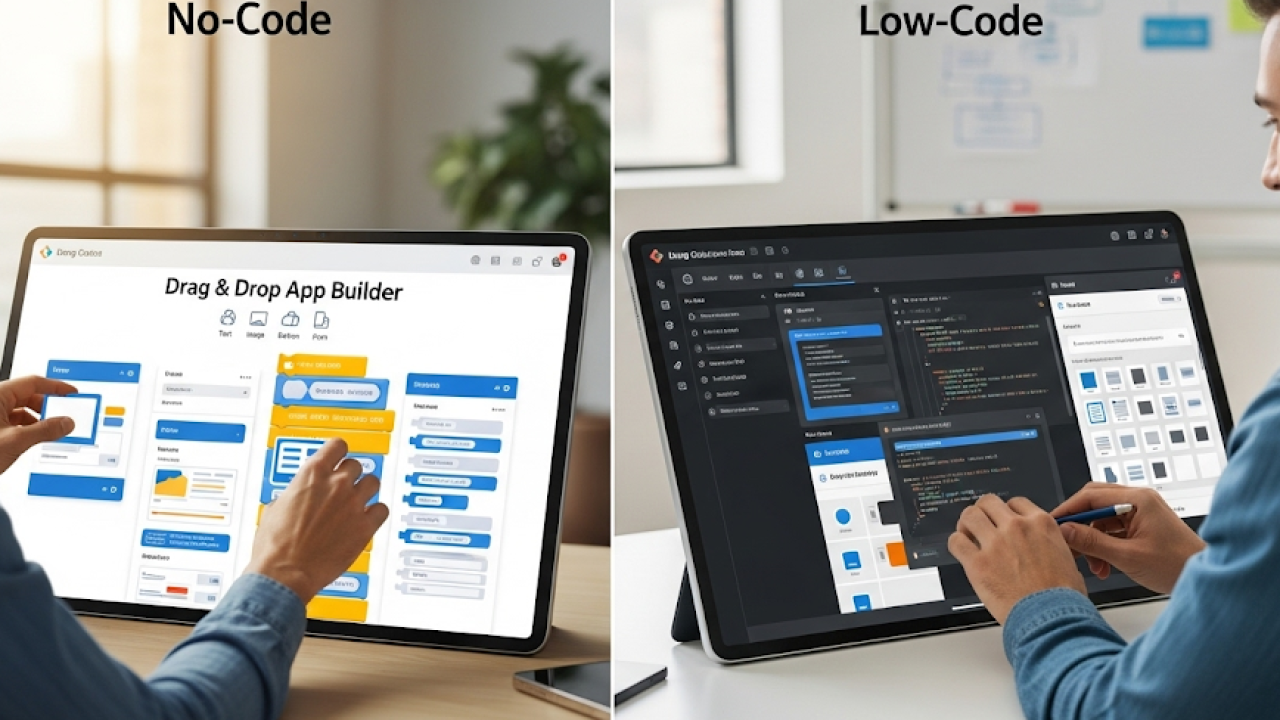
No-code and low-code are not the same thing marketed differently. No-code platforms let you build apps entirely through visual interfaces, drag-and-drop editors, and pre-built templates. Low-code platforms reduce the amount of manual coding required, but they still expect users to write scripts, configure APIs with code, and handle data logic through developer-oriented tools. According to Gartner (2023), low-code application platforms now account for more than 65% of all enterprise application development activity, but that number includes a large volume of work still done by professional developers, not founders working solo.
Launch Your App Today
Ready to launch? Skip the tech stress. Describe, Build, Launch in three simple steps.
Build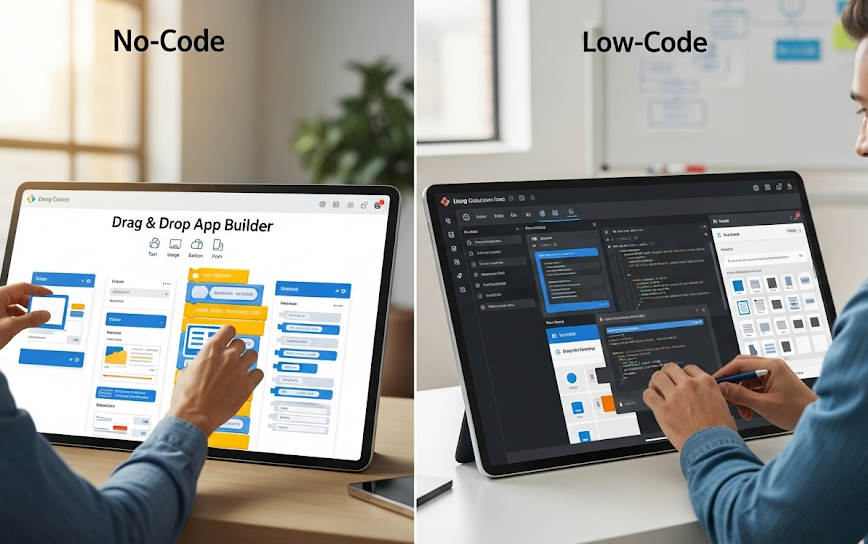
The practical gap is wider than marketing suggests. On a no-code platform like Adalo or Glide, you can wire up a functioning app in an afternoon without touching a single line of code. On a low-code platform like Mendix or OutSystems, you’ll configure workflows, write expression logic, and integrate services using developer conventions. A non-technical founder can theoretically use low-code, but the learning curve is steep and often defeated the original purpose.
The real confusion comes from the market blurring these labels intentionally. Many tools that call themselves “low-code” are actually no-code for their core features and only become low-code when you push past those limits. Knowing which category applies to which part of your workflow is more important than the platform’s self-description.
To understand this distinction in context with traditional development, the comparison in no-code vs. traditional development is worth reading alongside this guide.
Who Should Actually Use No-Code Tools in 2026?
No-code platforms are the right starting point if you have no coding background and need a working product quickly. They’re also the right call if your app fits recognizable patterns: a booking system, a directory, a simple marketplace, a membership portal, or a form-driven internal tool. According to a 2023 OutSystems industry report, 77% of organizations using no-code tools cited speed to market as their primary reason for adoption. That statistic tracks. When speed is the top priority and the product doesn’t require unusual logic, no-code wins on every dimension.
The strongest use cases for no-code in 2026 include:
- Solo founders validating a product idea before raising money or hiring
- Business owners replacing spreadsheet-based workflows with actual apps
- Consultants building client portals or reporting dashboards without dev support
- Non-technical marketers who need landing pages with functional backend logic
No-code tools do have a ceiling. Complex data relationships, custom authentication flows, real-time features, and deep third-party integrations can push you into workarounds that create technical debt. Understanding those limits before you start will save significant pain later. Read through the critical mistakes to avoid when building no-code apps before committing to a specific platform.
When Does Low-Code Development Actually Make More Sense?
Low-code is the better choice when you have technical resources but not enough engineering bandwidth for full custom development. It suits teams with at least one developer who can configure logic, write integration scripts, and maintain the system over time. According to IDC (2024), the global shortage of software developers is expected to reach 4 million by 2025, which is pushing enterprises toward low-code to extend what their existing dev teams can ship.
According to IDC (2024), the worldwide shortage of qualified software developers is expected to reach 4 million professionals by 2025. This gap is directly fueling enterprise adoption of low-code platforms, with 84% of IT leaders in a Mendix 2023 survey saying low-code has become essential for keeping pace with internal application demand.
Low-code makes sense when:
- You have one or two developers who need to move faster than traditional coding allows
- Your enterprise needs to integrate with existing systems like SAP, Salesforce, or legacy databases
- The application requires complex business rules that a visual builder cannot express
- You need granular control over data models, security policies, or performance tuning
The decision to explore how AI is reshaping low-code development is increasingly relevant here, because the line between low-code and AI-assisted coding is narrowing fast in 2025 and 2026.
How Do the Costs Actually Compare Across These Approaches?
The cost gap between no-code, low-code, and traditional development is significant. Traditional custom development for a production-ready web application typically runs $50,000 to $250,000 and takes six to twelve months, based on developer rate benchmarks tracked by Clutch and Upwork in 2024. No-code platforms typically charge $25 to $200 per month for small to mid-size applications. Low-code enterprise platforms like OutSystems or Mendix start at several hundred dollars per month and can reach tens of thousands annually for large deployments.
A direct cost comparison for a booking app with user authentication, calendar integration, and payment processing reveals the following rough ranges: Traditional development costs $40,000 to $80,000 and 3 to 6 months. A low-code platform runs $3,000 to $15,000 in platform fees plus developer time. A no-code tool built on imagine.bo or a comparable AI-first platform can deliver the same functional app for under $500 in platform credits, in days not months. The productivity differential is not marginal; it’s structural.
The full picture on app development costs in 2026 breaks this down by project type, including what hidden costs compound over time on each platform.
Hidden costs often decide the real comparison:
- No-code platforms charge per user, per row, or per operation at scale
- Low-code platforms often require a dedicated administrator to manage updates
- Custom code requires ongoing developer availability for maintenance, not just build
Where Do AI-First App Builders Fit Into This Picture?
AI-first app builders like imagine.bo represent a third category that didn’t meaningfully exist before 2023. They’re not pure no-code, because they can generate custom backend logic, create database schemas, and write production-ready code. They’re not low-code, because you don’t write any code yourself. You describe what you want in plain English, and the platform generates a complete full-stack application: frontend, backend, database, and deployment.
A founder building a client onboarding portal with role-based access and document uploads would traditionally face a choice between Bubble’s steep learning curve or hiring a freelancer. With imagine.bo’s Describe-to-Build feature, the same app can be generated from a plain English prompt in minutes. The AI-Generated Blueprint shows you the complete application structure before a single line of code is written, letting you approve or redirect the architecture before any build time is spent.
imagine.bo’s Hire a Human feature separates it further from both no-code and low-code tools. When the AI hits a genuine limit, you can assign a specific task to a vetted engineer directly from the dashboard, inside the same workflow. This hybrid model handles the 80% of app features that AI can generate autonomously while giving you a clear path for the 20% that need human judgment.
According to the Gartner Hype Cycle for Emerging Technologies (2024), generative AI for application development is moving from peak hype into productive adoption. Platforms that combine AI generation with real human engineering support are positioned to capture the next wave of non-technical builders.
See the full breakdown of benefits of prompt-to-app development for a deeper look at how this approach compares on quality and speed.
No-Code vs. Low-Code vs. AI Builders: Side-by-Side
| Factor | No-Code | Low-Code | AI-First (imagine.bo) |
|---|---|---|---|
| Coding required | None | Some scripting | None |
| Build speed | Fast (days to weeks) | Moderate (weeks to months) | Fastest (hours to days) |
| Customization ceiling | Limited | Moderate | High (full-stack generation) |
| Technical skill needed | Beginner | Intermediate developer | None |
| Starting monthly cost | $25 to $150 | $300 to $5,000+ | $6 to $25 |
| Deployment | Usually managed hosting | Varies | Vercel + Railway by default |
| Code ownership | No | Partial | Full |
| Human support | Community or tickets | Developer team required | On-demand via Hire a Human |
| Best for | Simple apps, quick MVPs | Enterprise workflows | Full-stack products without dev team |
The comparison table above reveals something the platform marketing rarely admits: low-code’s main advantage over no-code is not flexibility for the end user. It’s flexibility for developers who still need to do significant configuration work. For non-technical founders, low-code is often harder to use than no-code while also being more expensive. AI-first builders are collapsing the historical advantage of low-code for this audience.
To understand how different hybrid and no-code platforms compare specifically, the guide on comparing hybrid AI and no-code platforms goes deeper on platform-specific trade-offs.
What Are the Real Scalability Limits You Need to Know?
Every platform has a ceiling, and knowing where it sits before you build can save you a painful migration. No-code platforms typically struggle when you need highly customized data queries, complex real-time functionality, or integrations with legacy enterprise systems. According to Forrester Research (2023), 43% of no-code users report hitting platform limitations that required either a paid upgrade, a workaround, or a complete rebuild in traditional code.
Low-code platforms generally scale better for enterprise complexity, but they require ongoing developer involvement to maintain. The scaling cost is not just money. It’s access to technical skill. If your one developer leaves, a low-code platform’s codebase can become difficult to maintain for someone stepping in without context.
AI-first platforms that generate exportable, owned code sidestep the vendor lock-in problem entirely. imagine.bo produces clean code you own completely. If you ever need to migrate to a different infrastructure or hand it to an engineering team, you have real source files to work with, not a platform-locked configuration.
For founders planning to scale without a dev team, the no-code tech stack guide for founders in 2026 covers which tool combinations hold up at different growth stages.
How Should You Choose the Right Approach for Your Project?
The right choice depends on three variables: your technical background, your timeline, and how unusual your product logic is. According to a 2024 Stack Overflow developer survey, 60% of developers who use low-code tools say they’re used alongside traditional code, not as a replacement. That means low-code is primarily a developer productivity tool, not a solution designed for non-technical founders.
Use no-code if: You have no technical background, your app fits recognizable patterns, and you need to launch within weeks on a budget.
Use low-code if: You have at least one developer on your team, your app requires integration with complex enterprise systems, and speed alone isn’t the only constraint.
Use an AI-first platform like imagine.bo if: You want a real, full-stack application with custom logic, you don’t want to hire a developer or manage one, and you need production-ready deployment from day one.
Among the use cases where imagine.bo’s AI-first approach consistently outperforms traditional no-code: multi-role web apps with RBAC, subscription-based SaaS products with billing logic, client portals with document management, and custom CRMs with automated follow-up workflows. These are the categories where Bubble’s complexity becomes a liability and where low-code requires developer hours that founders don’t have.
If you’re at the stage of choosing a technical path for your startup, read the full guide on building a tech startup without a developer before making a final call.
Frequently Asked Questions
Is no-code development good enough for a real startup in 2026?
Yes, with caveats. According to Gartner (2023), 70% of new applications built by enterprises now use no-code or low-code technologies. Plenty of real startups have launched and scaled on no-code. The question is whether your specific product’s logic fits what the platform can express. Apps with standard data patterns and predictable user flows are well-suited. Apps with unusual real-time requirements or complex permission models hit ceilings faster.
Can I migrate from a no-code app to custom code if I need to later?
It depends entirely on the platform. Most traditional no-code tools like Bubble use proprietary data structures and do not export usable code. You would need to rebuild from scratch. AI-first platforms like imagine.bo generate real, exportable code you own outright, so migration is as straightforward as handing the codebase to a developer.
What’s the practical difference between low-code and AI code generation tools?
Low-code platforms still require a developer to configure workflows, manage data models, and maintain integrations. AI code generation tools like imagine.bo or Cursor generate actual code from natural language. The distinction matters for non-technical founders: low-code still requires you to think like a developer, even if you write less. AI generation removes that requirement entirely. According to GitHub (2023), AI-assisted tools now help developers write code up to 55% faster, but that advantage is for developers, not non-technical users.
How long does it actually take to build a working app with no-code vs. low-code?
A no-code MVP on a platform like Glide or Adalo can be functional in one to three days for simple use cases. A low-code build on OutSystems or Mendix for a comparable app typically takes two to six weeks, assuming developer availability. An AI-first platform like imagine.bo using Describe-to-Build can produce a full-stack app including authentication, database, and deployment in hours. According to Forrester Research (2023), development time reductions on AI-assisted platforms range from 50% to 90% compared to traditional methods.
Is low-code the same as vibe coding?
No. Vibe coding refers to using AI assistants to generate code through conversational prompting, where the developer iterates on the output. Low-code is a platform category with structured visual tools and configuration interfaces. Vibe coding assumes you have some ability to read and direct the generated code. Low-code assumes you can configure workflows in a structured editor. Neither is the same as purely non-technical app building, though AI-first platforms are converging the experience for non-developers.
Conclusion
Three takeaways worth keeping from everything above. First, no-code and low-code serve genuinely different audiences. Conflating them leads founders to pick tools that either under-deliver or require skills they don’t have. Second, AI-first builders like imagine.bo now offer a third path that matches or exceeds both in speed, customization, and code quality for non-technical founders building full-stack products. Third, code ownership matters more than most comparisons acknowledge. Building on a platform that traps your app in proprietary format is a technical and business liability that compounds as your product grows.
If you’re a non-technical founder or operator ready to build something real without hiring a developer, imagine.bo is worth testing directly. Use the Describe-to-Build feature to generate your first AI-Generated Blueprint in minutes, see the full application structure before committing, and access vetted human engineers through Hire a Human when your requirements go beyond what AI handles alone.
For a closer look at the tools available in 2026, the low-code MVP validation strategies guide covers how to test your product assumptions before investing in a full build on any platform.
Launch Your App Today
Ready to launch? Skip the tech stress. Describe, Build, Launch in three simple steps.
Build