

Healthcare professionals spend more time on administration than almost any other profession. Physicians in 2026 lose an average of 15 to 19 hours per week to paperwork, scheduling, documentation, and billing tasks that have nothing to do with patient care (BillingParadise, 2026). That is nearly half a working week spent on operational friction, not clinical outcomes. The good news is that the same digital tools reshaping software development everywhere are now accessible to clinicians, practice owners, and digital health founders with no coding skills required. This article covers seven specific, practical ways healthcare professionals are building and launching apps without developers, the use cases where it works best, and the platform features that make it possible. You can also see how AI agents are already reducing patient care delays across similar clinical workflow problems.
TL;DR: Healthcare professionals are building patient portals, booking systems, CRMs, and clinical dashboards without developers using AI-powered no-code platforms. According to Statista, the digital health market hit $198 billion in 2025 with more than 1.4 billion users (Statista, 2025). Platforms like imagine.bo generate full-stack, production-ready apps from plain-English descriptions in minutes, with built-in security foundations for sensitive health data.
Why Are Healthcare Professionals Building Their Own Apps?
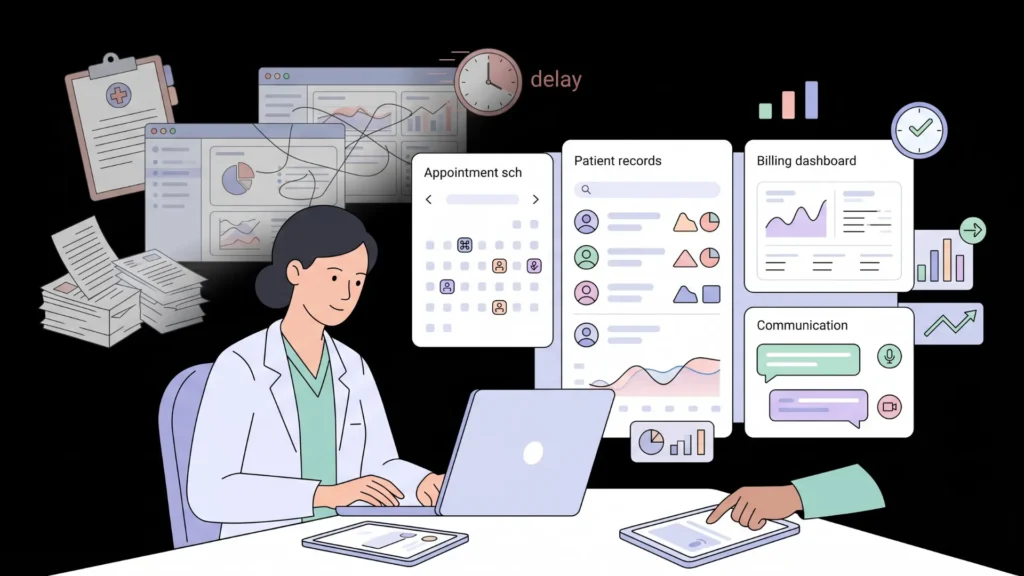
Healthcare professionals are building their own apps because the operational tools they actually need either do not exist, cost thousands per month, or force them into workflows that do not fit their practice. The answer is not “because it is now easy.” It is because the pain of not having the right tool is costing them patients, time, and revenue every single day.
Launch Your App Today
Ready to launch? Skip the tech stress. Describe, Build, Launch in three simple steps.
BuildAccording to research from the Center for American Progress cited by VectorCare (2025), U.S. healthcare payers and providers spend approximately $496 billion annually on billing and insurance-related administrative costs, with an estimated $248 billion considered excessive. A significant share of that waste flows from mismatched software: generic EHR systems that do not fit specialty workflows, scheduling tools that cannot handle complex multi-practitioner availability, and client portals that were designed for enterprise hospitals, not a 12-person physio clinic. Like fitness professionals who are launching their own operational apps to replace expensive SaaS subscriptions, healthcare professionals are discovering that building a custom app is faster and cheaper than waiting for an off-the-shelf solution to catch up.
The shift is also driven by cost. A custom healthcare app built via a traditional development agency costs $55,000 to $300,000 and takes three to six months. An equivalent operational app built on imagine.bo costs $25 per month on the Pro plan and takes days. That math changes who can afford to solve their own workflow problems.
The healthcare professionals gaining the most from no-code tools are not those building clinical diagnostic software. They are the ones solving the layer of operational problems that sit between clinical care and the patient: booking, communication, records access, intake forms, billing summaries, and follow-up workflows. Those problems do not require medical device certification. They require good product thinking and the right platform.
Citation capsule: According to BillingParadise (2026), physicians across 23 specialties spend an average of 15 to 19 hours per week on paperwork and administrative duties. Family medicine physicians alone devote approximately 17 hours per week to these tasks. A recent time-allocation study cited by EvidenceCare (2025) found that physicians spend 49% of their day in the EHR, with only 27% spent directly caring for patients (BillingParadise / EvidenceCare, 2025–2026).
1. Patient Appointment Booking and Scheduling Apps
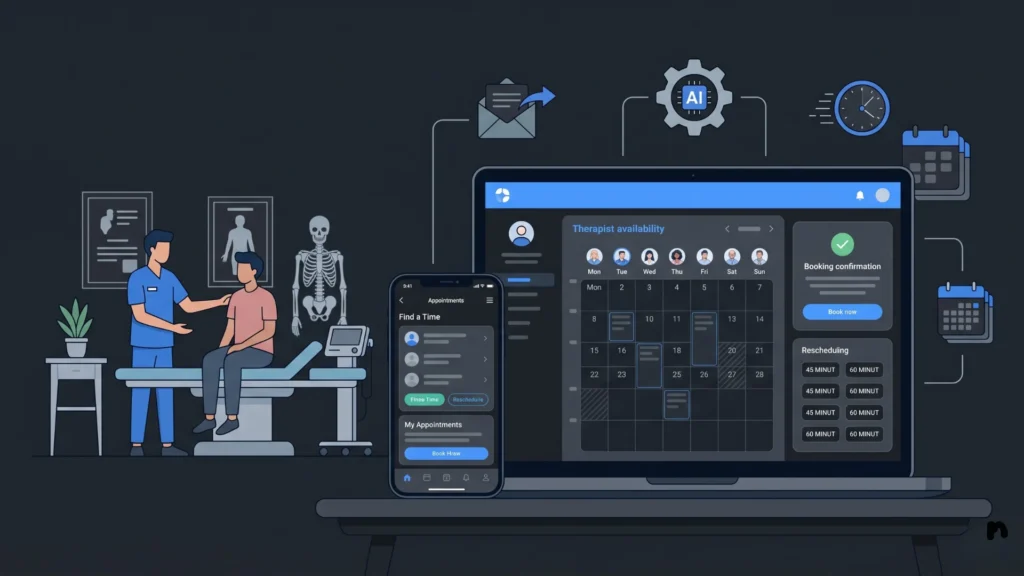
Appointment booking is the most common starting point for healthcare professionals building their first app, and for good reason. It is the single highest-friction point in most practices. Patients call during clinic hours, hold music plays, staff manually check availability, appointments get double-booked, and cancellations cascade through the day without automated rebooking. A custom booking app built on imagine.bo solves all of this without paying $200 per month for a generic scheduling SaaS that covers 70% of your actual workflow.
The Describe-to-Build feature generates the complete scheduling architecture from a plain-English prompt. A physiotherapy clinic might describe it like this: “Build a patient appointment booking app for a physiotherapy practice. Patients can view therapist availability by day, book 45-minute or 60-minute sessions, receive email confirmations, and cancel or reschedule with at least 24 hours notice. Staff can view the full schedule, block time, and mark sessions as completed. Patients cannot see other patients’ bookings.” That single paragraph produces the database schema, authentication system, availability logic, and confirmation email workflow automatically through the AI-Generated Blueprint.
The step-by-step guide to building a booking or scheduling app in minutes walks through the exact prompt structure for this type of app, including how to handle multi-practitioner availability and recurring appointment logic through follow-up conversation with the AI.
Citation capsule: According to the global telemedicine and digital health market analysis from IPH Technologies (2026), telemedicine reduces patient wait times by up to 75% and has evolved from a pandemic necessity to a permanent fixture in healthcare delivery. The global telemedicine market is projected to grow from $104.6 billion in 2024 to $298 billion by 2028, driven entirely by demand for more accessible, digitally managed care access (IPH Technologies, 2026).
2. Patient Intake and Pre-Consultation Forms
Paper intake forms and PDF questionnaires that patients fill out in a waiting room are a solved problem. Yet the majority of small and mid-size healthcare practices still use them because the alternatives are either expensive platforms with unnecessary features or custom-built portals that require a developer. A digital intake app captures patient history, consent, insurance details, and presenting complaints before the appointment, routes them to the right practitioner record, and flags completions so staff do not have to chase.
Building this on imagine.bo takes one well-structured prompt: “Build a patient intake form app for a general practice clinic. New patients complete a multi-step form covering personal details, medical history, current medications, allergies, and insurance information before their first appointment. Completed forms route to the assigned GP’s dashboard. Patients cannot see other patients’ records. Staff can search, filter, and export submitted forms.” The app generates with secure authentication, role-based access control, and a database that stores submissions cleanly. No spreadsheet. No PDF filing.
The critical detail that most healthcare professionals miss when first building an intake app is the access control layer. Every patient should only see their own data. Every practitioner should only see their assigned patients by default, with admin access available to practice managers. Specifying these role distinctions explicitly in the initial prompt saves a follow-up correction cycle. imagine.bo’s RBAC is built in at the data layer, not just the UI, which matters for practices handling sensitive health information.
Citation capsule: According to a national survey cited by VectorCare (2025), nearly 75% of insured nonelderly adults reported engaging in healthcare-related administrative tasks, and 24.4% experienced delayed or foregone care as a direct result of that administrative friction. Digital intake tools that remove patient-side paperwork directly reduce this delay and improve show rates at first appointments (VectorCare, 2025).
3. Patient Management and CRM Portals
Healthcare professionals running independent practices, telehealth services, or specialist clinics need a way to manage patient relationships over time, not just individual appointments. Generic CRM tools built for sales teams are the wrong fit. Enterprise EHR systems are overkill and overpriced. A custom patient management portal built with no-code tools gives you exactly the fields, workflows, and views your practice actually uses.
A well-built patient CRM tracks appointment history, treatment notes, follow-up tasks, communication logs, and billing status for each patient. It lets a practitioner see at a glance who is due for a follow-up, who has outstanding invoices, and which patients have not responded to outreach. The guide to building a custom CRM without coding shows how to structure a prompt that produces a multi-role patient management system with practitioner notes, admin billing access, and patient-facing view restrictions, all from a single generation pass.
On imagine.bo’s Pro plan at $25 per month, a practice can deploy a production-ready patient CRM with secure authentication, exportable data, and a private deployment. That is less than the monthly cost of a seat in most mid-market CRM platforms, without the feature bloat or vendor lock-in.
Citation capsule: According to Statista data cited by SolveIT (2026), the digital health market reached $198 billion in 2025 with more than 1.4 billion active users globally. This growth reflects demand not for complex clinical AI, but for the operational layer of digital health: the portals, management tools, and communication systems that connect practitioners and patients between appointments (Statista / SolveIT, 2026).
4. Telehealth Client Portals and Secure Messaging
Telehealth adoption has stabilized at 38 times pre-pandemic levels, and digital health habits formed during that period have become permanent for a large share of patients (Softermii, 2025). Healthcare professionals offering virtual services need more than a video link. They need a portal where patients can book sessions, access session notes, complete homework or follow-up exercises, and message securely between appointments.
Building a telehealth client portal on imagine.bo does not require deep technical knowledge. It requires clarity about who the users are and what each role can do. A mental health counselor might prompt: “Build a client portal for an online therapy practice. Clients can book sessions from available slots, view session notes their therapist has shared, complete assigned self-reflection worksheets, and send secure messages to their therapist. Therapists can view all their clients, write session notes, assign worksheets, and respond to messages. Neither client can see the other’s data.”
The One-Click Deployment pushes this to production on Vercel and Railway with SSL and HTTPS active by default. For practices that need additional compliance work for specific jurisdictions, the Hire a Human feature provides direct access to vetted engineers who can implement those specific security controls. The launch client portals without code guide covers the full deployment workflow for portals serving external clients.
Citation capsule: According to Grand View Research cited by SolveIT (2026), the global telehealth market was valued at approximately $123.26 billion in 2024 and is expected to reach $455.27 billion by 2030. Healthcare professionals who build their own telehealth portals retain the patient relationship data and avoid platform dependency fees that can reach 10 to 20% of session revenue on third-party telehealth platforms (Grand View Research / SolveIT, 2026).
5. Staff Scheduling and Internal Operations Tools
Running a healthcare practice means managing human resources as much as clinical outcomes. Rostering nursing staff, tracking practitioner availability, managing leave requests, and coordinating multi-location schedules are operational problems that generic HR tools handle badly for clinical environments. Healthcare-specific scheduling complexity, shift patterns, credentialing requirements, and on-call rotations, requires software that matches the actual workflow.
A no-code internal operations app built for a healthcare practice can handle shift scheduling, leave requests with manager approval workflows, credentialing expiry tracking, and daily handover checklists for care teams. The no-code AI scheduling assistant guide covers how to build this type of multi-role operational tool using conversational prompts that define each role’s permissions precisely.
Based on imagine.bo’s pricing and imagine.bo platform capability, a ten-person healthcare practice can deploy a full staff scheduling and operations app on the Pro plan at $25 per month. The closest comparable commercial tool for healthcare rostering typically costs $300 to $600 per month for a practice of the same size. That is a 92 to 96% cost reduction for a custom-built equivalent that fits the practice’s exact workflow rather than forcing the practice to adapt to the tool.
Citation capsule: According to the Commonwealth Fund (2025), administrative burden in primary care is not only driven by documentation but also by fragmented internal communication and scheduling workflows. Practices that digitize internal operations report meaningful reductions in staff coordination time and fewer scheduling errors that affect patient flow (Commonwealth Fund, 2025).
6. Health Data Dashboards and Analytics Tools
Healthcare professionals generating their own clinical or operational data often have no good way to visualize it. Practice managers tracking appointment volumes, cancellation rates, revenue per practitioner, and patient retention are doing that analysis in spreadsheets. Researchers collecting patient survey data or outcome scores are copying and pasting into Excel. A custom analytics dashboard built with no-code tools replaces that manual process with a live, role-appropriate view.
imagine.bo generates apps with built-in analytics dashboards that track user behavior, engagement, and usage patterns. For a healthcare practice, that translates to custom dashboards showing weekly appointment volumes by practitioner, cancellation patterns by day, outstanding invoice totals, and patient follow-up completion rates. The data is yours entirely. The export feature means you can pull it into external tools whenever needed without being locked to the platform.
For more complex data workflows, the healthcare data analysis with no-code AI guide covers how to connect operational data sources to visual dashboards using prompt-driven development rather than SQL or data engineering skills.
Citation capsule: According to Health Affairs research cited by Creyos (2025), administrative spending accounts for up to 30% of total healthcare costs in the United States, and at least half of that spending is considered wasteful. Custom analytics tools that give practice managers real-time visibility into operational patterns are one of the most effective levers for reducing that waste at the practice level (Health Affairs / Creyos, 2025).
7. Digital Health Product MVPs for Founders with Clinical Backgrounds
The most ambitious application of no-code tools in healthcare is not improving an existing practice. It is launching a net-new digital health product. Clinicians with deep domain expertise are uniquely positioned to identify the gaps that technology companies miss, because they live inside those gaps every day. The barrier has historically been technical. It is no longer.
A nurse practitioner building a medication adherence app, a physiotherapist building a remote rehabilitation exercise tracker, a GP building a chronic disease management tool for their patient population: all of these are achievable on a no-code platform like imagine.bo without a technical co-founder or a development agency. The Describe-to-Build feature generates the full-stack architecture. The AI-Generated Blueprint shows you what was built before deployment. The Hire a Human feature brings in a vetted engineer for the specific modules that need custom logic, like a complex data integration or a specialist notification system.
For founders at this stage, the launch a production app without hiring developers guide covers the exact workflow from prompt to deployed product, including how to think about the boundary between what no-code handles and when to use Hire a Human for specialist engineering.
The competitive advantage clinical founders have over general tech founders in digital health is domain specificity. A physiotherapist knows the exact exercise progression logic a rehabilitation app needs. A diabetes nurse knows which patient data points predict non-adherence. That knowledge, translated into a precise Describe-to-Build prompt, produces a better first generation than any general-purpose developer working from a brief. No-code tools turn clinical expertise directly into product architecture without the translation layer.
Citation capsule: According to IPH Technologies (2026) citing venture capital data, health tech companies attracted $25.2 billion in investment globally in 2024, with funding for AI-driven care and remote patient monitoring increasing by nearly 300% from early 2020 levels. Clinical founders with validated no-code prototypes enter fundraising conversations with working products, not slides (IPH Technologies, 2026).
FAQ
Do no-code healthcare apps meet HIPAA or GDPR requirements?
No-code platforms like imagine.bo provide GDPR and SOC2 readiness foundations built into every deployment, including SSL/HTTPS, data encryption at rest and in transit, and role-based access control. For full HIPAA compliance in US-regulated healthcare settings, specific additional controls are required. The Hire a Human feature connects you directly with vetted engineers who can implement those controls for your specific use case. According to Netguru (2026), organizations using modern platforms see 40 to 60% fewer compliance violations than those on legacy systems.
What types of healthcare apps can be built without a developer?
Patient booking portals, intake forms, patient CRMs, staff scheduling tools, telehealth client portals, health data dashboards, and digital health MVPs are all well within no-code capability. Apps that require direct medical device integration, real-time biometric data processing, or FDA Software as a Medical Device classification need specialized development. The best AI tools to automate client service portals shows the full range of portal types that no-code handles cleanly.
How long does it take to build a healthcare app with no-code tools?
A patient booking system or intake form app can be built, tested, and deployed in one to two days on imagine.bo. A more complex patient management portal with multiple user roles takes three to five days for the core build. Traditional development for equivalent functionality takes three to six months and costs $55,000 to $300,000. According to Gartner data cited by American Chase (2025), no-code platforms deliver MVPs 50 to 70% faster than traditional methods.
Does imagine.bo work for solo healthcare practitioners or only practices?
It works for both. A solo physiotherapist, counselor, or specialist can build and deploy a booking and client portal on the Lite plan at $5 per month. A multi-practitioner clinic with more complex role requirements and private deployment needs the Pro plan at $25 per month. The Done For You plan at $499 is a one-time fully managed build for practices that want a complete product delivered by imagine.bo’s engineering team.
What happens when the app needs a feature beyond what AI can generate?
You use the Hire a Human feature directly from the dashboard. You describe the specific task, and a vetted imagine.bo engineer picks it up, writes the custom code for that module, and pushes the update to your project’s repository. This is the feature that separates imagine.bo from tools that leave you stuck at 80% completion. Payment integrations, specialist API connections, and custom compliance features are the most common triggers for this.
Conclusion
The common thread across all seven approaches is this: the operational problems healthcare professionals face every day, scheduling friction, patient data scattered across spreadsheets, no portal for remote patients, staff coordination done over WhatsApp, are software problems with known solutions. The only thing that has changed is the cost and time required to build those solutions without a developer. Platforms like imagine.bo have reduced both to the point where building the right tool is faster than continuing to work around the wrong one.
Three specific takeaways. First, start with the operational problem that costs you the most time each week. For most healthcare professionals that is scheduling or patient intake. Build that first. Second, specify user roles explicitly in your prompt. Healthcare apps with multiple user types produce much better results when the access logic is defined upfront rather than added after generation. Third, do not build what needs a medical device engineer in a no-code platform. Build the operational and communication layer, where no-code works well, and bring in human engineering through Hire a Human for anything that touches regulated clinical data flows.
If you are a healthcare professional, practice owner, or digital health founder ready to move on this today, the Pro plan on imagine.bo gives you 150 credits, private deployment, rollover credits, and a one-hour expert session before you launch. For a practical first step, the guide to building a booking or scheduling app in minutes is the fastest way to see exactly how the build process works before you commit to a full product idea.
Related Articles
- How Healthcare & Wellness Professionals Are Launching Apps Without Developers
- How Fitness Professionals Are Launching Apps Without Developers and Growing Their Brands Faster
- How Nonprofits Are Launching Impactful Apps Without Developers
- How Educators and Coaches Are Launching Apps Without Developers — And Scaling Their Impact
- AI Apps Builder: Create Smarter, Faster, and Without Code
Launch Your App Today
Ready to launch? Skip the tech stress. Describe, Build, Launch in three simple steps.
Build