
Most builders who reach imagine.bo arrive after at least one painful experience with a competing tool. They tried Bubble and spent three weeks learning the editor before building a single page. They tried Bolt.new and got 70% of an app that stalled on every complex feature. They paid a developer $15,000 for an MVP that took four months and still needed changes they could not afford. The promise of building a real web app without coding has been around for years. imagine.bo is one of the few platforms where that promise matches the delivery, specifically because it generates actual full-stack code from a plain English description rather than configuring a template or scaffolding components inside a proprietary editor. This article covers the seven most significant benefits of building a no-code web app with imagine.bo, with honest context on where each benefit applies and where the platform’s limits sit. For a direct comparison between imagine.bo and the leading alternatives, this post on comparing hybrid AI and no-code development platforms covers the full competitive landscape.
TL;DR imagine.bo generates a complete full-stack web app from a plain English description, deploys to production-grade infrastructure in one click, and produces clean exportable code you own outright. Seven core benefits: full-stack generation from prompts, production infrastructure included, code ownership, the Hire a Human hybrid model, credit rollover pricing, built-in security defaults, and iterative refinement through conversation. According to Gartner, 70% of new applications will use no-code or low-code by 2025 (Gartner, 2021). imagine.bo represents the most technically complete path through that shift for non-technical founders.
Benefit 1: Full-Stack Generation From a Plain English Prompt
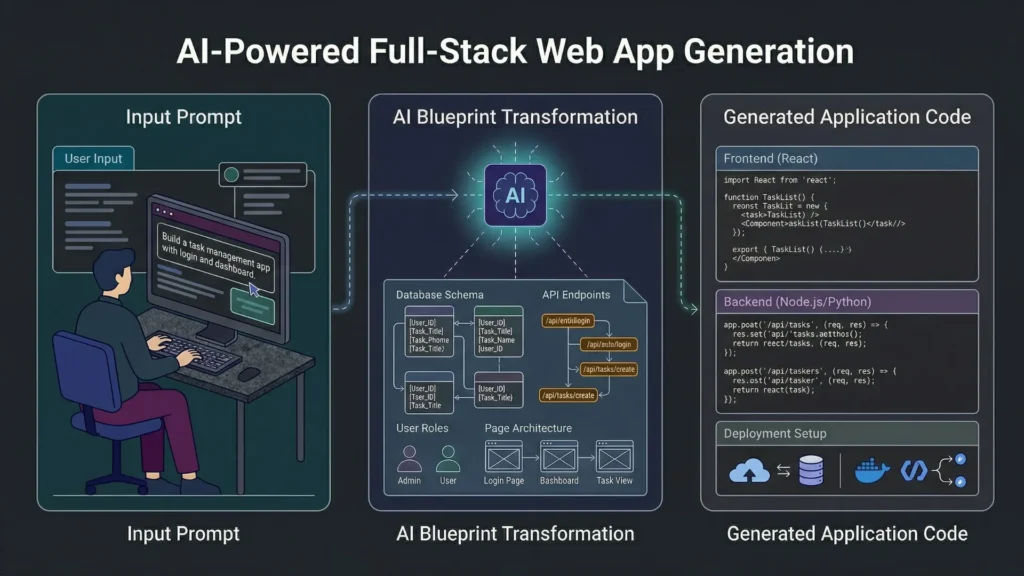
The most important difference between imagine.bo and every template-based no-code tool is what the output actually is. Webflow generates a visual layout. Bubble generates a platform configuration. imagine.bo generates real source code: React frontend components, a relational database schema with the correct tables and relationships, backend API endpoints, authentication logic, and deployment configuration, all from a description of what you want to build.
Launch Your App Today
Ready to launch? Skip the tech stress. Describe, Build, Launch in three simple steps.
BuildThis matters because the ceiling of a template-based tool is fixed by the vendor’s feature list. When you need something the template does not support, you are stuck. imagine.bo’s output is real code. When you need something beyond what the conversational interface generates, a developer can extend the codebase directly without rebuilding from scratch.
According to GitHub’s 2024 Octoverse report, AI-assisted development reduces time spent on common software patterns by an average of 55% (GitHub, 2024). For non-technical founders, the gain is not 55%. It is the entire development cycle, from months to days, because the technical barrier does not exist in the first place.
The AI-Generated Blueprint, displayed before any code is written, shows the complete application architecture including the database schema, user roles, page structure, and backend design. You review and adjust the structure before committing to the build. That blueprint review step is the quality gate that separates imagine.bo’s generation quality from tools that generate blindly and expect correction after the fact.
For a practical guide to writing prompts that produce accurate first generations, this post on building an app by describing it in plain English covers the four-element structure that consistently works.
Benefit 2: Production Infrastructure Included With Every Deployment
Most no-code tools deploy to their own platform’s infrastructure. You do not control the hosting, the CDN, or the scaling configuration. When you want to migrate to a different host or hand the project to a developer, the code does not go with you.
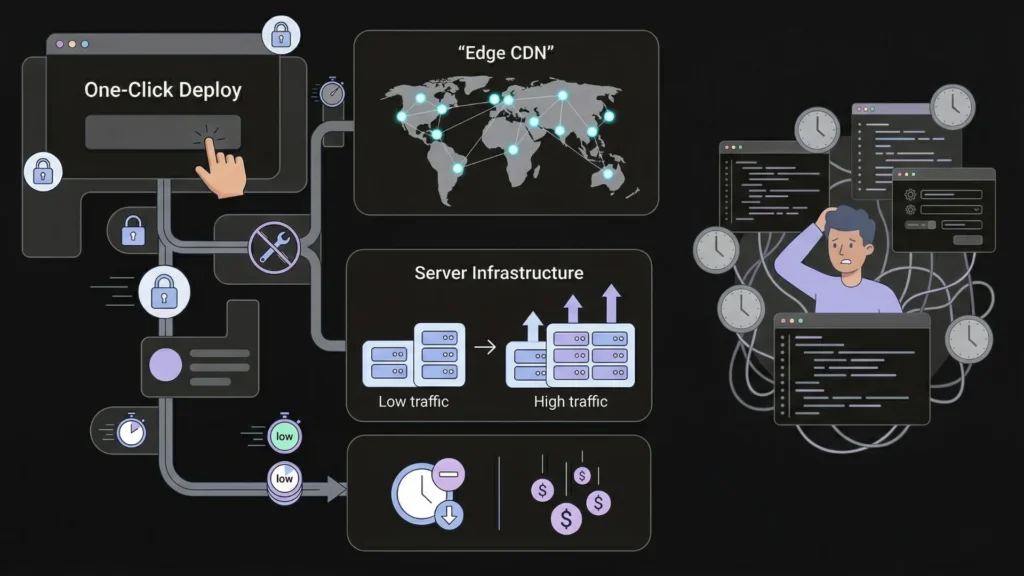
imagine.bo’s One-Click Deployment sends your frontend to Vercel’s global edge network and your backend to Railway for automatic scaling. Both are production-grade infrastructure services used by major commercial applications. Vercel serves static assets from CDN nodes closest to each user globally, producing fast load times without any configuration from you. Railway scales your backend automatically based on traffic, handling load increases from 10 users to 1 million without manual capacity planning.
SSL certificates apply to every deployment by default. No certificate generation, no renewal management, no HTTPS configuration required. The infrastructure that most developers spend days configuring is present on every imagine.bo deployment from the first build.
A developer configuring equivalent production infrastructure manually, specifically a Vercel frontend with Railway backend, SSL, and environment variable management, spends an estimated four to eight hours on initial setup and one to two hours per deployment for a typical project. At an average developer rate of $100 per hour, that is $400 to $1,000 in DevOps time saved on setup alone, with additional savings on every subsequent deployment. imagine.bo’s Pro plan at $25 per month eliminates that cost entirely.
For a technical overview of how no-code AI apps scale on this infrastructure to handle production traffic, this post on scaling no-code AI apps to production covers the architecture in detail.
Benefit 3: You Own the Code Outright
Code ownership is the benefit that most differentiates imagine.bo from every traditional no-code platform, and it is the one with the largest long-term financial implications.
Bubble, Glide, and Webflow produce configurations that live inside their platform’s proprietary system. The application cannot be exported as source code. When the platform changes its pricing, when you want a developer to add a complex feature, or when you consider selling the business, the platform dependency is a significant liability.
imagine.bo generates clean, exportable code following modern standards. You own it entirely. You can export the codebase, hand it to a developer for extension work, deploy it on any infrastructure, or transfer it as part of a business sale without any platform negotiation. The code you build on imagine.bo is your asset, not a lease on someone else’s infrastructure.
The code ownership benefit compounds most significantly at the point of a potential acquisition or investment round. Technical due diligence on a no-code platform business invariably surfaces the question of what happens when the platform changes pricing or shuts down. A business built on imagine.bo-generated code can answer that question with a GitHub repository and a deployment configuration. A business built on a Bubble database cannot. For early-stage founders who plan to raise investment or sell, code ownership is not a nice-to-have. It is a due diligence requirement.
For a direct comparison between imagine.bo’s code ownership model and Bubble’s proprietary ecosystem, this post on Bubble vs. imagine.bo for 2026 covers the ownership question specifically.
Benefit 4: The Hire a Human Hybrid Model
Every AI code generator hits the same ceiling. A complex third-party API integration, a custom business logic algorithm, a payment flow with unusual compliance requirements. Tools like Lovable and Bolt.new leave you at that ceiling with no path forward except finding a developer independently, re-explaining the entire project context, and paying for engineering work disconnected from the platform that built everything else.
imagine.bo’s Hire a Human feature is the practical solution to that ceiling. From your project dashboard, you submit a task ticket to a vetted engineer who reviews the request, writes the custom code for that specific module, and pushes the update directly to your project’s repository. The cost is $25 per page for targeted tasks. No hiring process, no equity negotiation, no retainer.
The Pro plan includes a 20% discount on Hire a Human tasks, a 24-hour turnaround guarantee, and a one-hour expert pre-launch session. That pre-launch session is the highest-leverage hour in the entire build process. A vetted engineer reviews your application’s architecture before your first real users arrive, identifying any structural issues that would create problems at scale.
Citation capsule: According to imagine.bo’s platform documentation, the Hire a Human feature is accessible directly from the top-right corner of the generating screen and allows assignment of individual pages at $25 per page or full project delivery through the Done For You service. The hybrid model is designed specifically to address the “Day 2” problem that pure AI builders cannot solve: what happens when the product needs to scale, add complex payment flows, or integrate legacy systems (imagine.bo, 2026).
For a dedicated guide to when and how to use the Hire a Human feature effectively, this post on why Hire a Human is the AI app builder feature you actually need covers the specific scenarios where it produces the most value.
Benefit 5: Credit Rollover Pricing That Matches Real Build Cycles
Software development is not linear. A founder building their first product spends three weeks in heavy iteration, then two weeks doing nothing while validating with users, then another intensive week adding features based on feedback. Most platform pricing models charge you the same monthly amount regardless of how much you use the product, meaning your light months subsidize a flat cost that does not adjust to your workflow.
imagine.bo’s credit rollover on paid plans means unused credits carry forward month to month as long as the subscription is active. A founder who uses 50 of their 150 Pro plan credits in March rolls 100 credits into April, which can be spent during a heavy iteration sprint without buying a credit top-up. The credits accumulate during lighter months and fund heavier development periods without plan upgrades.
This pricing model aligns with how non-technical founders actually build. They do not build continuously at a fixed pace. They build intensively around product decisions, pause to validate, and build intensively again. Credit rollover matches that rhythm.
The free plan at $0 provides 10 credits per month for testing the platform and building scoped first versions. The Lite plan at $6 per month provides 30 credits for small business sites and simple apps. The Pro plan at $25 per month provides 150 credits with rollover for full SaaS products and complex applications. The Done For You plan at $499 one-time provides a fully managed build by imagine.bo’s engineering team for founders who want production-ready delivery without any building involvement.
Benefit 6: Built-In Security Defaults on Every Deployment
Security is the benefit most non-technical founders underweight at the start and most frequently regret not having built in properly after the first incident. Misconfigured authentication, missing SSL, exposed API keys, and absent role-based access control are the four most common security failures in early-stage web applications built by non-technical teams.
imagine.bo applies the following to every deployment by default, without additional configuration:
SSL on all connections, so all data in transit is encrypted from day one. RBAC enforced at the API layer, not just the UI layer, so restricted routes reject unauthorized access at the server rather than relying on frontend redirects. Data encryption at rest and in transit. Secure authentication and session management with industry-standard practices. GDPR readiness foundations and SOC2 readiness foundations baked into the deployment architecture.
The RBAC enforcement at the API layer is the security feature that prevents the most damaging early-stage data breaches. Most no-code platforms and early-stage custom builds enforce access control by hiding UI elements from unauthorized users. A user who navigates directly to a restricted URL or who calls the API directly can still access data. imagine.bo’s generated backend enforces role checks on every API endpoint, so a client who guesses an admin dashboard URL receives a 403 rejection from the server rather than seeing the data. That distinction is the difference between a cosmetic access control and a real one.
For the full security audit checklist covering every layer of an AI-generated application, this post on no-code app security best practices covers the implementation details.
Benefit 7: Iterative Refinement Through Conversation
Traditional development iterates through tickets, standups, and pull request reviews. Visual no-code tools iterate through clicking, dragging, and reconfiguring components. imagine.bo iterates through conversation. You describe what needs to change, and the platform applies the change to the existing application without rebuilding unrelated parts.
This conversational iteration model has a specific practical advantage: it has no learning curve. There is no editor to learn, no component library to understand, no configuration interface to navigate. If something in your web app needs to change, you describe the current state, the expected state, and any relevant constraint, and the change applies.
Post-launch feature additions work the same way. “Add a notifications centre to the main navigation where users can see the last thirty alerts with read and unread status.” “The dashboard is showing all records regardless of the logged-in user. Filter it to show only records owned by the current user.” “Add a CSV export button to the analytics table that exports the currently filtered data.” Each of those generates a targeted fix without touching unrelated functionality.
According to imagine.bo’s platform documentation, the Describe-to-Build interface supports full iterative refinement throughout the product lifecycle, from initial generation through post-launch feature additions, using the same conversational interface at every stage (imagine.bo, 2026). This makes imagine.bo the only tool in the no-code category where the build workflow and the maintenance workflow are identical, removing the context-switching cost that slows most product teams down after launch.
For a direct comparison between imagine.bo’s conversational iteration model and Lovable’s approach, this post on Lovable vs. imagine.bo for 2026 covers both platforms’ iteration workflows in detail.
How imagine.bo Compares to the Main Alternatives
| Feature | imagine.bo | Bubble | Lovable | Bolt.new | Webflow |
|---|---|---|---|---|---|
| Full-stack generation | Yes | No (visual config) | Yes | Yes | No (frontend only) |
| Code ownership | Yes | No | Yes | Yes | No |
| Production deployment | Vercel + Railway | Bubble hosting | External | External | Webflow CDN |
| Human engineering support | Yes (Hire a Human) | No | No | No | No |
| Credit rollover | Yes (paid plans) | No | No | No | No |
| Built-in security defaults | Yes | Partial | Partial | Partial | No |
| Iterative conversation | Yes | No | Yes | Yes | No |
| Starting price | $0 | $29/month | $25/month | $20/month | $18/month |
FAQ
Is imagine.bo genuinely no-code or does it require some technical knowledge?
Imagine.bo requires the ability to describe your application clearly in plain English. No programming knowledge, database configuration, deployment experience, or technical background is required. The quality of the output depends on the specificity of the description, not on technical skill. A founder who can articulate their user roles, their data model, and their access rules clearly will generate a more accurate first version than one who provides a vague concept. This post on no-code web app building with imagine.bo covers the full workflow for first-time builders with no technical background.
How does imagine.bo compare to Bubble for building complex apps?
Bubble is a visual editor that requires learning its specific interface and logic system before building confidently. imagine.bo generates the full application from a description without a visual editor learning curve. Bubble produces platform configurations that cannot be exported as code. imagine.bo produces exportable source code you own. Bubble’s ceiling is defined by Bubble’s features. imagine.bo’s ceiling is extended by the Hire a Human feature for any functionality the generator does not handle. For most founders building complex web apps, imagine.bo reaches the same functional output in significantly less time with more architectural flexibility. This post on Bubble vs. imagine.bo for 2026 covers the full comparison.
What happens when my app grows past what imagine.bo can generate?
The Hire a Human feature handles specific engineering tasks at $25 per page when AI generation reaches its limits. The generated codebase is clean and exportable, meaning a developer can extend it directly without rebuilding from scratch. Imagine.bo’s architecture deploys to Vercel and Railway, both of which scale automatically without infrastructure changes from you. The combination of on-demand engineering support and exportable code means there is no hard ceiling where you are forced to abandon the platform and start over. For the specific scenarios where Hire a Human produces better outcomes than prompt iteration, this post on building complex apps with imagine.bo covers the boundary between AI generation and engineering support.
Conclusion
The seven benefits of building a no-code web app with imagine.bo compound on each other. Full-stack generation from a prompt produces a working application in days. Production infrastructure included in every deployment eliminates DevOps overhead. Code ownership removes platform lock-in. The Hire a Human hybrid model extends the platform’s ceiling to any level of technical complexity. Credit rollover pricing matches real build cycles. Built-in security defaults protect users from day one. Iterative conversation makes post-launch changes as simple as the initial build.
No platform is perfect for every use case. If you need a native mobile app, you need a different tool. If you need real-time collaborative editing at scale, you need engineering support from day one. But for the majority of web applications non-technical founders and small teams want to build, imagine.bo combines the fastest path from description to deployed product with the fewest long-term constraints.
Start with the free plan and 10 credits at zero cost. Write a specific four-element prompt describing your app, review the AI-Generated Blueprint before building, and deploy your first version this week. For the top ten benefits of the broader prompt-to-app development approach that imagine.bo leads, this post on the top 10 benefits of prompt-to-app development is the most direct companion resource.
Related Articles
- How MBA Students Can Validate Startup Ideas with No-Code Tools
- How Nonprofits Are Launching Impactful Apps Without Developers
- AI App Builder App Builder No Code: Build World-Class Apps Without Writing a Single Line of Code
- AI Apps Builder: Create Smarter, Faster, and Without Code
- E-Commerce Website Builder: Build & Launch Faster with AI
Launch Your App Today
Ready to launch? Skip the tech stress. Describe, Build, Launch in three simple steps.
Build