
Most founders hit the same wall when they try to build a mobile app. Agencies quote $80,000 to $250,000 and a six-month runway. Freelancers are cheaper but unpredictable. Learning to code is not a realistic option when you’re running a business with real deadlines. The result? Most ideas die before they ship.
AI mobile app builders change that math. This article covers how they work, what separates useful tools from demo toys, how long builds actually take, and where imagine.bo fits into the picture. You’ll finish with a clear read on whether this approach fits your use case and what your realistic path to a working product looks like. For a grounded view of what non-technical founders are actually shipping today, building products without a technical background is worth reading before you dive in.
Launch Your App Today
Ready to launch? Skip the tech stress. Describe, Build, Launch in three simple steps.
BuildTL;DR: No-code platforms reduce app development time by up to 90%, according to Pathfinder research (Code Conductor, 2026). Where traditional development costs $80,000 to $250,000 and takes 3 to 9 months (Netguru, 2026), AI-powered builders like imagine.bo generate a deployed, full-stack web application from a plain English description in hours. The speed and cost gap is not marginal. It is a category difference.
What Is an AI Mobile App Builder?
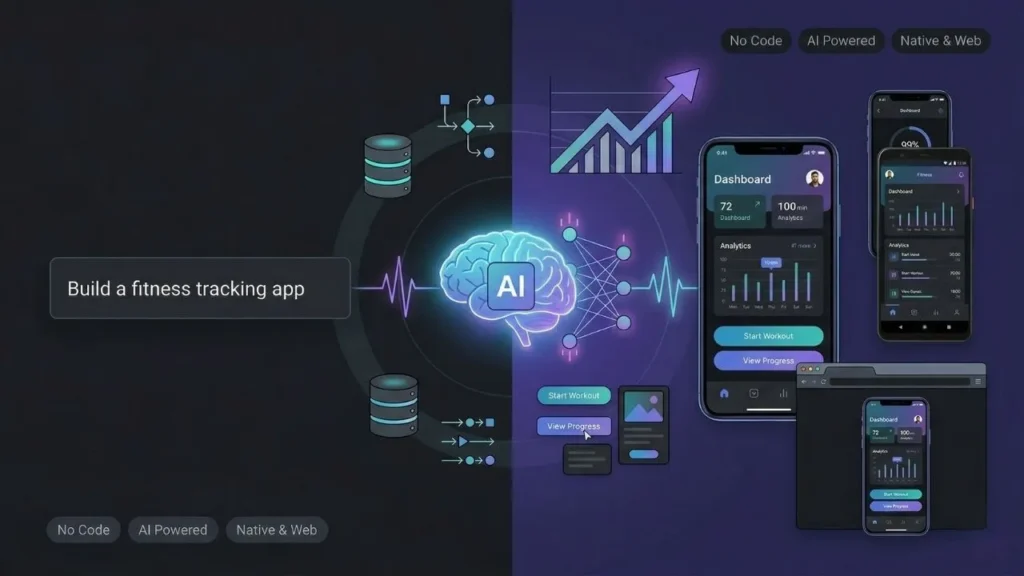
An AI mobile app builder is a platform that uses artificial intelligence to generate a working application from your input, without requiring you to write code. The input is typically a text description. The output is a functional app with real logic, a real database, and a real user interface. According to Grand View Research, the no-code AI platforms market was valued at $4.28 billion in 2024 and is projected to reach $44.15 billion by 2033 at a compound annual growth rate of 30.2% (Grand View Research, 2024). That’s not a niche experiment. It’s a market that has crossed into the mainstream.
These platforms sit on a spectrum. On one end are native builders that output iOS and Android apps for the App Store and Google Play. On the other are full-stack web app builders that produce mobile-responsive web applications, accessible from any phone browser without a download. Both qualify as AI mobile app builders. The right choice depends on your actual distribution requirement.
Most comparisons between AI app builders focus on the output format, native versus web. They miss the more important question: what does your user actually need to do? If your product requires offline functionality, device hardware access like Bluetooth or GPS sensors, or app store discoverability, a native builder is your path. If your user needs a functional tool on any device without installation friction, a web-first builder ships faster, costs less, and often converts better. Match the tool to the job, not to an assumption about what an app should be.
The no-code AI platforms market, valued at $4.28 billion in 2024, is on track to reach $44.15 billion by 2033 (Grand View Research, 2024). That 30.2% annual growth rate reflects real enterprise and founder adoption, not hype. More than 60% of CIOs cite acute developer shortages as a primary driver of this shift, according to Mordor Intelligence (2026).
For a direct breakdown of when no-code outperforms low-code for early-stage products, the no-code vs. low-code decision for startups walks through the key trade-offs with specific use cases.
How Fast Can an AI Mobile App Builder Actually Ship Your App?
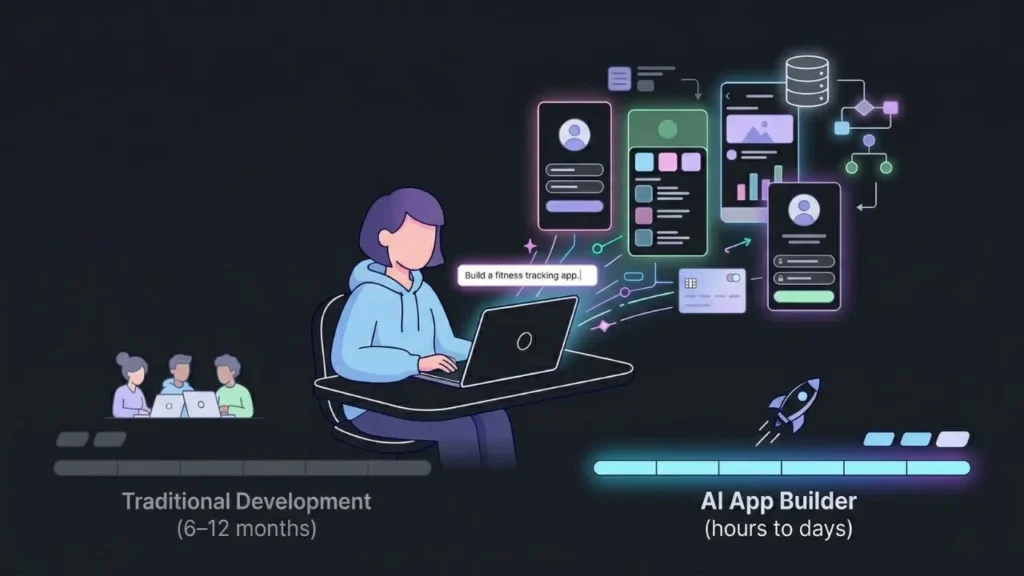
The speed advantage is real and specific. According to Adalo’s analysis of the no-code market, 72% of users develop working applications in three months or less using low-code platforms, compared to traditional cycles of 6 to 12 months (Adalo, 2026). Pathfinder research, cited by Code Conductor, puts the time reduction at up to 90% for no-code approaches versus conventional development. What took a team of engineers nine months now takes a single non-technical founder a few days of focused iteration.
For a simple product, a booking system, a client portal, a subscription app, you’re looking at hours to days on a well-built AI platform. Mid-complexity applications with multi-role authentication, payment processing, and custom dashboards typically require one to two weeks of prompt-driven refinement. Compare that to the 3 to 9 month baseline for an agency build covering the same scope.
A founder building a subscription-based SaaS on imagine.bo starts by entering a plain English description of what the app does, who uses it, and what the core user flows are. imagine.bo’s Describe-to-Build feature generates an AI-Generated Blueprint outlining the full app structure before any code is written. The founder reviews it, adjusts through conversation, and approves. From that point, a working application with frontend, backend, and database is generated. The time from first prompt to a testable build is measured in hours, not weeks.
That speed creates a compounding advantage. Instead of spending nine months building the wrong thing, you can ship a working version, gather real user feedback, and iterate. Is that not the whole game for early-stage products? Gartner research, cited by Lovable’s analysis of mobile development trends, shows that 40% of enterprise applications will feature task-specific AI agents by the end of 2026, up from less than 5% in 2025 (Gartner, 2026). The apps that win in that environment are the ones that launched early enough to learn.
According to Pathfinder research (Code Conductor, 2026), no-code platforms reduce app development time by up to 90% compared to traditional coding. Adalo’s market analysis (2026) confirms that 72% of builders using low-code platforms ship their applications within three months, a timeline that traditional development reaches only for the simplest possible projects.
To see how this plays out from initial concept to a live deployed application, the path from idea to live app shows a real build sequence with specific time markers.
What Features Should You Look for in an AI Mobile App Builder?
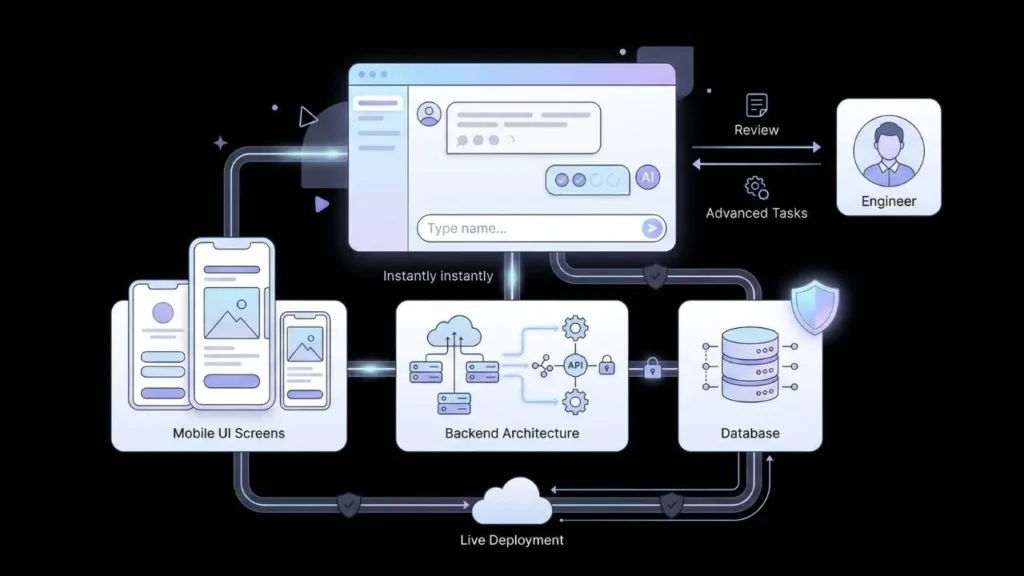
The feature that separates useful AI app builders from demo tools is production-readiness. The app development market was valued at $264.96 billion in 2025, growing at a 15.18% CAGR through 2031 (Mordor Intelligence, 2026). Platforms operating in that market face real commercial pressure to deliver working outcomes, and most will tell you whatever sounds best in a sales context. Here is what actually matters.
Full-stack output. A frontend without a backend is not an app. It’s a prototype. The platform should generate the database schema and backend logic alongside the user interface. imagine.bo does this by default. The generated code includes the full stack, deployed and running, not a UI waiting for a developer to wire up the data layer.
Deployment included. Configuring servers is a DevOps job. An AI builder should handle deployment as part of the output. imagine.bo deploys frontend to Vercel and backend to Railway, both production-grade infrastructure choices used by thousands of real companies at scale.
Security built in from day one. Role-based access control, SSL certificates, and GDPR foundations should come standard. Security retrofitted after launch is expensive and often incomplete. imagine.bo includes RBAC, SSL, GDPR foundations, and SOC2 readiness out of the box, which matters from the first user who signs up.
Conversation-driven editing. The best builders let you refine through dialogue. If you have to open a visual drag-and-drop editor every time you want to change something, the platform is not truly AI-native. You describe the change in plain English. The system makes it.
A human escalation path. AI generation hits ceilings. The honest platforms acknowledge this and solve for it. imagine.bo’s Hire a Human feature connects you to vetted engineers directly from your dashboard when a specific task exceeds what AI can handle. No context-switching. No re-explaining the project from scratch to a freelancer. The human engineer works within the existing project context.
According to Mordor Intelligence (2026), more than 60% of CIOs cite acute developer shortages as the primary driver pushing organizations toward low-code and AI-first development. With the app development market at $264.96 billion in 2025 and growing, platforms that combine AI generation with on-demand human expertise represent the most practical path for teams building without a dedicated engineering department.
For a side-by-side look at how today’s leading AI builders compare across these criteria, the best mobile app development software in 2025 evaluates the field in detail.
How Does imagine.bo Work as an AI Mobile App Builder?
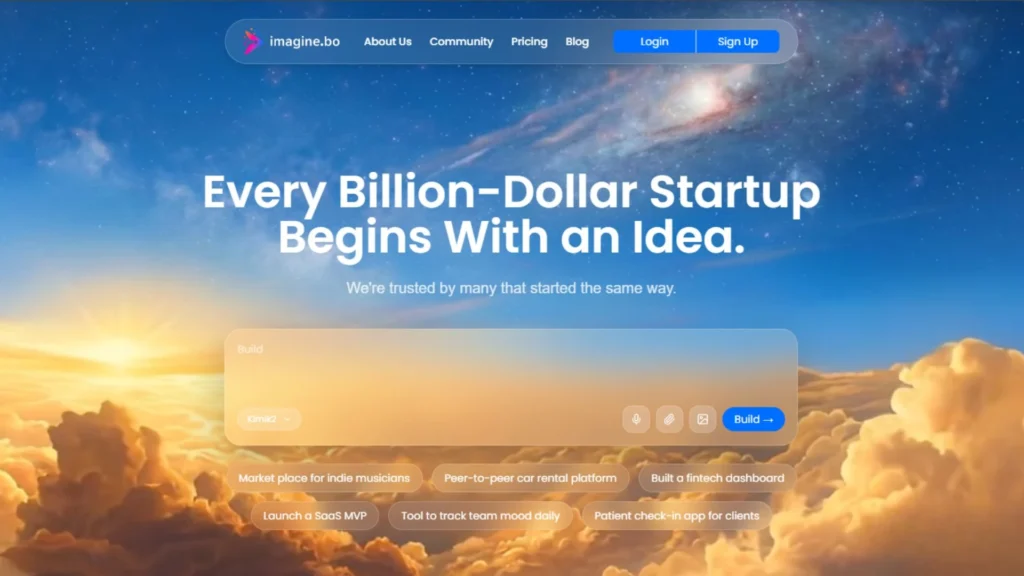
imagine.bo is a full-stack web app builder. You type a plain English description of what you want to build. The Describe-to-Build feature interprets your input and generates an AI-Generated Blueprint: a structured view of the proposed app covering user roles, pages, database schema, and core logic. You review it, refine through conversation, and approve. The platform then generates the complete application, frontend, backend, and database, deployed and accessible from any device.
The output is a mobile-responsive web application, not a native iOS or Android app. This is worth being direct about. If your product requires App Store distribution, push notifications through native APIs, or access to device hardware like accelerometers or Bluetooth, you’ll need a native builder or a hybrid approach. For the vast majority of founder use cases, a production-ready web application that works on any phone is the right answer and gets to market faster.
Consider a solo operator building a client onboarding portal. They need multi-role authentication for clients and admins, document uploads, form submissions, automated email confirmations, and a payment gate before access. On imagine.bo, that description becomes a structured Blueprint in under an hour. The resulting app includes all those features plus clean, exportable code the founder owns entirely. No vendor lock-in. No monthly platform fee tied to keeping the app alive. The founder can export the code and host it anywhere, or hand it to a developer for extension later.
Credit rollover on paid plans means unused credits carry forward month to month, which matters for founders who build in bursts. The Pro plan at $25 per month includes 150 credits, private projects, rollover credits, a 1-hour expert session before launch, and priority support with 24-hour turnaround. The Done For You option at $499 is a one-time fee for a fully managed build by the imagine.bo team, covering founders who want a hands-off path to production.
Gartner reports that nearly 60% of custom applications are now built outside traditional IT departments (Code Conductor, 2026). imagine.bo’s model is designed for exactly this shift. Its Describe-to-Build feature, AI-Generated Blueprint, and Hire a Human escalation path give non-technical founders and operators a complete path from concept to production without a development team.
For a step-by-step look at how the build workflow runs in practice, building an app by describing it shows the process from first prompt to working product.
What Does an AI Mobile App Builder Actually Cost?
Traditional custom app development averages $80,000 to $250,000 for a mid-scope project, with timelines of 3 to 9 months (Netguru, 2026; Americaneagle.com, 2025). That is the baseline you’re replacing when you choose an AI builder. According to Noloco and KumoHQ, no-code platforms are 10 to 20 times cheaper than traditional development for comparable functionality (2025). The math is not subtle.
AI mobile app builder pricing breaks into three practical tiers.
Free and Lite tiers are for prototyping and validation. imagine.bo’s free plan includes 10 credits per month, public projects, and community support. The Lite plan at $6 per month extends to 30 credits, up to 8 pages, and a 20% discount on Hire a Human tasks. This is enough to build and test a product concept before committing to a paid plan.
Pro tiers are where serious builders operate. imagine.bo’s Pro plan at $25 per month includes 150 credits, private projects, rollover credits, and a pre-launch expert session. For a product generating even modest revenue, that monthly cost against a $150,000 traditional development quote is not a close call.
Managed builds exist for founders who want full delivery without any DIY. imagine.bo’s Done For You service is $499 as a one-time fee, with the complete build handled by the imagine.bo engineering team.
Across the imagine.bo plan structure, the maximum monthly spend for a self-directed build with 150 credits is $25. A US-based developer charges $100 to $150 per hour. At a modest 500-hour traditional build, which covers a real mid-complexity product, the cost gap is $50,000 to $75,000 versus $25 per month. That is not a marginal efficiency difference. It changes which products non-technical founders can realistically attempt to build without investor backing.
The low-code development market is projected to grow from $37.39 billion in 2025 to $264.40 billion by 2032 at a CAGR of 32.2% (Lovable analysis citing Gartner, 2026). That trajectory signals this pricing model is not a temporary discount. It is the new structure of a significant portion of software development.
For a direct side-by-side of what the cost and speed difference looks like across real project types, code vs. no-code app development speed and timelines puts the numbers in concrete terms.
Where Do AI Mobile App Builders Fall Short?
Being honest about limits is not a weakness. Founders making real decisions with real money deserve a straight answer.
Native app store distribution. If your product strategy requires a listing in the Apple App Store or Google Play, a web-first builder like imagine.bo is not your direct output path. Web apps can be wrapped in native shells using tools like Capacitor, but that adds technical overhead and a step that requires developer involvement. If app store presence is non-negotiable, plan for that upfront.
Proprietary algorithms and custom machine learning. AI builders generate standard application logic well. If your app’s core value is a proprietary matching engine, a custom ML model, or a specialized real-time calculation, the AI generation layer will reach its ceiling. imagine.bo’s Hire a Human feature is designed for exactly these moments. But knowing in advance where the ceiling is helps you plan.
Pixel-perfect custom design. Conversation-driven builders produce functional, clean interfaces. If your vision requires custom animations, highly specific interaction states, or a brand design system built from scratch at the component level, you’ll get close but not identical. The trade-off is hours of prompt refinement versus weeks of design work. Most products ship fine on the former.
Enterprise-scale infrastructure at launch. imagine.bo deploys on Vercel and Railway, which are serious production platforms. For most founding-stage products, these are more than adequate. If you’re planning for hundreds of thousands of concurrent users from day one with enterprise SLA requirements, you’ll eventually want a DevOps engineer in the conversation. That is a later-stage problem for most founders, not a day-one constraint.
Gartner reports that nearly 60% of custom applications are now built outside traditional IT departments (Code Conductor, 2026). The remaining 40% represents cases where specialized requirements, regulated industries, or complex infrastructure still demand developer expertise. AI builders close the gap dramatically. They don’t eliminate it entirely, and platforms that claim otherwise aren’t being straight with you.
For a realistic picture of what the full launch process looks like when you’re moving without developers, launching apps without developers covers the practical details of what you handle yourself and where you might need support.
Frequently Asked Questions
What is the best AI mobile app builder for non-technical founders?
The right choice depends on your distribution requirement. For full-stack web apps that work on any device, imagine.bo generates a complete frontend, backend, and database from a plain English description with deployment included. For native app store distribution, dedicated native builders are the more direct path. According to Adalo (2026), 65% of apps are now built without coding, which means the tooling for non-technical founders has matured into a real production option.
How long does it take to build an app with an AI builder?
Simple apps take hours to a day. Mid-complexity products with authentication, payments, and multi-role access typically take one to two weeks of iterative refinement. Pathfinder research puts no-code time savings at up to 90% versus traditional development (Code Conductor, 2026). Traditional development for a comparable product runs 3 to 9 months. The difference is not incremental. It changes your whole validation cycle.
Can an AI app builder handle payments and user authentication?
Yes. Production-ready AI builders include standard integrations for both. imagine.bo includes role-based access control and SSL out of the box, and payment gateway integration is part of the standard build. For a detailed look at what integration issues to anticipate before launch, Stripe payment integration challenges explained covers the most common friction points.
Is the code from an AI mobile app builder exportable?
With imagine.bo, yes. The code is clean and fully owned by the user. Some platforms lock you into their ecosystem so the app only runs on their infrastructure. Code ownership matters when you plan to scale, bring on a technical co-founder, or eventually sell the product. According to Code Conductor (2026), code export policies vary significantly across no-code platforms. Always verify this before committing to a tool.
What happens when the AI can’t build what I need?
imagine.bo’s Hire a Human feature connects you to vetted engineers directly from the project dashboard. You assign the specific task, the engineer works within the existing project context, and the work is completed without you having to restart the conversation on a separate freelancer platform. This hybrid model, AI generation combined with on-demand human engineering, covers the vast majority of real-world founder requirements.
Conclusion
Three concrete takeaways from this article.
First, the cost and time gap between AI mobile app builders and traditional development is not marginal. Traditional development averages $80,000 to $250,000 and takes 3 to 9 months. AI builders like imagine.bo produce a deployed, working application in hours to days. That gap changes what non-technical founders can realistically attempt without investor funding.
Second, “AI mobile app builder” is not a single category. Native builders produce app store listings. Web-first builders like imagine.bo produce mobile-responsive full-stack applications that work on any device. Match the tool to your actual distribution requirement before you start building.
Third, the hybrid model matters more than pure AI generation. The ability to escalate a specific task to a vetted human engineer, within the same platform and without re-explaining the project, is what separates tools that work at the end of a build from those that break precisely when things get complicated.
If you’re ready to test the process, start with a clear plain English description of what your app does, who uses it, and what the three core user flows are. imagine.bo’s Describe-to-Build feature generates an AI-Generated Blueprint before any code is written, so you can review and refine the structure before committing a single credit.
For a broader look at where AI-powered no-code development is heading next, AI-powered no-code app development in 2025 covers the trajectory of the category and what it means for builders working today.
Related Articles
- AI App Builder App Builder No Code: Build World-Class Apps Without Writing a Single Line of Code
- Revolutionizing Mobile App Development: How AI Can Build Your Next App and Scale Your Business
- Revolutionizing Mobile App Development: Your Guide to AI-Powered App Building
- AI Apps Builder: Create Smarter, Faster, and Without Code
- Revolutionizing Mobile App Development: How AI is Changing the Game
Launch Your App Today
Ready to launch? Skip the tech stress. Describe, Build, Launch in three simple steps.
Build