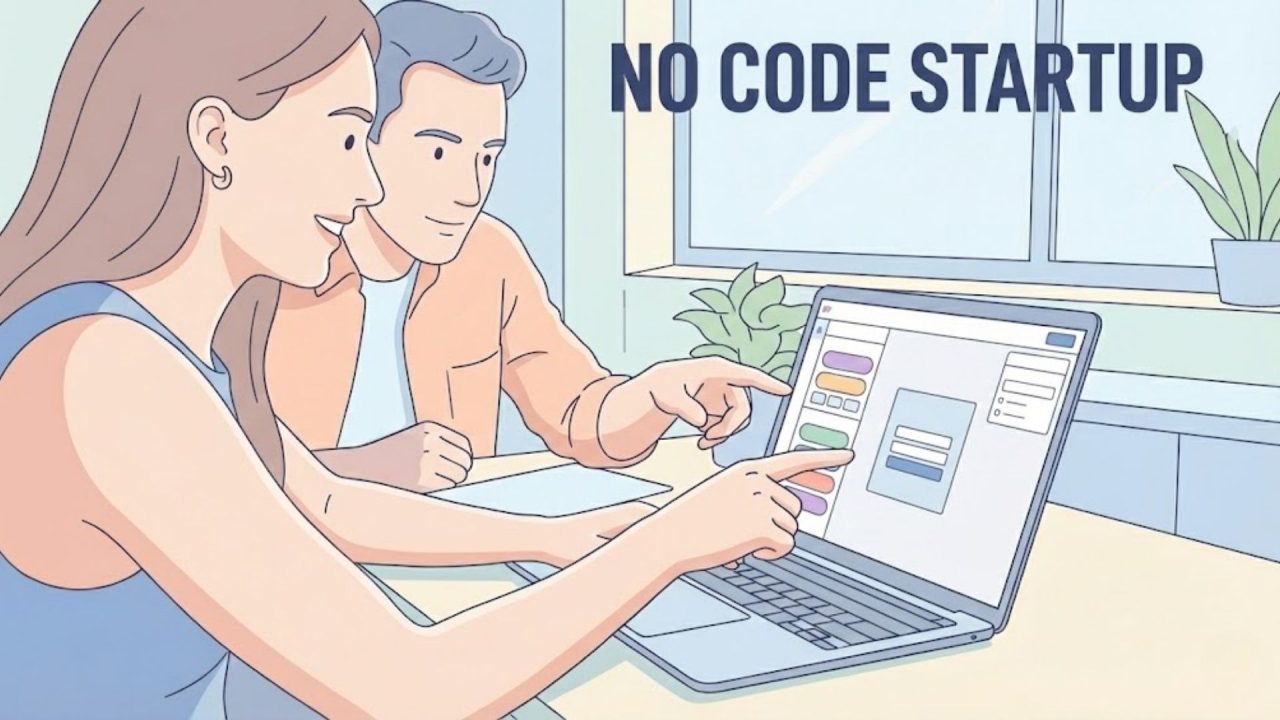
Most lean startup advice was written before it was actually cheap to build software. Eric Ries published The Lean Startup in 2011, when the fastest path to a working MVP still cost tens of thousands of dollars and several months of developer time. The methodology was sound, but the tools were slow. That mismatch is gone. According to Gartner, 70% of new enterprise applications will be built using no-code or low-code platforms by 2025, a shift that validates what early-stage founders have already discovered: no-code app development does not just lower costs, it changes the speed at which you can test whether your idea deserves to exist. This article explains why no-code tools are the natural infrastructure for the lean startup model, what that means for founders without technical backgrounds, and where the real constraints still live. For a direct cost breakdown, the developer vs AI vs no-code app building cost comparison gives the full picture before you commit to a build approach.
TL;DR: No-code tools align with lean startup principles at every stage: they cut MVP build costs from $30,000-plus to under $100 (Clutch, 2024), compress build-measure-learn cycles from months to days, and let non-technical founders own their product decisions entirely. According to Statista, the no-code/low-code market will exceed $65 billion by 2027. Platforms like imagine.bo add human engineering on demand when AI reaches its limits, solving the one problem that previously made no-code risky at scale.
What Is the Lean Startup Model and Why Does No-Code Fit It So Naturally?
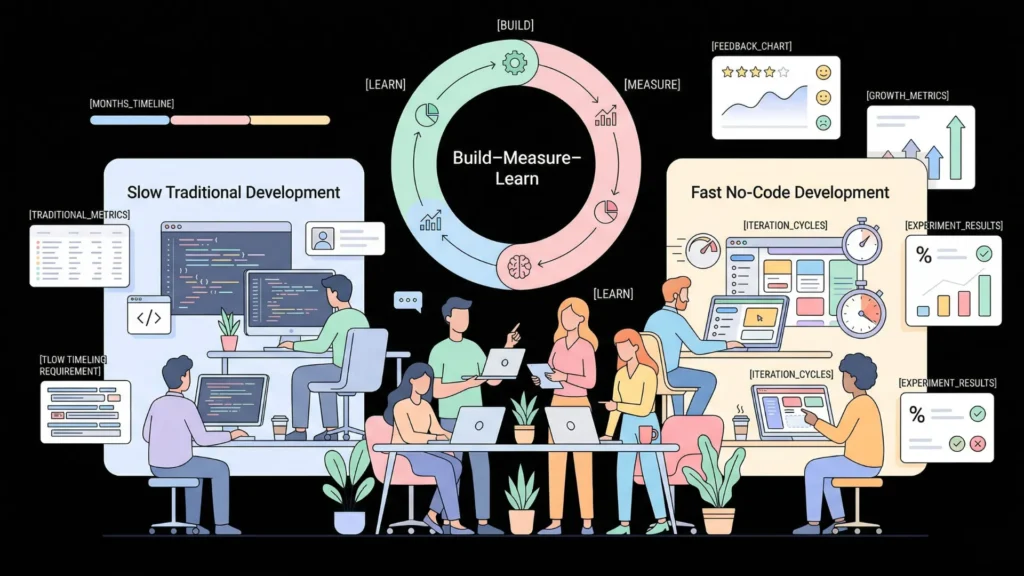
The lean startup model rests on one core loop: build something small, measure how real users respond, and learn fast enough to act before you run out of resources. According to CB Insights, 38% of startups fail because they exhaust their cash before finding product-market fit, and 42% fail because they build products nobody wants. Those two failure modes are not separate problems. They are the same problem: spending too much time and money before validating that the product deserves more investment.
Launch Your App Today
Ready to launch? Skip the tech stress. Describe, Build, Launch in three simple steps.
BuildNo-code for startups fits this model because it collapses the build phase from months to days. The bottleneck in the traditional build-measure-learn cycle has always been the build. A team that takes twelve weeks to ship a feature can only run four experiments per year. A team that ships in two days can run dozens. That difference is not incremental. It is the difference between a startup that finds product-market fit and one that runs out of runway first.
There is a deeper structural fit that most discussions of lean startup methodology miss. Eric Ries originally designed the minimum viable product concept for an era when even a basic working product required professional developers. The cheapest validation tool available was often a landing page, a fake door test, or a Wizard of Oz prototype where humans manually delivered the “automated” service. No-code changes the instrument of validation itself. You are no longer testing a simulation of your product. You are testing the actual product, with real users, real data, and real behavior. That is a fundamentally more reliable signal, and no-code makes it available without the capital requirement that used to gatekeep it. The why prompt-driven development is a startup advantage post explores this shift in more depth.
How Do No-Code Tools Cut the Real Cost of Building an MVP?
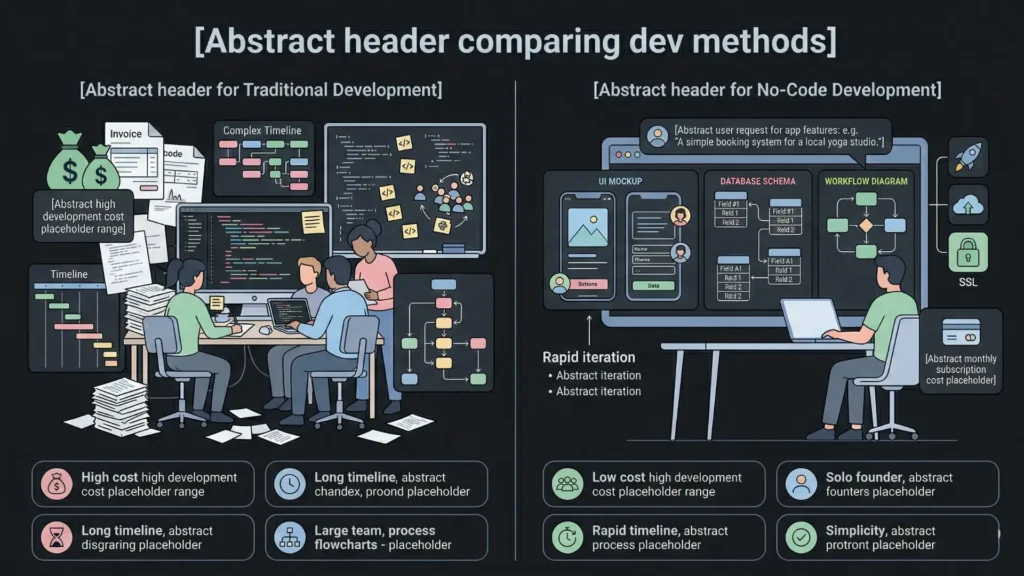
No-code tools reduce MVP costs by replacing the highest-cost line item in early-stage software development: developer time. According to Clutch, hiring a freelance development team to build a custom MVP typically costs between $30,000 and $150,000 depending on scope. For a bootstrapped founder, that is the entire first-year budget before a single user has paid them anything.
No-code platforms like imagine.bo compress that same scope to a monthly subscription that starts at $25 on the Pro plan. The platform’s Describe-to-Build feature generates a complete full-stack application, including frontend, database schema, and backend logic, from a plain English description. One-Click Deployment handles infrastructure, SSL, hosting, and scaling automatically. The engineering work that a contractor would bill for over weeks happens in a single session.
The cost reduction is not limited to the initial build. Iteration costs drop equally. In traditional development, every feature change requires a ticket, a developer, a review, a merge, and a deployment. Each cycle costs time and money, which means founders ration changes and avoid small experiments. On a no-code platform, iteration happens through conversation. Requesting a layout change, a new workflow, or an updated data model is a prompt, not a sprint. According to the Startup Genome Report, startups that iterate rapidly in response to user feedback are 2.3 times more likely to scale successfully. No-code removes the cost barrier that prevents frequent iteration.
A realistic cost model for a lean startup’s first six months: traditional development approach averages $45,000 to $80,000 for an MVP plus one round of major revisions, based on Clutch market rate data. A comparable build on imagine.bo’s Pro plan, including several Hire a Human tasks for complex integrations, costs under $500 for the same period. The savings do not just preserve capital. They preserve the founder’s ability to change direction without the sunk-cost pressure that comes from having spent six figures on a specific version of the product. For a fuller look at where no-code sits in the broader development landscape, the no-code vs low-code for startups comparison is worth reading before committing to a toolchain.
Why Does Iteration Speed Matter More Than Perfect Code at the Early Stage?
Iteration speed matters more than code quality at the early stage because the hypothesis you are testing changes faster than any codebase can be properly engineered to reflect. According to Y Combinator research, the median successful startup pivots its core product concept at least once before reaching product-market fit. A codebase that took three months to build carries real psychological and financial costs when a pivot requires rewriting significant portions of it. No-code builds do not carry that weight in the same way.
A lean startup’s first product is not a finished product. It is a question made tangible. The question is: does this specific solution, for this specific user, solve this specific problem well enough that they will pay for it? Answering that question requires a working tool in the hands of real users, not a polished product. The faster you can get a working version in front of users and update it based on what they do, the faster you get to an answer that is worth building on.
On imagine.bo, the iteration loop looks like this in practice. A founder ships a client booking tool to twenty early users. Within a week, heatmap and analytics data shows that users are spending the most time on a feature that was a secondary priority in the original scope. The founder prompts imagine.bo to expand that feature and simplify the original primary one. The change is live the same day. In a traditionally developed product, that same insight would have entered a backlog, been scoped, estimated, developed, reviewed, and deployed over two to four weeks minimum. The information was available in both cases. Only one product could act on it quickly enough to matter.
Citation capsule: According to the Startup Genome Report, startups that iterate based on user feedback are 2.3 times more likely to scale successfully, compared to those that build according to a predetermined roadmap without frequent user input (Startup Genome, 2023). No-code platforms reduce iteration time from weeks to days, making them structurally aligned with the build-measure-learn cycle that lean startup methodology requires.
The low-code MVP strategies for validation and feedback post covers the specific scoping and validation techniques that make rapid no-code iteration most effective.
How Are Citizen Developers Changing Who Gets to Start a Company?
Citizen developers, non-technical professionals who build software using no-code and low-code tools, are reshaping who has access to the startup process. According to Gartner, the citizen developer population will surpass professional developers at a ratio of four to one inside enterprises by 2025. That ratio is even more pronounced in early-stage startups, where the cost of a technical co-founder or first engineering hire can be prohibitive.
The practical effect is straightforward: founders who previously needed a technical partner to ship a product can now own the entire build themselves. That changes the economics of starting a company. You no longer need to give up equity to attract a technical co-founder whose primary value is execution capacity. With no-code app development, domain expertise is the differentiator, and domain expertise belongs to the founder.
This shift is not just about cost. It is about decision latency. When a non-technical founder relies on a developer for every product change, every product decision has to survive translation from business intent to technical specification and back again. That translation process introduces delay, misinterpretation, and rework. When the founder owns the build tool, the loop closes. The decision and the implementation happen in the same conversation.
The deepest implication of citizen developer growth is not that more people can build software. It is that more people with real domain expertise in specific industries can now build software for those industries without needing to partner with someone who does not share that expertise. A healthcare administrator who understands insurance workflows builds a better claims management tool than a generalist developer who has to learn the domain first. No-code does not just lower the barrier to building. It transfers the advantage back to subject-matter experts. For more on this shift, the rise of citizen developers in the AI era covers the full scope of the trend.
What Happens When a No-Code Build Hits Its Limits?
No-code tools hit real limits, and any honest comparison has to name them. Complex payment flows requiring PCI-DSS compliance need human engineering oversight. Custom algorithms for data processing, unusual third-party API integrations, and performance-sensitive backend logic can exceed what AI generation handles cleanly. The question is not whether limits exist. It is what happens when you reach them.
Most no-code platforms leave you stuck. You have a partially built product, a platform you cannot export cleanly from, and a technical problem you cannot solve without starting over. That is the failure mode that has given no-code a mixed reputation among founders who tried it and hit a wall two-thirds of the way through a build.
imagine.bo addresses this through the Hire a Human feature, which lets you assign a specific task to a vetted engineer directly from the project dashboard. The engineer writes the custom code for that module and pushes it to the project repository. You do not leave the platform. You do not find a freelancer. The escalation path is built into the workflow. The Done For You plan at $499 one-time hands the entire build to the imagine.bo engineering team, using AI generation for what AI does well and human engineering for what it does not.
According to McKinsey, knowledge workers spend 28% of their week on administrative and coordination tasks. For a founder managing a no-code build, Hire a Human removes the coordination overhead of managing a contractor relationship from outside the product entirely. That is not a minor convenience. It is the difference between staying in flow and losing a week to sourcing, briefing, and managing external work. The launching apps without developers guide walks through the full decision tree for when to build, when to hire, and when to hand off entirely.
Which No-Code Approach Is Right for Your Stage of Growth?
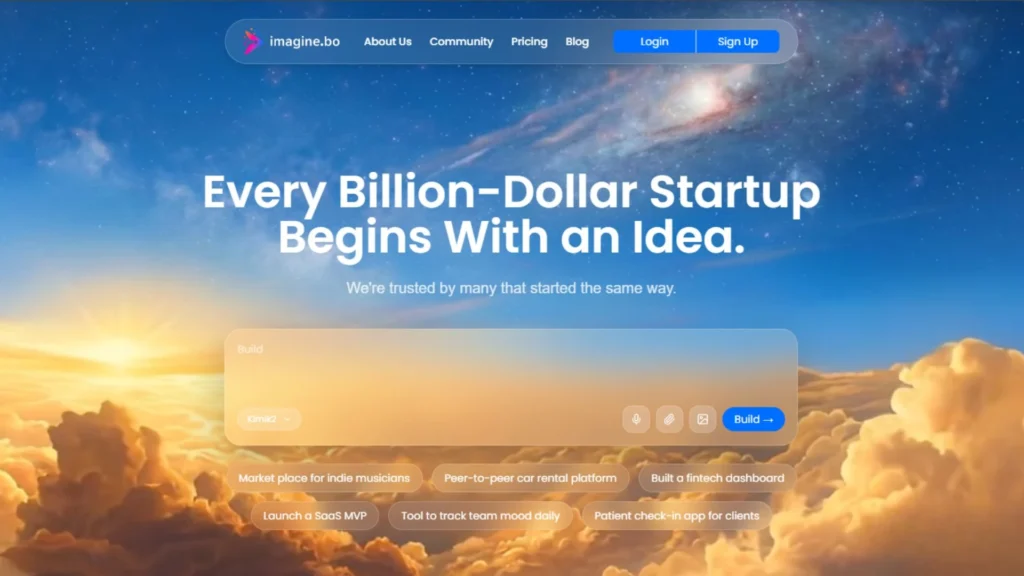
The right no-code approach depends on what stage your startup is actually in, not what stage you hope to be in after the build. Three stages have meaningfully different requirements, and using the wrong tool for the wrong stage wastes the very time and money no-code is supposed to save.
At the validation stage, your only goal is answering whether the core hypothesis is true. Use an AI app builder like imagine.bo on the Free or Lite plan. Build one user flow end-to-end. Ship it to twenty to fifty real users in under a week. Measure what they do, not what they say. Do not build an admin panel, a payments module, or a mobile app until you have evidence the core workflow produces the engagement you need.
At the iteration stage, you have early signal that the hypothesis is partially correct but the product needs refinement. This is where the Pro plan’s 150 credits and rollover become valuable. You are making frequent changes in response to user behavior, testing different implementations of the same core feature, and adding secondary workflows as you understand the user better. The AI-Generated Blueprint gives you a structural foundation to build from rather than starting from scratch with each change.
At the growth stage, your validated product needs to handle scale, compliance, and integrations that go beyond what conversational AI generation handles alone. This is where Hire a Human tasks and the Done For You option bridge the gap between what the no-code platform built and what a production system at scale requires. Knowing this transition point exists, and that it does not require abandoning the platform, changes how confidently you can commit to no-code from day one.
Citation capsule: According to Statista, the global no-code and low-code development platform market is projected to exceed $65 billion by 2027, driven by demand from early-stage startups and enterprise teams seeking faster development cycles (Statista, 2024). The growth reflects a structural shift: no-code is no longer a workaround for founders without developers. It is the default approach for any team that prioritizes speed of validation over perceived engineering credibility.
The best no-code tools to launch your startup fast post covers the full tooling landscape by stage if you want to compare options before committing to a stack.
FAQ
What is no-code app development and why do lean startups use it?
No-code app development lets you build functional software using visual editors or plain English prompts instead of writing code. Lean startups use it because the lean methodology requires fast, cheap iteration cycles. According to Gartner, 70% of enterprise applications will use no-code or low-code technology by 2025. For early-stage startups, no-code collapses the build phase from months to days, letting founders test hypotheses before they exhaust their runway.
Can a no-code tool build a production-ready startup product, not just a prototype?
Yes, with the right platform. Modern AI app builders like imagine.bo generate full-stack applications with database schemas, backend logic, secure authentication, and RBAC deployed on infrastructure like Vercel and Railway. According to Clutch, a comparable custom build costs $30,000 to $150,000. No-code tools do not just build prototypes. They build the same production layer, at a fraction of the time and cost. For complex features, imagine.bo’s Hire a Human feature brings in vetted engineers without leaving the platform.
What are the biggest risks of building a lean startup with no-code tools?
The two main risks are platform dependency and hitting a complexity ceiling. Platform dependency is mitigated by choosing tools that export clean code you own entirely, as imagine.bo does. Complexity ceilings appear when custom logic, specific integrations, or compliance requirements exceed AI generation capacity. According to CB Insights, 42% of startups fail from no market need, not technical limitations. Building with no-code and hitting a technical limit at scale is a problem worth having. Building a technically perfect product no one uses is not. Use the non-technical founders building products guide to understand how to scope around these risks from the start.
How do no-code tools support the build-measure-learn cycle?
No-code tools accelerate all three phases. Build is faster because AI generates structure, logic, and UI from a description. Measure is built in on platforms like imagine.bo through native analytics dashboards. Learn is actioned faster because changing a layout, workflow, or data model is a prompt, not a developer sprint. According to the Startup Genome Report, startups that iterate on user feedback are 2.3 times more likely to scale successfully. No-code removes the cost and time friction that prevents frequent iteration in traditionally built products.
Is no-code development right for a startup that plans to raise venture funding?
Yes, provided the platform exports clean, ownable code. Investors care about traction, user retention, and revenue, not what stack you used to build the product. A no-code MVP with 200 active paying users is a stronger funding signal than a custom-coded product with zero. According to Y Combinator research, most successful startups pivot at least once before finding product-market fit. A no-code build makes that pivot cheaper and faster, which is exactly the kind of capital efficiency early-stage investors look for.
Conclusion
The lean startup methodology always demanded a build tool fast enough to match the speed of learning. For most of the last fifteen years, no such tool existed at an accessible price point. No-code changed that. Three things explain why no-code app development is now the natural infrastructure for lean startups: it cuts MVP costs from tens of thousands of dollars to tens of dollars per month, it makes iteration fast enough to actually run experiments rather than just plan them, and it puts product control back in the hands of founders with deep domain expertise rather than developers with deep technical expertise. The constraint is not gone entirely. Complex logic, compliance requirements, and custom integrations still require human engineering. But those constraints appear late in the product lifecycle, after you have already validated that the product deserves to be built. That is exactly the right time to face them. If you are ready to move from concept to deployed product without a developer, start with the how to build a SaaS with AI and no-code guide and build your first version on imagine.bo this week.
Launch Your App Today
Ready to launch? Skip the tech stress. Describe, Build, Launch in three simple steps.
Build