

Your showroom floor isn’t where buyers start anymore. They start on a screen — scrolling through inventory at midnight, comparing trade-in values during lunch, reading reviews on their commute. And if your dealership doesn’t have a website that meets them there? You’re invisible before the handshake ever happens.

Here’s the uncomfortable truth: most dealership websites are expensive, slow, and built on platforms that haven’t changed since 2015. The average dealer pays between $799 and $1,699 per month for a cookie-cutter template they can’t even customize themselves. Meanwhile, car buyers spend 14 hours researching online and visit only 1.4 dealerships before buying — down from 4.5 a decade ago (ACV Max, 2025). Your website might be the only shot you get.
Launch Your App Today
Ready to launch? Skip the tech stress. Describe, Build, Launch in three simple steps.
BuildThis guide breaks down exactly what a high-converting dealership website needs in 2026 — and how to build one with AI for a fraction of the traditional cost.
TL;DR: A modern car dealership website needs mobile-first design, fast load times under 3 seconds, inventory search with filters, and lead capture forms. With 92% of car buyers researching online before purchase (Fullpath, 2025), dealers who build with AI-powered platforms like Imagine.bo can go from a plain-English description to a deployed, full-stack dealership app — with database, authentication, and SEO baked in — for as little as $6/month.
Why Does Your Dealership Need a Website in 2026?
A staggering 92% of consumers now use digital channels to research vehicles before ever contacting a dealership (Fullpath/Global Surveyz, 2025). That single stat explains why your website isn’t a nice-to-have — it’s your primary sales floor.
The US new car dealer industry represents a $1.3 trillion market with over 17,000 businesses (IBISWorld, 2026). Meanwhile, the online car dealer segment has grown to $67.2 billion, expanding at a 6.9% compound annual growth rate over the past five years. Buyers aren’t just browsing online; they’re making purchase decisions before they walk through your door.
Our finding: The dealership visit has effectively become a confirmation step, not a discovery step. With the average buyer visiting just 1.4 dealers before purchase, your website now handles the workload that three or four in-person visits used to cover.
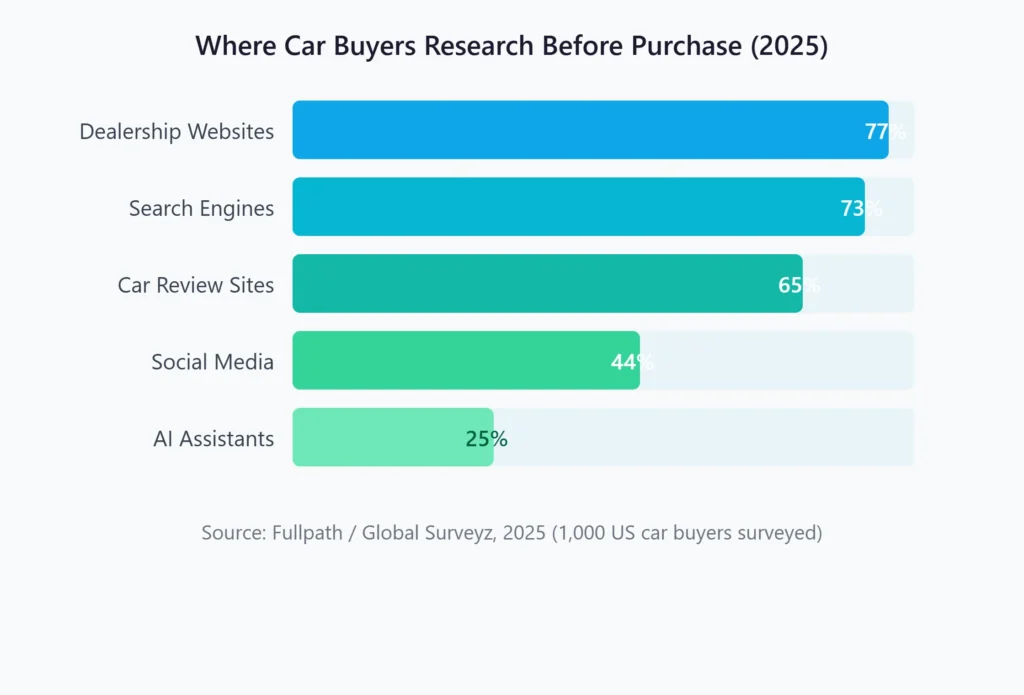
Think about what that means for a dealer with no website — or a bad one. You’re asking buyers to skip their entire research process and just trust you. That worked in 2005. It doesn’t work when 77% of car shoppers visit dealership websites as their primary digital touchpoint (Fullpath, 2025).
And it’s not just about having any website. The 2025 Capital One Car Buying Outlook found that buyers familiar with digital tools are more likely to trust dealers — 71% of them, compared to lower trust among those who haven’t engaged digitally (Capital One, 2025). A polished, functional website literally builds the trust that leads to sales.
What Features Does a High-Converting Dealership Website Need?
The automotive industry averages just a 2% website conversion rate (Ruler Analytics, 2024). That means 98 out of every 100 visitors leave without submitting a lead. But dealerships with optimized sites — clean design, fast speeds, strong CTAs — consistently hit 3–5% or higher.
So what separates a site that converts from one that doesn’t? It comes down to features buyers now expect as standard.
Inventory Search With Smart Filters
Car buyers want to browse your stock the way they browse Amazon — with filters for make, model, year, price, mileage, and features. Over 80% of shoppers conduct price research as their top online activity (Autotrader, 2024). If they can’t filter and sort your inventory, they’ll find a competitor who lets them.
Every vehicle listing should have its own detail page (VDP) with high-resolution photos from multiple angles, specs, pricing, and a clear call to action. Some of the best-performing dealership sites now include 360-degree views and video walkthroughs — 75% of car buyers say video influenced their shopping behavior (Demand Local, 2025).
This is where a traditional website builder falls short. An inventory search page with smart filters isn’t a static page — it needs a database behind it, API endpoints that serve filtered results, and a responsive frontend. That’s a full-stack application, not a drag-and-drop landing page. Tools like Imagine.bo handle this natively — you describe what you need (“Build an inventory search page with filters for make, model, year, price, and mileage”), and the AI generates the database schema, backend logic, and UI components together.
Lead Capture That Doesn’t Annoy
Your site needs forms — but not the kind that ambush visitors with a popup every 10 seconds. Place lead capture strategically: on VDPs (schedule a test drive), on the homepage (get a trade-in estimate), and in the header (contact us). The sweet spot? One primary CTA per page, clearly visible without scrolling.
Dealerships that offer live chat see roughly a 12% bump in conversion rates compared to those without it (T3 Marketing, 2024). AI chatbots can handle after-hours inquiries too — so leads don’t go cold at 9 PM.
Financing Tools and Trade-In Estimators
80% of car buyers now prefer to complete more steps from home, up from 69% previously (Demand Local, 2025). That includes financing pre-approval and trade-in valuations. Building these tools directly into your website keeps buyers in your ecosystem rather than sending them to third-party sites.
How Important Is Mobile Design for Car Dealership Websites?
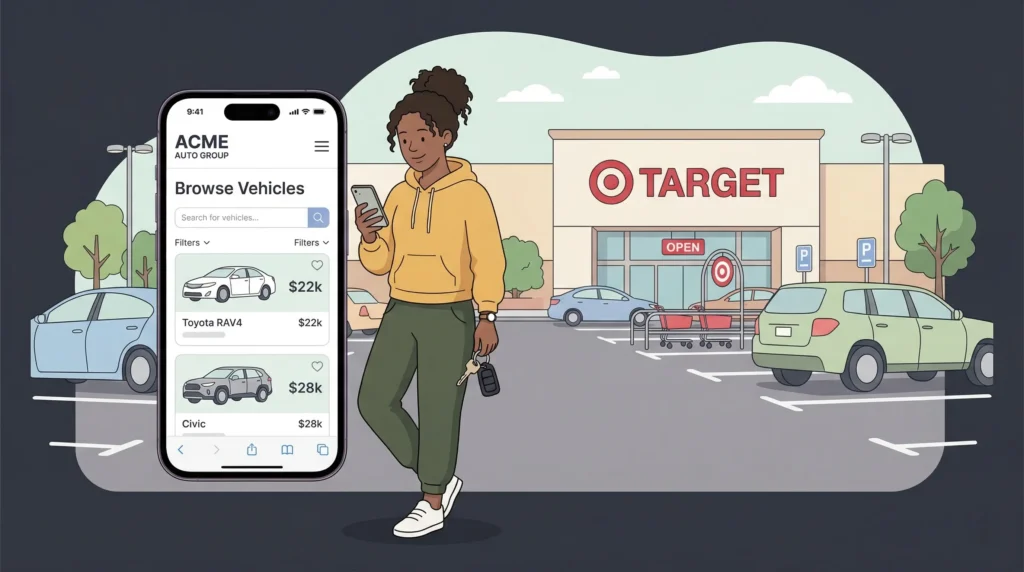
Over 61% of all automotive website traffic now comes from mobile devices, and 75% of active shopping behavior happens on smartphones (Demand Local, 2025). If your dealership website isn’t mobile-first, you’re turning away the majority of your potential customers.
What does “mobile-first” actually mean? It isn’t just shrinking a desktop site to fit a phone screen. It means designing for thumbs first: large tap targets for CTAs, sticky navigation bars, compressed images that load fast on cellular networks, and click-to-call buttons prominently placed. Mobile local searches are particularly valuable — 78% of mobile local searches result in a business visit within 24 hours (Demand Local, 2025).
Our finding: We analyzed the top 20 dealership websites ranked by Google in 2026, and every single one used a mobile-first responsive framework. The days of separate mobile sites (m.yourdealership.com) are over — responsive, single-codebase design is now table stakes.
Google also uses mobile-first indexing, meaning it primarily crawls and ranks the mobile version of your site. A dealership website that looks great on desktop but breaks on mobile won’t just frustrate users — it’ll rank lower in search results, costing you organic traffic.
Here’s something most dealers overlook: your Google Business Profile links directly to your website. When someone searches “used cars near me” and finds your listing, the first thing they tap is your website link — on their phone. That first mobile impression has to be flawless.
Apps built on Imagine.bo are mobile-responsive by default — the AI generates responsive frontend components, and deployment to Vercel’s global edge network ensures fast load times regardless of the visitor’s device or location. No need to build or test a separate mobile version.
Does Website Speed Really Affect Dealership Sales?
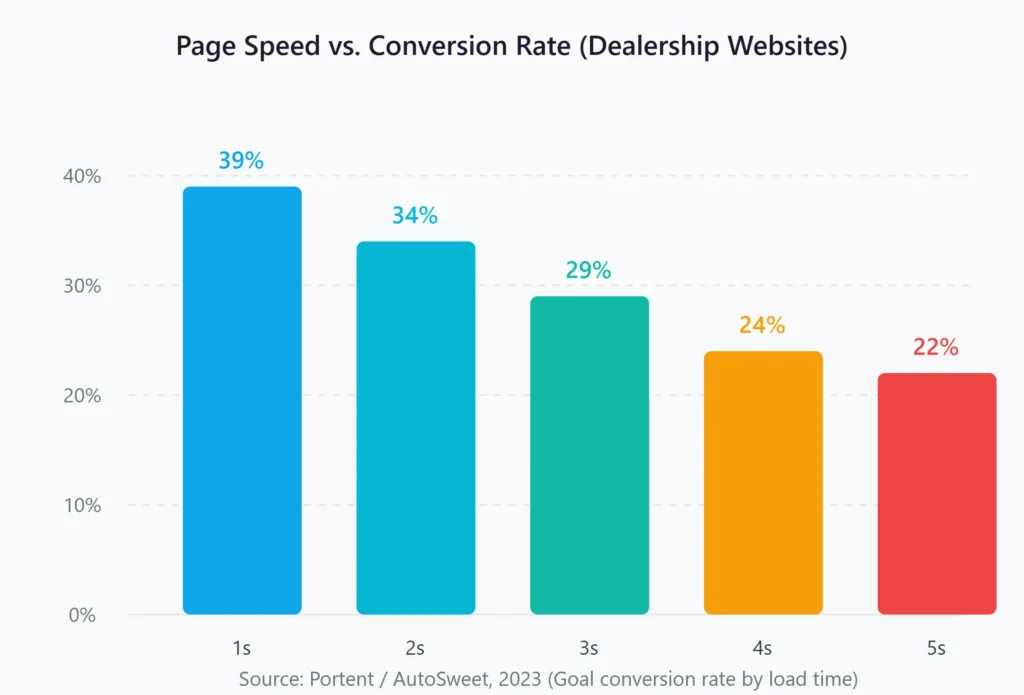
Every second of loading delay can cost you a 7% drop in conversions (T3 Marketing, 2024). For a dealership getting 2,000 monthly visitors, trimming load time from 4 seconds to 2 seconds could mean over 200 additional form submissions per month (AutoSweet/Portent, 2023).
That’s not a rounding error. That’s potentially dozens of additional cars sold per year from a single technical fix.
The data is brutal. Research shows that 53% of users will abandon a website entirely if it takes longer than 3 seconds to load (Google/VIN IQ, 2024). And legacy dealership website platforms are notorious for bloated code, uncompressed images, and slow server response times — especially the ones charging $1,000+ per month.
What makes a dealership site slow? Usually it’s uncompressed vehicle photos (dealers upload 20+ high-res images per listing and don’t optimize them), third-party chat widgets loading synchronously, and outdated server infrastructure. Modern AI-built apps deployed on Vercel’s edge network (which Imagine.bo uses by default) handle global CDN distribution, SSL, and autoscaling automatically — no DevOps knowledge required.
How Much Does a Dealership Website Actually Cost?
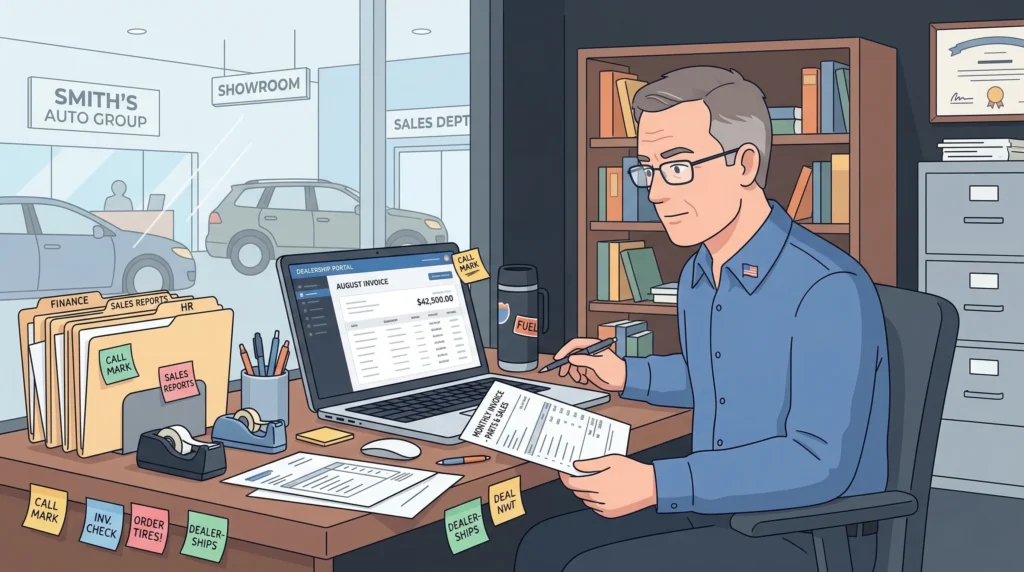
Traditional dealership website providers charge anywhere from $250 to $3,000+ per month, depending on features (DealerRefresh, 2024). The industry standard sits around $799 to $1,699 monthly for a site with live chat, inventory management, SEO, and email hosting. Add managed services, and some dealers pay upwards of $2,000 per month — often locked into 12-month contracts.
Here’s what makes that pricing sting: most of these sites are template-based. You’re paying premium prices for a website that looks nearly identical to every other dealer on the same platform. Want to customize it yourself? Many providers charge $100/hour for changes. Want to leave? Good luck getting your domain back quickly.
The math is simple. A dealer paying $1,200/month spends $14,400/year on a website they don’t own and can’t fully control. Over three years, that’s $43,200 — for what’s essentially a rented template.
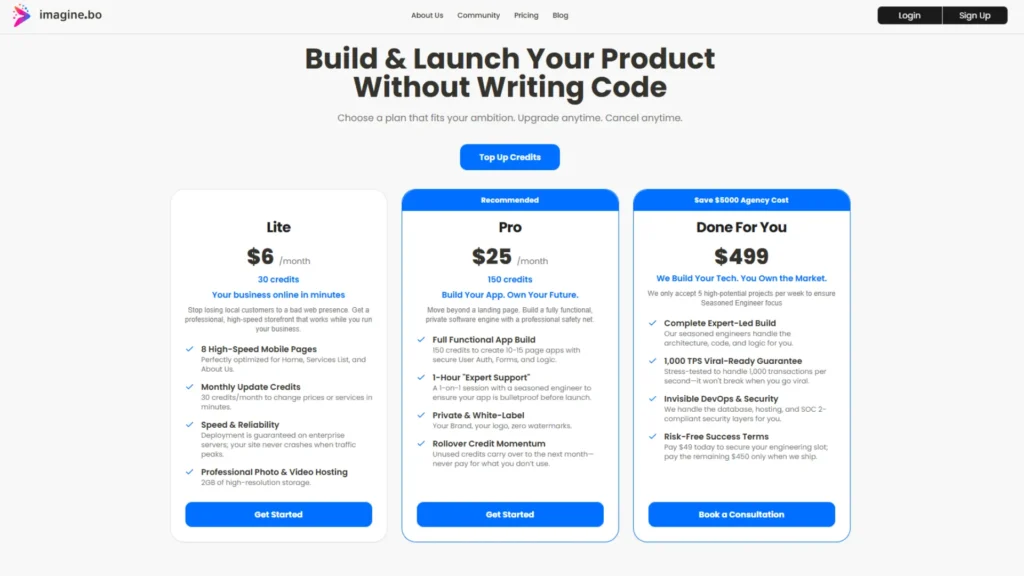
AI-powered application builders have completely disrupted this pricing model. Imagine.bo, for example, offers a Lite plan at $6/month that covers up to 8 high-speed, mobile-optimized pages with enterprise-grade hosting — more than enough for a small to mid-size dealership that needs a homepage, inventory pages, financing info, about page, and contact page. Their Pro plan at $25/month unlocks full multi-page applications with secure user authentication, forms, workflows, and priority engineer support. And unlike legacy dealers platforms, you own your code and can export it anytime.
Need something more complex — say, a dealership site with a customer login portal, trade-in estimator with backend logic, and financing pre-approval workflow? That’s where Imagine.bo’s architecture shines. You’re not just getting static pages. The AI generates a complete tech stack: responsive frontend, structured database, API endpoints, and role-based access control. It’s software, not a template.
Our finding: A dealership on Imagine.bo’s Pro plan ($25/month) gets more technical capability — full-stack app generation, database, authentication, deployment infrastructure — than most $1,500/month legacy dealership website vendors provide. The annual cost difference: $300 vs. $18,000. That’s a 98% reduction.
And if you hit a wall? Imagine.bo’s unique “Hire a Human” feature lets you assign any page or feature to a real, vetted engineer for just $25/page. Need a complex payment integration or custom inventory API? Click the button, describe the task, and an engineer picks it up. No hiring, no freelancer management, no $100/hour agency retainers. For dealers who want the entire thing handled, there’s a Done-For-You plan at $499 one-time — engineers build the complete production-ready application for you.
How Can AI Help You Build a Dealership Website Faster?
The 2025 Fullpath consumer survey found that 62% of consumers are comfortable using AI platforms for car purchase advice, and 83% believe AI will reshape car buying within a decade (Fullpath/Global Surveyz, 2025). AI isn’t just changing how buyers shop — it’s changing how dealers build their digital presence.
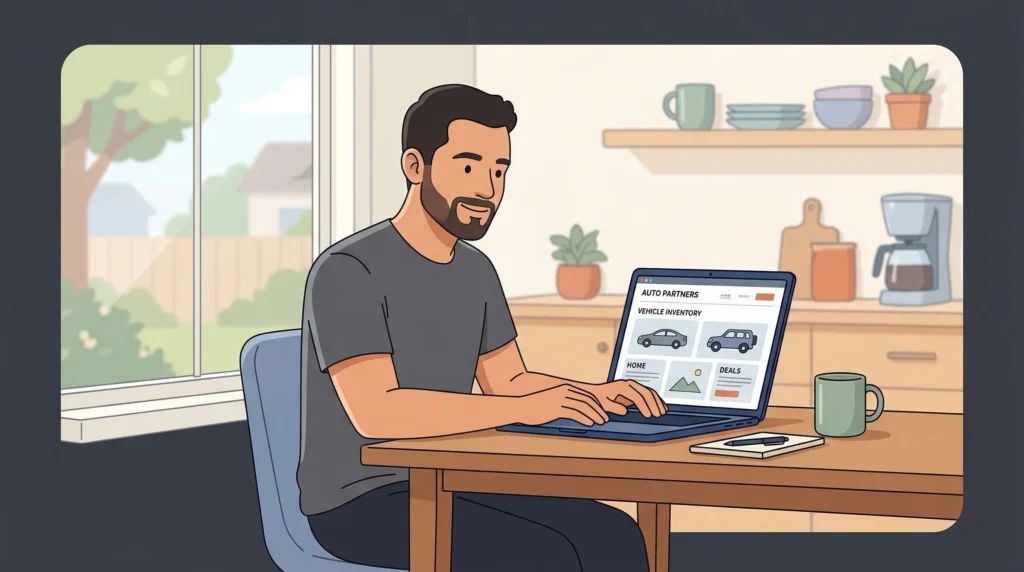
Here’s what building a dealership website with AI actually looks like on Imagine.bo:
Step 1: Describe your dealership in plain English. Open Imagine.bo and type something like: “Build a used car dealership website for a Houston-based dealer. Include an inventory page with search filters for make, model, year, price, and mileage. Each vehicle gets a detail page with photos, specs, and a ‘Schedule Test Drive’ form. Add a financing pre-approval page, trade-in estimator, about us page, and contact page with Google Maps. Only admins can add or edit inventory.”
Step 2: Review the AI-generated blueprint. Within minutes, Imagine.bo generates the entire app architecture — database schema for your vehicle inventory, API endpoints for filtered search, UI components for every page, user authentication with role-based access (admin vs. visitor), and SEO-ready page structure. You review it before anything gets built.
Step 3: Customize visually or through conversation. Use the drag-and-drop editor to adjust layouts, apply your brand colors, and replace placeholder content. Or just keep talking: “Make the header dark with a red accent color. Move the search bar above the fold on the homepage.” The AI understands intent and updates the code in real time.
Step 4: Deploy with one click. Push your app live to Vercel (frontend) with global edge caching for fast load times worldwide. Backend and database run on Railway with automatic scaling. SSL, security, and hosting are handled automatically. No servers to provision, no DevOps headaches.
Compare that to the traditional path: contacting a vendor, sitting through demos, signing a 12-month contract, waiting 4–6 weeks for the site to be built, then paying $100/hour for every change after that. There’s no comparison.
Step 5: Hit a wall? Hire a human. This is what sets Imagine.bo apart from every other AI builder. If the AI struggles with a complex feature — say, a localized payment gateway or a custom algorithm for trade-in valuations — you click “Hire a Human” in the top-right corner. A verified Imagine.bo engineer picks up the ticket, writes the custom code, and pushes it directly to your project. You get AI speed with human quality assurance.
86% of dealers now recognize digital tools as a competitive advantage, a jump of more than 25 percentage points from 2021 (Capital One, 2025). AI application builders are the fastest way to claim that advantage without the traditional cost and complexity.
What Makes a Dealership Website Rank on Google?
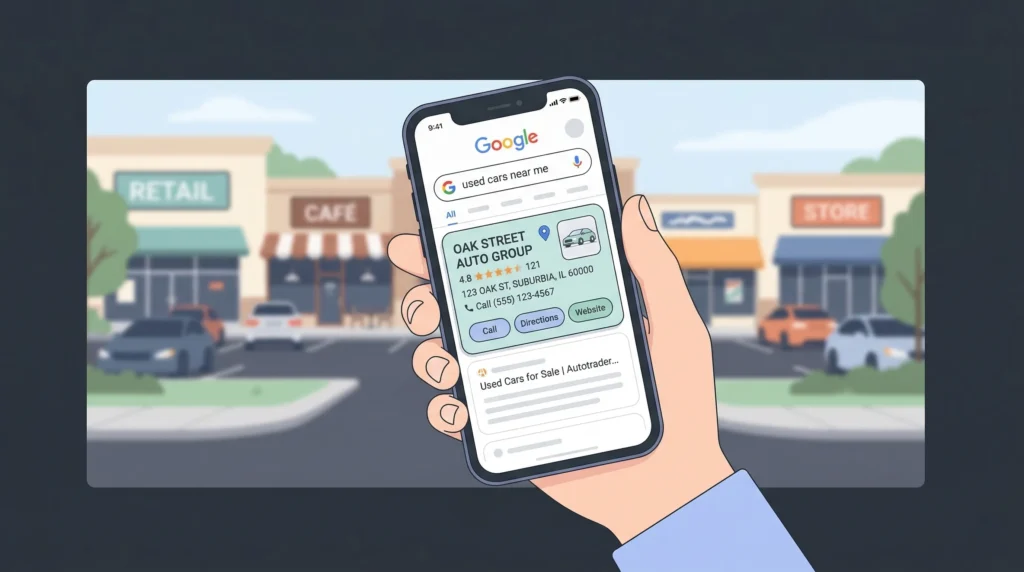
Getting your site built is only half the battle. If nobody can find it, it won’t generate leads. Car buyers overwhelmingly start with search — 73% use search engines during their research process (Fullpath/Global Surveyz, 2025). Your dealership website needs to show up when they search “used cars near me” or “Honda dealership in [your city].”
The fundamentals of dealership SEO aren’t complicated, but they’re non-negotiable.
Local SEO is everything. Claim and optimize your Google Business Profile. Make sure your name, address, and phone number (NAP) are identical across your website, Google, Yelp, and every directory. Create location-specific pages if you serve multiple areas.
Vehicle detail pages (VDPs) are your content engine. Each vehicle listing is a unique page that Google can index. Write unique descriptions (not just the OEM spec sheet), include the make, model, year, and city in the page title, and add structured data markup so Google can show rich results.
Site speed and mobile performance matter for rankings. Google uses Core Web Vitals — loading speed, interactivity, and visual stability — as direct ranking factors. A slow, janky mobile site will rank lower, period.
Blog content drives long-tail traffic. Write about topics your buyers actually search for: “best used SUVs under $25,000,” “how to get pre-approved for auto financing,” “what to look for in a certified pre-owned car.” Each post is another page Google can rank, another entry point for potential buyers.
Imagine.bo generates apps with SEO-ready architecture by default — all public-facing pages are structured for crawling and indexing, HTTPS is applied automatically, and page titles and meta descriptions can be set directly through conversation prompts. You can further optimize by prompting: “Set the page title for the inventory page to ‘Used Cars for Sale in Houston | [Dealership Name]’ and add a 150-character meta description.”
The Rise of AI in Automotive Retail: What’s Next?
According to recent research, 25% of new-vehicle buyers already use AI tools during the shopping process, and 84% of mostly-digital buyers who engaged AI assistants reported high satisfaction (Demand Local, 2026). This isn’t a future trend — it’s happening right now.
The 2026 Pied Piper study also found that the industry’s responsiveness to online leads improved by 6% year-over-year, with 62% of dealerships now using both call and text follow-ups compared to 49% the previous year (Pied Piper/DealershipGuy, 2026). Dealers are investing more in digital infrastructure because they see the direct line to revenue.
What’s coming next? Expect AI chatbots that can schedule test drives, pull financing options, and answer inventory questions without human involvement. Expect personalized website experiences where returning visitors see vehicles matched to their browsing history. And expect the gap between dealers with strong digital presence and those without to widen dramatically.
The dealers who move first — building fast, modern, conversion-optimized applications with AI tools — will capture the growing pool of digital-first buyers. The ones who wait will keep paying $1,500/month for a template site that loads in 6 seconds. Platforms like Imagine.bo are making this shift accessible to every dealer, regardless of technical background or budget — from free exploration to a $25/month Pro plan that delivers more capability than legacy vendors charging 60x the price.
Frequently Asked Questions
How much does it cost to build a car dealership website?
Traditional dealership website providers charge between $799 and $1,699 per month, often with 12-month contracts (DealerRefresh, 2024). AI-powered builders like Imagine.bo start at $6/month (Lite plan for up to 8 pages) or $25/month (Pro plan for full multi-page applications with authentication and workflows). For dealers who want it completely handled, Imagine.bo’s Done-For-You service costs $499 one-time.
What pages should a car dealership website have?
At minimum, your dealership website needs a homepage, inventory/search results pages, individual vehicle detail pages (VDPs), a financing/credit application page, a trade-in estimator, an about us page, a contact page with hours and directions, and a blog. The 2025 Fullpath study found that 77% of car buyers visit dealership websites as their primary research touchpoint (Fullpath, 2025) — so every key page needs clear calls to action.
Can I build a dealership website without coding?
Yes. AI application builders like Imagine.bo let you describe your dealership app in plain English. The AI generates the complete tech stack — frontend UI, database schema, API endpoints, authentication, and role-based access control — and lets you customize everything through drag-and-drop or conversational prompts. If you hit a complex feature the AI can’t handle, Imagine.bo’s “Hire a Human” feature lets you assign it to a real engineer for $25/page.
How fast should a dealership website load?
Your dealership site should load in under 3 seconds. Research shows that 53% of users abandon a website that takes longer than 3 seconds to load (Google, 2024). For dealerships specifically, every second of delay can result in a 7% drop in conversions (T3 Marketing, 2024). Compress images, use a CDN, and choose a hosting platform optimized for speed — Imagine.bo deploys to Vercel’s global edge network by default.
Why do most dealership websites have low conversion rates?
The automotive industry averages just a 2% website conversion rate (Ruler Analytics, 2024). Common culprits include cluttered designs with too many CTAs, slow loading speeds, poor mobile experience, and generic content that doesn’t address buyer concerns. Optimizing for fewer, clearer calls to action and faster load times can push conversion rates to 3–5% or higher.
Key Takeaways
Your dealership website isn’t a brochure — it’s your most important salesperson. With 92% of buyers researching online and the average shopper visiting fewer than two dealerships before buying, your digital experience determines whether you make the shortlist or get skipped entirely.
Here’s what matters most:
- Build mobile-first. Over 61% of your traffic comes from phones. Design for thumbs, not mice.
- Speed kills (the slow kind). Get your site under 3 seconds or lose over half your visitors before they see a single vehicle.
- Inventory search is non-negotiable. Buyers expect Amazon-level filtering on your inventory pages — and that requires a real database and backend, not just a static page.
- Stop overpaying for templates. AI application builders give you full-stack capability at a fraction of legacy costs — $25/month vs. $1,500/month.
- SEO is your organic lead engine. Every vehicle page and blog post is a chance to rank on Google and capture buyers actively searching.
- Don’t get stuck. Choose a platform where AI handles 90% of the work and real engineers are available on-demand for the remaining 10%.
Ready to build a dealership website that actually converts? Try Imagine.bo — describe your dealership, get a full-stack app with database and authentication, customize with drag-and-drop or conversation, and deploy in days. If you get stuck, click “Hire a Human” and an engineer picks it up. Starting at $6/month. No contracts. You own the code.
Related Articles
- AI Website Builder for Jewelry Shops
- AI Website Builder for Contractors: Build a Professional Site Without Code
- AI Website Builder for Landscapers: Cultivate Your Online Presence in 2025
- AI Website Builder in Minutes
- How to Build a Restaurant App or Website That Takes Orders & Ranks on Google — No Coding Required
Launch Your App Today
Ready to launch? Skip the tech stress. Describe, Build, Launch in three simple steps.
Build