Imagine sending a unique video ad to 5,000 different customers—each mentioning their favorite product, their preferred use case, and their last interaction with your brand. Not a template with name variables. Not a segment-based variation. A completely unique creative asset, generated in real-time, tailored to individual behavior.
This isn’t science fiction. It’s the natural endpoint of AI-powered personalization, and it marks the definitive end of mass marketing as we know it.
Launch Your App Today
Ready to launch? Skip the tech stress. Describe, Build, Launch in three simple steps.
BuildThe End of Mass Marketing
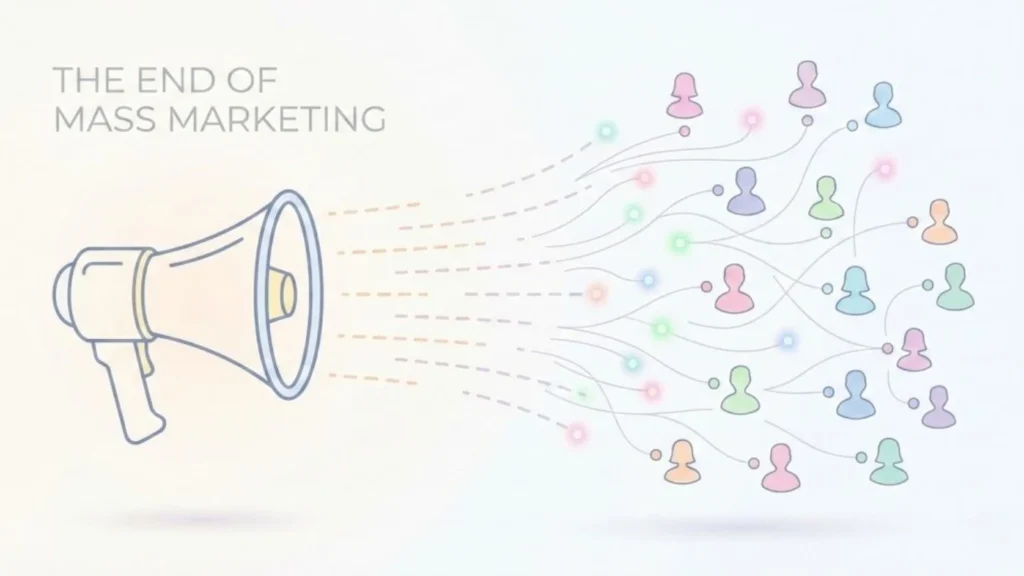
The economics of attention have fundamentally broken.
CPMs have doubled in competitive categories over the past three years. Click-through rates continue their decade-long decline. The average consumer sees between 4,000 and 10,000 ads daily, and their brains have evolved sophisticated filtering mechanisms to ignore almost all of them.
Generic ads—those designed for broad audiences with surface-level targeting—are experiencing terminal failure. Not gradual decline. Terminal failure.
The structural shift is clear: attention has fragmented across platforms, devices, and contexts. A customer browsing on mobile at 11 PM is psychologically different from the same customer on desktop at 9 AM. Their intent differs. Their receptivity differs. Yet most brands still serve them the same creative.
This mismatch between static creatives and dynamic human behavior creates massive waste. Marketing teams throw budget at frequency, hoping repetition compensates for irrelevance. It doesn’t.
The winners in this new landscape aren’t spending more. They’re personalizing deeper. For founders looking to gain this advantage, understanding generative SEO strategies becomes critical—not just for visibility, but for creating personalized entry points that convert.
What Hyper-Personalized Marketing Really Means (Beyond Buzzwords)
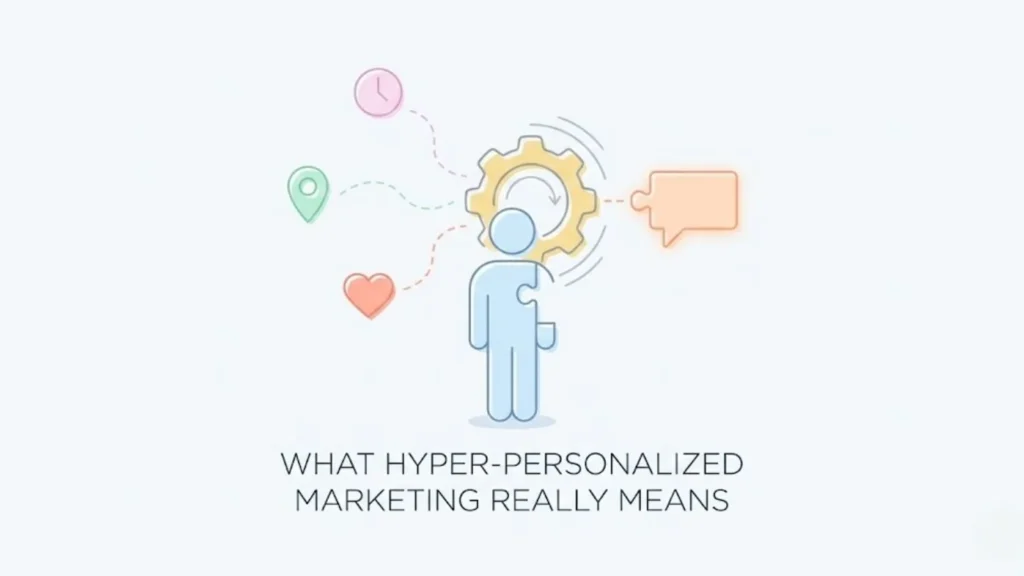
Strip away the marketing jargon, and hyper-personalization means one thing: real-time, data-driven creative generation at the individual customer level.
This is not what most companies call “personalization.”
Traditional personalization operates on segments. You divide your audience into buckets—maybe 10, maybe 100—and serve each bucket a different message. “New customers get Creative A. Returning customers get Creative B.” This is segmentation with better branding.
True hyper-personalization operates on individuals. Every customer receives messaging generated specifically for them, incorporating their behavioral data, preferences, lifecycle stage, and contextual signals. The creative itself is constructed dynamically, not selected from a pre-made library.
The difference is architectural, not incremental.
Segment-based marketing scales linearly. You can create 10 variations, maybe 50 if you have a large team. But you hit a ceiling determined by human creative capacity.
Hyper-personalized marketing scales exponentially. With AI-driven creative generation, you can produce infinite variations because the system constructs them on-demand. The bottleneck shifts from creative production to system logic.
Most importantly, hyper-personalization enables context-aware reasoning. The system doesn’t just swap out variables in a template. It understands customer intent, constructs relevant messaging, and adapts creative elements based on predicted receptivity.
This is the paradigm shift: from creative production to creative systems.
The Rise of the Personalized Marketing App
Here’s what most marketers miss: the tools you’re using were built for the old paradigm.
Email platforms, ad managers, and marketing automation tools were designed around campaigns—discrete initiatives with fixed creatives and predefined segments. They’ve added “AI features” and “smart targeting,” but their fundamental architecture still assumes humans create the assets.
The future belongs to personalized marketing apps—systems purpose-built to generate, distribute, and optimize individualized marketing at scale.
A personalized marketing app isn’t a single tool. It’s a complete system that:
- Ingests customer data from multiple sources in real-time
- Applies AI reasoning to understand context and intent
- Generates dynamic creatives (emails, ads, landing pages, videos)
- Distributes across appropriate channels automatically
- Learns from performance data to improve continuously
Think of it as infrastructure, not software. You’re not buying a feature. You’re building a marketing engine.
For technical founders, this parallels serverless SaaS architecture—scalable, event-driven systems that respond to triggers and process data without manual intervention. The same principles that power modern backend infrastructure now apply to marketing automation.
Off-the-shelf tools plateau quickly because they’re designed for the median use case. They offer templates, integrations, and workflows that serve 80% of users reasonably well. But they can’t encode your specific business logic, customer understanding, or competitive positioning.
Custom apps win long-term because they’re built for your exact needs. They can handle complex conditional logic (“If customer X took action Y within timeframe Z, generate creative emphasizing benefit A”). They can integrate proprietary data sources. They can evolve with your business model.
The companies pulling ahead aren’t using more tools. They’re building better systems without code.
AI Ad Generator Tools Are Evolving—Here’s What Most Miss
The first wave of AI ad generator tools focused on automation: generate ad copy variations, create image alternatives, scale creative production. Useful, but fundamentally limited.
These tools treat AI as a production accelerator. You input parameters, they output creatives. Faster than humans, but not fundamentally smarter.
The critical limitation: they generate without context.
An AI that writes 50 ad variations doesn’t understand which variation resonates with which customer segment. It doesn’t know that Customer A just browsed your pricing page while Customer B abandoned their cart. It can’t reason about timing, lifecycle stage, or behavioral signals.
Real advantage comes from context + logic + workflows.
The next generation of AI ad generator tools—more accurately called personalized marketing engines—incorporate three layers:
Context Layer: Real-time customer data, behavioral signals, lifecycle stage, historical interactions, predictive intent modeling.
Reasoning Layer: AI that doesn’t just generate text, but understands business logic. “This customer fits profile X, is in lifecycle stage Y, and showed intent signal Z, therefore emphasize benefit A using tone B.”
Workflow Layer: Automated distribution, multi-channel orchestration, performance tracking, continuous optimization based on feedback loops.
The difference between “AI that generates” and “AI that reasons” determines whether you’re automating busywork or building competitive advantage.
Most AI ad generator tools are stuck at layer one. They generate creatives. The sophisticated ones reach layer two—they generate contextually relevant creatives. Almost none have reached layer three: autonomous marketing engines that reason, generate, distribute, and optimize continuously.
This is where the category splits. Tools versus engines. Automation versus intelligence.
From Tools to Engines: How Hyper-Personalized Systems Scale
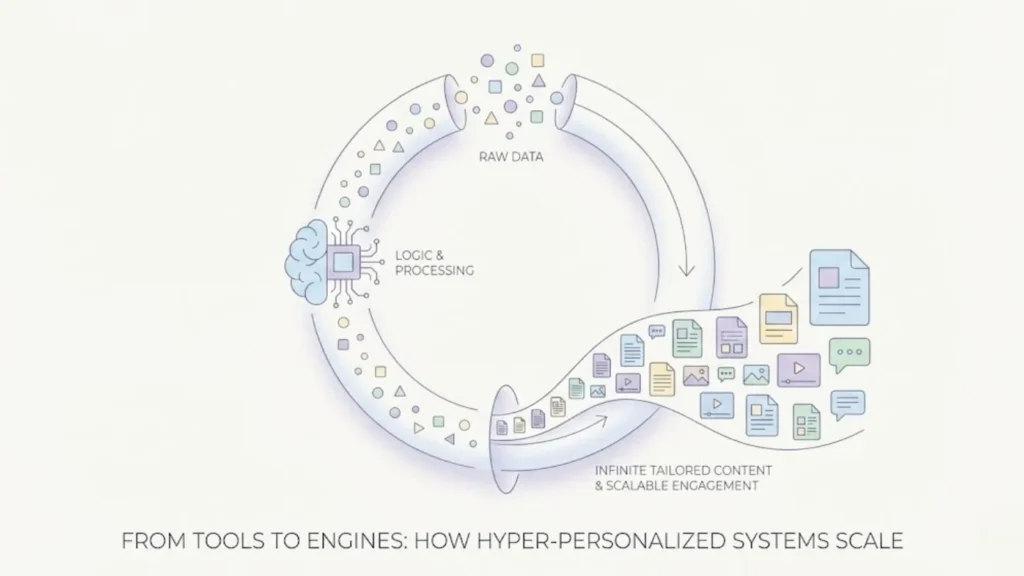
Building a hyper-personalized marketing engine requires thinking in systems, not tools.
Here’s the conceptual architecture:
Input Layer: Customer data flows in continuously. Website behavior, purchase history, email engagement, support interactions, product usage, external signals. This isn’t batch processing—it’s real-time streaming data that updates customer profiles constantly.
Intelligence Layer: AI reasoning processes incoming data to understand current state and intent. Not just “What did this customer do?” but “What does this behavior signal about their needs, urgency, and receptivity?”
Generation Layer: Dynamic creative production. Based on the intelligence layer’s analysis, the system constructs personalized messaging. This could be email copy, ad creatives, landing page variations, video content—generated on-demand with elements tailored to the individual.
Distribution Layer: Automated channel orchestration. The system determines optimal timing, channel selection, and frequency. It doesn’t just send—it strategically deploys based on predicted effectiveness.
Feedback Loop: Performance data flows back to the intelligence layer. Open rates, click-through rates, conversion events, engagement signals. The system learns what works for different customer profiles and adjusts accordingly.
This architecture enables three critical capabilities:
Infinite Scalability: Because creatives are generated programmatically, you can personalize for one customer or one million. The system doesn’t care. Each interaction is constructed dynamically, so there’s no linear relationship between audience size and creative production effort.
Reduced CAC: Hyper-relevant messaging converts at multiples of generic messaging. When every customer sees content specifically constructed for their context, conversion rates rise while ad spend remains constant. Customer acquisition costs drop naturally.
Increased LTV: Personalization doesn’t stop at acquisition. The same engine that generates acquisition creatives can generate onboarding sequences, feature announcements, upsell messaging, and retention campaigns—all tailored to individual customer journeys. This drives engagement, reduces churn, and maximizes lifetime value.
The compounding effect is significant. Better targeting reduces CAC by 40-60%. Better engagement increases LTV by 30-50%. The math becomes overwhelming: hyper-personalized systems generate 2-3x the ROI of traditional campaigns.
But here’s the strategic insight most founders miss: these systems become defensible moats.
Once you’ve built a personalized marketing engine—with customer data pipelines, AI reasoning logic, creative generation workflows, and optimization loops—replicating it takes months. Your data gets better over time. Your models improve continuously. The system becomes smarter with every customer interaction.
Competitors can’t just “buy the same tool.” There is no tool. You built infrastructure.
This is why understanding how AI is revolutionizing startup product launches matters. The companies that recognize marketing as engineering infrastructure—not campaign execution—create compounding advantages that become insurmountable.
Scaling SaaS with Personalized Marketing Infrastructure
The most sophisticated founders realize something crucial: personalized marketing apps don’t just improve marketing—they become products themselves.
Consider the evolution:
Stage 1: You build an internal personalized marketing app to improve your own customer acquisition and retention.
Stage 2: The app generates significant competitive advantage. Your conversion rates improve. Your CAC drops. Your customers receive better experiences.
Stage 3: You realize this system has value beyond your immediate use case. Other companies in adjacent verticals face identical challenges.
Stage 4: You productize the system. What started as internal infrastructure becomes a standalone SaaS offering.
This pattern repeats constantly. The best marketing automation platforms started as internal tools. The most successful personalization engines were originally built for specific use cases and then abstracted.
The strategic implication: building personalized marketing apps creates optionability.
Maybe you keep it internal and maintain competitive advantage. Maybe you productize it and build a new revenue stream. Maybe you use it to attract customers to your core product by demonstrating sophisticated marketing capabilities.
All three outcomes require the same foundation: a properly architected, scalable system built with production-grade logic and automation.
This is where most marketing teams fail. They cobble together tools—Zapier workflows, multiple SaaS subscriptions, manual processes. It works at small scale but doesn’t evolve into real infrastructure. When they try to scale, everything breaks.
The alternative: build the infrastructure correctly from the beginning. Treat your marketing system like a product. Design it with proper data architecture, modular logic, and extensibility. Make it scalable before you need it to scale.
For founders exploring this path, understanding how to build a SaaS with AI and no-code tools becomes critical. The ability to rapidly prototype, test, and deploy personalized marketing systems separates those who execute from those who theorize.
Similarly, launching vertical SaaS solutions using AI demonstrates how personalization engines can be adapted for specific industries—creating not just generic tools, but category-defining platforms.
This requires a different approach to building.
Why Imagine.bo Is Built for This Future
Most no-code platforms let you build simple apps quickly. Imagine.bo lets you build sophisticated systems properly.
The distinction matters enormously for personalized marketing engines.
When you’re building infrastructure that will process thousands of customer data points, generate dynamic creatives, orchestrate multi-channel distribution, and optimize continuously, you need more than drag-and-drop interfaces. You need:
AI reasoning that handles complex business logic: Not just “if this, then that” but genuine conditional intelligence that can evaluate multiple variables, predict outcomes, and make sophisticated decisions.
Scalable backend architecture: Systems that handle real-time data streams, process requests efficiently, and maintain performance under load.
Production-grade security and reliability: When your marketing engine is business-critical infrastructure, downtime isn’t acceptable.
End-to-end ownership: Complete control over data, logic, workflows, and integrations without vendor lock-in.
Imagine.bo provides these capabilities through plain-English app creation backed by AI that generates production-ready code. You describe what you want to build—”Create a system that generates personalized email campaigns based on user behavior and purchase history”—and the platform constructs the underlying architecture.
This isn’t template-based building. It’s actual software development, abstracted behind conversational interfaces.
The platform handles data pipelines, API integrations, logic execution, and deployment. You focus on defining business requirements and system behavior. The AI reasoning engine translates your intent into working applications with SDE-level code quality.
For personalized marketing engines specifically, this means you can:
Build custom data ingestion pipelines that pull from your CRM, analytics platform, customer support tools, and product usage databases.
Implement sophisticated segmentation logic that goes far beyond traditional demographic or behavioral buckets.
Create dynamic content generation workflows that produce genuinely personalized messaging, not just mail-merge variations.
Orchestrate multi-channel distribution with complex timing, frequency, and channel-selection logic.
Set up automated optimization loops that test, learn, and improve continuously without manual intervention.
All of this happens at production scale, with proper error handling, monitoring, and performance optimization.
The result: you’re not limited by tool capabilities. You build exactly what your business needs. And because you own the underlying application, you can evolve it continuously as your requirements change.
This is the infrastructure advantage. While competitors stitch together SaaS tools and hit scaling ceilings, you’ve built custom systems that grow with your business.
The Future: Every Brand Runs Its Own AI Marketing Engine
Five years from now, sophisticated brands won’t “run ads.”
They’ll operate AI-driven personalization engines that generate, test, and optimize thousands of marketing variations continuously. These engines will handle everything from initial acquisition to long-term retention, creating individualized experiences at every customer touchpoint.
The distinction between marketing team and product team will blur. Marketing becomes engineering. Campaigns become systems. Creative strategy becomes infrastructure.
This future is already emerging in pockets. The most sophisticated e-commerce companies generate personalized product recommendations, pricing, and promotional strategies in real-time. Leading SaaS platforms deliver individualized onboarding sequences, feature announcements, and upgrade prompts based on usage patterns. Performance marketing teams at growth-stage startups build custom attribution models and creative optimization systems.
But these capabilities remain concentrated among companies with large engineering teams and significant budgets. The next phase—democratization—happens when these systems become buildable by anyone.
That’s the unlock.
When founders can build personalized marketing engines without writing code, without hiring specialized engineers, without months of development time—the competitive landscape shifts entirely. The advantage moves from those with resources to those with insight.
Small teams with deep customer understanding will outcompete large teams with generic strategies. Bootstrapped startups will achieve efficiency metrics that previously required venture-scale spending. The winners won’t be those who collect the most tools—they’ll be those who build the best systems.
This is not gradual evolution. It’s category disruption.
Generic marketing is already dead in competitive categories. The companies still running broad-targeting campaigns with static creatives are burning money while pretending it’s strategy. Their conversion rates betray them. Their CAC metrics prove it.
Meanwhile, the early adopters of hyper-personalized marketing engines are seeing 2-3x improvements in key metrics. Not through incremental optimization. Through architectural advantages.
The question facing every founder and marketer isn’t whether to personalize. That question is answered. Personalization is table stakes.
The real question is: Who builds the engine behind it?
Do you rely on third-party tools that limit your capabilities, lock you into their roadmaps, and commoditize your competitive advantage? Or do you build custom infrastructure that encodes your unique understanding, evolves with your business, and becomes defensible over time?
The answer determines whether you’re competing on execution or infrastructure. Whether you’re renting capabilities or owning them. Whether you’re optimizing campaigns or building systems that compound.
Choose correctly, and you build marketing infrastructure that becomes increasingly valuable as it learns, adapts, and improves. Choose incorrectly, and you’re perpetually chasing marginal gains within someone else’s limitations.
The death of the generic ad isn’t the end of marketing. It’s the beginning of marketing as engineering—where the best-architected systems win. For those ready to build rather than rent, the tools exist now to create AI-powered apps from simple descriptions and launch complete products in record time.
Launch Your App Today
Ready to launch? Skip the tech stress. Describe, Build, Launch in three simple steps.
Build