
Most founders trying to bootstrap a startup hit the same wall early: the product costs too much to build. According to CB Insights, 38% of startups fail because they ran out of cash before finding product-market fit. That number looks very different when your first version costs $500 instead of $50,000. No-code tools changed the math entirely. This article covers three specific, practical ways to use no-code tools to bootstrap a startup, ship faster, and avoid the debt trap that kills most early ventures. You will also find out where no-code genuinely falls short and what to do when it does. For a full breakdown of what development actually costs in 2026, see this comparison of developer vs AI vs no-code app building costs.
TL;DR: No-code tools let bootstrapped founders build, launch, and validate a startup for a fraction of traditional dev costs. According to Gartner, 70% of new enterprise applications will use low-code or no-code technology by 2025. The three smartest moves are: replace developer costs with an AI app builder, validate demand before building more, and automate operations from week one. imagine.bo covers all three starting at $0.
Why Does Bootstrapping with No-Code Tools Actually Work in 2026?
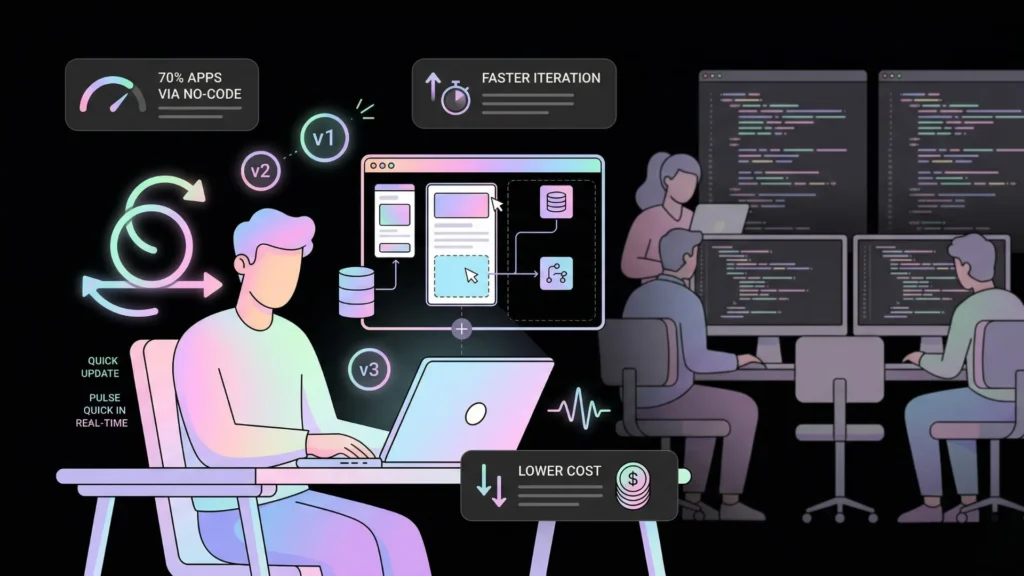
No-code tools work for bootstrapped startups because speed and cost efficiency now outperform raw engineering horsepower at the early stage. According to Gartner, 70% of new enterprise applications will be built using low-code or no-code platforms by 2025, a figure that reflects the real shift in how software gets made. That is not a fringe trend. It is the default path for anyone who cannot justify a $100,000 engineering bill before a single user has paid them anything.
Launch Your App Today
Ready to launch? Skip the tech stress. Describe, Build, Launch in three simple steps.
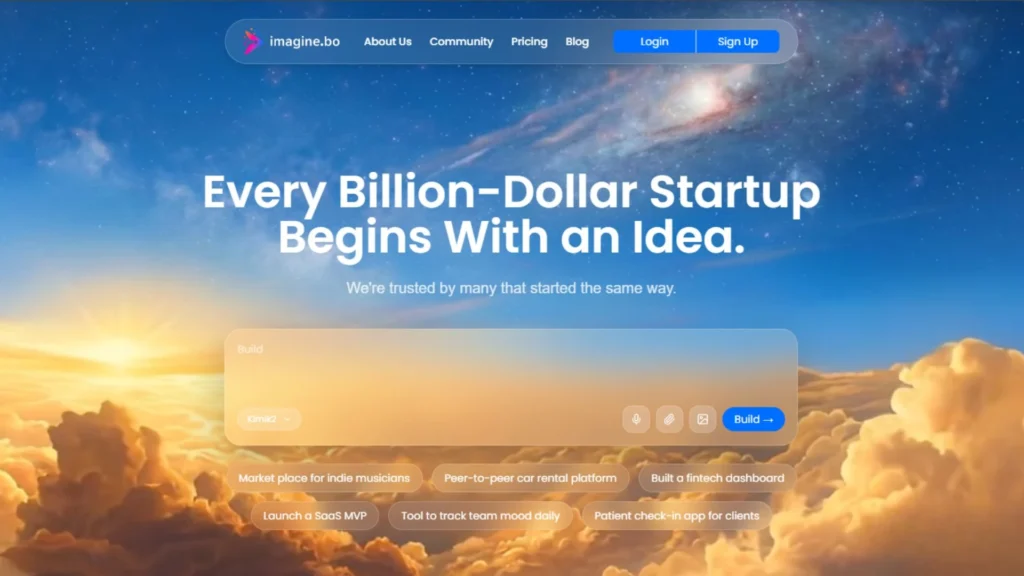
BuildThe old argument against no-code was that it produced toys, not real products. That argument has not aged well. Platforms like imagine.bo now generate full-stack applications including a database schema, backend logic, and a deployed frontend from a plain English description. The gap between “built with no-code” and “built by a developer” is narrowing fast, and for MVPs, it has effectively closed.
The real advantage of no-code for bootstrappers is not just cost savings. It is iteration speed. A founder who can update a product in hours, not weeks, learns faster than one waiting on a dev sprint. According to the Startup Genome Report, startups that iterate quickly in response to user feedback are 2.3 times more likely to scale successfully. No-code does not just save money. It compresses the feedback loop that determines whether a business survives.
For more context on how no-code and low-code differ in practice, this comparison of no-code vs low-code for startups is worth reading before you pick a stack.
Smart Way 1: Replace Developer Costs with an AI App Builder
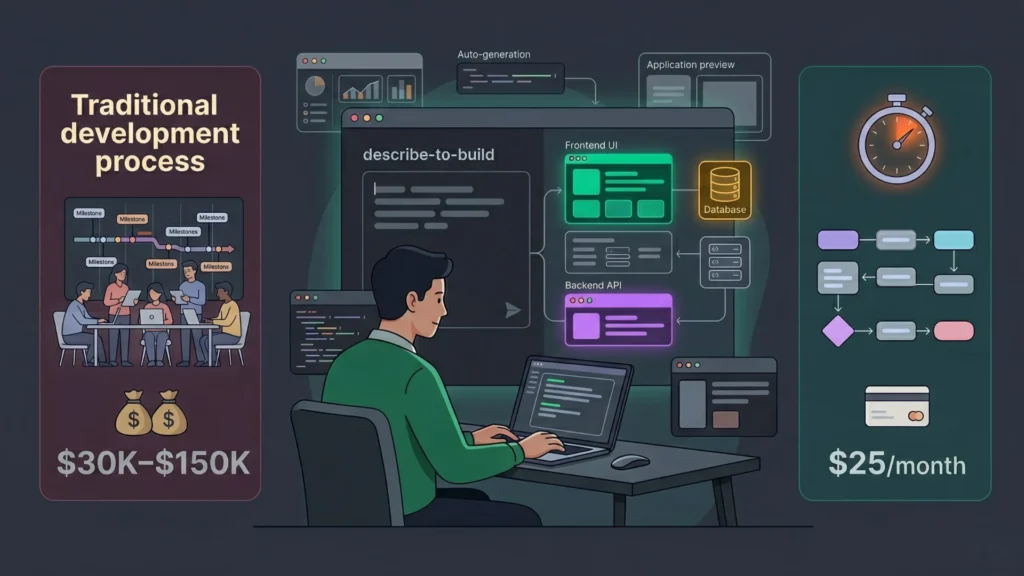
The first smart move is the most obvious one: stop paying developer rates for work an AI can handle. According to Clutch, hiring a freelance developer to build a custom MVP typically costs between $30,000 and $150,000 depending on complexity. Most bootstrapped founders do not have that capital, and spending it before validating demand is one of the most common early-stage mistakes in the startup playbook.
AI app builders like imagine.bo let you describe your product in plain English and generate a working full-stack application within minutes. The Describe-to-Build interface handles frontend components, database schema, and backend API logic automatically. You do not configure servers, write boilerplate, or manage a dev team.
A realistic example: a founder building a client portal for a consulting business would traditionally need a backend developer, a frontend developer, and at least six to eight weeks of coordination. On imagine.bo, the same scope takes a single prompt session and a few hours of refinement through conversation. The Pro plan at $25 per month provides 150 credits and includes rollover, meaning unused credits carry forward. That is the entire monthly cost of building a product that would otherwise require a $60,000 contract.
The key is starting with an MVP scope. One focused prompt covering the core user flow, three to five features, and clear access control rules produces a better first build than a sprawling prompt that tries to ship the whole product at once. The low-code MVP strategies for validation and feedback guide covers exactly how to scope this correctly.
What Happens When the AI Hits a Limit?
Not every feature can be generated cleanly. Complex third-party API integrations, custom payment flows, and unusual business logic sometimes require a human engineer. imagine.bo’s Hire a Human feature handles this directly from the dashboard. A vetted engineer picks up the task, writes the code for that specific module, and pushes it to the project repository. The Done For You plan at $499 one-time assigns the full build to the imagine.bo team. You are never stuck at a technical wall, and you never have to source a freelancer from scratch.
Smart Way 2: Validate Demand Before You Build More
The second smart move is using no-code tools to test whether anyone actually wants your product before you build the full version. According to CB Insights, the single most common cause of startup failure is building a product with no market need, accounting for 42% of post-mortem reports. That is not a funding problem or a team problem. It is a validation problem.
No-code tools make real validation possible at a fraction of the cost of a traditional build. You can ship a working version of your core product, put it in front of real users, and measure behavior, not just survey responses. A landing page with a waitlist is not validation. A working tool that users log into and interact with daily is.
The math on validation is compelling: if a founder spends $25 on a Pro plan and builds a working MVP in one week, they can gather meaningful user data within 30 days for under $100 total. Compare that to the 12-to-16-week timeline of a traditional build before any user feedback is possible. At that pace, a no-code founder has iterated through two to three versions of their product before a traditionally-built competitor has shipped version one.
The validation loop matters more than the feature list. Ship the core workflow, watch where users drop off, and build from there. imagine.bo’s built-in analytics dashboards let you track engagement and retention directly from your project dashboard without integrating a third-party tool. This is particularly useful when you need to make the case to an early investor or co-founder that the idea has traction.
For a practical framework on how non-technical founders approach product decisions, the non-technical founders building products guide is a direct complement to this section.
Smart Way 3: Automate Operations from Week One
The third smart move is using no-code tools to automate the operational work that would otherwise consume your time as a solo founder or small team. According to McKinsey, knowledge workers spend an average of 28% of their working week managing email and administrative tasks. For a bootstrapped founder, that is 11 to 12 hours per week not spent on building or selling.
No-code automation tools let you replace repetitive tasks with workflows that run without you. Client onboarding sequences, invoice generation, appointment scheduling, and support ticketing can all be handled by purpose-built no-code tools or built directly into your main product using a platform like imagine.bo.
Here is the angle most bootstrapped founders miss: the operational tools you build for yourself often become products you can sell. A founder who builds a custom client portal to manage their own consulting workflow has, in effect, built a SaaS product. The infrastructure is already there. Packaging it for others is a pricing and positioning decision, not an engineering one. This is the logic behind prompt-driven development as a startup strategy, which is explored in detail in this post on why prompt-driven development is a startup advantage.
Specific workflows worth automating in your first 90 days include email notification triggers on user signups, role-based access control so team members and clients see only what they need, and data export functions so you can pull reports without logging into multiple tools. All of these are configurable through conversation in imagine.bo without touching a line of code.
What About Single-Person Operations?
Solo founders benefit disproportionately from automation because every hour saved has no substitute. According to Statista, the global no-code development platform market is projected to exceed $65 billion by 2027, and a significant driver of that growth is the one-person business looking to operate at the efficiency of a small team. The single-person startups AI enterprise strategy post covers the full scope of what is now achievable without a team.
FAQ
How much does it cost to bootstrap a startup with no-code tools?
Costs vary significantly by platform and complexity. A basic MVP on imagine.bo costs $25 per month on the Pro plan, which includes 150 credits and rollover. According to Clutch, traditional custom development for a comparable MVP starts at $30,000. No-code tools reduce that entry cost by 99% for early-stage validation. Most bootstrapped founders can test product-market fit for under $300 total.
Can I build a real business with no-code tools, not just a prototype?
Yes. Modern AI app builders generate full-stack applications with secure authentication, role-based access control, and production-grade deployment. According to Gartner, 70% of enterprise applications will use low-code or no-code by 2025. The distinction between “prototype” and “production app” depends on the platform. imagine.bo deploys to Vercel and Railway by default, the same infrastructure used by serious commercial products. For more on what you can actually build, see build complex apps with imagine.bo.
What are the biggest limitations of no-code tools for startups?
The main limitations appear at the edges: highly custom algorithms, unusual third-party integrations, and compliance-heavy industries may require human engineering. According to CB Insights, 42% of startup failures are attributed to no market need, not to technical limitations. The risk of over-engineering early is greater than the risk of hitting a no-code ceiling. imagine.bo’s Hire a Human feature exists specifically for those edge cases, at $25 per page.
How do I validate my startup idea before building a full product?
Ship the core workflow only. Build one user journey end-to-end, put it in front of 20 to 30 real users, and measure drop-off and return rate. According to the Startup Genome Report, startups that iterate on user feedback are 2.3 times more likely to scale. A working tool that users log into generates real behavioral data. A survey or landing page does not. See low-code MVP strategies for validation and feedback for a step-by-step process.
Is imagine.bo better than other no-code tools for bootstrapped founders?
For founders who need a full-stack application with database, backend, and deployment in one workflow, imagine.bo is a stronger choice than tools built for static sites or simple workflows. The Hire a Human feature and Done For You plan create a safety net that pure AI tools do not offer. According to Gartner, 70% of enterprise apps will use no-code by 2025. Tools that combine AI generation with on-demand engineering support are better positioned for that future than those that offer only one or the other.
Conclusion
Bootstrapping a startup with no-code tools is not a workaround. It is now the fastest route from idea to paying user. Three things make the difference: replacing developer costs with an AI app builder, validating demand with a real working product before building more, and automating operations from day one so you can stay lean long enough to find product-market fit. Traditional development timelines and costs are no longer the benchmark. They are the trap. The founder who ships in days and iterates in hours learns faster than the one waiting on a dev sprint. If you are ready to go from description to deployed application, building a SaaS with AI and no-code tools is the logical next step. Start your first build on imagine.bo for free, with no credit card required, and see how far your idea gets before you spend a dollar.
Launch Your App Today
Ready to launch? Skip the tech stress. Describe, Build, Launch in three simple steps.
Build