
Launching an app without hiring developers is completely possible if you approach it with the right tools and a clear plan. Start by defining the single problem your app must solve, then map the features required to support that outcome. Use no-code platforms to build and test a functional version quickly, gather real feedback from early users, and refine based on what you learn. This process keeps costs low while helping you validate demand before investing further.
The New Reality: How No-Code Empowers the Non-Technical Builder

The democratization of technology is arguably the biggest and most exciting shift in the software industry today. This power shift is enabled by sophisticated no-code app builders.
Launch Your App Today
Ready to launch? Skip the tech stress. Describe, Build, Launch in three simple steps.
BuildWhat exactly is a no-code builder? It is a visual development platform that allows you to construct a real, functional application—complete with complex logic, user authentication, and database connectivity—using a simple drag-and-drop interface. If you can use common tools like Google Sheets or PowerPoint to manage information and design a basic layout, you possess the necessary skills to build a complete application. This technology finally separates the idea from the complex code required to run it, putting the power back squarely in the hands of the visionary.
To succeed in this new landscape, you don’t need a diploma in computer science; you just need a disciplined, structured process.
Validate Your App Idea (The Essential First Step)
This is the most critical phase, and it’s the one most founders skip in their eagerness to start building. It’s easy to fall in love with your solution. Successful founders, however, fall in love with the problem. Before you invest a single hour in building, you must gather tangible evidence that there is genuine, measurable demand.
Define Your Core Problem and Solution
Your concept must be crystal clear. Distill your entire vision into one powerful, specific sentence that defines the pain point and your unique intervention.
- Avoid: “A social media platform for pet owners.” (Too vague and easily distracted by unnecessary features)
- Focus On: “Busy professionals need a trustworthy person to walk their dog, but they are frustrated by the high fees and lack of personal connection offered by major platforms.” (Specific, highlights a clear emotional and financial pain, and points toward a solution).
To find this specificity, conduct problem interviews. Talk to 10-15 people in your target demographic about their existing frustrations, not about your proposed app. Listen for keywords, repetitive problems, and emotional responses.
Identify Your Niche Audience and Define the MVP Scope
You cannot build for “everyone.” Trying to serve a massive market immediately leads to an unfocused, under-resourced product. Specificity is the key to early momentum and cost-effective marketing.
- Avoid: “Anyone who has a dog.”
- Focus On: “Dual-income couples, aged 30-45, living in urban apartments, who work in-office 3+ days a week.”
This laser focus defines an audience you can actually target, find, and market to effectively. This audience is small enough to serve perfectly but large enough to validate your business model. This process naturally leads to the Minimum Viable Product (MVP) definition: The smallest, most essential set of features needed to solve the core problem for your niche audience. For a complete framework, read our guide on achieving Product-Market Fit using no-code tools.
Test Demand with a “Smoke Test”
This is the non-negotiable, financially responsible test of market fit. Do not build the app yet. You are testing intent, not functionality.
- Create a Simple Landing Page: Use a tool (even a basic website builder) to create a single page.
- Describe the Future: On this page, describe your app as if it is already live, highlighting the benefits of your solution to your niche audience.
- The Call-to-Action: Add one prominent button: “Sign Up for Our Private Beta.” This action requires a genuine commitment (sharing an email) and measures real interest.
- Run Targeted Ads: Run a small, targeted ad campaign (e.g., $100-$200 on social media) aimed directly at your niche.
Analyze the Results: If your conversion rate (visitors who sign up) is less than 5%, your idea or messaging has a problem. You’ve just saved yourself six months of work. If it’s 10-20% or higher, you have tangible proof of demand and should proceed.
Design and Prototype Your App’s Blueprint

Once you have validation, it’s time to create a structural plan—your blueprint. You don’t need to be a professional designer; you just need a guide that clearly dictates how the app should function.
Map Your Key User Flows
A user flow is simply the series of steps a person takes to achieve a core, valuable task in your app. By focusing only on the MVP features, you keep complexity low.
For the dog-walking app, the essential flows are:
- Pet Owner: Log in → See available walkers → Request a walk → Make a payment.
- Walker: Log in → See pending requests → Accept a walk → Get paid.
Always map the “happy path” first (the ideal journey). Then, identify one or two crucial “edge cases” (e.g., what happens if a walker cancels a request?). Resist the urge to add non-essential features, even if they sound cool.
Create Simple Wireframes
A wireframe is a low-fidelity, black-and-white sketch that focuses only on placement, content, and structure—not aesthetics. You can literally draw this on a napkin, a whiteboard, or use free digital tools like Figma or Miro.
Draw one box for each step in your user flow:
- The “Log In” screen (Email/Password fields, Submit button)
- The “Home / Dashboard” screen (List of Requests, Walker Search bar)
- The “Request Confirmation” screen (Summary of cost, Confirm button)
This blueprint transforms your abstract idea into a concrete, screen-by-screen building plan, saving you countless hours when you move to the build phase.
Building Your Functional App with No-Code
You’ve proven your idea and created your blueprint. Now, and only now, is it time to bring the product to life.
Choosing a Robust No-Code App Builder
The no-code platform you choose acts as your virtual engineering team and infrastructure. It must be robust enough to handle complex logic, scalable enough for future growth, and intuitive enough for non-technical users.
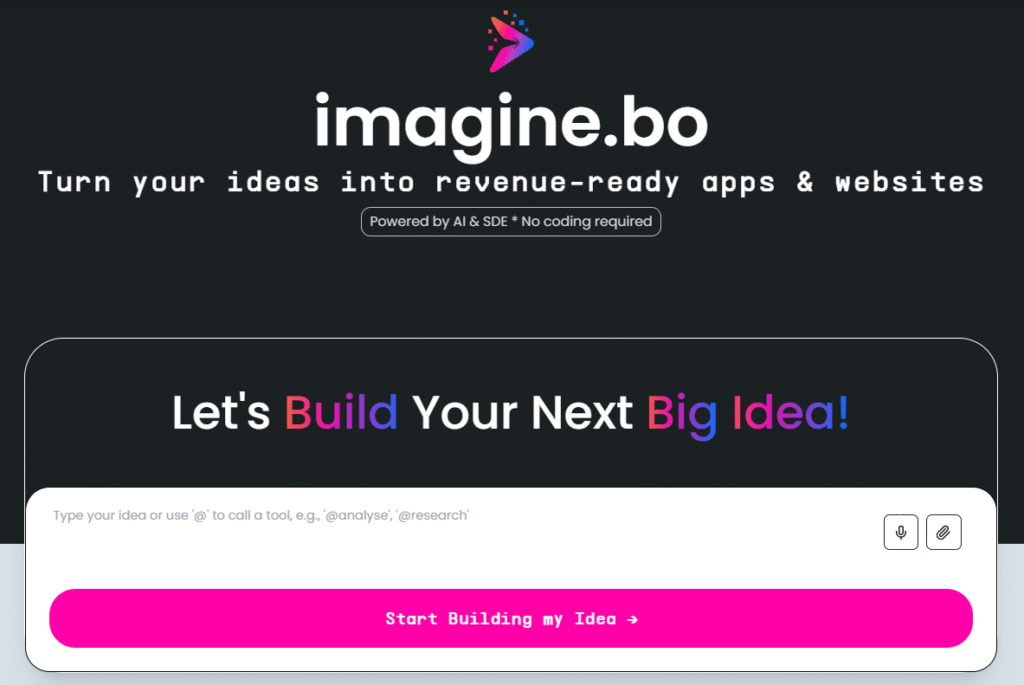
This is the exact challenge platforms like Imagine.bo were built to solve.
Imagine.bo is an AI-powered no-code app builder designed to democratize software development and ensure professional standards. Instead of spending time on initial setup and coding, you utilize a sophisticated artificial intelligence helper combined with a visual, drag-and-drop interface.
What makes Imagine.bo a powerful, founder-friendly solution is its unique combination of automation, scalability, and unparalleled human support:
- AI-Powered Architecture: You can describe your app idea in plain English (e.g., “Build a marketplace for local dog walkers”), and the AI automatically generates the foundational architecture, database structure, core features, and initial workflows. This massively reduces the time-to-market.
- Scalability and Security: Unlike some simpler builders, the platform is built for enterprise-grade growth. Apps are cloud-deployable and designed for high performance and compliance (GDPR/SOC2-ready), ensuring your app can scale reliably from 10 users to 100,000 without requiring expensive migrations.
- Expert Developer Backup: This is a crucial differentiator. When the AI automation reaches its limits, or you encounter a particularly complex task, you have the unique ability to assign that task directly to a professional human developer for guaranteed resolution. This bridges the gap between no-code speed and custom-code power, ensuring you never get truly stuck.
Build Your Core Features and Connect the Logic
This is the assembly phase, where you translate your wireframes into a live, interactive product within your chosen builder.
- Set up Your Database: Create the necessary data tables (e.g., “Users” table, “Walks” table, “Payments” table) and define the relationships between them.
- Build Your Screens: Drag and drop UI elements (buttons, forms, lists, images) to match your wireframes and create the visual experience.
- Connect the Logic: This is the heart of the application. You define simple rules that govern how the app behaves. For example: “When the ‘Request Walk’ button is clicked (Action), create a new row in the ‘Walks’ table (Data change), and send an email notification to all users in the ‘Walkers’ table (Workflow).” This visual programming is intuitive and powerful.
By following your blueprint, you will see your application come to life in days or weeks, not months.
The ‘No-Developer’ Launch and Growth Plan
You’ve built a functional MVP. Now it’s time to move from private testing to public growth.
Formalized Beta Testing and Feedback Loops
Take your app to the people who signed up on your landing page. Give them free, early access in exchange for honest feedback. This feedback is gold.
- Structured Feedback: Ask users to complete specific tasks. Instead of asking “Do you like the app?”, ask “Were you able to successfully request a walk? On a scale of 1-5, how easy was it?”
- Identify Bugs and Friction: They will find bugs, and they will point out confusing flows. The beauty of no-code (especially with a tool like Imagine.bo) is the autonomy: you can receive feedback, log directly into the visual builder, fix the issue instantly, and relaunch the update in minutes. This speed of iteration is impossible with traditional development. To properly analyze user actions and improve your app, learn about leveraging real user data.
Deploying Across Web, iOS, and Android
Modern no-code platforms build truly native applications, not just mobile-optimized websites.
With a few clicks within your builder, you can prepare your app for distribution across all major channels:
- A web app (accessible via any browser).
- A native iOS app (ready for the Apple App Store, requiring an Apple Developer account).
- A native Android app (ready for the Google Play Store, requiring a Google Play Developer account).
You will still need to follow the submission guidelines for each store, but the complexity of compiling and bundling the source code is handled entirely by the no-code platform.
Get Your First 100 Users (The Guerilla Growth Strategy)
Do not worry about getting a million users. Focus your entire effort on acquiring your first 100 dedicated users within your niche.
If you built the dog-walking app specifically for “urban apartment complexes,” go to those complexes. Put up flyers, host a small meet-up, or talk to the property manager and doorman. This involves “doing things that don’t scale” initially. This direct engagement generates powerful word-of-mouth marketing and, most importantly, provides the deep, unfiltered user insights you need. Your first 100 users are your professors; they will teach you everything you need to know to refine your product and prepare it for wider scaling. For a long-term strategy, start by understanding your customer lifetime value (CLV).
Beyond Launch: Scaling, Iteration, and Long-Term Ownership
The launch is just the beginning. The biggest advantage of the no-code path is the ability to iterate rapidly based on real user data.
The Continuous Iteration Loop
Instead of lengthy developer sprints, you can implement changes daily or even hourly. Did users ask for a ‘favorites’ list for walkers? You can add that screen and link the logic yourself in an afternoon. This speed allows you to outmaneuver competitors who are stuck waiting weeks for code changes.
When to Seek Custom Code (and How Imagine.bo Helps)
While no-code is incredibly powerful, there might come a point where you need an extremely specialized integration or unique algorithm.
This is where the Imagine.bo model shines again. Because the platform provides access to a professional human developer when the AI or visual builder is insufficient, you never have to fully transition off the platform. You maintain control over 95% of the application through the no-code interface, and simply delegate the 5% of deep, complex tasks to an expert, keeping your core development overhead low and predictable. You get the stability of code with the speed of no-code.
Conclusion: You Are the Architect of Your Future
You’ve successfully gone from a simple idea to a live, scalable application in the real world. For the first time, this entrepreneurial journey is truly accessible to everyone, regardless of technical background. The path isn’t easy—no entrepreneurial path is—but the barrier to execution has been permanently removed.
The power is in your hands. You are the architect. You are in control.
Launch Your App Today
Ready to launch? Skip the tech stress. Describe, Build, Launch in three simple steps.
Build