
In 2026, 84% of developers use AI tools in their development process, and AI now contributes to roughly 41% of all code written globally (Stack Overflow Developer Survey, 2025). But the tools driving that adoption GitHub Copilot, Cursor, Windsurf are designed for people who already write code. They make existing developers faster. They do not help a non-technical founder, a solo operator, or a small business owner ship a real product. Imagine.bo is a different category of AI code generator entirely. It takes a plain-English description and produces a complete, deployed, production-ready web application: frontend, backend, database, and infrastructure included. No prior coding knowledge required. No IDE to configure. No stack to assemble from parts. This article explains how imagine.bo’s AI generation engine works, what it produces, how it compares to alternatives, and where it fits best for builders who want to move from idea to live app as fast as possible. For a closer look at the underlying generation model, the full explanation of how imagine.bo’s code generator works goes deeper on the technical architecture.
TL;DR: Imagine.bo is an AI code generator that produces full-stack web applications from plain-English prompts. Unlike code completion tools that assist developers line by line, imagine.bo generates the complete application architecture database schema, API logic, frontend components, and deployment in a single generation pass. The AI code generation market is projected to reach $30.1 billion by 2032 at a 27.1% CAGR (Grand View Research, 2025). Imagine.bo targets the segment of that market where the output is an app, not a snippet.
What Makes Imagine.bo an AI Code Generator?
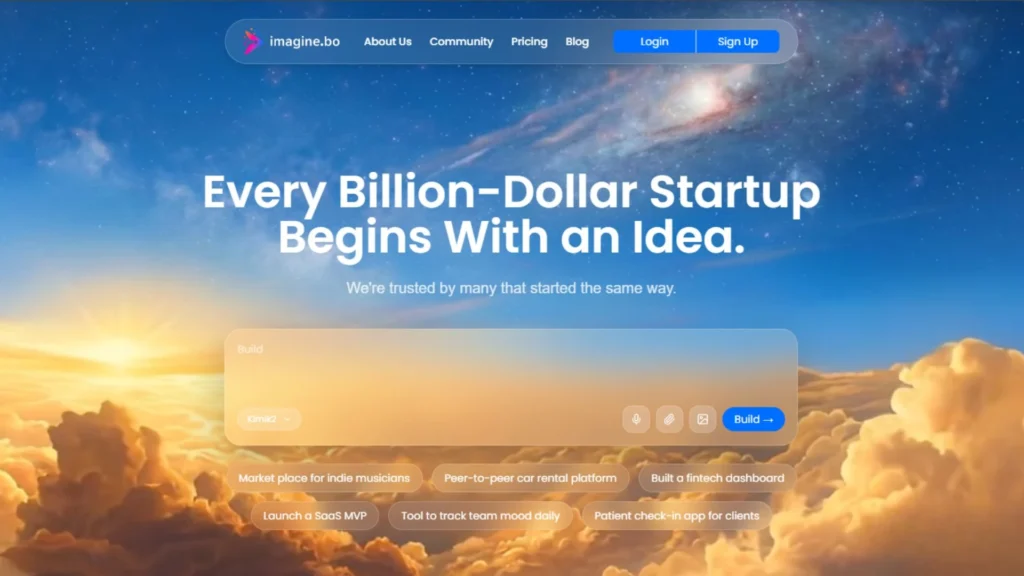
Imagine.bo qualifies as an AI code generator in the most complete sense of the term: it generates production-grade code from a natural language description without requiring human coding input. But the way it generates code is fundamentally different from the developer-assistant tools that dominate headlines.
Launch Your App Today
Ready to launch? Skip the tech stress. Describe, Build, Launch in three simple steps.
BuildTools like GitHub Copilot, Cursor, and Windsurf operate at the function or file level. A developer writes a comment or partial implementation, and the AI suggests the next lines. The developer remains in the loop for every decision: architecture, data modeling, API design, security configuration, and deployment setup. Those tools are powerful for developers. They save roughly 3.6 hours per week per developer on average (DX Analysis, 2025). But they assume the developer exists.
Imagine.bo operates at the application level. You describe an entire system in plain English who uses it, what it does, what rules govern its behavior and the Describe-to-Build feature generates the complete structural output: a responsive frontend built with modern frameworks, a database schema with the correct relational model, backend API endpoints with business logic, and role-based access control enforced at the data layer. All of this goes from prompt to deployable code in minutes.
The AI-Generated Blueprint shows you this complete structure before anything deploys. You review what was generated, catch anything missing, and then refine through conversation. If a section is wrong, you describe the correction. The AI updates the underlying code in real time. No code editor. No terminal. No build commands. The output is a working, deployable application, not a set of files waiting to be assembled.
The distinction between “AI that helps you write code” and “AI that writes the app” is not a marketing phrase. It is a structural difference in who the tool serves. The developer-assistant category solves a throughput problem for technical teams. The application-generator category solves an access problem for everyone else. Imagine.bo is squarely in the second category, which is why comparing it to Copilot or Cursor is a category error. The right comparison is Lovable, Bolt.new, or Bubble and what sets imagine.bo apart from those platforms is the Hire a Human layer that keeps human engineering inside the same workflow.
Citation capsule: According to the Stack Overflow Developer Survey (2025), 84% of developers use or plan to use AI coding tools, with 51% using them daily. The AI code generation market was valued at $4.91 billion in 2024 and is projected to reach $30.1 billion by 2032 at a CAGR of 27.1% (Grand View Research / Second Talent, 2025). The fastest-growing segment within that market is prompt-to-application generation, where the output is a deployable product rather than a code suggestion.
How Does Imagine.bo’s AI Code Generator Actually Work?
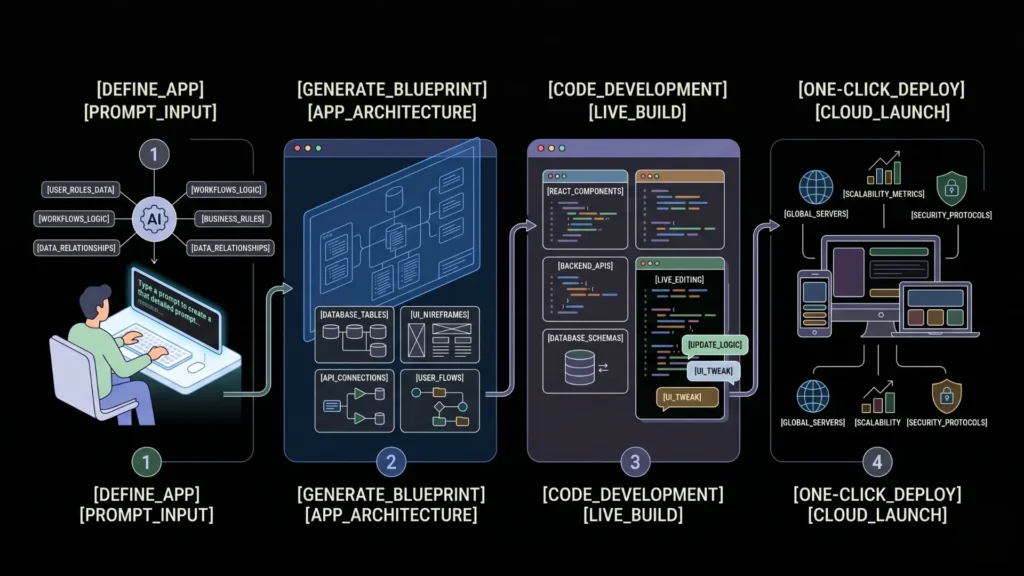
The generation pipeline runs through four distinct stages, each of which produces a specific type of output. Understanding what happens at each stage demystifies why the platform produces complete applications rather than fragments.
Stage 1: Natural Language Analysis via Describe-to-Build
When you submit a prompt, imagine.bo’s AI parses it for four elements: the user personas interacting with the system, the core workflows each persona performs, the business logic rules that govern those workflows, and the data relationships required to store and retrieve information correctly.
A prompt like “Build a project management tool for marketing agencies. Agency managers can create projects, assign team members, and view progress reports. Team members can update task status and upload deliverables. Clients can view their project status but cannot see internal notes” contains enough information for the AI to correctly generate a multi-role application with appropriate data access boundaries. A prompt like “Build a project management tool” does not. Specificity is the input quality that drives output quality. The 40 real app prompts copy-paste library by app type gives ready-made prompt templates across dozens of application categories, including the exact four-element structure that consistently produces accurate first generations.
Stage 2: AI-Generated Blueprint
After parsing the prompt, imagine.bo generates an AI-Generated Blueprint the complete structural plan for the application. This includes the database schema with table relationships and field types, the user flow for each role, the UI component structure for each screen, the API endpoints required to serve each data operation, and the backend business logic that implements the rules specified in the prompt.
The blueprint renders before any deployment. You review it as a structured document that shows exactly what will be built. This is the quality control step that separates imagine.bo from pure black-box generators where you only see the output after the build completes. Catching a missing feature at the blueprint stage takes one follow-up prompt. Catching it after deployment requires undoing and rebuilding.
Stage 3: Code Generation and Iterative Refinement
With the blueprint approved, the AI generates the actual application code: React components for the frontend, database migrations for the schema, API route handlers for the backend, and authentication flows with role enforcement. This code is clean, exportable, and follows modern standards. You own it entirely.
Refinement happens through continued conversation. “The client dashboard is missing a file download button. Add that to the project overview screen.” “The task status should have four options: Not Started, In Progress, In Review, and Complete.” “Add a notification email to the assigned team member when a task status changes.” Each instruction updates the live codebase. No branching. No pull requests. No deployment pipeline to manage.
Stage 4: One-Click Deployment to Production Infrastructure
When the application is ready, One-Click Deployment pushes it to Vercel for the frontend and Railway for the backend. Vercel’s global edge network handles geographic distribution, DDoS mitigation, and automatic HTTPS. Railway handles backend autoscaling. Both infrastructure layers are maintained at enterprise scale by providers whose entire business depends on uptime and performance. The application is live, mobile-responsive, and production-ready from the moment deployment completes.
For tasks that exceed what the AI generation can handle a complex payment gateway integration, a custom data processing algorithm, a specialized compliance requirement the Hire a Human feature assigns that specific task to a vetted imagine.bo engineer. They work in your existing codebase and push the result back without requiring you to leave the platform workflow. The detailed breakdown of why Hire a Human is the feature that changes the equation explains this mechanism and when to use it.
The most common mistake new imagine.bo users make is treating the initial prompt like a search query short, vague, and expecting the AI to fill in the gaps. The AI generates something, but it is generic and requires many correction cycles to shape into something useful. The builders who get clean first generations consistently write prompts of five to ten sentences, define all user roles explicitly, state the key features as action sentences, and include one or two constraint examples. That investment in the prompt pays off in a blueprint that is 70 to 80% accurate on the first pass.
Citation capsule: According to McKinsey’s 2026 developer survey cited by Tech Insider (2026), AI coding tools reduce time spent on routine coding tasks by an average of 46%, and mean time from feature request to production-ready code drops by 28%. For non-technical builders using application-level AI generators like imagine.bo, the compression is more dramatic: weeks to days for standard SaaS MVPs, without requiring any developer on the team (McKinsey / Tech Insider, 2026).
What Types of Apps Can Imagine.bo Generate?
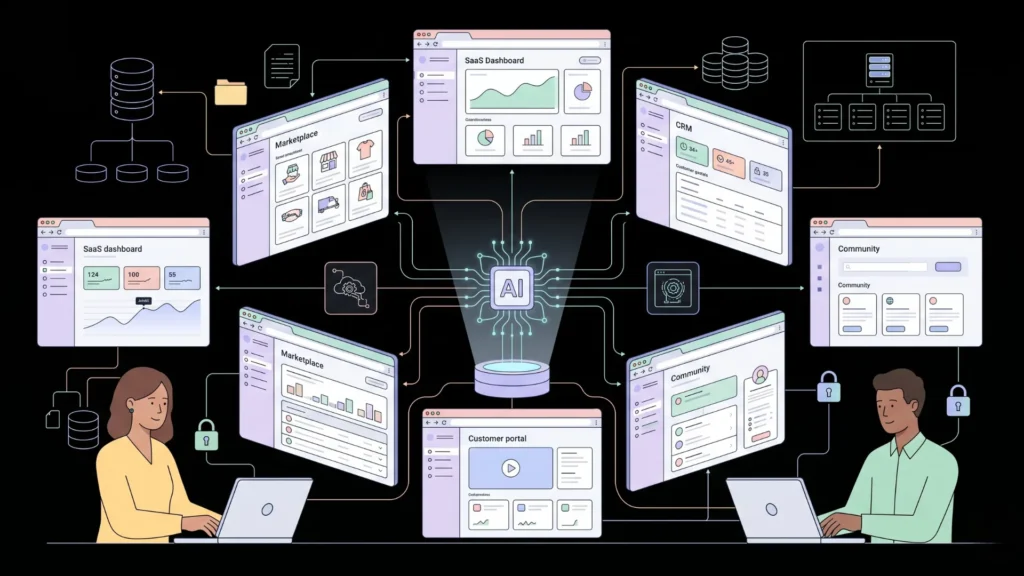
The generation capability covers the full range of standard web application types. These are not templates or themes. They are generated codebases with custom logic, real databases, and enforced security policies.
SaaS and subscription platforms. Multi-tenant architectures where different organizations have isolated data. Subscription billing foundations, user management, and admin dashboards. The guide to building a SaaS with imagine.bo’s AI generation covers the specific patterns that work well and the ones that require Hire a Human support.
Marketplaces and two-sided platforms. Buyer-seller dynamics with listing management, booking or transaction flows, and review systems. The data modeling for these applications is complex enough that the blueprint review stage is especially important confirming that the relationship between buyers, sellers, listings, and transactions is correctly structured before any code is committed.
Internal tools and operational software. CRMs, approval workflows, inventory systems, HR dashboards, and compliance trackers. These are often the highest-ROI applications because they replace manual processes that cost teams hours per week, yet they typically do not justify the cost of custom development. Imagine.bo changes that calculus entirely.
Customer-facing portals. Self-service account management, booking and scheduling systems, onboarding flows, and support ticket interfaces. Applications where customers interact directly with your data through a controlled interface.
Community and content platforms. Membership sites, content feeds, forum-style communities, and social tools. Higher-complexity consumer apps benefit from Hire a Human for real-time features, notification systems, or recommendation logic.
What imagine.bo does not generate: native iOS or Android binaries for App Store submission, desktop applications, hardware-dependent systems, or embedded software. The platform generates full-stack web applications. Mobile-responsive design is included by default, but the output is a web app accessed via browser, not a native mobile app.
Citation capsule: According to Gartner research cited by CIO.com (2025), low-code development accounted for more than 70% of application development activity in 2025, up from 20% in 2020. The fastest adoption is in teams without formal IT departments non-technical founders, small business operators, and individual product managers who use application-level AI generators to ship products that previously required a full engineering team (Gartner / CIO.com, 2025).
How Does Imagine.bo Compare to Other AI Code Generators?
The AI code generation space in 2026 splits into two distinct categories: developer-assistant tools and application-generator tools. Imagine.bo competes in the second category.
Versus GitHub Copilot and Cursor: These are developer-assistant tools. They accelerate coding for people who already know how to code. They do not generate complete applications. They are not alternatives to imagine.bo for non-technical builders. Comparing imagine.bo to Copilot is like comparing a contractor who builds your house to a nail gun that makes the contractor faster.
Versus Lovable and Bolt.new: These are the direct comparators. Both generate full-stack applications from prompts. Lovable produces clean React code and recently reached $206 million ARR (Sacra, 2025). Bolt.new has strong developer adoption and a fast initial generation. The critical difference: both are pure AI generators. When the AI fails or reaches a complexity ceiling, you are on your own or you leave the platform to find external help. The detailed comparison of Lovable vs Bolt pricing, speed, and security maps those differences across key decision factors.
Imagine.bo adds the Hire a Human layer. When AI generation stalls on a specific module, you assign it to a vetted engineer from the same dashboard. They work in the existing codebase with full context. The continuity of that workflow no context switching, no external relationship to manage, no explanation from scratch is what makes the hybrid model functionally superior for production builds.
Versus Bubble: Bubble is the most mature no-code builder for complex web applications, with over 2 million users. Its visual logic editor handles sophisticated workflows. The tradeoff is a steep learning curve that frequently results in teams hiring Bubble specialists, which reintroduces the development cost the platform was supposed to eliminate. Bubble does not generate code from prompts. You build visually, which is a different paradigm.
Versus Cursor and Windsurf for vibe coding: Vibe coding describing what you want and having an AI produce code is a valid approach for developers. Cursor and Windsurf are excellent vibe coding environments for people who can read and review generated code. The full guide to vibe coding and building apps with AI covers this approach in detail. Imagine.bo is the right choice when you want the output of vibe coding without needing to understand or review the code itself.
Based on imagine.bo’s pricing structure and standard development market rates, the cost comparison for a production SaaS MVP is stark. Imagine.bo Pro plan: $25 per month, deployed in days. Traditional agency MVP: $55,000 to $140,000 and three to six months (Softermii, 2025). Freelance MVP: $10,000 to $50,000 and four to eight weeks. Imagine.bo Done For You: $499 one-time, fully managed by the imagine.bo engineering team. At the Pro plan level, that is a 99%+ reduction in upfront capital cost for the validation phase of a product, before accounting for the time advantage of days versus months to first deployment.
Citation capsule: According to a McKinsey study published in February 2026 covering 4,500 developers across 150 enterprises, AI coding tools reduce routine coding time by 46% and shorten code review cycles by 35%. However, the same study found that bug density was 23% higher in projects with unreviewed AI-generated code. The human-in-the-loop model that imagine.bo’s Hire a Human feature provides addresses this directly: complex modules get human review built into the workflow, not added as an afterthought (McKinsey / Tech Insider, 2026).
Who Gets the Most Value from Imagine.bo’s AI Generation?
Three user types consistently get the highest return from imagine.bo’s generation model, and they share a common characteristic: they have clear product thinking but no coding background.
Non-technical founders who understand their domain deeply and can describe their product precisely. The platform turns domain expertise into architecture directly. The guide to how non-technical founders are building products fast covers the workflow, the mental model, and the prompting patterns that produce the fastest results for this group.
Solo operators and small business owners replacing manual processes and generic SaaS subscriptions with tools built exactly for their workflows. A business managing six different SaaS tools that each cover 70% of a specific need can consolidate into one custom application that covers 100% of all of them, built in days, at a fraction of the combined subscription cost.
Product managers and indie hackers who want to ship faster than their current constraints allow. These users often have partial technical understanding. They write precise prompts, review blueprints critically, and use Hire a Human strategically for the modules that require engineering depth. They move from idea to revenue faster than any other user type on the platform.
The build an AI app people buy and keep playbook is specifically written for this mindset: how to think about product architecture, which features to build first, and how to structure a generation that produces something users actually want to pay for.
Imagine.bo is not the right tool for developers who want full control over every architectural decision, teams building native mobile apps for app store submission, or enterprise organizations with strict on-premise infrastructure requirements. The top 10 benefits of prompt-to-app development is honest about both the benefits and the cases where a different approach makes more sense.
FAQ
Is imagine.bo really an AI code generator, or just a website builder?
It is a full-stack AI code generator. The platform generates React frontend components, database schemas, REST API endpoints, and backend business logic from natural language prompts. You own the exportable code. The output is a working web application with a real database and server, not a static website assembled from templates. The difference matters: a website builder lets you customize a template; imagine.bo generates a codebase specific to your product description.
How fast can imagine.bo actually build an app?
The AI-Generated Blueprint appears within minutes of submitting a prompt. A production-ready MVP with authentication, user roles, a database, and core workflows is typically deployable within one to three days including refinement. Traditional development takes three to six months at a cost of $55,000 to $140,000 for equivalent scope (Softermii, 2025). The full cost and time comparison for app development in 2026 breaks this down in detail across all three development approaches.
What happens when the AI gets something wrong?
You describe the correction in the conversation. The AI updates the underlying code in real time. For persistent issues after multiple correction prompts, the Hire a Human feature assigns that specific module to a vetted engineer. They fix the issue in your existing codebase and push the result back without requiring you to restart the project. This is the functional difference between imagine.bo and pure AI generators where there is no escalation path when generation fails.
Does imagine.bo generate secure code?
Every application deploys with SSL/HTTPS by default, data encryption at rest and in transit, and role-based access control enforced at the database layer. GDPR and SOC2 readiness foundations are included in every deployment automatically. For payment integrations, health data, or other compliance-sensitive modules, the Hire a Human feature provides engineer review for the specific compliance controls your use case requires.
Can I export my code and move off imagine.bo?
Yes. Imagine.bo produces clean, exportable code that follows modern standards. You can export or hand off the codebase at any time. You are never locked into the platform. Code ownership is a core product principle: you paid to build it, it belongs to you. This is a meaningful contrast to platforms like Bubble, where code export requires an enterprise plan upgrade.
Conclusion
Three things define imagine.bo’s position in the AI code generation landscape. First, it generates applications, not code snippets the output is a complete, deployed product, not a file that needs assembly. Second, the hybrid model means the AI handles the 80% of every build that is standard, repeatable, and well within generation capability, while human engineers handle the 20% that requires expertise and judgment. That combination produces production-ready results rather than impressive-looking prototypes that stall before launch. Third, you own the code entirely, which means the platform is a tool in your workflow, not a dependency that controls your product.
The AI code generation market is growing at 27% per year and will reach $30 billion by 2032. The platforms that earn and keep trust in that market will be the ones that deliver real products for real users, not just fast demos. Imagine.bo is built for that standard. If you want to see what your specific product idea produces in the generation flow, the free plan gives you 10 credits per month to test it at zero cost. The Pro plan at $25 per month is the right tier for anything you intend to ship. Start with the 40 real app prompts library to find the prompt pattern for your application type before you generate your first blueprint.
Related Articles
- AI Apps Builder: Create Smarter, Faster, and Without Code
- Build 10 Awesome AI Apps with No Code: The Ultimate Beginner’s Guide
- AI App Builder App Builder No Code: Build World-Class Apps Without Writing a Single Line of Code
- How Educators and Coaches Are Launching Apps Without Developers — And Scaling Their Impact
- 10 Questions Every Founder Should Ask Before Hiring a Developer in 2025
Launch Your App Today
Ready to launch? Skip the tech stress. Describe, Build, Launch in three simple steps.
Build