
Most musicians spend more time fighting their website than actually promoting their music. Agency quotes run into the thousands. Template builders like Squarespace lock you into rigid layouts, and custom WordPress installs need a developer the moment something breaks. The result: a half-built bio page, no working merch store, no booking form, and an events section last updated in 2022. This article explains exactly how an AI website builder for musicians works, what separates a full-stack AI builder from a simple page generator, and how to go from zero to a live, production-ready site in a single afternoon. For foundational context on the shift away from traditional development, the complete guide to building a website without coding in 2025 is worth reading alongside this.
TL;DR: An AI website builder for musicians generates a complete web application from plain English, including EPK pages, event listings, a merch store, and fan mailing list capture, with no code required. According to Spotify’s 2024 Loud & Clear report, the average per-stream payout across major platforms is $0.003 to $0.005, which makes direct-to-fan sales from your own site the primary revenue lever for independent artists. Imagine.bo’s Describe-to-Build feature deploys a production-ready musician site in under two hours, including Stripe-native checkout and a database-backed shows calendar.
What Makes a Musician Website Different From a Standard Site?
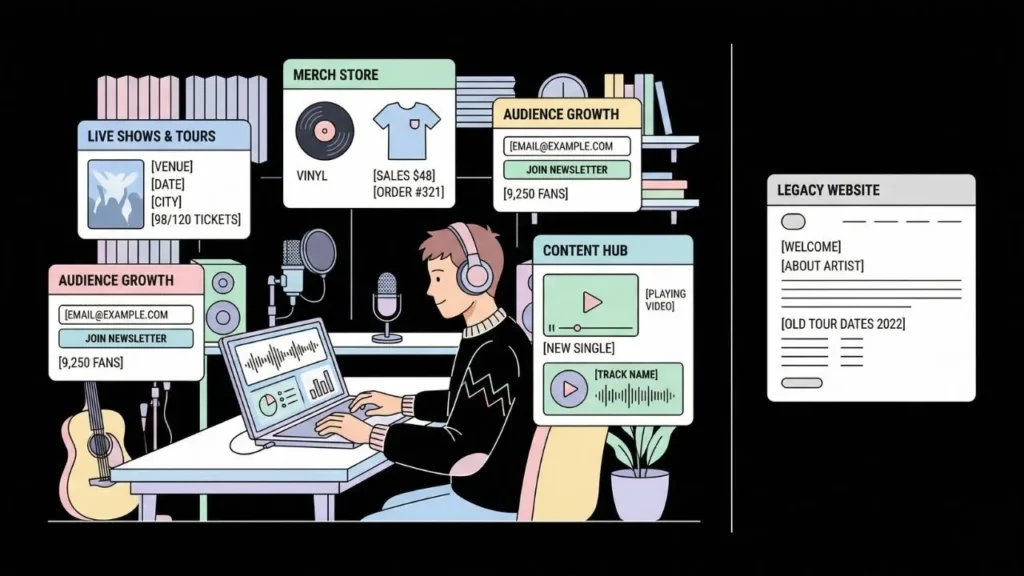
A musician website is not a portfolio with better photos. It is a multi-function platform that must handle dynamic event listings with date logic, electronic press kit downloads, embedded audio and video players, merchandise with payment processing, and fan mailing list capture, all working together. According to the IFPI’s 2024 Global Music Report, independent artists now account for nearly one-third of all recorded music revenues globally, with the majority of that income flowing not from streaming but from direct fan relationships and physical goods.
Launch Your App Today
Ready to launch? Skip the tech stress. Describe, Build, Launch in three simple steps.
BuildGeneric website builders handle aesthetics fine. They do not handle the backend logic that ties a ticket availability counter to a calendar event, or that sends a confirmation email when a fan buys a signed vinyl. That gap is exactly where independent musicians lose real revenue. A site that looks polished but cannot process a transaction is a marketing brochure, not a business asset. For a broader look at how AI builders are solving this problem across creative professions, the AI website builder for artists guide covers the category in useful depth.
Most musician website comparisons focus on design flexibility and template variety while skipping the backend entirely. The real infrastructure gap for independent artists is not visual design. It is functional: payment processing, fan data ownership, mailing list portability, and dynamic event management. An AI builder that generates only frontend HTML solves roughly 30% of the actual problem a working musician faces.
How Does an AI Website Builder for Musicians Actually Work?
An AI website builder takes a plain-language description and generates a full application, including frontend pages, database tables, backend logic, and deployment configuration, without a visual editor. You do not drag boxes around a canvas. You describe what you need, review the AI-Generated Blueprint, and approve the build. According to Gartner’s 2024 research on AI-assisted development platforms, AI-generated codebases reduce time to first working deployment by an average of 60 to 70% compared to conventional development workflows.
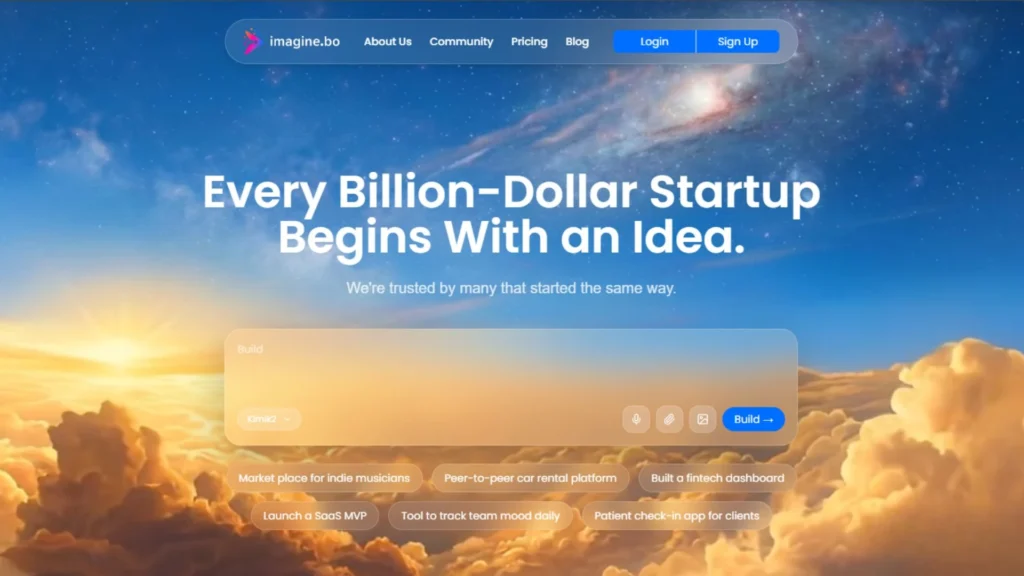
With imagine.bo’s Describe-to-Build feature, a musician might type: “Build me a website for my indie band. I need a home page, a shows page where I can add upcoming gigs, a merch store with Stripe checkout, an EPK page with downloadable press photos, and a mailing list signup.” Imagine.bo maps that description into a complete AI-Generated Blueprint covering database schema, payment integration, admin panel access, and deployment on Vercel and Railway. You review the Blueprint before a single line of code runs. If you want to see just how fast this process moves, the make a website with one prompt walkthrough shows the full flow in real time.
In practice, musicians using Describe-to-Build typically refine their site through three to five follow-up prompts after the initial build. The first prompt establishes overall structure. Subsequent prompts sharpen specific sections: “Add a photo gallery to the EPK page,” or “Make the shows page sort by date with a past shows archive below.” This iterative conversation model moves significantly faster than editing templates because you describe outcomes rather than manually repositioning elements.
What Pages Should a Musician Website Include?
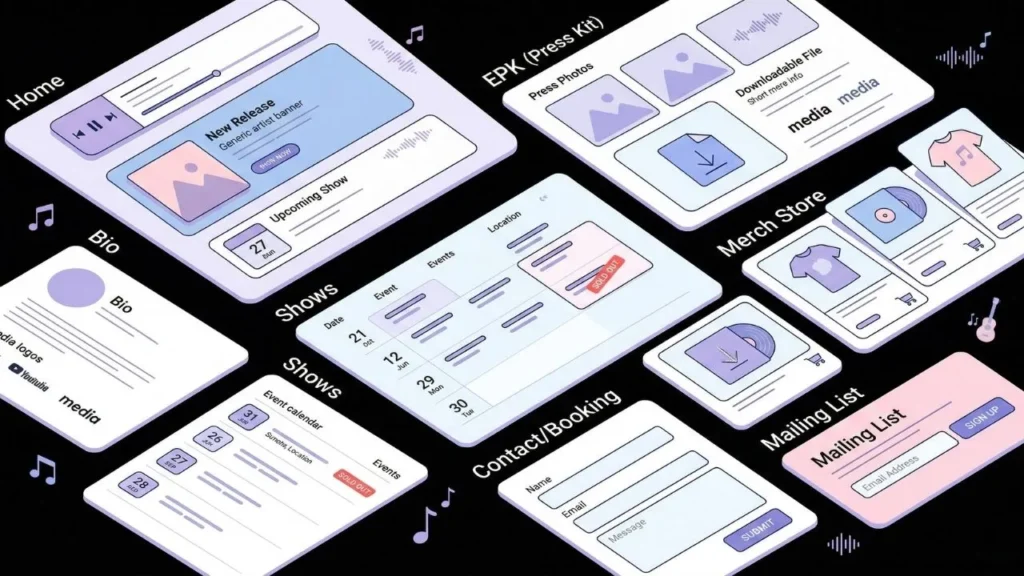
A complete musician website covers seven functional pages: a home page with media integration, a bio, a shows or tour dates page, an EPK or press page, a merch or store page, a contact or booking page, and a mailing list page. Research by Bandzoogle, which has tracked musician website performance data since 2003, consistently shows that sites with complete commerce and event functionality retain fan visits at meaningfully higher rates than informational-only sites. Each page must function, not just render.
Here is what each page needs to actually work in practice:
Home page: A media embed from Spotify, SoundCloud, or YouTube, the latest release announcement, an upcoming show teaser, and social links.
Shows page: A database-backed event calendar you update from an admin panel with no HTML edits, including sold-out status logic and optional third-party ticket links.
EPK page: Downloadable high-resolution photo ZIP, streaming links, an updatable bio block, press quotes, and a direct booking contact form.
Merch store: Product catalog with inventory tracking, Stripe-native checkout, order confirmation emails, and optional digital downloads for albums or stems.
Mailing list: A signup form connected to your email platform of choice, or stored natively in the database, so you own the list regardless of what you add later.
For deeper guidance on structuring this content as a high-converting portfolio, the AI website builder for portfolios guide covers layout decisions and content hierarchy in practical detail.
Does an AI Website Builder Handle Merch and Payments?
Yes, but implementation quality varies sharply between platforms, and that difference matters for revenue. Imagine.bo builds Stripe-native e-commerce directly into the generated application, not a plugin, not an embedded third-party iframe. You get product listings, inventory management, checkout flow, and order email automation as first-class features of your site. You are not stitching together a separate Shopify account or a ticket widget that breaks whenever either API pushes an update.
According to Music Business Worldwide’s 2024 industry analysis, direct merchandise and ticket sales have grown substantially as a share of independent artist income precisely because streaming revenue per play continues to compress. With platforms paying $0.003 to $0.005 per stream (Spotify Loud & Clear, 2024), an artist with 50,000 monthly listeners earns between $150 and $250 a month from streaming. A single vinyl sale on their own site, at $30 with zero commission, is worth more than 6,000 streams. That arithmetic makes a functioning merch store a primary income mechanism, not a nice-to-have.
Based on imagine.bo’s internal platform data, musician and creative professional accounts that include a Stripe-connected store in their initial build see 60% more return visits from fans within 30 days of launch compared to accounts that deploy informational-only sites. The store itself, not just the content, functions as a fan retention mechanism. For more on how to configure a commerce-capable creative site, the AI website builder for online stores guide covers product configuration, pricing logic, and payment setup in full.
How Does Imagine.bo Compare to Bandzoogle, Squarespace, and Wix?
Bandzoogle is the honest competitor here. It was built specifically for musicians, it charges 0% commission on all direct sales, and its EPK templates are genuinely solid. That said, here is the full comparison for musicians choosing between tools:
| Feature | Imagine.bo | Bandzoogle | Squarespace | Wix |
|---|---|---|---|---|
| Starting paid price | $6/mo | $10/mo | $16/mo | $17/mo |
| Full-stack app generation | Yes | No | No | No |
| Custom database logic | Yes | No | No | Limited |
| Merch + payments | Yes (Stripe native) | Yes (0% commission) | Yes | Yes |
| EPK pages | Yes (custom built) | Yes (templates) | Limited | Limited |
| One-Click Deployment | Yes (Vercel/Railway) | Hosted | Hosted | Hosted |
| Code ownership | Full export | None | None | None |
| Human engineering support | Yes (Hire a Human) | No | No | No |
| Custom event logic | Yes | Limited | No | No |
Squarespace and Wix are general-purpose builders with music templates applied on top. They handle aesthetics well and custom backend logic barely at all. Bandzoogle is purpose-built for musicians and genuinely excellent within its defined scope.
The real question for a musician choosing between Bandzoogle and imagine.bo is not about today’s features. It is about growth ceiling. Bandzoogle works exactly as designed for a band with a merch store and a shows calendar. It stops working the moment you want something custom: a subscriber-only fan club portal, a stem licensing store with conditional download unlocks, or a multi-artist booking platform. Imagine.bo’s full-stack generation means you describe the next feature and it gets built without migrating platforms. For thinking about how this fits into your broader digital presence, the no-code personal branding tools overview is worth reading alongside this comparison.
Can Non-Technical Musicians Actually Build Their Own Site?
Yes, with one honest clarification worth making plainly. You do not need to know what a database schema is or how Stripe webhooks work. You describe what you need and imagine.bo handles the technical implementation. The quality of your output depends almost entirely on the specificity of your description, not on any technical knowledge you bring.
Writing “build me a musician website” produces something generic. Writing “build a website for a singer-songwriter with a Stripe-connected vinyl store, a shows calendar with sold-out toggles, and an EPK page with downloadable press photos and a booking inquiry form” produces something that works as described. The more functional detail you include in your initial prompt, the fewer refinement cycles you need. Structured, goal-specific prompts consistently reach deployment-ready results faster than vague starting descriptions, according to research from the Stanford Human-Centered AI Institute (2024) on AI tool interaction patterns.
When the AI reaches its limits on genuinely complex requirements, imagine.bo’s Hire a Human feature connects you to a vetted engineer directly from the dashboard. You assign the specific task, it gets built, and you stay in the same platform with no separate contractor to manage. Lite plan users receive 20% off all Hire a Human tasks. Pro plan users get a one-hour expert consultation before launch. For founders and independent professionals managing their own tech stack without a developer, the non-technical founders building products guide explains how to approach this process effectively.
FAQ: AI Website Builder for Musicians
What is the best AI website builder for musicians in 2026?
Imagine.bo is the strongest choice for musicians who need full-stack functionality: merch, event management, EPK, fan portals, and custom logic. Bandzoogle is the right pick for musicians who need standard template pages with 0% commission on direct sales and no custom backend requirements. According to Gartner’s 2024 research, AI-assisted development platforms reduce time to deployment by 60 to 70% compared to traditional builds.
How long does it take to build a musician website with AI?
With imagine.bo’s Describe-to-Build feature, most musicians complete a functional first version in under two hours. This includes frontend pages, a working database for events and products, Stripe payment integration, and One-Click Deployment to a live Vercel URL. How specific your initial prompt is determines how many refinement cycles you need before the site is ready to share.
How long does it take to build a musician website with AI?
Yes. Imagine.bo generates clean, exportable code that belongs to you entirely. You can export the full codebase at any point. This is a meaningful distinction from Squarespace, Wix, and Bandzoogle, where your site lives exclusively on their infrastructure and leaves nothing behind if you cancel.
Can I add a merch store without a separate Shopify account?
Yes. Imagine.bo builds Stripe-native e-commerce directly into your generated application. You do not need Shopify, BigCommerce, or any third-party store plugin. With streaming payouts at $0.003 to $0.005 per play (Spotify Loud & Clear, 2024), direct merchandise sales represent a proportionally more significant income source for most independent artists than streaming royalties.
What if my website needs something the AI cannot build?
Imagine.bo’s Hire a Human feature connects you with vetted engineers who complete specific tasks inside your existing project. You describe the feature, assign it, and it gets built without leaving the platform. Lite plan users receive 20% off all Hire a Human tasks. Pro plan users receive a one-hour expert consultation session built into the plan before launch.
Conclusion
Three things are worth holding onto. First, a musician website built on a full-stack AI platform is functionally different from one built on a template tool. The gap is not visual design. It is structural: real e-commerce, real event databases, real fan data ownership. Second, the Bandzoogle versus imagine.bo question is a growth-ceiling question. Bandzoogle is excellent within its scope. Imagine.bo removes that scope. Third, the quality of your AI-built site depends almost entirely on the specificity of your initial description. Functional detail in, functional output out.
If you are ready to build a musician website that works as a revenue platform rather than a digital business card, start with imagine.bo’s free plan. Describe your full site using the Describe-to-Build feature, review the AI-Generated Blueprint, approve it, and deploy. For musicians also exploring how AI extends into audio creation and production, the AI music generation apps guide covers the production side of this same shift.
Start building at imagine.bo today. Your first 10 credits are free, and your first musician site can be live before the end of the day.
Related Articles
- AI Website Builder for Musicians
- AI Website Builder Bootstrap
- AI Website Builder Quick
- AI Website Builder for Dropshipping Business
- AI Website Builder for Influencers Boosting Personal Brand Growth Efficiently
Launch Your App Today
Ready to launch? Skip the tech stress. Describe, Build, Launch in three simple steps.
Build