
Most musicians spend thousands of dollars producing a single track. Most non-musicians assume they can never make music at all. Both assumptions are being challenged in 2026 by a new category of tools: AI music generation apps that require no instruments, no studio time, and no coding knowledge. This guide covers how these tools work, which ones are worth using, and how platforms like imagine.bo let you build your own custom AI music app from scratch using plain English. By the end, you’ll know exactly what to use, what to build, and what to avoid.
TL;DR: AI music generation apps use large language models and audio diffusion models to create original music from text prompts. The global AI music market is projected to reach $3.5 billion by 2028, according to MarketsandMarkets. Tools like Suno, Udio, and Mubert handle casual creation. For founders and creators who want to build their own music platform, imagine.bo’s Describe-to-Build feature generates the full-stack app in minutes with no code required.
What Are AI Music Generation Apps, and Why Do They Matter in 2026?
AI music generation apps are software tools that convert text prompts, mood descriptions, or reference inputs into complete, playable audio tracks. According to MarketsandMarkets, the AI music market is projected to hit $3.5 billion by 2028, growing at a compound annual rate of over 28 percent. That growth is not driven by record labels. It is driven by solo creators, content marketers, game developers, and indie founders who need music but cannot afford a composer.
Launch Your App Today
Ready to launch? Skip the tech stress. Describe, Build, Launch in three simple steps.
BuildThe shift matters because it removes the last creative bottleneck for non-musicians. Video creators can generate custom soundtracks. Podcast hosts can produce original intros. App builders can add adaptive background music. None of these use cases required negotiating sync licenses or paying studio rates that can run $200 to $500 per hour.
The real disruption here is not that AI can write a song. It is that the cost floor for original, licensable music just dropped to near zero. That fundamentally changes what a solo founder or content creator can offer their audience without a budget.
This connects directly to a broader creator economy shift. As covered in our piece on exploring the creator economy with AI automation, the fastest-growing creator businesses are those that automate their production layer while keeping their voice and brand identity intact.
How Do No-Code AI Music Tools Actually Work?
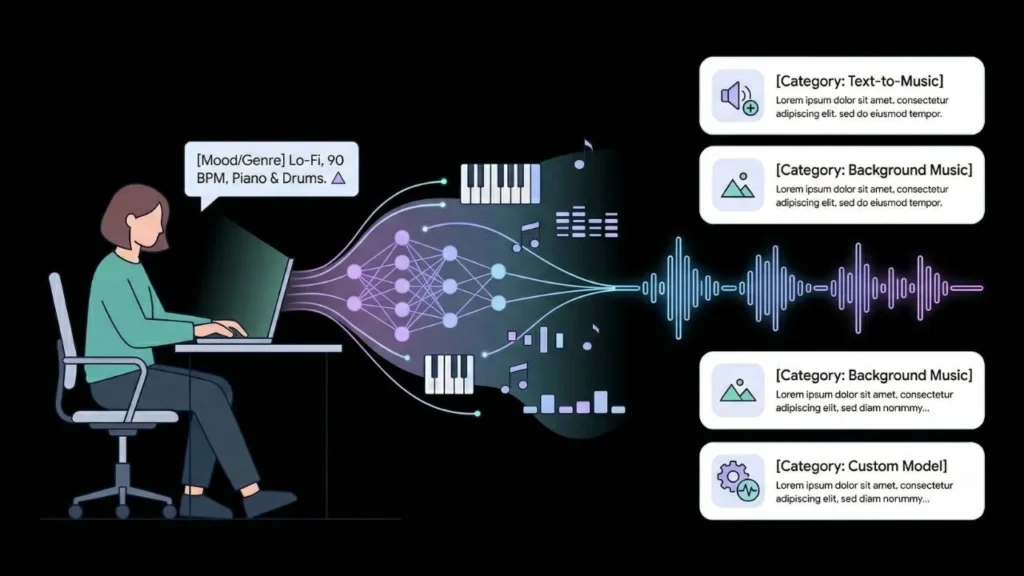
No-code AI music generators use a combination of transformer-based language models and audio diffusion models trained on millions of tracks. You type a prompt like “upbeat lo-fi hip hop, 90 BPM, with piano and light drums” and the model generates a waveform that matches those parameters. No instrument required, no DAW knowledge needed.
According to a 2024 report by Music Ally, over 60 percent of independent musicians surveyed had experimented with at least one AI music tool in the prior 12 months. That figure represents a near-doubling from their 2022 survey. The tools have gotten good enough that experimentation has become standard practice for working musicians, not just tech enthusiasts.
Most tools today fall into three categories. Text-to-music generators like Suno and Udio take a prompt and produce a full song including lyrics, melody, and production. Generative background music platforms like Mubert and Soundraw produce royalty-free tracks for specific use contexts like a video game level or a YouTube video. Custom model builders let developers or no-code builders train or fine-tune models on a specific musical style, then deploy them as standalone apps.
When you use imagine.bo to build a music-adjacent app, like a beat marketplace or a jingle generator for small businesses, the Describe-to-Build feature handles the architecture that would otherwise take a developer team two to three weeks. You describe what you want, and the AI-Generated Blueprint lays out the entire structure before a single line of code is written. That means founders can validate the concept visually before committing to build.
The technical underpinning matters to understand even if you never touch the code. Knowing that these tools generate audio in latent space, not by splicing existing recordings, helps you understand why the output sounds original rather than plagiarized. That distinction is central to the ongoing licensing debate in the music industry.
Which AI Music Generation Apps Are Worth Using?
The best AI music generation app depends on what you actually need: a quick track for content, a commercial license for a product, or the infrastructure to build your own music platform. Here is a direct breakdown of the major options.
According to Similarweb data from Q4 2024, Suno reached over 12 million monthly active users, making it the most-used consumer AI music app in the world. That scale reflects genuine product-market fit, not hype.
Suno is the default recommendation for casual creators. You describe a song, optionally add lyrics, and it produces a two to four minute track with vocals. The free tier gives you 50 credits daily. The Pro plan at $8 per month offers 2,500 credits monthly, commercial usage rights, and no watermarks. Its weakness is that outputs lack fine-grained control. You cannot easily specify BPM, key, or instrumentation.
Udio launched in early 2024 and produces notably higher audio fidelity than Suno for instrumental tracks. It also supports song extension, meaning you can build a longer piece iteratively. The free tier is limited. Their Standard plan runs $10 per month. Udio is better suited for producers who want more stylistic control.
Mubert focuses on generative background music rather than full song production. It streams AI-generated tracks that adapt to mood, tempo, and use context in real time. At $14 per month for the Creator tier, it handles YouTube, podcasts, and commercial video projects with proper licensing included.
Soundraw is particularly strong for content creators who need tracks cut to specific lengths. It generates music from genre and mood parameters, then lets you adjust the structure manually. Pricing starts at $16.99 per month.
Boomy remains the simplest entry point. You create a track in seconds, and the platform handles distribution to streaming services. Boomy is useful if your goal is getting tracks onto Spotify quickly, though audio quality lags behind Suno and Udio for serious projects.
Comparing the five tools by use case: Suno wins on ease and vocal output. Udio wins on instrumental fidelity. Mubert wins on real-time adaptive background generation. Soundraw wins on length editing for video. Boomy wins on distribution speed. No single tool dominates all five dimensions, which is exactly why building a niche music app with a specific focus still represents a viable market opportunity.
This comparison matters if you are thinking about building in this space. Our guide to AI music generation without coding goes deeper on the technical architecture of each platform for builders who want to understand the infrastructure layer.
How Do You Build Your Own AI Music App Without Writing Code?
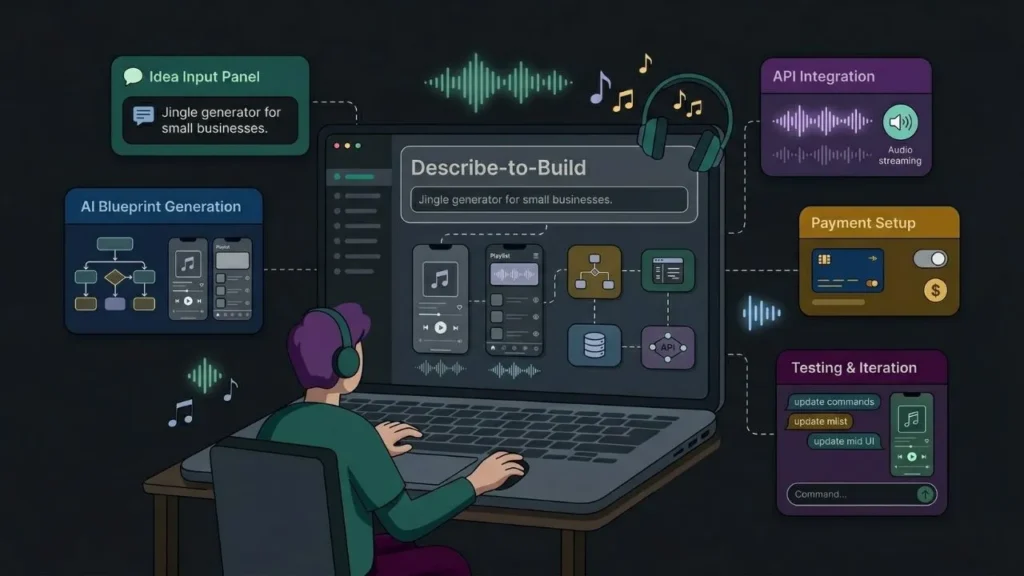
You build a no-code AI music app by combining a generative audio API with a frontend built on a platform like imagine.bo. The process takes a day, not a month, and does not require a developer. According to a 2025 State of No-Code report by Makerpad, over 40 percent of new SaaS tools launched in 2024 were built using no-code or AI-assisted development platforms.
Here is the actual workflow using imagine.bo’s Describe-to-Build feature:
Step 1: Define your use case clearly. “I want to build a jingle generator for small business owners. They input their business name, tone (professional, playful, or bold), and preferred tempo. The app generates a 30-second custom music track using the Mubert API.” That specificity is what separates a working app from a vague prototype.
Step 2: Use Describe-to-Build to generate your AI-Generated Blueprint. Paste your description into imagine.bo. Within seconds, you receive a full app structure: the frontend pages, the database schema, the backend logic, and the API connections. Review the blueprint before building.
Step 3: Connect your audio API. Imagine.bo connects to third-party APIs including Mubert’s generative audio API and Suno’s API (currently in beta access). You specify the integration in plain English: “When a user submits the form, call the Mubert API with their mood parameter and return a streaming audio URL.”
Step 4: Configure user accounts and payment. If you plan to charge for generations, imagine.bo builds in Stripe-compatible payment logic from the start. The Pro plan includes One-Click Deployment to Vercel and Railway, so your app is publicly accessible the same day you build it.
Step 5: Test and iterate conversationally. Unlike drag-and-drop builders, refinement happens through conversation. “Add a download button to the results screen” is a complete instruction. The platform updates the app accordingly.
A musician founder building a custom beat licensing platform for Twitch streamers does not need a developer. They need a clear description of the user flow and a platform that can turn that description into a deployable product. That is exactly the scenario imagine.bo is designed for. The Hire a Human feature exists for the edge cases where AI generation hits its limit, letting you assign specific tasks to a vetted engineer directly from your dashboard.
For additional context on building niche apps like this from scratch, see our walkthrough on building an AI music app.
How Should Musicians Use Their AI Website Alongside Music Generation Tools?
A music generation tool creates tracks. An AI-built website turns those tracks into a product, a brand, and a business. The two are distinct needs, and conflating them is a common mistake that costs musicians both money and time.
According to IFPI’s 2025 Global Music Report, independent artists who sell directly through their own platforms retain an average of 80 to 100 percent of their revenue, compared to 15 to 20 percent through traditional streaming royalties. That gap explains why owning your channel matters as much as producing the music itself.
An AI website builder for musicians handles the parts that music generation tools do not: booking forms, press kits, merch stores, music licensing inquiry pages, and email list capture. Imagine.bo builds these as fully functional web apps, not static sites. A fan can buy a license, book you for an event, and sign up for your newsletter all within the same experience you built in a single day.
The combination is particularly valuable for music producers who want to sell beats directly. Instead of depending on platforms like BeatStars that take 30 percent of every sale, a custom beat store built on imagine.bo gives you full margin control and full data ownership.
For musicians considering this approach, our guide to AI website builders for musicians covers the specific pages, features, and flows that convert visitors into paying fans.
How Do You Monetize AI-Generated Music?
There are four viable monetization models for AI-generated music in 2026, and they are not equally good. Choosing the wrong one can mean generating a lot of tracks that produce very little income.
According to Midia Research, the royalty per stream on Spotify averaged $0.003 to $0.005 in 2024 for independent artists. At that rate, you need roughly 200,000 streams to earn $1,000. AI-generated music faces additional distribution scrutiny from platforms that are now flagging high-volume AI submissions.
Model 1: Licensing directly to businesses. Sell tracks to marketing agencies, video producers, and game developers who need original background music. Platforms like Musicbed and Artlist take 30 to 50 percent. Building your own licensing storefront on imagine.bo eliminates that cut. Target a specific niche, like real estate video walkthroughs or fitness app soundtracks, and price accordingly.
Model 2: Subscription-based streaming for niche audiences. Build a private streaming app for a specific community: meditation practitioners, study music subscribers, or ambient horror fans. Charge $4 to $9 per month. A niche audience of 500 subscribers paying $7 per month generates $42,000 annually with minimal overhead.
Model 3: Jingle and custom music creation as a service. Use AI tools to produce custom jingles for small businesses on demand. Charge $99 to $299 per track. The production cost to you is near zero. Margin is exceptional. You can build a client-facing ordering system on imagine.bo in a day.
Model 4: Selling the platform, not the music. Build and sell a white-labeled music generation tool for a specific vertical, like a jingle generator for real estate agents or a background music tool for yoga studios. This is a SaaS product, not a music career. Pricing the tool at $19 per month and acquiring 200 subscribers generates $45,600 per year.
The most underrated model is Model 4. Musicians with AI generation skills are often so focused on the music itself that they miss the fact that other professionals in their vertical are willing to pay for that same capability as a tool. The platform is worth more than the individual tracks because it scales without additional production effort.
For a deeper look at building and monetizing these kinds of tool businesses, see our guide to monetizing AI-built apps without coding.
What Are the Real Limitations of AI Music Generation?
AI music generation is genuinely useful, but treating it as a complete replacement for human musical judgment will produce disappointing results. Knowing where it breaks down helps you use it more intelligently.
According to a 2024 survey by SoundExchange, 71 percent of professional musicians expressed concern about AI’s impact on their income, but only 24 percent had changed their workflow in response. That gap suggests the industry is watching but not yet fully adapting.
Structural coherence breaks down in long-form tracks. Most AI generators produce two to four minute outputs that sound good individually but lack the internal logic of a composed piece. Themes do not develop the way a composer would develop them. Tension and release are often random rather than intentional. For short-form content this is fine. For film scores or albums it is a meaningful limitation.
Vocal quality and lyrical coherence remain inconsistent. Suno produces surprisingly good vocals for a casual listener. Under close attention, phrasing feels generic, rhyme schemes are often clunky, and the emotional register of lyrics often does not match the musical mood. A songwriter using AI to draft a first pass, then editing the lyrics manually, gets much better results than someone accepting the first output.
Licensing is still murky. The legal status of training data, output ownership, and commercial rights varies by platform and jurisdiction. Suno and Udio are currently in litigation with major labels. Platforms like Mubert and Soundraw have clearer commercial licensing terms. If you plan to use AI music in a commercial product, verify the terms before publishing.
You cannot fine-tune on your own style through most consumer interfaces. If you want an AI to generate music in your specific sonic style as a produced artist, the off-the-shelf tools are inadequate. Fine-tuning requires API access and some technical knowledge. This is where building a custom app with imagine.bo and connecting to a more flexible audio model API gives you options that consumer tools do not.
Our piece on AI tools for artists addresses the broader question of where AI augments creative work versus where human judgment remains essential.
FAQ
What is the best AI music generator for beginners with no music experience?
Suno is the best starting point for complete beginners. You type a description like “happy acoustic guitar, coffee shop vibe, no lyrics” and get a playable track in seconds. The free tier gives you 50 daily credits. According to Similarweb, Suno had over 12 million monthly active users by Q4 2024, which reflects just how low the barrier to entry has become for new creators.
Can I legally sell music created with AI tools?
It depends on the platform. Mubert and Soundraw offer explicit commercial licenses with their paid plans. Suno and Udio have faced litigation from major labels over training data, and their commercial terms are less settled. According to the U.S. Copyright Office’s 2024 guidance, AI-generated content without human creative input may not qualify for copyright protection, which affects how you can license your output.
How much does it cost to build an AI music app with no-code tools?
A basic AI music app built on imagine.bo costs between $6 and $25 per month on the platform’s Lite or Pro plan, plus any API costs for the audio generation service you connect. Mubert’s API starts at around $0.001 per generated track at scale. A full-featured music licensing platform with user accounts, payments, and audio delivery can be deployed in under 48 hours at a total monthly cost under $100.
Do I need an API to build a music generation app with imagine.bo?
Not always. Some integrations are handled natively or through no-code connectors. For more advanced customization, like specifying tempo, key, and instrumentation parameters from a user form, you will want to connect to an audio API directly. Imagine.bo’s Describe-to-Build feature supports API connection in plain English, so you do not need to write API calls manually.
How is building a music app different from using a music app?
Using a music app means consuming its features within its interface and pricing model. Building one means you own the product, the user data, and the revenue model. According to Makerpad’s 2025 report, over 40 percent of new SaaS tools launched in 2024 used no-code or AI-assisted platforms. Building your own music tool puts you in a position to serve a niche with a product that perfectly fits their workflow, rather than adapting your needs to an existing product’s limitations. Our guide to building a fan engagement app shows what this looks like in practice for musicians.
Conclusion
Three things are worth taking away from this guide. First, AI music generation is mature enough in 2026 to be genuinely useful for content creators, musicians, and app builders alike. Suno, Udio, Mubert, and Soundraw each solve a specific problem well. Second, the most durable opportunity is not in using these tools but in building niche products on top of them. A custom jingle generator for restaurants, a beat licensing storefront for streamers, or a subscription ambient music app for meditators: all are viable SaaS products that a single founder can build and launch in a day. Third, having a strong web presence that connects your music, your licensing terms, and your fan community in one place is as important as the music itself.
If you are ready to stop using other people’s platforms and start building your own, start with imagine.bo’s Describe-to-Build feature. Describe the music app you want in plain English, review the AI-Generated Blueprint, and deploy in one click. For anything the AI cannot handle alone, the Hire a Human feature connects you to a vetted engineer directly from your dashboard. See also our complete guide to building a micro-SaaS in 48 hours for the full launch playbook.
Related Articles
- AI Website Builder for Musicians
- Unlocking Generative AI: Your Comprehensive Guide to Building Cutting-Edge Applications
- Unlock Your Creativity: A Step-by-Step Guide to Generative AI Design Tools
- Unlock Your Inner Game Designer: Generative AI for Non-Coders
- Unlock Your Creativity: The Ultimate Guide to the Best AI Image Generator Tools
Launch Your App Today
Ready to launch? Skip the tech stress. Describe, Build, Launch in three simple steps.
Build