Hiring is supposed to get easier as your company grows. It usually gets harder. According to Glassdoor, the average corporate job posting attracts around 250 applications. Most hiring managers read fewer than 10 carefully before attention degrades. The rest get a three-second skim, or nothing at all. That is not a discipline problem. It is a volume problem, and AI resume screening is the most practical fix available to non-technical teams right now.
This guide covers how AI-driven resume screening works, which no-code tools are worth your time, and how to build a custom screener tailored to your exact role criteria without writing a single line of code. You will leave with a working plan, not a list of software to explore later.
Launch Your App Today
Ready to launch? Skip the tech stress. Describe, Build, Launch in three simple steps.
BuildFor an overview of AI tools already transforming recruitment workflows, see best AI HR tools to automate recruitment and onboarding.
TL;DR: AI resume screening reduces time-to-shortlist by up to 75% for high-volume roles, according to LinkedIn Talent Solutions (2024). According to SHRM, the average U.S. cost-per-hire is $4,700, and automating the screening stage cuts that figure meaningfully. The fastest path for non-technical HR teams is a no-code AI builder like imagine.bo, which lets you build a custom screener around your exact criteria for less than most ATS monthly subscription fees.
Why Is Resume Screening Still Broken in 2026?
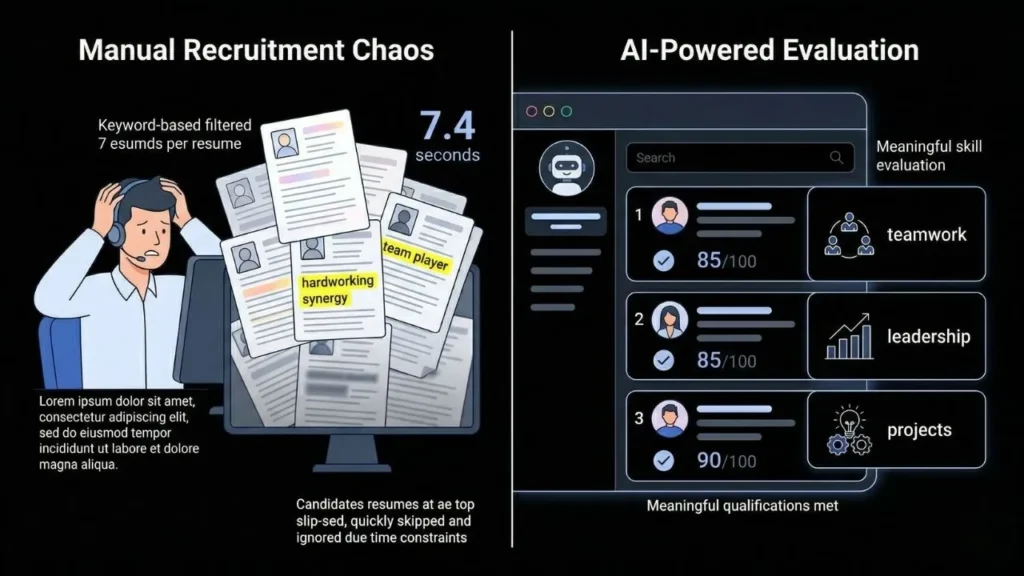
The screening problem is older than software, and keyword-based tools have not fixed it. According to a TheLadders eye-tracking study, recruiters spend an average of 7.4 seconds scanning each resume before deciding to read further or discard it. At 250 applications per role, that kind of speed makes inconsistency nearly inevitable. The first 20 applications get real attention. The last 200 get a glance at best.
Traditional applicant tracking systems (ATS) help with organization, not intelligence. They filter by keyword match, not by fit. A strong candidate who writes “managed a cross-functional project” instead of “project management” gets filtered out while a resume stuffed with exact-match buzzwords sails through. That gap between keyword filtering and actual job fit is where most small teams lose good candidates silently.
Here is what most HR software blogs skip over: the biggest return on investment from AI screening is not speed. It is consistency. When a single set of weighted criteria evaluates every resume the same way, you eliminate the “early applications get proper attention, late ones get a skim” problem that quietly degrades hiring quality at most growing companies. Consistency is the structural fix. Speed is the bonus.
Citation capsule: According to TheLadders (2018, continuously cited through 2025), recruiters spend an average of 7.4 seconds on initial resume review. With the average corporate role attracting 250 applications (Glassdoor, 2023), a hiring manager faces hundreds of fast-fire decisions before any substantive evaluation begins. Keyword-based ATS tools do not solve this; they only reorganize the pile.
How Does AI Resume Screening Actually Work?
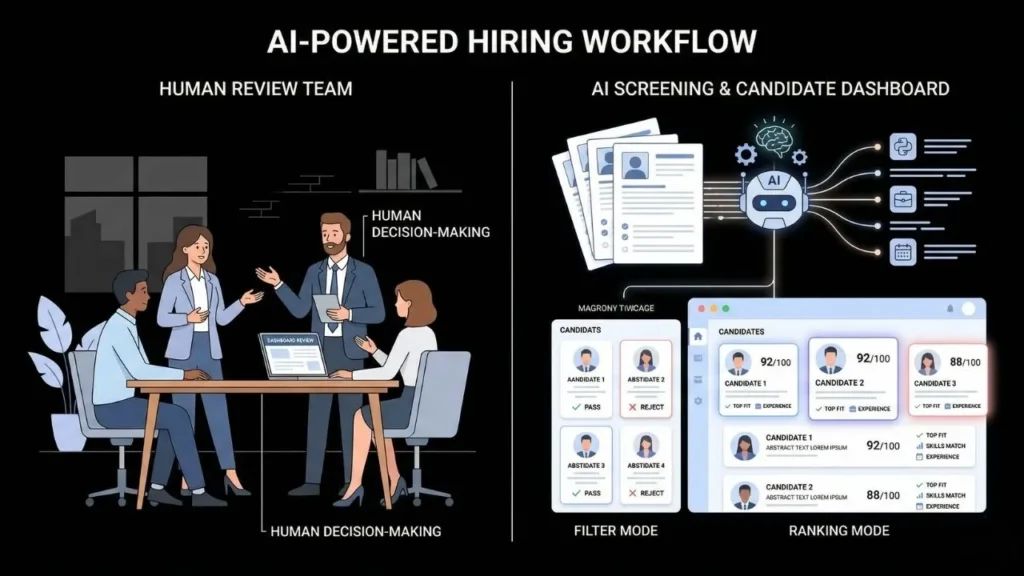
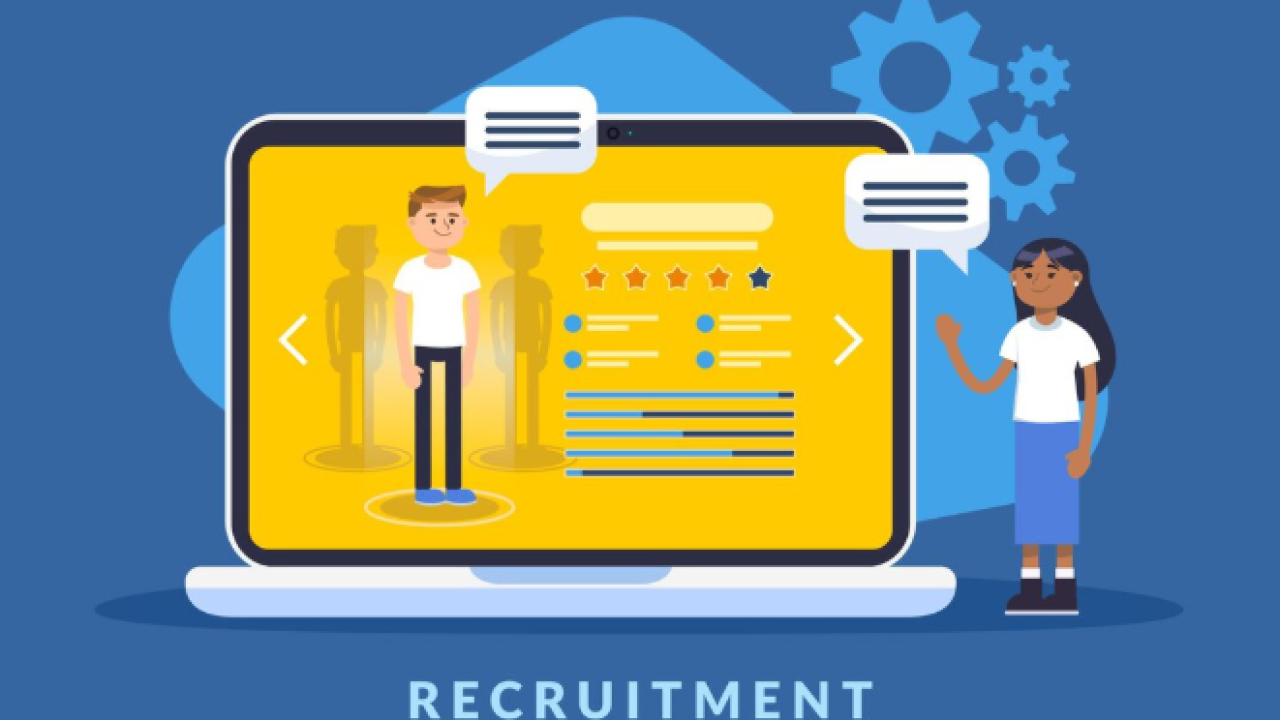
AI resume screening uses natural language processing (NLP) to parse resume text, extract relevant signals such as skills, role titles, and experience duration, then score each candidate against a defined rubric. Unlike keyword filtering, NLP reads in context. “Led a cross-functional team of eight to deliver a two-million-dollar project on time” scores differently from “participated in team meetings” even though both contain the word “team.”
According to LinkedIn’s 2024 Future of Recruiting report, nearly three-quarters of talent professionals are already using or actively piloting AI tools in their hiring workflows. The underlying mechanics vary by platform, but the better tools use a two-stage approach. First, a hard filter removes applicants who clearly miss minimum requirements. Second, a ranked shortlist of remaining candidates surfaces with scores and brief summaries visible to the hiring manager.
The distinction between filter mode and rank mode matters more than most guides acknowledge. Filtering gives you a binary yes or no result. Ranking gives you a prioritized list with context. For most small teams, ranking is the more valuable output because it keeps a human in the decision loop with enough information to make a judgment call, rather than trusting an automated gate entirely. The best no-code tools let you choose which mode fits the role.
For context on how AI automation performs across functions at smaller companies, see AI automation for small teams: efficiency and growth.
Citation capsule: LinkedIn’s 2024 Future of Recruiting report found that close to three-quarters of talent professionals are using or piloting AI tools in hiring. AI-powered resume screening applies NLP to evaluate candidate fit by meaning rather than keyword match, closing the gap between top-of-funnel volume and shortlist quality that traditional ATS filters cannot address.
What No-Code Tools Can You Use for AI Resume Screening?
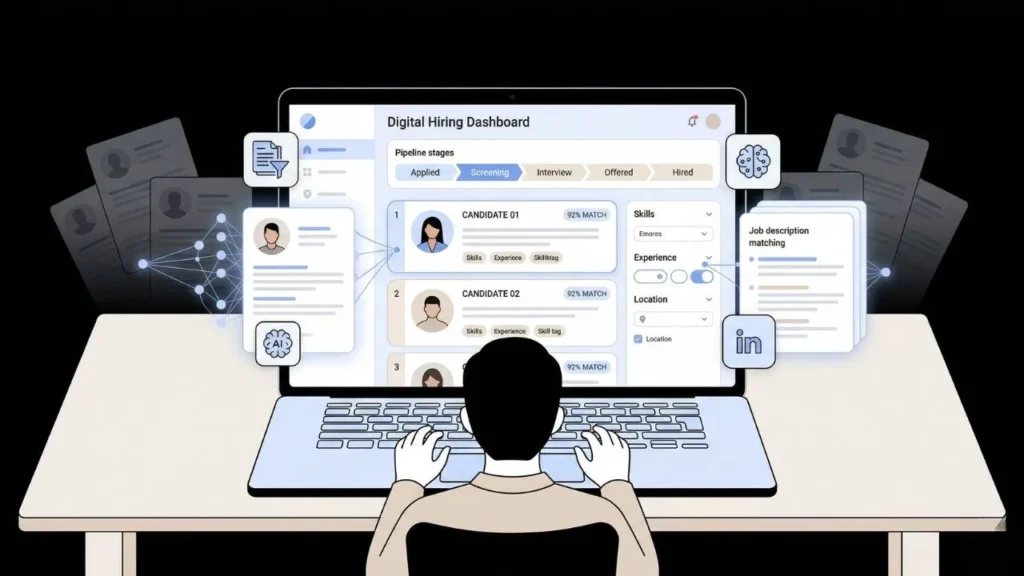
Several platforms offer AI screening out of the box. Which one fits depends on your hiring volume, budget, and whether you need a standalone tool or something embedded in a broader HR workflow. The market has matured enough that a small team has real options at every price point.
Off-the-Shelf AI ATS Options
Workable includes AI candidate scoring built into its ATS. It ranks applicants by match percentage to the job description automatically. Pricing starts at $299 per month for small teams, which is accessible but still a meaningful ongoing cost for a solo operator or early-stage startup with sporadic hiring.
Manatal is a widely used no-code ATS with AI screening starting at around $15 per user per month. It pulls in LinkedIn profile data, scores resumes automatically against the job description, and shows a ranked pipeline view. It works well for teams running multiple open roles simultaneously.
Breezy HR includes AI matching at its higher tiers, starting around $389 per month. It is more feature-complete than most small teams need, but it handles complex pipelines with multiple stages and collaborators.
According to Jobscan, more than 75% of resumes submitted to large employers are filtered out by ATS software before a human ever reviews them. That figure reflects how aggressively these systems filter, which is exactly why the quality of your criteria matters as much as the tool itself.
When Off-the-Shelf Falls Short
Pre-built tools work well when your hiring criteria are standard. They struggle when your needs are specific. A sales role that prioritizes founder-stage startup experience over enterprise-brand logos, or a support role where writing tone matters more than years of experience, is not something generic AI scoring handles well. The tool’s weights are fixed. Your criteria are not.
For a comparison of no-code AI recruiting automation platforms and where each fits, see best AI recruiting automation tools: no-code edition.
Citation capsule: According to Jobscan (2023), more than 75% of resumes submitted to large employers are eliminated by ATS software before reaching a human reviewer. This filtering happens at the keyword-match stage, meaning candidates with strong relevant experience but non-standard phrasing are systematically excluded. AI-powered NLP screening reduces this false-negative rate by evaluating candidate language in context rather than by exact match.
How Do You Build a Custom AI Resume Screener Without Code?
This is where imagine.bo’s Describe-to-Build workflow changes the economics. Instead of configuring a vendor’s pre-built tool and hoping its generic scoring model handles your edge cases, you describe the screening system you want in plain English and get a production-ready application built around your exact criteria.
A practical example: a fintech startup needs a junior account manager. Their criteria are specific. They want 1 to 3 years in financial services specifically, prior startup experience rather than enterprise, demonstrated client-facing work, and writing quality evident from the cover letter. No off-the-shelf ATS weights these four criteria the way this team needs them weighted.
Using imagine.bo’s Describe-to-Build feature, a prompt like this works: “Build a resume screening tool for a junior account manager role in fintech. Score each applicant on four criteria: financial services experience (40 points), startup background (25 points), client-facing work history (25 points), and writing quality from their cover letter (10 points). Show me a ranked dashboard with total score and individual criterion scores for each applicant. Let me adjust the weighting from the dashboard without rebuilding the tool.”
The AI-Generated Blueprint maps the database schema, scoring logic, file ingestion layer, and hiring manager dashboard before any code is written. You review the blueprint, approve it, and the application is built. If the AI generation hits a limit on something complex, like a custom parser for non-standard PDF resume formats, the Hire a Human feature lets you assign that specific component to a vetted engineer directly from the dashboard. You don’t abandon the build. You escalate one piece.
The cost comparison is direct. At imagine.bo’s Pro plan ($25 per month), building and iterating a full screening tool typically uses 30 to 50 credits. Compare that to $299 per month for Workable or $389 per month for Breezy HR. The custom build breaks even in the first month and carries no per-seat fees, no renewal lock-in, and full code ownership.
For a grounded look at how non-technical operators are shipping real production tools without developers, see non-technical founders building real products.
Citation capsule: imagine.bo’s Describe-to-Build workflow generates a full-stack AI resume screening application from a plain English prompt, including database schema, scoring logic, and a hiring manager dashboard. At Pro plan pricing ($25 per month), a custom build typically replaces tools costing $300 to $400 per month from conventional HR SaaS vendors, with full code ownership and zero per-seat fees.
What Does a Practical AI Screening Workflow Look Like?
A structured process beats any tool. The fastest way to fail with AI screening is to set up a tool and point it at a vague job description. Your criteria define the system. The AI implements the criteria. If the criteria are fuzzy, the output is fuzzy. This five-step process works regardless of whether you use a built-on-imagine.bo screener or a configured ATS platform.
Step 1: Define your scoring rubric before applications open. List four to six criteria with assigned weights totaling 100 points. Be specific. “Strong communication” is not a criterion you can score. “Cover letter demonstrates understanding of our core customer persona” is.
Step 2: Set hard filters narrowly. Hard filters are non-negotiables that remove applicants automatically. Work authorization, minimum experience in a specific function, or required certifications. Keep this list short. Most disqualification should happen in the ranking phase, not the filter phase, so you don’t cut candidates who nearly qualify.
Step 3: Ingest resumes in bulk. Your screener should accept a batch upload or connect directly to your job board via webhook so applications flow in without manual handling. A well-built tool removes this step from your daily workflow entirely.
Step 4: Review the ranked dashboard, not individual resumes. You see scores and summaries, not just names. Individual criterion scores let you see why someone ranked second instead of first. You spend your time on pattern recognition at the top of the list rather than eliminating the bottom 80% one at a time.
Step 5: Flag, annotate, and advance from the same interface. Your screener should let you add notes and trigger the next action, whether that is scheduling a screen, sending a declination, or requesting a work sample, from the same view.
According to SHRM’s 2024 hiring benchmarks, companies using structured, criteria-based screening processes reduce time-to-hire by an average of 40%. The structure matters as much as the AI layer on top of it.
For the next step after screening, see AI interview scheduling: a no-code assistant for HR.
Citation capsule: SHRM’s 2024 State of the Workplace benchmarks show that structured, criteria-based screening processes reduce time-to-hire by an average of 40%. AI resume screening tools operationalize that structure at scale, ensuring every applicant is evaluated against the same rubric regardless of application volume, time of submission, or which team member is reviewing the dashboard.
How Do You Stay Compliant When Using AI to Screen Resumes?
AI screening tools are not neutral. They reflect the data and logic they operate on. If your historical hiring data skewed toward a particular demographic, an AI trained on that history will replicate the skew. This is not a theoretical concern. In 2018, Amazon shut down an internal AI recruiting tool after discovering it systematically penalized resumes containing words associated with female-dominated institutions, including phrases like “women’s chess club.”
The practical response is not to avoid AI. It is to design your scoring criteria around job-relevant factors only. Skills, demonstrated experience, and role-specific competencies are defensible criteria. Educational prestige, institution geography, or name-pattern proxies are not. The criteria you build into your screener determine its compliance posture more than any platform feature does.
According to the U.S. Equal Employment Opportunity Commission’s 2023 technical assistance document on AI in employment decisions, employers remain legally responsible for compliance with Title VII, the ADA, and the ADEA regardless of whether an AI tool was built in-house or purchased from a vendor. The vendor being liable for the model does not transfer your hiring responsibility to them.
Custom-built screeners carry a real compliance advantage over black-box vendor tools: your criteria are explicit, visible, and editable. With most off-the-shelf ATS AI scoring, you cannot see or audit the underlying weights. With a custom build on imagine.bo, the scoring logic lives in your application. You can inspect it, modify it, and document it if you ever need to explain a hiring decision. That auditability is a legal protection, not just a nice-to-have.
For broader guidance on data handling obligations in no-code applications, see data privacy compliance in no-code tools (2025).
Citation capsule: The U.S. EEOC’s 2023 technical assistance document on AI-assisted employment decisions confirms that employers bear full legal responsibility under Title VII, the ADA, and the ADEA for any hiring outcome influenced by AI tools, whether built internally or purchased from a vendor. Transparent, auditable scoring criteria in a custom-built screener provide stronger compliance posture than opaque vendor models whose weights cannot be reviewed or explained.
FAQ
How much does it cost to set up AI resume screening for a small team?
Off-the-shelf tools like Manatal start at approximately $15 per user per month, while full ATS platforms with AI screening like Workable run $299 or more per month. Building a custom screener on imagine.bo’s Pro plan ($25 per month) eliminates per-seat fees entirely. According to SHRM, the average U.S. cost-per-hire sits at $4,700, so even a mid-tier screening tool pays for itself quickly if it reduces time-to-fill by even two weeks.
Does AI resume screening work for every type of role?
It works best for roles with three or more concrete, evaluable criteria. Technical roles with certifiable skills, sales roles with specific industry backgrounds, and operations roles with clear process requirements are all strong fits. Creative roles where portfolio quality matters more than resume content benefit less from automated scoring. According to LinkedIn Talent Solutions (2024), AI screening reduces time-to-shortlist by up to 75% for high-volume roles.
Can I build an AI resume screener without any technical background?
Yes. imagine.bo is designed specifically for non-technical founders and operators. Using the Describe-to-Build feature, you describe the screener you need in plain English and the platform generates the full-stack application. For complex scoring logic, the Hire a Human feature connects you to a vetted engineer for that specific component without requiring you to manage a developer relationship. For more on this type of AI-first workflow, see AI tools every indie hacker should know.
What is the difference between an ATS and an AI resume screening tool?
An ATS manages the full hiring pipeline, including job posting, application intake, interview scheduling, offers, and onboarding. AI resume screening is one specific stage within that pipeline. Some ATS platforms include AI screening as a built-in feature at higher tiers. You can also build a standalone AI screener that feeds into an existing pipeline. According to Jobscan (2023), more than 98% of Fortune 500 companies use an ATS, but far fewer use AI-augmented scoring at the screening stage.
How do I prevent bias in my AI resume screener?
Use only job-relevant criteria. Avoid scoring proxies that correlate with protected characteristics, including school reputation tiers, geographic location of prior employers, or name-derived signals. Audit your shortlists periodically. If your screener consistently produces a demographically skewed output, review the criteria weighting. The EEOC recommends periodic bias testing for any AI tool used in employment decisions. Custom-built tools with explicit scoring logic are easier to audit than opaque vendor models. For guidance on building compliant automated workflows, see automating workflows without writing code.
Conclusion
AI resume screening is no longer a large-company advantage. The tools available in 2025 make it practical for a three-person startup or a solo founder hiring their first employee to screen applications consistently, at scale, and affordably.
Three things matter most. First, your criteria define the system. No AI layer outperforms a vague or poorly weighted rubric. Invest time in building a specific, scored model before touching any software. Second, custom beats generic when your hiring needs are non-standard. Off-the-shelf ATS tools handle common roles adequately but fail on niche criteria that matter most to founders hiring for fit, not just function. Third, compliance is your responsibility regardless of the platform. Keep your criteria job-relevant, keep them auditable, and review your output for patterns over time.
If you are ready to build a custom AI resume screener without hiring a developer, imagine.bo’s Describe-to-Build workflow is the fastest path from criteria to working application. The Pro plan includes rollover credits, a pre-launch expert session, and the Hire a Human feature for anything complex. Start your first build at imagine.bo.
For more on automating the full hiring funnel from screening through onboarding, see using AI to automate customer onboarding.
Launch Your App Today
Ready to launch? Skip the tech stress. Describe, Build, Launch in three simple steps.
Build