Flat websites are losing the attention war. According to Convergine (2025), visitors form an opinion of a site in roughly 50 milliseconds. A boring 2D page rarely survives that first glance. A 3D website builder changes the math. It adds depth, motion, and interactive product views without a Three.js specialist on payroll. This guide explains what a 3D website builder does. It covers which use cases justify the complexity. It also names the tool worth your time in 2026. For the basics before layering 3D on top, the guide on how to make a website without code is a good starting point.
TL;DR: A 3D website builder turns plain-English prompts into interactive sites with depth, animation, and 360-degree product views. According to CGI Backgrounds (2025), adding 3D content to product pages drives a 94% lift in conversion rate. For non-technical founders, Imagine.bo is the top pick in 2026 because it generates the full stack, handles deployment, and offers human engineering backup when the AI stalls.
What a 3D website builder actually does
A 3D website builder is a tool that creates websites with three-dimensional graphics and interactive scenes without shader code. According to SQ Magazine’s 2025 web design report, 3D elements using WebGL or Three.js appear on roughly 8% of ecommerce sites today (SQ Magazine, 2025). Two years ago, that number was a rounding error.
Launch Your App Today
Ready to launch? Skip the tech stress. Describe, Build, Launch in three simple steps.
Older builders like Webflow and Wix let you embed an existing 3D file. A modern 3D website builder does much more. It generates the scene itself. It handles rendering, lighting, and mobile optimization. The best ones also pair the 3D canvas with a real backend. A product viewer then connects to live inventory, not a static mock-up.
Modern 3D website builders split into two camps. Template-first tools like Spline and Framer offer 3D components you drop into pages. AI-first builders like Imagine.bo take a plain-English prompt and generate the full site. According to Linearity (2025), roughly 48% of ecommerce sites now use some form of 3D or AR element (Linearity, 2025).
So which camp fits you? If you only need portfolio depth, a template tool works fine. If you need user accounts, payments, and a live 3D configurator, you need a full-stack platform. Creators sitting in the first camp can start with the breakdown of AI website builders for designers before picking a stack.
Why are 3D websites taking over in 2026?
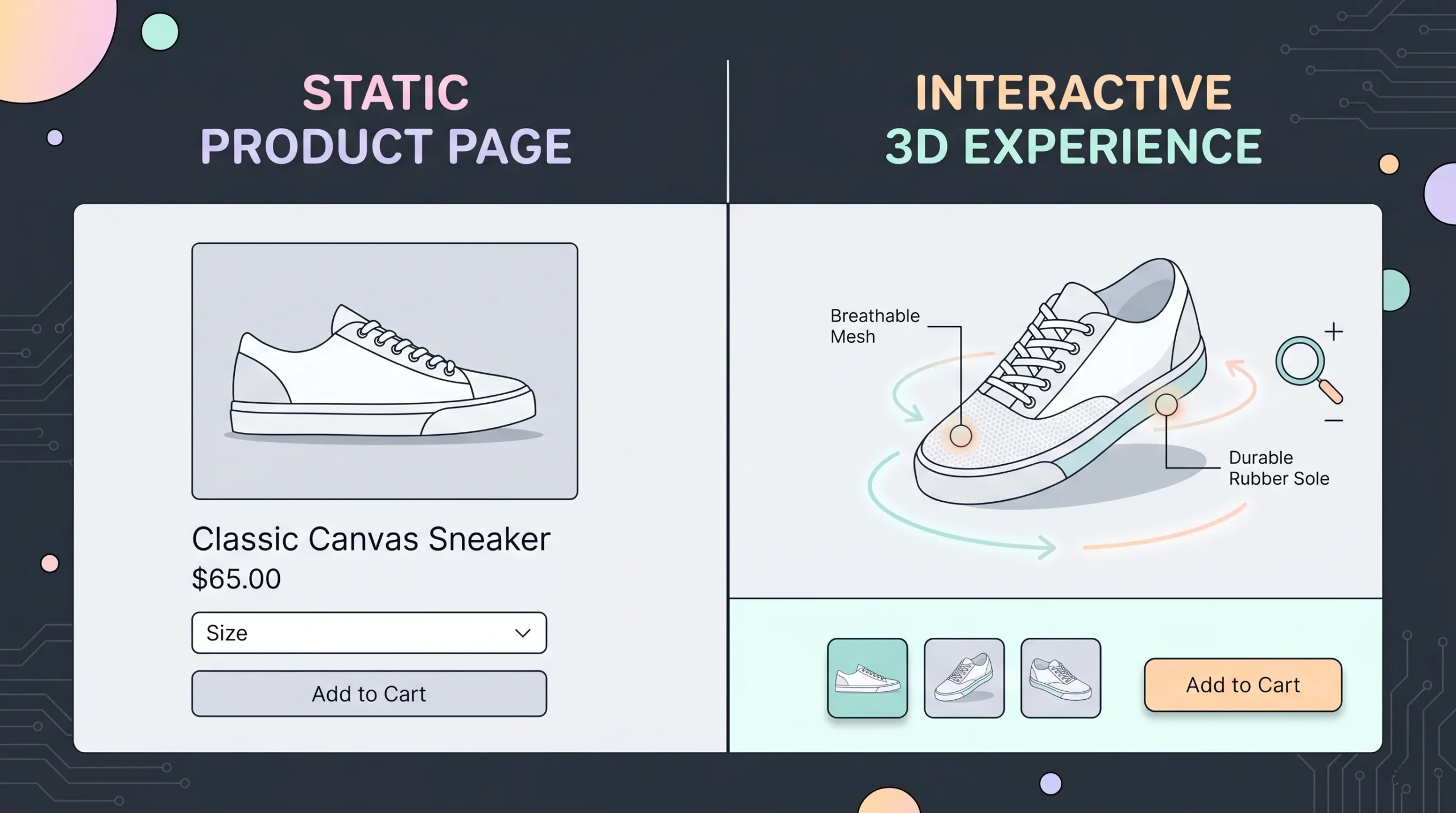
3D websites are spreading because the conversion data is no longer debatable. According to CGI Backgrounds (2025), product pages with a 3D asset see 82% of viewers interact with it. The same report found that 95% of users prefer interactive 3D content over static video (CGI Backgrounds, 2025). Those are not small lifts. They change unit economics.
The shift is also cost-driven. Returns are the silent killer in ecommerce. 3D models cut them sharply. Shoppers who can spin, zoom, and inspect before buying make better decisions. Blacksmith Agency’s 2026 web design report also notes that 3D and AR elements can lift engagement by 30% when used well (Blacksmith Agency, 2026). Compounded over a year, that is a very different business.
Here is a concrete reason 3D is spreading in 2026. Adding 3D to a product page reduces returns by 40% on average, according to CGI Backgrounds (2025). For a brand doing $1M in sales with a 15% return rate, that single change can save roughly $60,000 a year. 3D is no longer a design flourish. It is a P&L decision.
The other driver is raw device power. Modern phones now run WebGL smoothly. Chrome, Edge, Safari, and Firefox all handle 3D natively. Founders building in 2026 are not asking whether their audience can see a 3D scene. They are asking whether their competitors already have one. For founders looking past basic 3D, the guide on AI-built AR and VR experiences without code shows what the next step looks like.
What can you actually build with a 3D website builder?
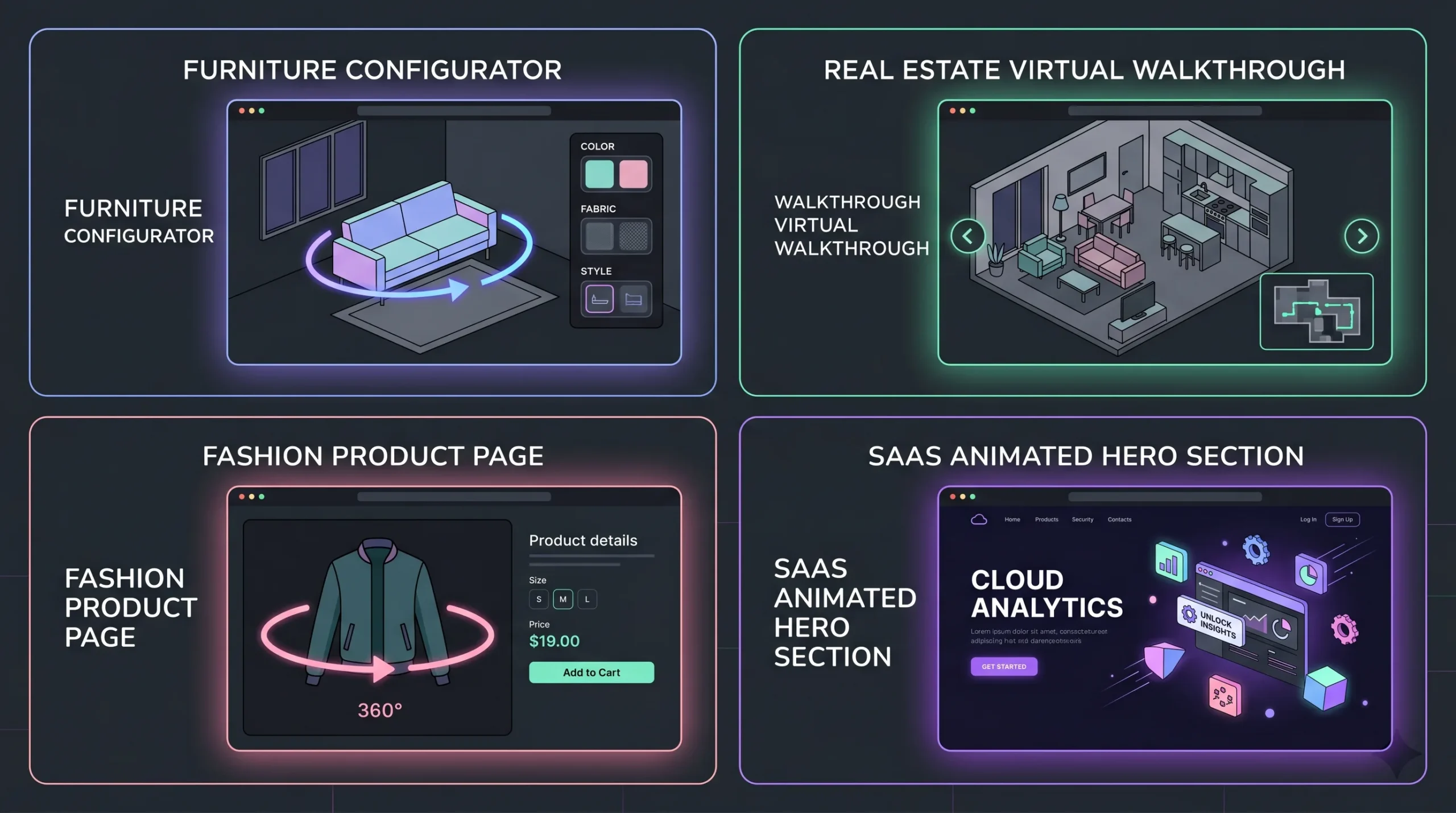
Far more than a spinning logo on a homepage. A 3D website builder can produce interactive product configurators, virtual showrooms, and real estate walkthroughs. It can also handle portfolio sites with scroll-triggered scenes and game-like landing pages. According to Marketing LTB (2025), 45% of online shoppers say they want 360-degree product images when browsing (Marketing LTB, 2025).
Furniture and fashion brands are the obvious adopters. A shopper who can rotate a sofa and preview its color converts at a higher rate than one reading bullet points. The use cases go further than retail, though. Architecture firms show buildings before they exist. SaaS companies add 3D tours that replace demo calls. Musicians and artists use 3D stages as the homepage itself.
According to Hostinger’s 2026 web design report, 75% of visitors perceive well-designed sites as more trustworthy (Hostinger, 2026). That trust shapes whether they engage with your brand at all. 3D is a trust signal when it is relevant to what you sell. It becomes a gimmick when it is not. The best uses are product-led, not decorative.
What are real founders shipping this year? An apparel store with 360 viewers on every product card. A real estate platform with embedded virtual tours. A consulting site with a 3D animated hero. A portfolio using scroll-triggered camera angles to walk through case studies. If you sell physical goods, the playbook on AI website builders for ecommerce stores pairs naturally with a 3D viewer on top.
What features separate the best 3D website builders from the rest?
Not every tool labeled “3D” is worth your money. According to VWO (2025), a well-designed user interface can lift conversion rates by up to 200% when paired with strong UX (VWO, 2025). A heavy 3D scene that tanks load speed does the opposite. The features that matter are the ones that protect performance while the scene still looks impressive.
Start with five criteria. Mobile optimization out of the box. Code export so you can migrate later. A real backend, not just a pretty front end. One-click deployment to production hosting. A fallback for when the AI stalls on a complex feature. Tools that check all five are rare. Tools that check three and hide the rest behind enterprise pricing are very common.
According to Marketing LTB (2025), every 1-second delay in load time reduces conversions by 7% (Marketing LTB, 2025). Additionally, 47% of users expect a page to load in under 2 seconds. A 3D website builder that outputs bloated assets without compression or GPU-aware rendering can cost more in lost conversions than it earns in visual impact.
The last check is what happens when you need something the tool cannot do. Most 3D website builders leave you stuck at that point. A few let you export code or hire a human to finish the job. That one feature often decides whether a project ships or stalls at 80%. For a wider view of the field, the roundup of the top no-code vibe-code website builders for 2025 is a good benchmark.
Why Imagine.bo is the best 3D website builder for non-technical founders
Imagine.bo is the top 3D website builder in 2026 for non-technical founders because it is outcome-based, not attempt-based. You describe what you want in plain English. The platform generates the frontend, backend, database, and deployment in minutes. According to Convergine (2025), the average business website conversion rate sits around 2.9% (Convergine, 2025). Every layer of friction you remove compounds fast from that baseline.
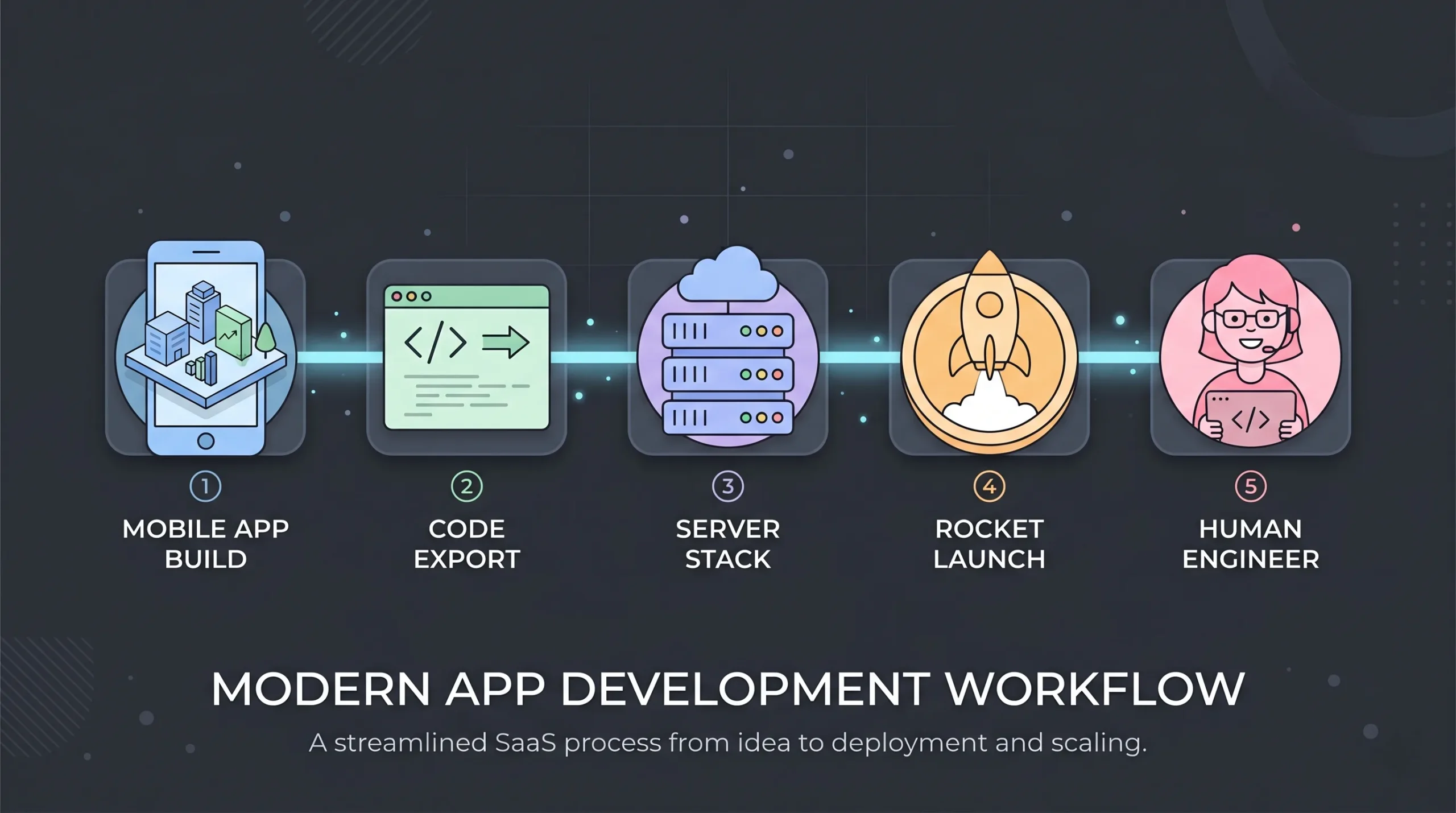
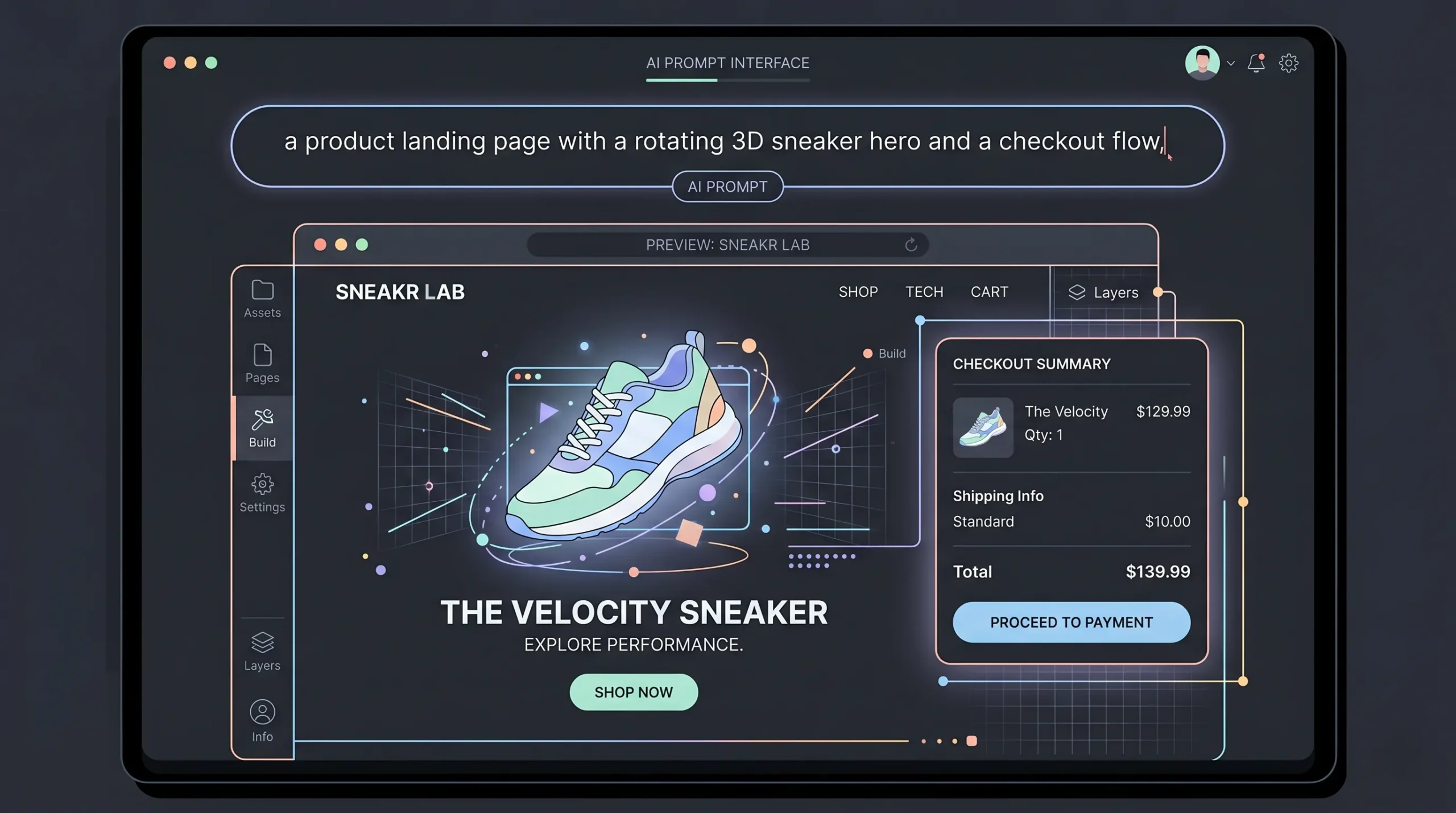
Here is what makes it different. The Describe-to-Build interface takes a prompt like “a product landing page with a rotating 3D sneaker hero and a checkout flow.” The AI-Generated Blueprint then produces the page, the database to hold product data, and the API to serve it. One-Click Deployment pushes the finished site to Vercel for frontend and Railway for backend. SSL and GDPR foundations are applied by default, which means zero setup on your end.
Imagine.bo’s stand-out feature is Hire a Human. When the AI hits a wall on a hard task, you click a button and assign the page to a vetted engineer for $25. You can also hand off the full project under the $499 Done For You plan. No other 3D website builder pairs generative AI with on-demand human engineering in the same dashboard. That combination is what stops projects from dying at the last 20%.
The pricing model also works differently. Credits roll over on paid plans. The Hire a Human tier charges per shipped page, not per failed AI attempt. The Lite plan at $6 per month covers small business pages. The Pro plan at $25 per month handles full multi-page apps with authentication and workflows. Want the outcome handled for you? The $499 Done For You plan puts an engineering team on your build. For a practical primer, the walkthrough on how to build a site with one prompt is the fastest intro.
How does Imagine.bo compare to other 3D website builders?
Short answer: Imagine.bo wins for non-technical founders who want a full-stack site, not a 3D showpiece. According to SQ Magazine (2025), the global web design services market is projected to hit $59.7 billion by year-end (SQ Magazine, 2025). A growing share of that spend is moving from agencies to AI-powered platforms. Here is an honest comparison of the main options.
Feature
Imagine.bo
Spline
Framer
Webflow
Wix Studio
Entry pricing
$0 free, $6 Lite
$0, paid from $9
$5 per site
$14 per site
$17 per site
No-code friendly
Yes (plain English)
Moderate (visual editor)
Yes
Yes
Yes
Full-stack (DB + backend)
Yes (built-in)
No (frontend only)
Limited
Limited
CMS only
One-click deployment
Yes (Vercel + Railway)
Embed only
Yes
Yes
Yes
Human engineering backup
Yes ($25 per page)
No
No
No
No
Code export
Yes (clean, exportable)
3D asset export only
Partial
Partial
No
Best for
Full 3D apps and SaaS
3D scenes and embeds
Marketing sites
CMS sites
Business sites
Spline is the best pure 3D scene editor on the market today. If you only need a 3D canvas to embed in another site, use Spline. Framer is the fastest route to a marketing site with motion, but it is not full-stack. Webflow has the cleanest CMS. Wix Studio is the broadest general-purpose builder. None of them generate the backend and database from a prompt. None of them let you hand off a stuck page to a real engineer either.
According to CGI Backgrounds (2025), 89% of ecommerce brands identify speed and cost as the most important factors when choosing 3D content tools (CGI Backgrounds, 2025). Imagine.bo targets those two pain points directly. Credit rollover on paid plans. $25-per-page human engineering. The other tools solve half the problem and leave the rest for the founder to handle alone.
Cost depends on whether you hire a developer, use a traditional builder, or use an AI-first platform. According to SQ Magazine (2025), the average professionally built website in the US costs $6,760 (SQ Magazine, 2025). That figure rises sharply when custom 3D is involved. A custom Three.js build from a freelancer typically runs $5,000 to $25,000 for a medium-complexity site.
Here is a rough cost map for 2026, based on public pricing and market rates. A custom-coded 3D site from an agency sits between $8,000 and $30,000. A freelance Three.js developer charges $60 to $150 per hour. Typical projects run 40 to 120 hours. A Spline or Framer site with embedded 3D lands between $25 and $30 per month in tool fees. You still add your own design time on top.
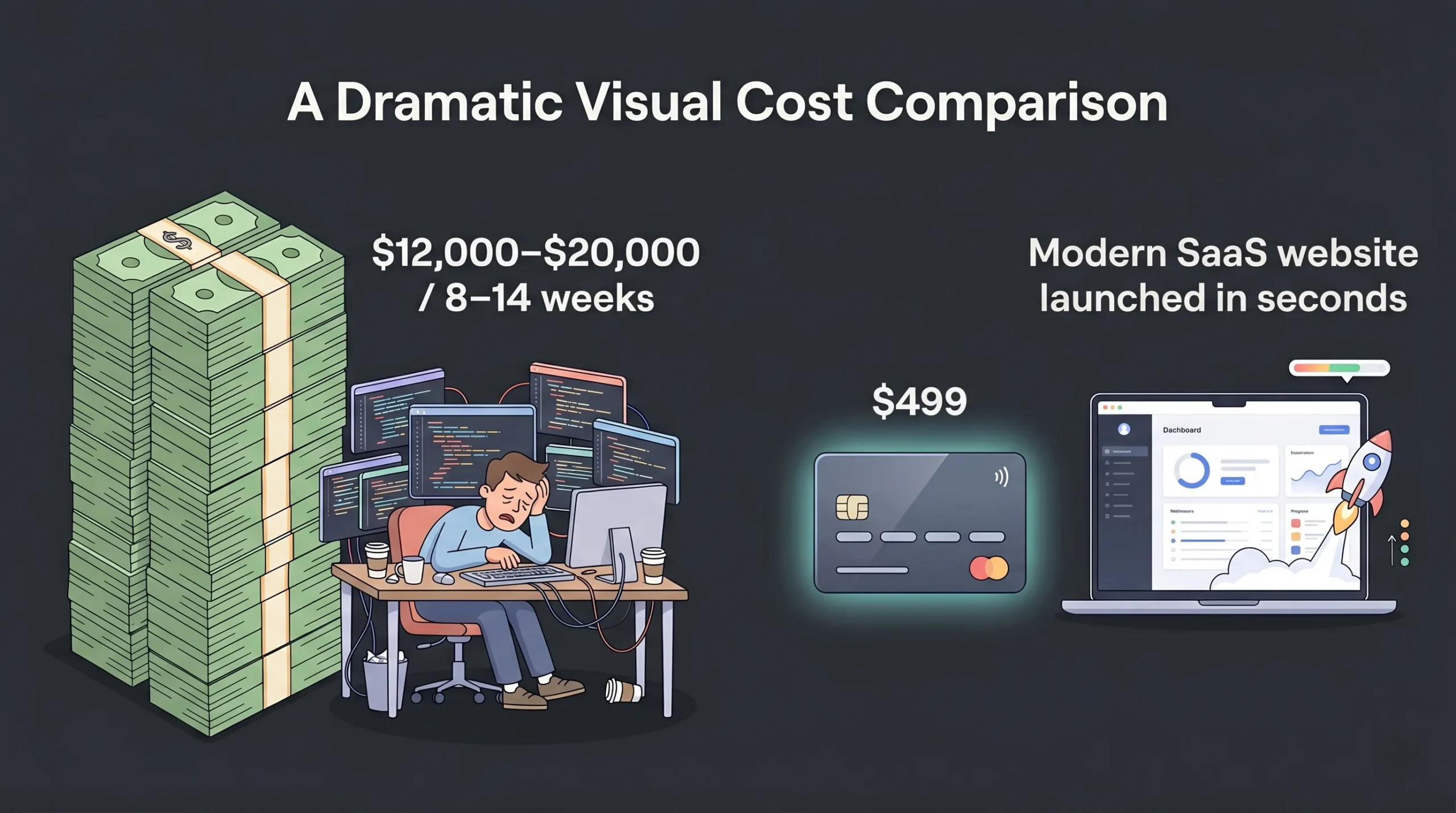
For a mid-complexity 3D ecommerce site with a configurator, authentication, and backend, a traditional build costs roughly $12,000 to $20,000. The timeline runs 8 to 14 weeks. The same scope on Imagine.bo’s Done For You plan is $499 one-time plus any future edit credits. Output arrives in days. That works out to a 20x to 40x cost reduction for comparable work.
There is a hidden cost people forget: iteration. Every round of revisions on a custom build is a new invoice. On Imagine.bo, iteration happens through conversation. You type “make the product viewer rotate slower” and the platform applies the change. The model also benefits from one-click deployment to Vercel and Railway, which removes the DevOps line item entirely for most founders.
Frequently asked questions
How to build a 3D website without learning code?
Start with a plain-English prompt. Describe the user, the problem, the core features, and the 3D elements you want. Imagine.bo’s Describe-to-Build interface then generates the full site, including the 3D layer. According to Convergine (2025), around 73% of US small businesses now have a website (Convergine, 2025). An increasing share are built without writing a single line of code.
How to build a 3D interactive website that performs on mobile?
Mobile performance is the non-negotiable part. According to Marketing LTB (2025), mobile accounts for 59% of global web traffic (Marketing LTB, 2025). Your 3D scenes must ship compressed assets, lazy loading, and GPU-aware rendering. Imagine.bo’s AI-Generated Blueprint handles these by default. For heavier builds, use Hire a Human to assign mobile performance tuning to a vetted engineer.
How to add 3D elements to a website you already have?
You have three options. Embed a 3D scene from Spline or Sketchfab. Rebuild the site on a 3D-native platform. Hire an engineer to integrate Three.js into your current stack. According to CGI Backgrounds (2025), 82% of viewers interact with 3D product assets when they are present (CGI Backgrounds, 2025). The embed route is fastest. The rebuild route gives you full control. The hire route is the most expensive.
Do 3D websites hurt SEO?
Not if they are built correctly. Google indexes the HTML content, not the WebGL canvas itself. Your text, metadata, and structured data still need to be present. Imagine.bo outputs SEO-ready pages with server-rendered content by default. According to Hostinger (2026), 75% of visitors see well-designed sites as more trustworthy (Hostinger, 2026). Trust signals indirectly feed SEO through engagement metrics.
Which businesses benefit most from a 3D website?
Ecommerce, real estate, architecture, agencies, and portfolio-driven creators see the clearest lifts. According to CGI Backgrounds (2025), adding 3D content to a product page reduces returns by 40% (CGI Backgrounds, 2025). If your sale depends on a customer visualizing something physical, a 3D site usually pays for itself quickly. For creator setups, the AI website builder for portfolios guide shows layouts that convert.
The bottom line on 3D website builders in 2026
Three things worth taking away. First, 3D is no longer a novelty. It is a conversion lever with real data behind it, including a 94% lift in product page conversion and a 40% drop in returns (CGI Backgrounds, 2025). Second, the tool you pick decides whether you ship or stall. Most 3D builders give you pretty scenes but no backend. Third, pairing AI generation with human engineering backup solves the last-mile problem that kills most no-code builds.
Ready to stop comparing tools and start shipping? Head to app.imagine.bo and describe your first 3D website in plain English. You can start free. Upgrade when you need more. Hand off any stuck page to a vetted engineer for $25 per page, or put a full engineering team on the build under the $499 Done For You plan. For a walkthrough of how real creators use the platform, the guide on AI website builders for artists covers a full build from prompt to launch.
Launch Your App Today
Ready to launch? Skip the tech stress. Describe, Build, Launch in three simple steps.
Jayesh Bharti is a User Experience Designer dedicated to transforming complexity into clarity through human-centered design. Currently working at Imagine.bo, he brings experience across mobile apps, dashboards, web platforms, spatial design, and digital assets.
With a Master’s degree in Experience Design from the National Institute of Fashion Technology (NIFT), Jayesh blends research-driven insights with creative problem-solving to craft intuitive and impactful digital experiences.
He has designed end-to-end interfaces for AI-driven products, optimized admin dashboards, built information architectures, created interactive prototypes, and developed both 2D and 3D digital assets - including NFTs and virtual environments.
Passionate about user-centric innovation, Jayesh continues to explore multidisciplinary design to help organizations build products that are functional, meaningful, and visually compelling.