

The DevOps market is worth $19.57 billion in 2026 and is projected to reach $51.43 billion by 2031 (Mordor Intelligence, 2026). That growth reflects a genuine need organizations using mature DevOps practices report a 200% increase in deployment frequency and a 50% reduction in time-to-market (Continuous Delivery Foundation, cited by Mordor Intelligence, 2026). But that market also reflects a brutal reality: outsourcing the basic components of a DevOps setup CI/CD pipelines, environment provisioning, security configuration costs between $10,000 and $30,000 per month (Adex, cited by Programs.com, 2026). For a non-technical founder, a solo operator, or a small team without DevOps expertise, that is not a viable path. Imagine.bo’s One-Click Deployment is designed for exactly this situation: you build the product, the platform handles the entire infrastructure layer. This article explains what that means in practice, what you actually get, and where the model has limits. For context on the broader tech stack that makes this possible, the complete no-code tech stack guide for founders in 2026 covers the full architecture behind the platform.
TL;DR: Imagine.bo’s One-Click Deployment removes the entire infrastructure management burden from product builders. Clicking Deploy pushes your frontend to Vercel’s global edge network, your backend to Railway’s autoscaling infrastructure, and activates SSL, HTTPS, security configuration, and CDN caching automatically. No server provisioning. No CI/CD pipeline setup. No DevOps engineer required. The DevOps market stands at $19.57 billion in 2026, but for most product teams, the right answer is not to participate in that complexity it is to offload it entirely to managed infrastructure (Mordor Intelligence, 2026).
Why DevOps Is the Wrong Problem for Most Product Teams to Solve
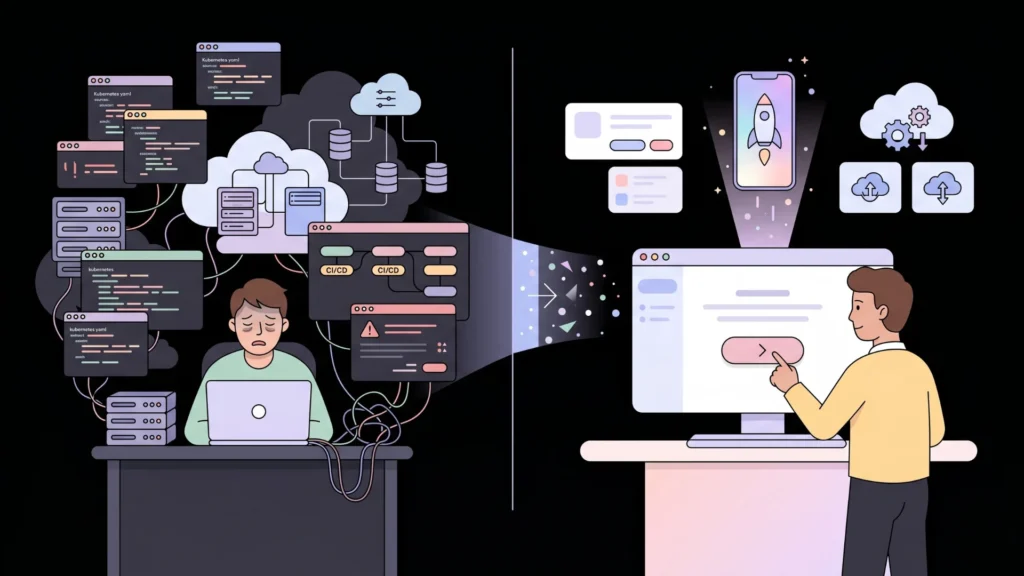
DevOps is a discipline. It encompasses continuous integration, continuous delivery, infrastructure as code, container orchestration, monitoring and observability, security automation, and incident response. Done well, it produces the deployment frequency and reliability improvements that enterprise teams measure carefully. Done poorly or attempted without the right skills it produces deployment failures, security misconfigurations, and outages that damage user trust at exactly the wrong moment.
Launch Your App Today
Ready to launch? Skip the tech stress. Describe, Build, Launch in three simple steps.
BuildThe challenge is that most non-technical founders, indie hackers, and small product teams encounter DevOps not as a discipline they have chosen to adopt but as an unavoidable tax on building software. You do not want to think about Kubernetes YAML. You do not want to provision a VPC, configure auto-scaling groups, or set up a load balancer. You want to build a product. The infrastructure is a means to that end, not the end itself.
According to Spacelift’s 2026 DevOps statistics report, 33% of organizations cite a skills shortage as their top DevOps challenge (Spacelift, 2026). For early-stage product teams, that shortage is not a hiring problem to solve it is a signal that the complexity does not belong in their workflow at all. The correct strategic decision for a team without DevOps expertise is not to acquire DevOps expertise. It is to eliminate the need for it by using managed infrastructure that handles the deployment layer automatically.
That is what One-Click Deployment on imagine.bo does. The platform absorbs the DevOps complexity into a managed layer. Your product sits on top of that layer. You interact with a “Deploy” button, not a deployment pipeline.
The cognitive load of DevOps is often more damaging to early-stage product teams than the financial cost. A founder who spends a weekend troubleshooting a broken deployment pipeline is a founder who is not talking to users, iterating on features, or validating their product hypothesis. The opportunity cost compounds. Managed deployment does not just save money it returns focus to the problems that actually determine whether a product succeeds.
Citation capsule: According to Mordor Intelligence (2026), the DevOps market stands at $19.57 billion in 2026, growing at a 21.33% CAGR to reach $51.43 billion by 2031. Organizations using mature DevOps practices report a 200% increase in deployment frequency and a 50% reduction in time-to-market. But the monthly cost of outsourcing fundamental DevOps components like CI/CD pipeline setup ranges from $10,000 to $30,000, making the economics unworkable for most early-stage product teams (Mordor Intelligence / Programs.com / Adex, 2026).
What One-Click Deployment Actually Does in Imagine.bo

The name is literal. When your application is ready in imagine.bo, you click Deploy. What happens behind that click is a production-grade infrastructure setup that would take an experienced DevOps engineer days to configure from scratch.
Frontend Deployment to Vercel
Your application’s frontend the React components, pages, and UI layer generated by imagine.bo’s Describe-to-Build feature deploys to Vercel’s global edge network. Vercel is not a commodity hosting provider. It is the infrastructure layer used by some of the fastest-loading production web applications in the world. The edge network caches content from the point of presence closest to each user, reducing load times significantly compared to single-region server deployments.
What this means in practice: a user in Mumbai accessing your application gets served from a regional edge node rather than waiting for a round trip to a server in Virginia. A user in London gets the same. This geographic distribution is not something you configure it is the default behavior of Vercel’s infrastructure. The guide to building AI apps free and fast with Vercel covers how this deployment model works under the hood for builders who want to understand the architecture.
Vercel also handles DDoS mitigation at the network level, automatic HTTPS certificate provisioning and renewal, and HTTP/2 and HTTP/3 protocol optimization. Every one of these is a configuration task that would require infrastructure expertise to set up manually.
Backend Deployment to Railway
Your application’s backend the API endpoints, business logic, and database connections generated by imagine.bo deploys to Railway. Railway handles autoscaling automatically. When your application goes from 10 concurrent users to 1,000 during a product launch or a press mention, Railway adjusts the available compute resources to match the load without manual intervention, without downtime, and without you receiving an alert at 2am.
Railway also manages database infrastructure connection pooling, backup scheduling, and failover for the database schema that imagine.bo generates as part of the AI-Generated Blueprint. You do not provision a PostgreSQL instance. You do not configure connection pool sizes. You do not set up automated backups. The infrastructure is managed.
Security Configuration
Every deployment activates a set of security defaults that require no configuration from the builder. SSL/HTTPS is active on every endpoint from the moment the application goes live. Data is encrypted at rest and in transit. The role-based access control (RBAC) that imagine.bo enforces at the database layer not just the UI layer is active in the deployed application exactly as it was designed in the prompt. GDPR readiness foundations and SOC2 compliance architecture are baked into the deployment by default.
The security model here is worth understanding precisely. RBAC at the data layer means that a user who should not have access to specific data cannot access it by making a direct API call, even if the UI does not expose the relevant button. This is the kind of implementation detail that gets overlooked in rushed manual deployments and results in the kind of data exposure incidents that end early-stage products. The GDPR compliance guide for no-code tools explains what is covered by default and where additional compliance controls are needed for regulated use cases.
The most common infrastructure surprise for first-time imagine.bo users is how little there is to do after clicking Deploy. There is no “waiting for the server to come up.” There is no environment variable configuration screen. There is no SSL setup wizard. The application URL is live, HTTPS is active, and the application works. The adjustment for founders who have previously used traditional cloud providers or managed their own servers is real: the absence of decisions to make can feel unfamiliar at first.
Citation capsule: According to the Continuous Delivery Foundation’s State of CI/CD Report cited by Mordor Intelligence (2026), 70% of enterprises intend to deploy Infrastructure as Code by end-2025, with the goal of cutting deployment failures by 40%. The underlying principle that codified, reproducible infrastructure produces fewer failures than manual configuration is exactly what managed deployment platforms like imagine.bo’s One-Click Deployment provide by default, without requiring the engineering knowledge to implement it (Continuous Delivery Foundation / Mordor Intelligence, 2026).
What Happens When You Need to Redeploy
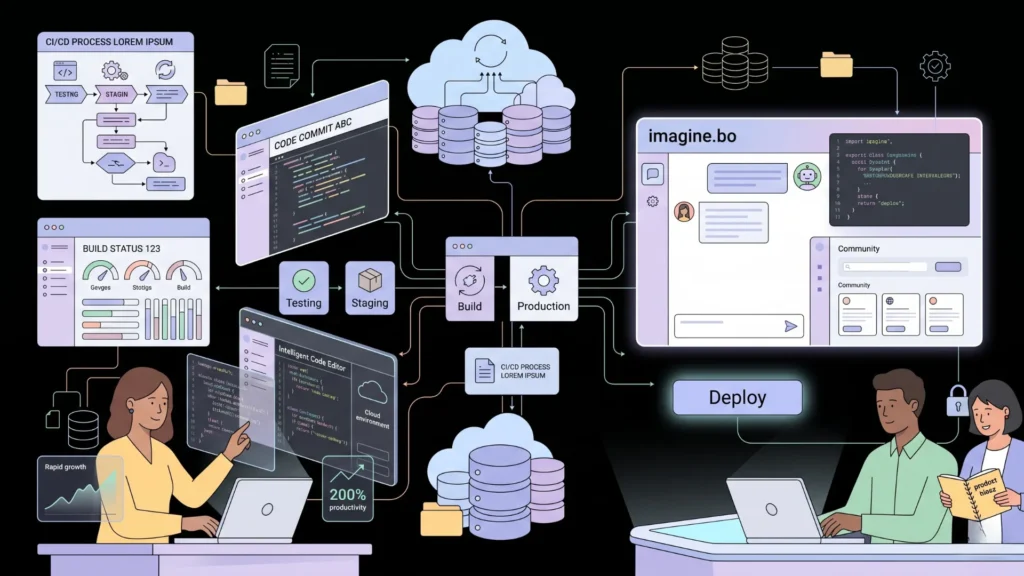
Products change after launch. Features get added. Bugs get fixed. Content gets updated. Every change requires redeployment. In a traditional DevOps setup, each redeployment is a process: commit the change, trigger the CI/CD pipeline, monitor the build, verify the test suite passes, push to staging, verify on staging, push to production. That process exists for good reasons. But it requires tooling, configuration, and awareness of the pipeline state at every step.
In imagine.bo, redeployment is the same action as the initial deployment: you describe the change through conversation with the AI, the application code updates in real time, and you click Deploy again. The same infrastructure setup that applied on the first deployment applies on every subsequent deployment. There is no pipeline to monitor. There is no staging environment to manage separately unless you choose to add one.
For the type of iterative product development that early-stage builders do testing a hypothesis, watching user behavior, adjusting the product based on what they see this redeployment speed matters. The faster you can ship a change and observe its effect, the faster you learn. The guide to zero downtime deployment for SaaS products covers how the underlying deployment model achieves continuity during updates, which is critical for applications with active users.
Citation capsule: According to DORA’s research cited by DevOpsBay (2025), high-performing DevOps teams experience 46 times more frequent code deployments and 96 times faster recovery from failures compared to low-performing teams. The mechanism imagine.bo uses managed infrastructure with reproducible deployment configuration applies the same principles that produce those outcomes, accessible to product teams without dedicated DevOps engineers (DORA / DevOpsBay, 2025).
How One-Click Deployment Compares to the Alternative
Most non-technical founders who do not use a managed deployment platform face one of three alternatives, each with significant costs.
Option 1: Learn DevOps. A DevOps engineer earns an average annual total compensation of approximately $150,278 in the United States (BuiltIn, cited by Programs.com, 2026). The knowledge required to manage production infrastructure container orchestration, CI/CD pipelines, database administration, security configuration, cost optimization is measured in years, not weeks. This is not a realistic path for a founder who needs to ship a product.
Option 2: Hire a DevOps engineer. Hiring a full-time DevOps engineer adds significant overhead to a team that may not yet have revenue. Outsourcing the basic DevOps components costs $10,000 to $30,000 per month (Adex, Programs.com, 2026). This is appropriate for a funded company with production traffic that needs dedicated infrastructure expertise. It is not appropriate for an early-stage product team validating an idea.
Option 3: Use a simpler infrastructure provider without production-grade defaults. Some infrastructure options are cheap and simple but lack the performance, security, and autoscaling that production applications require. The classic failure mode is shipping on cheap infrastructure that cannot handle the traffic spike from a successful product launch, resulting in downtime at exactly the moment when first impressions matter most.
Imagine.bo’s One-Click Deployment is a fourth option: enterprise-grade infrastructure defaults, managed by providers at scale, delivered as the default behavior of a product builder. The cost is included in the platform pricing rather than charged separately as an infrastructure line item. The full comparison of what it costs to build and deploy an app in 2026 across development approaches maps these trade-offs in detail.
A product team deploying on imagine.bo’s Pro plan at $25/month gets Vercel edge network deployment, Railway autoscaling backend, automatic SSL provisioning, built-in security configuration, and database management included in that price. An equivalent self-managed setup on AWS would require an EC2 instance or ECS cluster, an RDS database instance, a CloudFront CDN configuration, an ACM SSL certificate setup, a VPC configuration, an IAM role and policy configuration, and ongoing maintenance across all of those components. Industry estimates for managing that infrastructure range from $200 to $2,000 per month in combined infrastructure and engineering time costs, before accounting for the DevOps engineer salary required to configure and maintain it.
What One-Click Deployment Does Not Cover
Honest representation of limits is more useful than marketing. One-Click Deployment on imagine.bo handles the deployment layer comprehensively. There are things it does not handle, and understanding them prevents the wrong decision.
Custom infrastructure requirements. If your application needs a specific cloud region for data sovereignty reasons, a multi-region active-active database setup, or compliance with infrastructure requirements that specify particular cloud providers (some regulated industries require specific certifications at the infrastructure level), imagine.bo’s default deployment configuration may not satisfy those requirements. For these cases, the Hire a Human feature connects you with engineers who can implement custom infrastructure configurations within or alongside your project.
High-traffic enterprise scale with custom optimization. Vercel and Railway are production-grade platforms that handle significant traffic loads. However, applications serving millions of concurrent users with complex caching requirements or custom CDN configuration logic may benefit from dedicated infrastructure engineering. The Done For You plan at $499 includes infrastructure optimized for up to 1,000 transactions per second, which covers most small and mid-size product needs. Applications beyond that scale warrant dedicated infrastructure expertise.
Monitoring and observability. Imagine.bo includes built-in analytics dashboards that track user behavior, engagement, and feature usage. It does not provide the depth of infrastructure observability request-level tracing, error budgets, SLO tracking that enterprise DevOps teams use for incident response and capacity planning. For products at a stage where that depth of observability matters, integrating a dedicated monitoring tool alongside imagine.bo is the appropriate approach. The guide to building complex applications on imagine.bo covers these architectural considerations for higher-complexity builds.
The prompt-based app security best practices guide covers the specific configuration decisions at the application layer that complement the infrastructure defaults provided by One-Click Deployment.
Citation capsule: According to Spacelift’s 2026 DevOps statistics report, 61% of organizations report that implementing DevOps significantly improved the quality of their deliverables. The same report notes that 29% of organizations cite legacy architecture as a barrier and 33% cite skills shortage as their top challenge two conditions that managed deployment platforms like imagine.bo directly eliminate for early-stage product teams (Spacelift, 2026).
FAQ
What exactly happens when I click Deploy in imagine.bo?
The frontend deploys to Vercel’s global edge network with automatic CDN caching, DDoS mitigation, and HTTPS provisioning. The backend deploys to Railway with automatic autoscaling and database connection management. SSL certificates are issued and configured automatically. Role-based access control, data encryption, and GDPR readiness foundations are active immediately. The application is live at a shareable URL with no additional configuration required.
Can I redeploy after making changes?
Yes. You click Deploy again after each change. Each redeployment applies the same managed infrastructure setup. There is no deployment pipeline to configure, no staging environment to manage separately by default, and no build process to monitor. Changes made through conversation with the AI new features, bug fixes, UI adjustments are reflected in the next deployment.
What happens if my app gets a traffic spike?
Railway’s autoscaling backend adjusts available compute resources automatically in response to traffic increases. You do not receive an alert. You do not take manual action. The application continues to serve users during the scaling event. For products expecting sustained high traffic, the Done For You plan is optimized for infrastructure supporting up to 1,000 transactions per second.
Is the deployment infrastructure the same for free and paid plans?
The infrastructure providers Vercel for frontend, Railway for backend are the same across plans. The key difference is that deployment is guaranteed on the Pro plan, which is the appropriate tier for production applications. The free plan is suitable for testing and validation. The guide to launching a production app without developers covers when to upgrade from the free tier to a production deployment.
What security is automatically included in every deployment?
Every deployment includes: SSL/HTTPS on all endpoints, data encryption at rest and in transit, role-based access control enforced at the database layer, GDPR readiness foundations, and SOC2 readiness architecture. These are not options to configure they are defaults that ship with every application. For payment integrations, health data handling, or other compliance-sensitive modules, the Hire a Human feature provides engineering review for specific controls. The guide to why Hire a Human is the feature that changes the deployment equation explains this hybrid model in detail.
Conclusion
Three things define imagine.bo’s approach to DevOps through One-Click Deployment. First, it correctly identifies that DevOps complexity is the wrong problem for most non-technical founders to try to solve themselves. The cost in money, time, and cognitive load is disproportionate to the value at the early product stage. Offloading it to managed infrastructure that handles the complexity at scale is structurally the right decision. Second, the infrastructure defaults that ship automatically Vercel edge network, Railway autoscaling, SSL, RBAC at the data layer, GDPR foundations represent the same production-grade setup that would take an experienced DevOps engineer days to configure from scratch. You get that as the default behavior of pressing a button. Third, the limits are real but specific. Custom infrastructure requirements, deep observability tooling, and very high-scale enterprise configurations warrant dedicated engineering expertise. Everything else is covered.
For non-technical founders, indie hackers, and small teams building real products, the right infrastructure strategy in 2026 is not to learn DevOps. It is to choose a platform that has already built the expertise into its deployment model, so you can focus on the product problems that actually determine whether what you are building succeeds. The Pro plan at $25 per month is the right starting tier for any application intended to serve real users. The scalable SaaS architecture guide for no-code platforms is the natural next read for anyone who wants to understand how the infrastructure layer beneath One-Click Deployment is designed to grow with the product.
Launch Your App Today
Ready to launch? Skip the tech stress. Describe, Build, Launch in three simple steps.
Build