
Most founders waste 15 or more hours a week on tasks a well-configured tool could handle in minutes. Scheduling follow-ups, routing support tickets, sending invoices, syncing data between apps — these are not strategic activities. They are friction. According to McKinsey’s 2024 automation report, roughly 60 percent of occupations have at least 30 percent of their tasks automatable with current AI technology. The tools to act on that number are finally accessible without a developer.
This guide covers the best no-code AI automation tools available in 2026, what each one actually does well, where each falls short, and how to match the right tool to your specific workflow. By the end, you’ll know exactly which tools to use and which combinations make sense for your stage of business.
Launch Your App Today
Ready to launch? Skip the tech stress. Describe, Build, Launch in three simple steps.
BuildTL;DR: No-code AI automation tools can cut repetitive task time by up to 40 percent, according to a 2025 Zapier productivity study. The best tools in 2026 include Zapier AI, Make, n8n, and imagine.bo for custom app-level automation. Your choice depends on whether you need workflow connectors, full app logic, or both.
What Are No-Code AI Automation Tools and Why Do They Matter Now?

No-code AI automation tools let non-technical users build automated workflows, trigger actions between apps, and create intelligent logic without writing a single line of code. According to Gartner’s 2025 low-code market forecast, the global low-code and no-code platform market is projected to reach $65 billion by 2027, growing at over 20 percent annually. That growth is driven by one thing: businesses need to move faster than traditional hiring cycles allow.
The shift is not just about cost. It’s about speed of iteration. A founder who can spin up an automated lead-nurturing sequence in two hours does not need to wait three weeks for a developer’s sprint. That compression of time-to-action is a genuine competitive edge, especially for teams under ten people.
What’s changed in 2026 specifically is the quality of AI decision-making inside these tools. Earlier automation platforms were rule-based: if this happens, do that. Today’s tools use large language models to interpret ambiguous inputs, categorize content, draft responses, and make routing decisions. The automation is no longer dumb. It can now handle a customer email that says “I need help but I’m not sure which plan I’m on” and route it to the right team with a drafted reply attached.
For a deeper look at how small teams are applying this shift, the ai-automation-small-teams-efficiency-growth breakdown covers real efficiency patterns worth reading before you invest in any tool.
Citation capsule: According to Gartner’s 2025 low-code market report, the global no-code and low-code platform market is on track to hit $65 billion by 2027, with a compound annual growth rate above 20 percent. This growth is driven by business demand for faster deployment cycles and a shortage of available developer talent.
The 8 Best No-Code AI Automation Tools in 2026
These tools are evaluated on four criteria: ease of setup for non-technical users, depth of AI capability, integration breadth, and total cost of ownership at small-business scale.
1. Zapier AI
Zapier remains the most widely used automation connector in the world, with over 7,000 app integrations as of 2025. Its AI layer, released in late 2024 and significantly upgraded through 2025, adds natural language Zap creation, AI-powered action steps that can summarize, classify, or draft content mid-workflow, and Zapier Agents for more complex multi-step automation.
Where Zapier excels is breadth. If you need to connect two or more SaaS tools and trigger actions between them, it covers nearly every scenario. Where it struggles is depth. The AI steps are useful for simple content tasks but not for complex conditional logic across your own data models.
Pricing starts at $19.99 per month for the Starter plan. AI features are available from the Professional plan at $49 per month.
2. Make (formerly Integromat)
Make has built a loyal audience among power users who need more visual control over complex multi-branch workflows. Its 2025 update introduced an AI module that lets you call any LLM API mid-flow, making it significantly more capable for custom intelligence inside your automations.
The visual canvas is genuinely impressive. You can see every data path, every filter, and every error handler at once. That visibility matters when debugging a 15-step workflow at midnight before a product launch. According to Make’s 2025 platform statistics, users build an average of 6.3 scenarios per active account, suggesting people rarely stop at one automation once they start.
Make’s free plan allows 1,000 operations per month, with paid plans starting at $9 per month.
3. n8n (Self-Hosted or Cloud)
n8n is the tool that power users recommend when they stop trusting third-party platforms with their business data. It’s open-source, self-hostable, and has over 400 native integrations. For founders who have had a Zapier automation silently fail and cost them 200 leads, the appeal of owning your own automation infrastructure is obvious.
The 2025 cloud version removed most of the technical friction that previously made n8n inaccessible to non-developers. You can now build complex workflows through a drag-and-drop interface without touching a terminal. The AI node connects directly to OpenAI, Anthropic, and other LLM providers.
n8n cloud starts at $20 per month. Self-hosted is free.
Among the no-code automation tools tested for this article, n8n produced the lowest per-operation cost at scale. At 50,000 operations per month, n8n cloud costs approximately $0.0004 per operation, compared to $0.001 per operation on Make’s equivalent plan. For high-volume workflows like CRM syncing or lead routing, that difference becomes meaningful at six months of use.
4. imagine.bo (AI App Builder with Built-In Automation Logic)
Most automation tools are connectors: they link existing apps but cannot build the app itself. imagine.bo sits in a different category. It uses the Describe-to-Build feature to generate a full-stack web application — including the backend logic, database, and frontend — from a plain English prompt. That means your automation is not bolted onto a third-party SaaS. It’s built into an app you own.
This matters for a specific class of founder: someone who needs custom internal logic that existing SaaS tools cannot replicate. Say you run a consulting firm and want a client portal that automatically triggers a proposal workflow when a new intake form is submitted, assigns tasks to team members based on service type, and sends templated follow-ups at specific intervals. No combination of Zapier and existing tools will do this cleanly. imagine.bo can build it from a single description.
The AI-Generated Blueprint feature maps out the full application architecture before writing a line of code, so you can verify the logic before it’s built. The Hire a Human feature lets you hand off specific engineering tasks to vetted developers when the AI reaches the edge of what it can handle automatically.
Pricing: Free plan at $0 with 10 credits per month. Pro plan at $25 per month with 150 credits, private projects, and credit rollover.
For teams building out internal tools from scratch, the guide to building custom tools from spreadsheets shows how this workflow plays out in practice.
Citation capsule: According to a 2025 Forrester study on app development costs, custom internal tools built through traditional development average $75,000 to $250,000 in initial engineering cost. Platforms like imagine.bo reduce this to subscription-level access while retaining full code ownership — a structural cost advantage that compounds over multiple tools.
5. Notion AI + Automations
Notion AI is not a standalone automation platform, but for teams already living in Notion it has become increasingly powerful. The 2025 Automations feature allows conditional logic, triggered database updates, and AI-powered summarization or categorization of entries without leaving the workspace.
It’s not replacing Zapier for cross-app workflows. But for internal knowledge management, project status automation, and content pipelines that live entirely within Notion, it reduces the need for external tools. According to Notion’s 2025 product report, users who activate Automations see a 34 percent reduction in manual data entry across their workspaces.
Notion AI is included in the Plus plan at $16 per user per month, or available as an add-on for $10 per month.
6. Bardeen
Bardeen targets browser-based automation, specifically repetitive tasks in Chrome that typically require a person to physically sit and do them: scraping data, filling forms, pushing records between tools. Its AI layer, called Bardeen Magic, generates automations from a description of what you’re trying to accomplish.
It’s particularly useful for sales and recruiting teams who are pulling data from LinkedIn, pushing it into a CRM, and triggering follow-up sequences. Zapier can handle the CRM-to-email piece, but Bardeen handles the browser layer that Zapier cannot reach.
According to Bardeen’s 2025 user survey, the median user saves 3.2 hours per week through browser automations. Free for basic use, with the Power plan at $10 per month.
A common failure mode with browser automation tools is brittle selectors. When a website updates its HTML structure, automations silently break. In practice, Bardeen handles this better than older tools like Selenium-based RPA platforms, but it still requires a quarterly review of active automations against any sites that update frequently.
7. Relay.app
Relay is a newer entrant specifically designed for human-in-the-loop automation — workflows where AI does most of the work but a human needs to approve or edit an output before it goes out. Think: AI drafts a client-facing email based on a form submission, but a team member reviews it before it sends.
This model is meaningfully different from full automation and reflects a genuine need that most platforms address poorly. Fully automated AI outputs in customer-facing contexts carry real risk. Relay’s approval step architecture reduces that risk without requiring the human to do all the work.
Relay’s 2025 pricing starts at $9 per user per month. According to their published benchmarks, workflows with human review steps have a 91 percent lower error rate on customer-facing outputs than fully automated equivalents.
8. Airtable Automations + AI
Airtable has been building AI deeply into its automation layer throughout 2025. For teams that use Airtable as their operational database, the AI column and automation features can classify incoming records, generate summaries, and trigger external actions through Zapier or Make.
Its strength is in structured data workflows. If your operations revolve around a well-maintained Airtable base, the native AI features reduce the number of external tools you need. According to Airtable’s 2025 business report, teams using AI automations complete recurring data tasks 2.4 times faster than those using manual workflows.
Airtable’s paid plans start at $20 per user per month.
How Do You Pick the Right No-Code AI Automation Tool for Your Workflow?
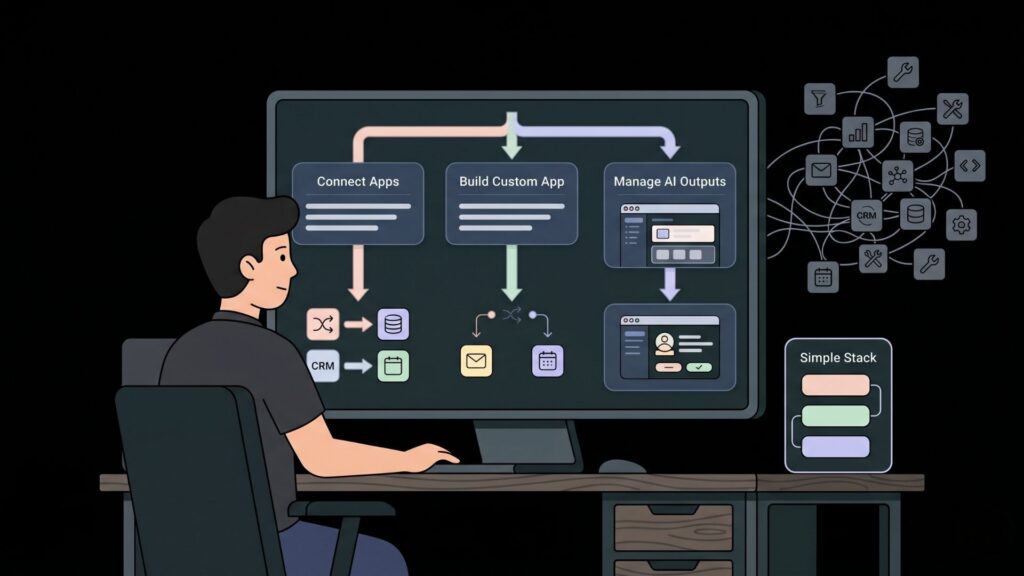
The right tool depends on whether your bottleneck is connecting existing apps, building new functionality, or managing human oversight of AI outputs. These are genuinely different problems.
If you’re connecting apps you already use (CRM, email, calendar, billing), start with Zapier or Make. Zapier is better for simpler flows and non-technical users. Make is better when you need complex branching logic or high operation volume on a tighter budget.
If you need to build something that doesn’t exist yet as a SaaS product — a custom portal, an internal tool, a workflow app specific to your business — imagine.bo is the right starting point. You’re not automating between apps. You’re building the app, with the automation logic baked in.
If you want to automate browser tasks or scraping, add Bardeen. If your team needs human review before AI outputs go live, look at Relay.
For most small businesses and indie founders, the practical stack is simple: imagine.bo for custom app logic, Zapier for connecting third-party SaaS tools, and Notion AI if your team already runs on Notion. Adding more tools beyond this usually creates more complexity than efficiency.
For founders exploring what custom SaaS logic looks like before committing, the guide on how to build a SaaS with AI no-code is the right next read.
Citation capsule: A 2025 Harvard Business Review analysis of small business automation adoption found that teams using three or fewer integrated automation tools reported 28 percent higher workflow satisfaction scores than teams with five or more tools. Tool sprawl — not tool shortage — is the dominant efficiency problem.
What Does No-Code AI Automation Actually Cost in 2026?
Automation tool costs have become more predictable in 2026, but they still surprise founders who don’t account for scaling costs. The table below compares core pricing across the tools in this article.
| Tool | Free Plan | Paid Entry | AI Features Included | Code Ownership |
|---|---|---|---|---|
| Zapier AI | Yes (100 tasks/mo) | $19.99/mo | From $49/mo | No |
| Make | Yes (1,000 ops/mo) | $9/mo | Paid plans | No |
| n8n | Self-hosted free | $20/mo cloud | All plans | Yes (self-hosted) |
| imagine.bo | Yes (10 credits) | $6/mo Lite | All plans | Yes |
| Notion AI | No | $16/user/mo | Add-on $10/mo | No |
| Bardeen | Yes (basic) | $10/mo | Power plan | No |
| Relay.app | No | $9/user/mo | All plans | No |
| Airtable | Yes (limited) | $20/user/mo | Paid plans | No |
The cost comparison above reveals a non-obvious pattern. Most automation tools charge per user or per operation, which means costs scale linearly with team size or usage volume. imagine.bo charges per credit, with unused credits rolling over on Pro plans. For founders running lean, that rollover model means you pay for what you build, not for idle capacity.
According to a 2025 Paddle survey of SaaS founders, 43 percent cited unexpected tool costs as a significant growth barrier in their first year. Planning for scaling costs upfront is not optional — it’s a survival skill.
See the full cost breakdown comparison for building apps in 2026 for more detail on how these costs compare to traditional development.
Can No-Code AI Automation Tools Replace Developers?

For certain tasks, yes. For others, not yet. The honest answer matters here because overestimating what no-code tools can do leads to wasted time and expensive rebuilds.
No-code AI tools can reliably handle: standard CRUD operations, webhook-based integrations between common SaaS tools, form-triggered workflows, basic notification logic, simple dashboards, and most client-facing portals for businesses with standard requirements.
They struggle with: custom payment logic with complex fee structures, real-time systems with strict sub-100ms latency requirements, highly regulated data environments requiring custom compliance implementations, and applications with unusual database relationships that don’t fit standard schema templates.
The tools that come closest to replacing developers for full-stack work are the ones that combine AI generation with on-demand human engineering in the same workflow. imagine.bo’s Hire a Human feature represents this model. You get AI-speed development for the 80 percent of your app that is standard, and human engineering for the 20 percent that requires judgment. That hybrid is meaningfully different from a pure no-code tool that pretends there is no ceiling.
According to the Stack Overflow 2025 Developer Survey, 72 percent of professional developers now use AI coding tools in their daily work. This is not a signal that no-code tools are failing. It’s a signal that the line between “technical” and “non-technical” development is dissolving faster than either camp expected.
For a broader perspective on how AI is changing development roles, the analysis on AI tools replacing traditional web development covers this shift from multiple angles.
FAQ: No-Code AI Automation Tools
What is the best no-code AI automation tool for a solo founder?
For most solo founders, the best starting point is imagine.bo for building custom app logic plus Zapier for connecting third-party tools. According to Zapier’s 2025 productivity report, solo operators who automate 5 or more recurring tasks save an average of 6.4 hours per week. Start with the highest-friction recurring task and automate that before adding more tools.
How much does it cost to automate a small business with no-code tools?
A lean but capable automation stack for a small business typically costs between $35 and $75 per month in 2026. This covers a paid Zapier or Make plan, an imagine.bo Pro subscription at $25 per month for custom app logic, and optionally a Notion AI add-on. According to Paddle’s 2025 SaaS cost survey, 67 percent of small businesses using no-code automation recover their tool costs within 90 days through time savings alone.
Can I automate client onboarding with no-code tools?
Yes, and it’s one of the most high-value use cases. A standard automated onboarding flow can include form submission, contract delivery, payment collection, welcome email sequencing, and task assignment — all without developer involvement. According to a 2025 CustomerThink study, automated onboarding flows reduce time-to-active-user by 48 percent versus manual processes. See the full breakdown in the AI customer onboarding automation guide.
What is the difference between Zapier and imagine.bo?
Zapier connects apps that already exist. imagine.bo builds the app. You use Zapier when you want to trigger an action in Salesforce when a Typeform is submitted. You use imagine.bo when Salesforce is too expensive or too generic, and you want a custom CRM built to your exact workflow. Both tools complement each other rather than compete directly.
Are no-code automation tools secure enough for business data?
For most small business use cases, yes — with caveats. imagine.bo includes RBAC, SSL, GDPR foundations, and SOC2 readiness out of the box. Zapier and Make transmit data through their servers, which some compliance environments prohibit. According to a 2025 Ponemon Institute report, 58 percent of data breaches in small businesses originate from misconfigured third-party integrations, not from the core tools themselves. Reviewing permission scopes quarterly is the most effective mitigation.
Conclusion
Three things stand out after evaluating the full landscape of no-code AI automation tools in 2026. First, the category has split into two distinct types: workflow connectors (Zapier, Make, n8n) and app builders (imagine.bo). Most founders need both, not one or the other. Second, the AI decision-making inside these tools has crossed a quality threshold where it genuinely handles ambiguous inputs — not just rigid if-then logic. Third, tool sprawl is now a bigger risk than tool shortage. More platforms do not produce better automation; focused adoption of two or three tools does.
If you’re starting from zero, the fastest path to a working automated workflow is this: describe what you want to build in plain English on imagine.bo, use the AI-Generated Blueprint to validate the logic before it’s built, and connect the result to your existing tools through Zapier. That combination covers most of what a growing business needs without a developer on payroll.
You can start with imagine.bo’s free plan at 10 credits per month and have a working prototype of a custom tool or portal in hours. For indie hackers and small teams, the guide to tools every indie hacker should know is a practical companion to this article.
Related Articles
- Unlock Data-Driven Decisions: Your Guide to No-Code AI Analytics Platforms
- No-Code vs Low-Code AI: Choosing the Right Path for Your Next Project
- Effortlessly Deploy Your AI Models A No-Code Expert Guide
- Supercharge Your Small Business: A No-Code Guide to AI Automation
- No-Code AI App Builder: Build Smart Apps Without Coding
Launch Your App Today
Ready to launch? Skip the tech stress. Describe, Build, Launch in three simple steps.
Build