

I remember my first “real” software project. It was a logistical nightmare. Weeks were burned just mapping database schemas. Endless nights were lost writing boilerplate code for user authentication. And through it all, there was a sinking feeling that 90% of our precious time was being spent on complex plumbing, not on the business-solving features our users actually needed.
We were hand-crafting every pipe, every joint, every faucet, just to get the water flowing.
Launch Your App Today
Ready to launch? Skip the tech stress. Describe, Build, Launch in three simple steps.
BuildThen, the first hack came: low-code and no-code (LCNC).
It was a revelation. Suddenly, you could build an internal tool, a customer portal, or a mobile app by dragging and dropping pre-built blocks. It was like trading in our wrenches for a set of industrial-grade, snap-together components. This movement democratized development, breaking the “developer monopoly” and giving rise to the “citizen developer.” Business analysts, marketing managers, and entrepreneurs could suddenly build.
But this hack had a limit. We all hit it.
We called it the “low-code ceiling.” It’s that moment you realize you can’t quite customize the UI the way you want. It’s the performance lag when your user base scales from 10 to 10,000. It’s the discovery that your generated code is a “black box” of unmaintainable spaghetti. It’s the cold reality of vendor lock-in, where your entire business logic is a prisoner on a platform you don’t control.
The revolution, it turns out, was never low-code itself. The revolution was the abstraction. Low-code was just the first step.
Generative AI is the final step. It’s the true realization of the hack. It is transforming rigid, template-driven low-code platforms into adaptive, intelligent development partners that you can talk to.
What Low-Code Is Now (And Why It’s Not Enough)

Before we can appreciate the new paradigm, we must give credit to the old one. Traditional low-code/no-code platforms are powerful. They are visual, component-based, and built on the promise of speed. They excel at automating internal workflows, digitizing paper forms, and creating straightforward customer-facing apps.
Their impact is undeniable. The market exploded because the need was so desperate. Analysts at Gartner have forecasted that by 2026, a staggering 80% of the user base for low-code development tools will be non-IT professionals. Think about that. Four out of five “builders” will be people from the business side, not the IT department.
This is the power of the citizen developer. But this is also the source of the problem. When you empower everyone to build, you also create new, complex challenges. The “low-code ceiling” isn’t just a technical limitation; it’s a collection of business-critical risks.
- The Rigidity Problem: Traditional LCNC platforms are template-bound. They are fantastic, as long as your idea fits perfectly into their pre-defined boxes. The second you need a custom integration, a unique UI element, or a complex piece of business logic, you’re stuck. You end up spending more time fighting the platform’s limitations than you would have spent just coding it from scratch.
- The “Black Box” Curse: What happens when you can export your code? Often, it’s a tangled, machine-generated mess that no human developer wants to touch. It’s unmaintainable, un-scalable, and impossible to debug. This “black box” code is a form of technical debt so severe it can cripple a growing company.
- The Scalability & Performance Trap: That internal tool you built for your 20-person sales team? It works great. Now, what happens when you try to launch it as a public-facing product for 20,000 users? The database grinds to a halt, the API calls time out, and the entire app collapses. Most LCNC platforms are not built on enterprise-grade architecture, and you only discover that when it’s too late.
- The “Shadow IT” Epidemic: This is the one that keeps CIOs up at night. A marketing manager, frustrated with IT’s backlog, builds their own app to collect customer data. It’s a “quick fix.” But it’s not secure. It’s not compliant with GDPR or SOC2. It’s not monitored. This “Shadow IT” opens up massive security vulnerabilities and legal risks, all created with the best of intentions.
We needed a new “hack.” We didn’t just need to build faster. We needed to build smarter. We needed abstraction, but with the power and flexibility of real code.
What AI Is Changing: The Adaptive Code Revolution
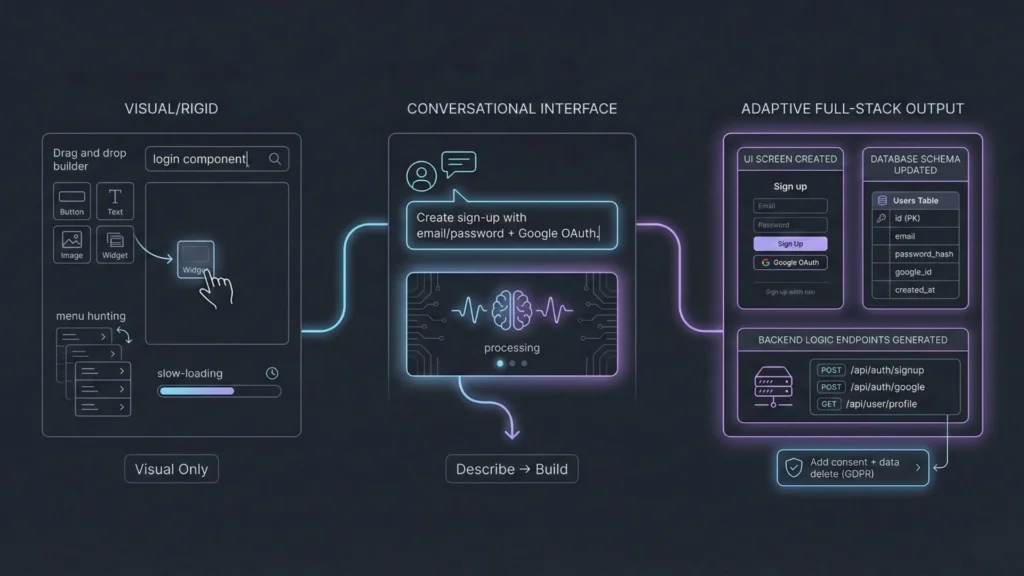
This is the core of the new paradigm. AI is not just another feature added to low-code. It is a new, intelligent layer that fundamentally changes the development process from visual to conversational. It turns the platform from a box of bricks into an expert building partner.
This is the birth of adaptive code.
1. From Visual and Rigid to Conversational and Fluid

The biggest shift is the user interface. We are moving beyond seeing and dragging to describing and iterating.
Instead of hunting for a “user login” widget, you simply type: “Create a user sign-up page with fields for email, password, and first name. Add Google OAuth as a login option.”
The AI doesn’t just pull a template. It understands the intent. It generates the UI, wires up the database schema, creates the backend authentication logic, and suggests the necessary API endpoints.
Platforms are now emerging that are built entirely on this premise. A prime example is Imagine.bo, which positions itself as an AI-driven “app builder.” A founder or product manager can describe their app idea in plain English, and the AI generates the foundational architecture, the database schema, and the initial, customizable application. This isn’t just a component; it’s the entire scaffold, built from a conversation.
This conversational model shatters the “low-code ceiling” because natural language is infinitely more flexible than a finite menu of drag-and-drop widgets.
2. From “Black Box” to Clean, Adaptive Code
The “hack” of the past gave us a final product but no visibility. The new, AI-driven “hack” gives us a starting point.
The code generated by modern AI models isn’t the garbled mess of yesterday. It’s often clean, human-readable, and based on best practices. It’s code you can actually hand off to a senior developer for optimization.
More importantly, it’s adaptive. You can iterate with the AI.
- You: “This is great, but I need to add a ‘profile picture upload’ feature.”
- AI: “Understood. I’ll add an image storage bucket (like S3), update the ‘users’ table with a ‘profile_picture_url’ field, and create the upload API endpoint. I’ll also add a ‘delete_account’ function to ensure GDPR compliance for data removal. Do you want to proceed?”
The developer’s new job, as one Forrester analyst put it, is to become an “agent orchestrator.” Your value is no longer in writing boilerplate; it’s in guiding the AI to build the right systems.
3. From Reactive Debugging to Proactive Partnership
Traditional development is reactive. You build, it breaks, you debug. AI flips the script.
As noted by Kissflow, AI can act as a “virtual quality assurance expert.” It sees what you’re building, understands the context, and offers proactive advice.
- Security: “This API endpoint you just created is public and has no authentication. Is that intentional? This could expose user data.”
- Compliance: “You’re collecting user data. To be GDPR-ready, you need to add a consent checkbox and a data-portability feature. I can add those for you.”
- Performance: “Your query to the ‘products’ table is inefficient. You should add an index on ‘category’ to speed it up.”
This is where the promise of a platform becomes tangible. When an AI builder, for instance, states it’s “GDPR/SOC2-ready,” it’s not just a marketing claim. It means the AI itself is trained to build within those compliance frameworks, spotting and fixing potential violations before they ever go live.
Real Examples in the Wild: From Co-Pilot to Creator
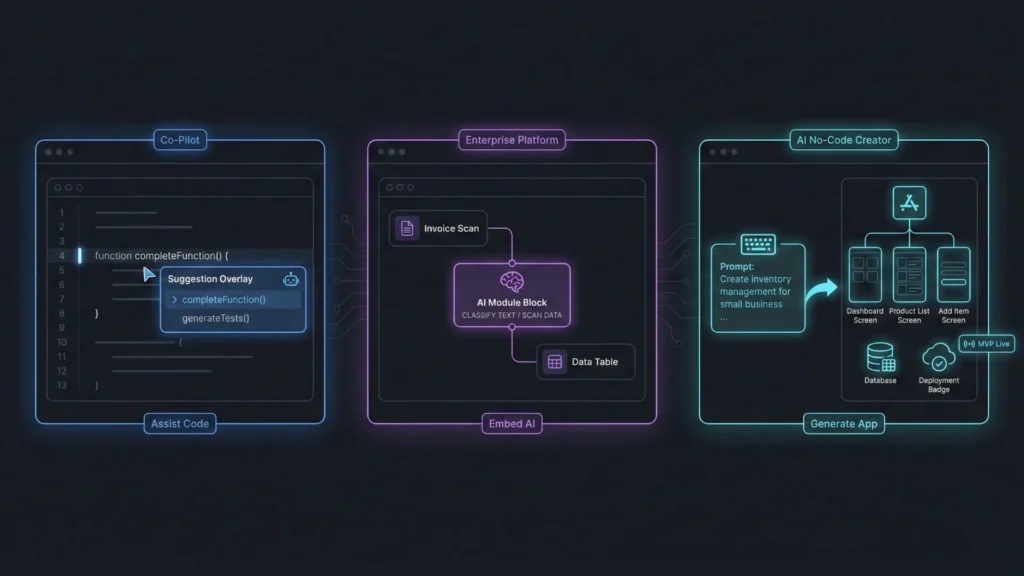
This AI-driven transformation is happening at every level of the development stack.
1. The Pro-Developer’s Partner: GitHub Copilot At the “pro-code” level, you have GitHub Copilot. It’s the ultimate pair programmer that lives in your code editor. It suggests entire functions, writes unit tests, and translates comments into code. It’s a massive productivity booster, but it’s still augmenting the traditional coder. The developer is still the one building the house, but now they have a super-powered nail gun.
2. The Enterprise Powerhouse: Microsoft Power Platform This is the “citizen developer” tool on steroids. With its AI Builder, Microsoft is empowering business users to embed AI models directly into their applications. A user can build an app that uses AI to scan invoices, predict customer churn, or analyze sentiment from support tickets. This is about putting AI into the app.
3. The Founder’s Launchpad: The New Breed of AI No-Code This is the culmination of the trend. It’s not just about augmenting code or embedding AI; it’s about generating the entire app from intent.
This is the niche where platforms like Imagine.bo are carving out new ground. They are laser-focused on the “idea-to-MVP” gap—a stage that is a notorious killer of startups. By translating a natural language description into a scalable, deployable application, they aren’t just lowering the skill-floor; they’re collapsing the development timeline from months to days.
The value proposition here is profound. It’s not just “you don’t need to code.” It’s “you can validate your entire business idea this week.”
This model is particularly powerful because it acknowledges a critical truth: AI alone is not enough. The best platforms bridge the gap between pure AI generation and real-world production readiness by including a human-in-the-loop. Features like “Expert Engineer Support” are vital. They provide an escape hatch, a way for founders to get human help to fix a bug or build a complex feature the AI can’t handle. It’s the perfect synthesis of AI speed and human expertise.
Expert Insights: The Human Perspective on the Machine
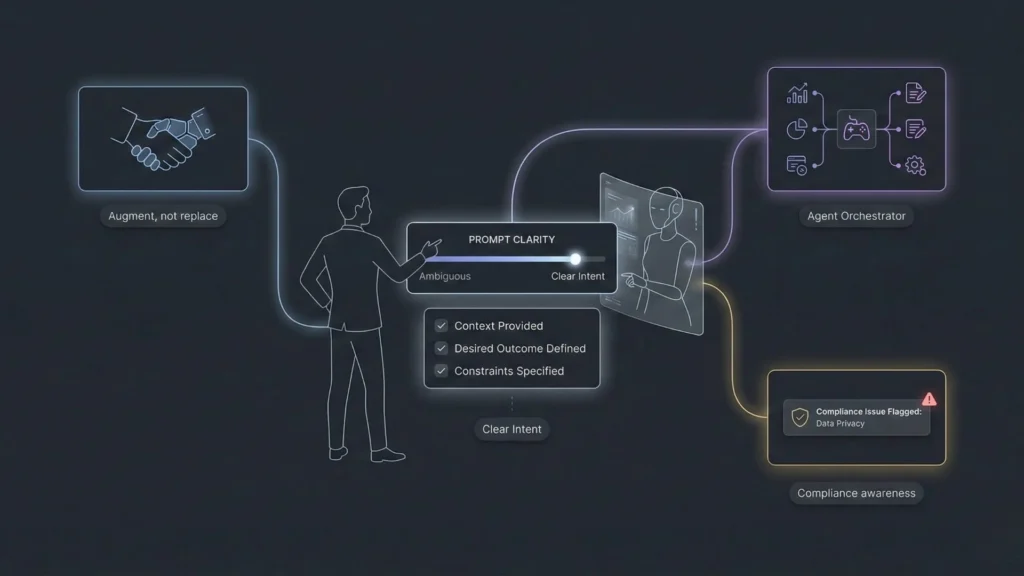
This isn’t just a technological shift; it’s a strategic one. And leaders are taking notice.
Ginni Rometty, former CEO of IBM, captured the sentiment perfectly: “Some people call this artificial intelligence, but the reality is this technology will enhance us… we’ll augment our intelligence.” This is the key. AI isn’t an it, it’s a partner.
This partnership has become a C-suite mandate. Forrester research is now blunt in its advice to development leaders: “Our advice: 1) If you don’t already have a strategic low-code platform, get one.”
But adopting the tool is only half the battle. We also have to adopt the new skills. As Alessio L. wrote for Forbes, the new bottleneck is human, not technical: “Its code can only be as good as the prompts that users introduce, so it will be vitally important… to teach employees how to ask the right questions.”
The most valuable skill in the next decade of development won’t be knowing Python or JavaScript. It will be the ability to clearly and precisely describe a business problem and its desired outcome. The new “10x developer” is a 10x communicator.
Satya Nadella, CEO of Microsoft, sees this as a fundamental unlock for human potential: “AI is not just a tool; it’s a partner for human creativity.”
Future Predictions: The Autonomous Development Era
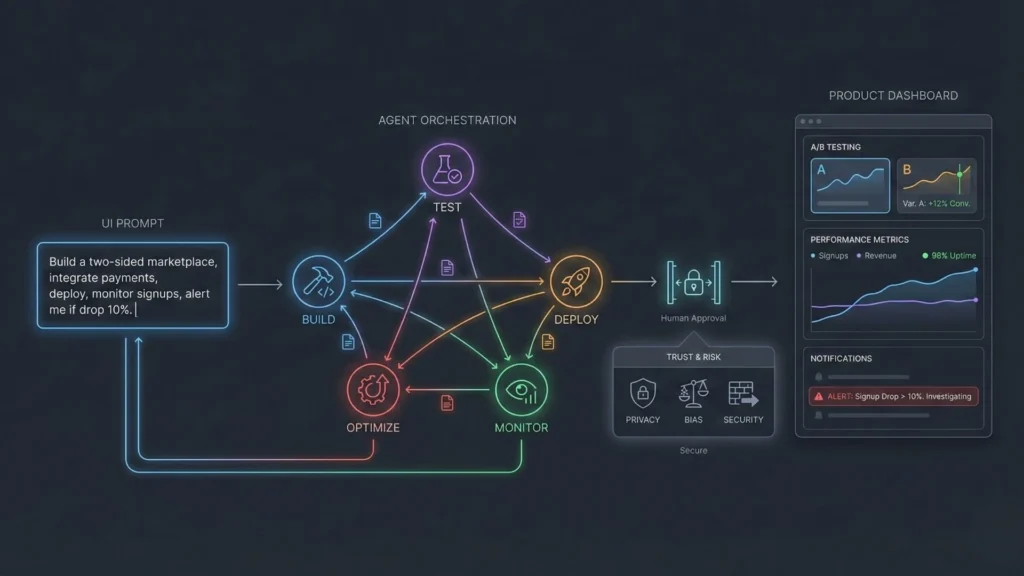
If today’s AI is a partner, tomorrow’s is an agent. We’re on the precipice of the autonomous development era.
- The “Citizen Developer” 2.0: Today’s citizen developer assembles apps. Tomorrow’s will solve business problems. Their tool won’t be a drag-and-drop UI; it will be a simple text prompt. “We have a 30% drop-off in our checkout flow. Analyze the user data, identify the bottleneck, and deploy a new, optimized checkout process. Run an A/B test and report the results to me on Monday.”
- Autonomous Agents: The “agent orchestrator” role will evolve. Soon, you’ll give a single command: “Build me a two-sided marketplace for freelance designers. Integrate payments, build a review system, deploy it to a scalable cloud provider, monitor its performance, and text me if signups drop by 10%.” The AI agent will coordinate other agents to do the rest.
- The “Low-Code Ceiling” Vanishes: The final gap between no-code simplicity and pro-code power will disappear. Need a custom, high-performance machine learning algorithm for your app? The AI will write it, optimize it, and integrate it, moving fluidly between no-code visuals and complex backend code.
- The Trust & Risk Frontier: This future isn’t guaranteed. The biggest challenges will be security, AI bias, and data privacy. As a CTO Magazine article noted, “Biasness is among AI’s most pressing ethical concerns.” The platforms that win will be the ones that are transparent, secure, and keep humans in control of the most critical decisions.
FAQ: Navigating the New Normal
Q: Is AI no-code replacing software developers?
A: No, it’s evolving them. It’s replacing coders, not developers. A Forrester report put it best: “Coders—who take requirements, write code, and pass it on—will die. Developers—who orchestrate agents and solve business problems—will thrive.” The mundane, repetitive work is being automated, freeing humans to focus on high-level architecture, complex problem-solving, and creative solutions.
Q: What’s the real difference between traditional low-code and AI no-code?
A: The interface and the output. Traditional low-code is visual (you drag and drop). AI no-code is conversational (you describe and build). Low-code gives you rigid templates. AI no-code gives you an adaptive foundation that you can iterate on with natural language.
Q: How secure are apps built with AI?
A: This is the most critical question you can ask. The answer is: it depends entirely on the platform. A basic AI “wrapper” can be incredibly dangerous, leaking data or writing vulnerable code. Trustworthy, enterprise-grade platforms are built with security and compliance at their core. Look for platforms that are transparent about their data models, train their AI on security best practices, and offer verifiable compliance (like GDPR/SOC2 readiness) and automated security testing from day one.
Summary: The Hack, Fully Realized
The original low-code hack was a brilliant half-measure. It was about building faster. It showed us a world where we didn’t have to waste our lives on plumbing. But it trapped us in a world of rigid templates and black boxes.
AI has shattered those limits.
The new “hack” is conversational. It’s adaptive. It’s intelligent. It’s not just about building faster; it’s about thinking differently—finally closing the gap between human intent and functional, scalable code.
We’re no longer just dragging and dropping blocks. We’re having a conversation with an expert partner who’s ready to build, secure, and scale our biggest ideas.
Launch Your App Today
Ready to launch? Skip the tech stress. Describe, Build, Launch in three simple steps.
Build