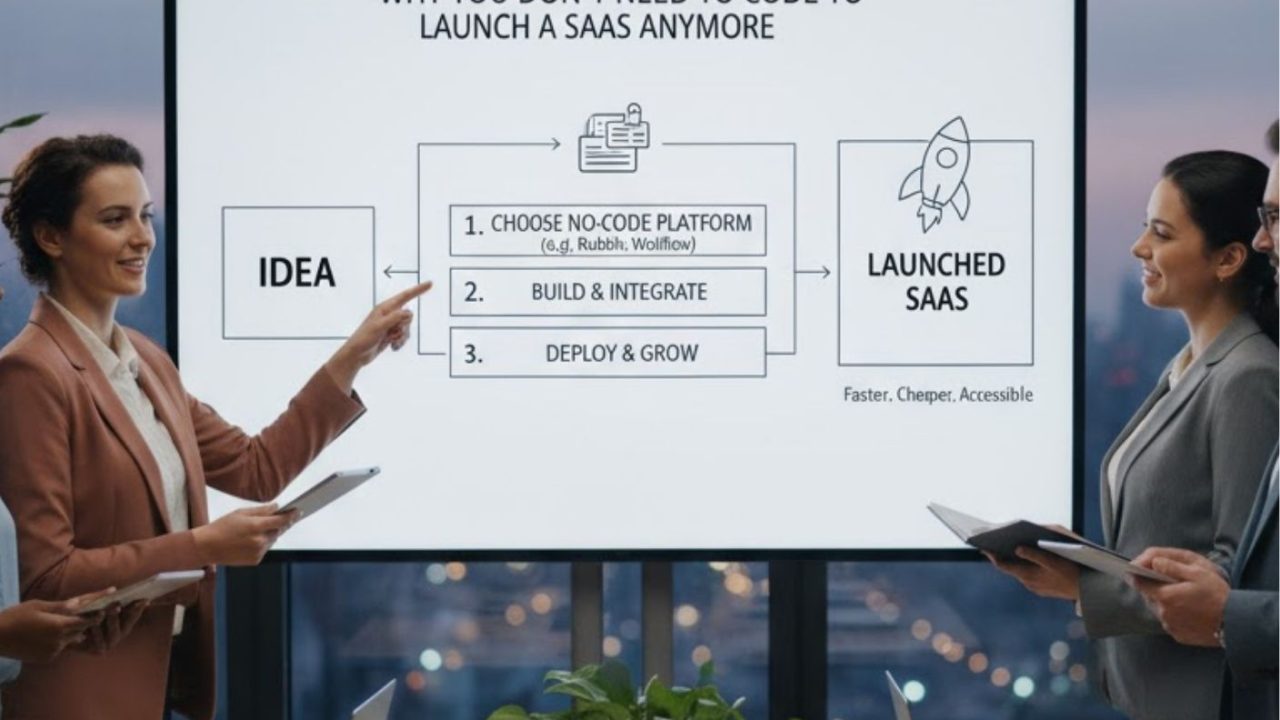
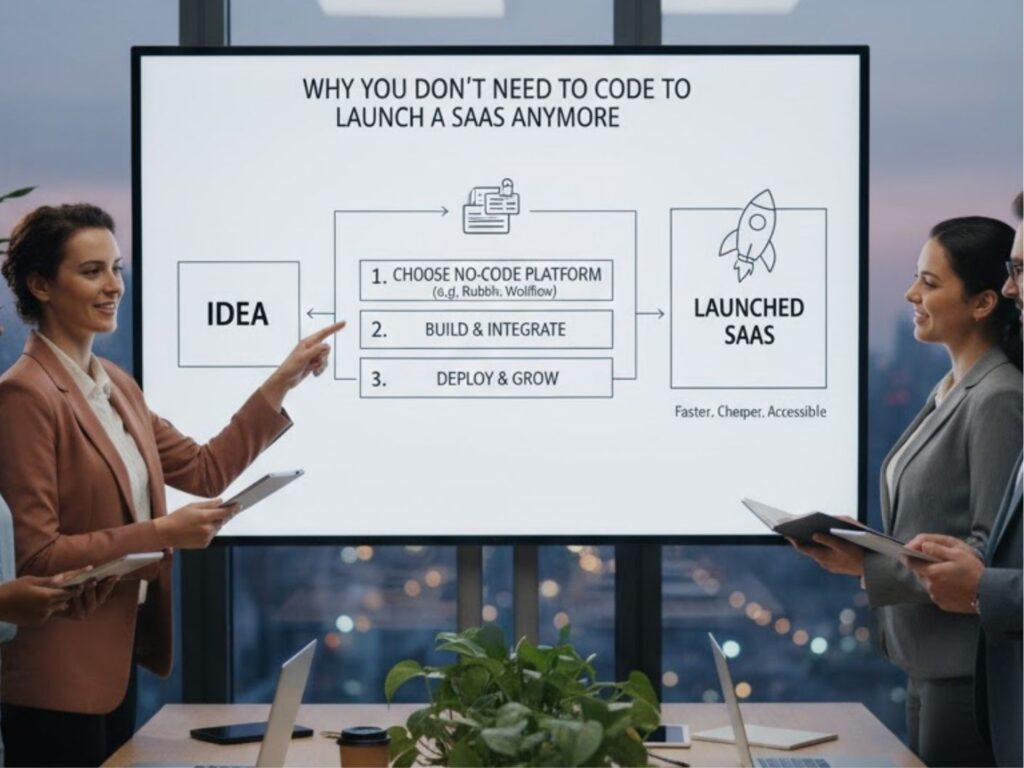
For decades, launching a Software as a Service (SaaS) was a high-risk gamble reserved for those with elite coding skills or massive capital. That era is over. The “technical barrier” has collapsed, replaced by a new wave of AI-driven, no-code platforms that democratize software creation.
This report analyzes how this seismic shift empowers non-technical founders to build sophisticated products in days, not months. We explore how next-gen tools like Imagine.bo are redefining the startup playbook from “drag-and-drop” to “prompt-to-product.”
Launch Your App Today
Ready to launch? Skip the tech stress. Describe, Build, Launch in three simple steps.
Build1. The Democratization of Creation: From Citizen Developer to Citizen Entrepreneur
To understand the magnitude of this opportunity, we must distinguish between the two waves of the visual development movement.
The first wave gave rise to the “Citizen Developer”—typically an employee within a large enterprise (e.g., in marketing or operations) who used internal tools to build dashboards or automate workflows. This was an efficiency play, designed to reduce the backlog of corporate IT departments.
However, a far more profound consequence has emerged: the rise of the “Citizen Entrepreneur.”
The same enterprise-grade capabilities that allow a logistics manager to track shipments now empower a solo, non-technical founder to build a commercial, public-facing SaaS product. This democratization lowers the barrier to entry, enabling individuals to start businesses with minimal upfront investment. Founders are effectively arbitraging these powerful, accessible tools to break their dependency on technical co-founders or pre-seed funding. You no longer need permission from a venture capitalist or a CTO to bring your vision to reality.
2. The New Economics of SaaS
This revolution is not just technological; it is fundamentally economic. No-code and AI app builders have altered the business case for starting a company by transforming three core variables: Speed, Cost, and Risk.
Radical Speed-to-Market
In the modern startup ecosystem, the “build-measure-learn” loop is the engine of success. The faster you cycle through this loop, the more likely you are to find Product-Market Fit (PMF). Traditional development cycles measure this in quarters; no-code compresses it into days.
Projects that traditionally required 6–8 months of full-stack engineering can now be deployed in weeks. This speed advantage is a profound strategic weapon. The founder who can test, invalidate, and pivot three different value propositions with real users—before a traditional-stack competitor has even finalized their server architecture—will inevitably win.
Cost Arbitrage and ROI
Traditional custom software development is prohibitively expensive. The average cost to develop a robust Minimum Viable Product (MVP) ranges from $40,000 to $100,000. In contrast, modern platforms operate on subscription models.
This “cost arbitrage” is critical. A non-technical founder with $50,000 in savings no longer has to spend $40,000 of it simply building the product. Instead, they can allocate $2,000 to the tech stack and deploy the remaining $48,000 on what actually drives a startup: marketing, sales, and customer acquisition. The cost structure has inverted from a “product-first” heavy investment to a “go-to-market-first” agility model.
De-Risking the Startup (The Market Risk Detector)
Perhaps the most valuable use case for these tools is their ability to distinguish between types of risk. No-code makes the technical risk of building software trivial. The question is no longer, “Can we build this?” It is now 100% focused on market risk: “Should this be built?” and “Will anyone pay for it?”
Therefore, no-code is a “market-risk detector.” It allows a founder to discover that their idea is unviable in three weeks at a cost of $300, rather than in nine months at a cost of $90,000. This ability to “fail cheap” is the ultimate de-risking mechanism for entrepreneurship.
3. The Architect’s Dilemma: The Complexity of the “Stack”
Despite these advantages, the “First Wave” of no-code tools (like Bubble, Webflow, or Zapier) introduced a new problem: Architecture Complexity.
A modern SaaS application is not a single monolith; it is a stack of four essential layers:
- The Frontend (The Storefront): The UI/UX the user interacts with.
- The Backend (The Warehouse): The database and server logic.
- The Glue (The Nervous System): Automation tools connecting disparate services.
- The Cash Register: Authentication and payment processing.
While tools exist for each layer, the founder’s job shifted from coder to systems architect. Learning to integrate a frontend builder with a separate database, while managing API keys and data privacy, is a steep learning curve. This “Architect’s Burden” often leaves non-technical founders paralyzed, staring at a blank canvas, unsure how to structure their database or design a user flow that converts.
Furthermore, there is the “No-Code Ceiling.” As an app scales, founders often hit performance limits or feature roadblocks that the visual tools simply cannot handle. This leads to the “Vendor Lock-in” trap, where a successful business is held hostage by a platform that cannot export code or scale with user demand.
4. The Third Wave: The Rise of AI-First Development
This brings us to the current moment—the “Third Wave” of development. If the first wave was Code (manual typing), and the second wave was No-Code (manual dragging and dropping), the third wave is Generative Development (AI-architected).
The industry is moving toward platforms that solve the “Architect’s Burden” by using Artificial Intelligence to handle the structural heavy lifting.
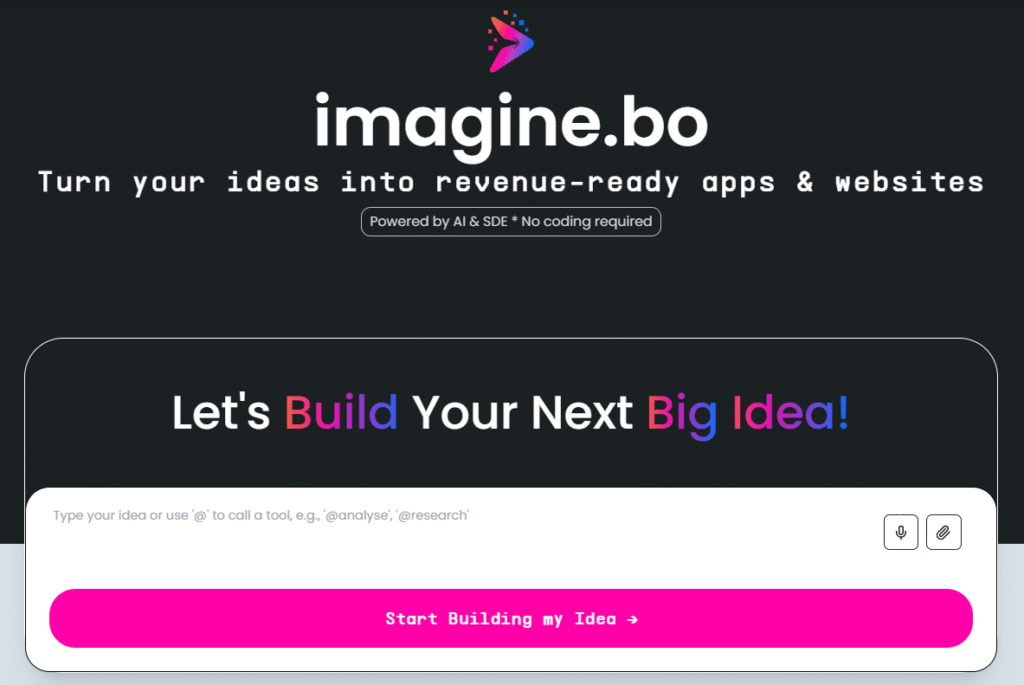
Enter Imagine.bo: The AI No-Code App Builder
Imagine.bo represents this next evolution. It is designed not just to be a tool for building, but an intelligent partner in creation. It addresses the critical flaws of the previous generation—complexity, the blank canvas problem, and the support gap—by integrating Generative AI directly into the development workflow.
Here is how this “AI-First” approach fundamentally changes the founder’s journey:
A. From “Blank Canvas” to “Prompt-to-Product”
In traditional no-code, you start with nothing. In Imagine.bo, you start with an idea. The platform utilizes AI to translate plain English descriptions into functional infrastructure.
A user can simply input: “I want a marketplace connecting freelance graphic designers with small businesses, featuring a bidding system and escrow payments.”
The AI then generates the foundational architecture, the database schema, and the core workflows automatically. This 3-step process—Describe, Build, Launch—removes the need for the founder to understand database normalization or API logic. The AI acts as the CTO, setting up the foundation so the founder can focus on refinement.
B. Solving the “Support Cliff” (The Human-in-the-Loop)
The greatest fear for a no-code founder is getting stuck. What happens when the AI reaches its limit? What happens when you need a highly specific, complex feature that the drag-and-drop interface doesn’t support? In the old model, you were stranded.
Imagine.bo introduces a hybrid solution: Developer Assistance. It acknowledges that while AI can build 90% of the app, the final 10% often requires human ingenuity. The platform allows users to “assign to a real developer” directly within the ecosystem. This feature effectively bridges the gap between no-code speed and pro-code flexibility. It provides a safety net, ensuring that a founder is never limited by the tool’s capabilities.
C. Enterprise-Grade by Default
Many early no-code tools were “toys”—great for prototypes but fragile at scale. The modern “Third Wave” stack prioritizes robustness. Imagine.bo emphasizes scalability, security, and performance from Day 1.
- Scalability: Apps are cloud-deployable (AWS, GCP, Vercel) and guaranteed to handle high transaction volumes (1,000 TPS).
- Compliance: With GDPR and SOC2 readiness, founders in sensitive industries like HealthTech or FinTech can build with confidence, knowing their infrastructure meets professional standards.
- Analytics & Growth: Built-in SEO tools and analytics dashboards mean the product is ready for growth, not just for show.
5. Strategic Summary: The Founder’s Playbook for 2025
The barrier to entry for launching a software company has effectively collapsed. However, the strategic barrier remains. Success is no longer about who can write the best code, but who can best leverage these tools to solve real problems.
For the aspiring founder, the playbook is clear:
- Validate Ruthlessly: Don’t spend months building. Use AI-driven tools like Imagine.bo to turn your concept into a live URL in days.
- Embrace the Hybrid Model: Do not fear the technical “ceiling.” Choose platforms that offer a bridge to human expertise when complexity demands it.
- Focus on the Business, Not the Divs: Your customers do not care if your backend is Python, Bubble, or AI-generated. They care about the value you provide.
The era of the “technical co-founder or bust” is over. We have entered the era of the strategic builder, where imagination, not syntax, is the only limit to execution.
Frequently Asked Questions (FAQ)
Can I really build a scalable SaaS without coding?
Yes. Modern platforms like Imagine.bo are designed for scalability, allowing you to handle thousands of transactions per second. The “No-Code Ceiling” is largely a myth with the latest generation of tools that offer cloud deployment (AWS/GCP).
How is Imagine.bo different from Bubble or Webflow?
Imagine.bo is an “AI-First” builder. While Bubble requires you to manually design pixels and logic, Imagine.bo generates the entire architecture from a text prompt. It also includes a “Human-in-the-Loop” feature to assign complex tasks to real developers, which traditional platforms lack.
Is no-code cheaper than hiring a developer?
Significantly. A traditional MVP can cost $40k-$100k. No-code platforms operate on a monthly subscription model (often under $100/mo), allowing you to reallocate funds to marketing and sales.
Who owns the IP and code in a no-code app?
This depends on the platform. Imagine.bo empowers founders by ensuring data sovereignty and avoiding strict vendor lock-in, unlike some older platforms where you cannot export your data easily.
Launch Your App Today
Ready to launch? Skip the tech stress. Describe, Build, Launch in three simple steps.
Build