
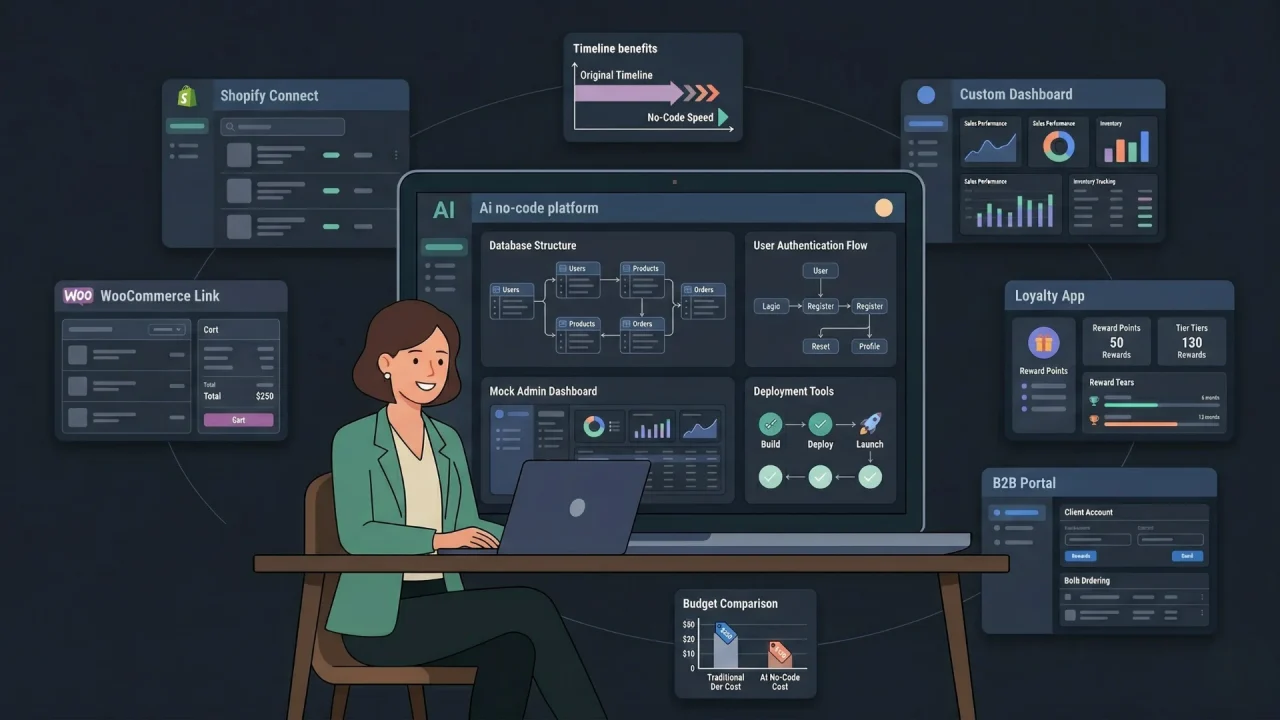
A custom e-commerce app built by a development agency costs between $50,000 and $200,000 and takes five to nine months to deliver. Most e-commerce brands at the growth stage do not have that budget or that runway. They have a product that is selling, customers who want a better experience, and an operations team drowning in manual processes. According to Statista, global e-commerce revenue is projected to reach $8.1 trillion by 2026 (Statista, 2024), and the brands capturing that growth are not always the ones with the largest engineering teams. They are the ones who ship faster. This guide covers exactly how e-commerce brands are launching real, production-grade apps without developers in 2026, what tools make it possible, what workflows each type of app requires, and where human engineering still belongs in the process. For the foundational overview of building an e-commerce app without a development team, this post on building an e-commerce app without developers covers the platform mechanics in depth.
TL;DR E-commerce brands are launching custom apps without developers by using AI-generation tools like imagine.bo that produce full-stack applications from plain English descriptions. The five highest-ROI apps for e-commerce brands without developers are custom storefronts, loyalty and rewards programs, inventory management tools, customer portals, and order management dashboards. According to Shopify, brands with a dedicated mobile app see 3x higher conversion rates than mobile web users (Shopify, 2023). AI generation cuts build time from months to days and cost from six figures to under $300. No coding required.
Why Are E-Commerce Brands Building Apps Without Developers Now?
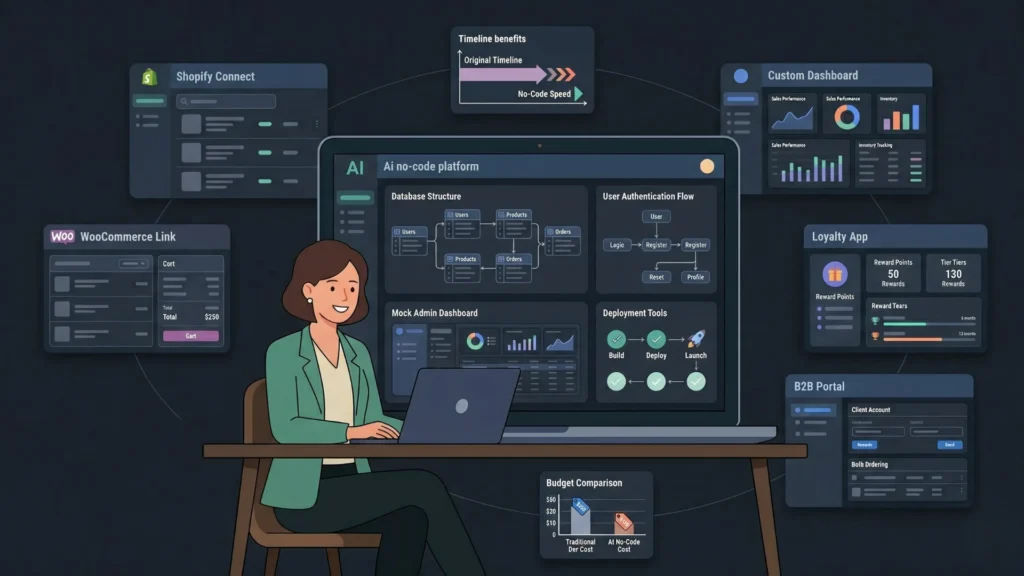
E-commerce brands are building apps without developers now because the tools have crossed a functionality threshold that was not achievable two years ago. Traditional no-code platforms could produce marketing pages and simple catalogs. AI-generation platforms produce full-stack web applications including real database logic, authentication systems, custom admin dashboards, and production-ready deployment, from a plain English description of what you need built.
Launch Your App Today
Ready to launch? Skip the tech stress. Describe, Build, Launch in three simple steps.
BuildThe economics reinforce the shift. According to Clutch’s 2025 software development survey, the average custom e-commerce application costs $75,000 to $200,000 in development fees (Clutch, 2025). imagine.bo’s Pro plan at $25 per month generates the same functional scope, including backend logic, user authentication, and deployment to Vercel and Railway, in days rather than months. The cost difference is not marginal. It changes which brands can compete.
The brands getting the most value from this shift are not replacing Shopify with a custom-built storefront. They are building the applications around their Shopify or WooCommerce store that their platform does not provide natively: custom loyalty systems, B2B portals, wholesale ordering tools, internal operations dashboards, and branded customer-facing apps that integrate with their existing stack. These are the five to ten applications that sit beside the core store and make the customer experience meaningfully different from a generic template.
What Types of E-Commerce Apps Deliver the Highest ROI Without Developers?
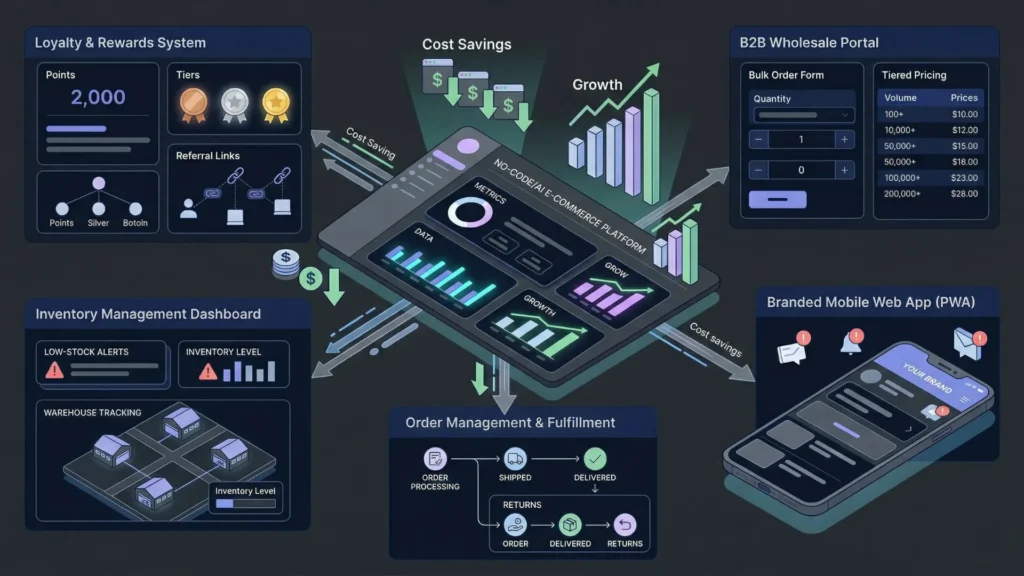
The five types of e-commerce apps that deliver the highest return on the no-developer build investment are those where custom functionality directly affects revenue, retention, or operational efficiency. Generic platforms handle commodity functionality. Custom apps handle the differentiated workflows that brand loyalty and operational leverage are built on.
Custom loyalty and rewards programs: Every major loyalty platform charges $299 to $999 per month for features you can build once and own permanently. According to Bain and Company, increasing customer retention by just 5% increases profits by 25 to 95% (Bain, 2022). A custom loyalty app with points accumulation, tier benefits, redemption rules, and referral tracking, built on imagine.bo, replaces a $400 per month SaaS subscription with a $25 per month build platform. This guide on creating a loyalty app without SaaS fees covers the specific build approach for e-commerce loyalty systems.
B2B and wholesale customer portals: E-commerce brands selling to retailers and resellers need custom ordering interfaces with tiered pricing, minimum order quantities, payment terms, and account-specific catalogs. These requirements do not fit cleanly into consumer-facing Shopify templates. A custom B2B portal built with AI generation handles those rules precisely without the $500 to $2,000 per month B2B platform fees.
Inventory and operations dashboards: Real-time inventory tracking, low-stock alerts, supplier reorder workflows, and multi-location stock management all require custom logic that generic tools approximate badly. According to the National Retail Federation, inventory distortion, including stockouts and overstocks, costs retailers $1.77 trillion globally per year (NRF, 2023). A custom internal tool that matches your specific warehouse, supplier, and fulfillment workflow is more effective than a generic inventory tool configured to approximate your process.
Custom order management and fulfillment tools: Post-purchase workflows including order status updates, fulfillment routing, return processing, and customer communication are often the weakest link in the customer experience. A custom order management app integrates your specific logistics providers, your return policy rules, and your customer communication preferences into one tool your operations team actually uses.
Branded customer-facing mobile web apps: A branded PWA (Progressive Web App) that customers add to their home screen delivers push notifications, faster load times, and an app-like experience without App Store fees or native app development costs. According to Shopify, mobile app users have 3x higher conversion rates than mobile web users (Shopify, 2023). A custom-generated PWA achieves most of that conversion lift without a $50,000 native app build.
How Does imagine.bo Build E-Commerce Apps From a Description?
imagine.bo’s Describe-to-Build interface takes a plain English description of your e-commerce application and generates the complete full-stack product: React frontend components deployed to Vercel, a relational database schema with the correct tables and relationships, backend API endpoints that enforce your access rules, and authentication with role-based access control. The AI-Generated Blueprint shows you the full architecture before any code is written, giving you the opportunity to review and adjust the structure before the build begins.
The e-commerce prompt pattern that consistently produces the strongest first generations follows four elements. First, identify the user types and what each one does. A wholesale portal has Wholesale Buyers who browse catalogs, place orders, and view invoices, and Admins who manage pricing tiers, approve new accounts, and view all orders. Second, describe the core workflow step by step. Third, specify the data that flows through that workflow. Fourth, state the access rules explicitly, what each role can see, create, edit, and delete.
A strong wholesale portal prompt: “Build a B2B wholesale ordering portal for a skincare brand. Wholesale buyers register with a business name and are approved by an admin before gaining full access. Approved buyers see a product catalog with wholesale pricing tiers based on their account level: Bronze, Silver, or Gold. Buyers can add products to a cart with minimum order quantity enforcement, place orders, and view their order history and invoices. Admins can manage buyer accounts and tiers, view all orders, and update pricing by tier. Unapproved buyers see only a pending approval page after registration.”
That prompt generates the full application architecture including the pricing tier logic, the account approval workflow, the role-separated views, and the order management system. The AI-Generated Blueprint maps those components before the build runs. For a practical library of proven e-commerce prompt structures across different app types, this 40-prompt copy-paste library by app type contains ready-to-adapt starting points.
One-Click Deployment sends the frontend to Vercel’s global edge network and the backend to Railway for automatic scaling. SSL applies by default. The entire production infrastructure is live without any DevOps work from your team.
A mid-size e-commerce brand replacing a third-party loyalty SaaS at $399 per month with a custom-built loyalty application on imagine.bo’s Pro plan at $25 per month saves $4,488 per year in subscription fees. Over three years, that savings is $13,464 while owning the application logic outright, including code that can be exported and handed to a developer for future extension. The break-even point versus the SaaS subscription occurs in the first month of the build.
Step-by-Step: Building an E-Commerce Loyalty App Without a Developer
The loyalty program is the most common first custom app for e-commerce brands moving away from third-party platforms, because the ROI is immediate and the build is self-contained. Here is the full workflow from first prompt to deployed product.
Step 1: Define the loyalty mechanics before writing any prompt.
What actions earn points? Purchases, referrals, reviews, social shares, or birthdays? What is the points-to-value ratio? Are there tiers, and what benefits does each tier unlock? What can points be redeemed for, discounts, free products, or free shipping? Are points cumulative or do they expire? Answer every one of these questions before opening imagine.bo. The specificity of your answers determines whether the first generation is accurate or requires multiple correction sessions.
Step 2: Write the four-element prompt.
“Build a customer loyalty program web app for an online beauty brand. Customers register with their email and are automatically enrolled. Customers earn 10 points per dollar spent, 500 points for referring a friend who completes a purchase, and 200 points for leaving a verified review. There are three tiers: Starter (0 to 999 points), Beauty Club (1,000 to 4,999 points), and VIP (5,000 and above). VIP members get free shipping on all orders. Points can be redeemed at checkout for discount codes: 500 points equals $5 off. Customers see their points balance, tier status, transaction history, and available rewards on their account dashboard. Admins can view all customers, manually adjust point balances, and see program-wide analytics including total points issued and redemption rate.”
Step 3: Review the AI-Generated Blueprint.
Check that the data model includes tables for Customers, PointTransactions, Redemptions, Tiers, and Rewards. Confirm the tier calculation logic is represented. Verify that the admin analytics dashboard is included as a separate page group from the customer-facing dashboard.
Step 4: Deploy and connect to your existing store.
After One-Click Deployment, use a targeted follow-up prompt to add the webhook endpoint that receives purchase data from your Shopify or WooCommerce store and automatically creates point transaction records. For the Shopify webhook integration specifically, use the Hire a Human feature rather than a prompt alone, as webhook signature verification and order data mapping require engineering precision. The cost is $25 for that specific page.
Step 5: Test the full reward cycle.
Create test accounts in each tier. Complete a simulated purchase and confirm points are credited. Attempt a redemption and confirm the discount code generates correctly. Log in as an admin and confirm transaction history and analytics are accurate. Fix any gaps with targeted correction prompts before opening to real customers.
For the full no-code guide to building retail and e-commerce operations tools, this no-code guide for retail covers the operational layer alongside the customer-facing application.
How Do E-Commerce Brands Handle Inventory Without a Developer?
Inventory management is the operational pain point most e-commerce brands are running on spreadsheets or expensive generic SaaS tools, neither of which matches their actual workflow. A custom inventory tool built on imagine.bo handles the specific SKUs, warehouse locations, supplier lead times, and reorder rules of your exact business, rather than the generic version of a retail operation.
According to a 2024 survey by the National Retail Federation, 63% of small and mid-size retailers cite inventory accuracy as their top operational challenge, and over 40% are still managing inventory primarily through spreadsheets and manual processes (NRF, 2024). The cost of that inaccuracy, in lost sales from stockouts and tied-up capital from overstocks, consistently exceeds the cost of a custom-built tool.
A custom inventory tracker built with imagine.bo handles real-time stock levels across multiple locations, low-stock alerts with configurable thresholds per SKU, supplier purchase order creation, and receiving workflows that update stock levels on confirmation. The admin dashboard shows stock level by location, pending orders against available inventory, and average daily sales velocity per SKU.
The most valuable feature in a custom inventory tool for e-commerce brands is not the stock level display. It is the reorder point calculation that factors in supplier lead time and your actual sales velocity. Generic inventory tools offer fixed reorder quantities. A custom-built tool on imagine.bo calculates dynamic reorder points based on average daily sales from your order history, current stock level, and supplier lead time in days. That calculation prevents stockouts during peak periods without overstocking during slow periods. No off-the-shelf inventory tool does this for your specific SKU mix without expensive custom configuration. A conversational prompt to the AI generator implements it directly: “Calculate reorder point for each SKU as current average daily sales multiplied by supplier lead time in days plus a safety stock of five days. Flag any SKU where current stock is below its reorder point.”
For a practical walkthrough of building a real-time inventory tracker specifically, this post on building a real-time inventory tracker in ten minutes covers the prompt structure and build workflow in detail.
Citation capsule: According to the National Retail Federation, inventory distortion, including the combined cost of stockouts and overstocks, costs global retailers $1.77 trillion per year, with small and mid-size retailers disproportionately affected because they lack the enterprise inventory management systems that reduce that distortion (NRF, 2023). Custom-built inventory tools that match a brand’s specific supplier relationships and sales velocity patterns reduce that distortion more effectively than generic platforms configured to approximate the workflow.
What Does Payment Integration Look Like for Custom E-Commerce Apps?
Payment integration for custom e-commerce apps built without developers follows two distinct paths depending on whether the app is the primary store or a supplement to an existing platform.
For apps built as supplements to an existing Shopify or WooCommerce store, such as a loyalty portal, a B2B ordering tool, or a customer account app, the payment logic typically lives in the existing store. The custom app handles the account management, the custom workflows, and the brand experience, while payment for product orders still routes through the existing platform. This is the cleanest architecture because it avoids duplicating PCI compliance obligations.
For apps built as standalone storefronts or wholesale portals where payment is processed within the custom app, Stripe integration is the standard approach. imagine.bo generates basic Stripe Checkout integration through the conversational interface, which handles PCI compliance automatically by collecting card data within Stripe’s certified environment. For custom checkout flows with subscription billing, tiered pricing, or net-30 payment terms for B2B customers, the Hire a Human feature handles the payment logic engineering at $25 per page.
The payment integration pattern that creates the most downstream problems for e-commerce brands using custom apps is trying to build payment logic through prompts alone for anything beyond standard Stripe Checkout. The moment a checkout requires proration for mid-cycle subscription changes, net terms with manual invoice approval, or split payments across multiple payment methods, the implementation moves into territory where precise engineering prevents silent failures that are difficult to diagnose after launch. A $25 Hire a Human task for the payment module is the most cost-effective insurance against the kind of revenue leakage that goes undetected for months. This guide on payment gateway integration in no-code apps covers the architecture decisions for different payment complexity levels.
How Do E-Commerce Brands Build Customer-Facing Apps That Compete With Big Players?
Small and mid-size e-commerce brands can build customer-facing apps that compete with enterprise experiences because the constraint was always engineering capacity, not product vision. When a $25 per month tool generates the same functional stack that a $200,000 agency build produces, brand differentiation comes down to how well you know your customer and how specifically you build for them.
The brands getting the best results from custom app generation share one characteristic: they build for a specific customer workflow rather than a general shopping experience. A sustainable activewear brand building a customer portal that tracks each order’s environmental impact, suggests care instructions for longevity, and rewards customers who choose slow shipping provides an experience that no generic Shopify theme approximates. A food brand building a subscription portal where customers customize their monthly box, set dietary restrictions, skip a month, and view their ingredient sourcing creates loyalty that a standard subscription app cannot match.
The most effective customer-facing e-commerce apps built without developers are not custom storefronts competing with Shopify on features. They are purpose-built experiences that extend the core purchase into a relationship. The purchase is the start of the workflow, not the end of it. Custom apps built with imagine.bo thrive in this post-purchase space because the Describe-to-Build interface generates the exact data model and workflow logic for your specific relationship model rather than a generic template of it. A prompt that says “build a skincare diagnostic tool where customers log their skin concerns monthly and receive personalized product recommendations based on their history” generates a product feature that costs $80,000 from an agency and $50 in credits from imagine.bo.
According to Salesforce, 73% of customers say customer experience is an important factor in their purchasing decisions, and brands that invest in post-purchase engagement see 70% higher repeat purchase rates than those that treat the sale as the end of the interaction (Salesforce, 2023). Custom apps built around the post-purchase relationship generate that engagement at a fraction of the cost of traditional development. This post on building e-commerce stores with voice commands and AI covers how AI-driven build approaches are changing the customer experience in e-commerce specifically.
When Should E-Commerce Brands Use Hire a Human for Their Apps?
The Hire a Human feature exists for a specific set of scenarios where engineering precision produces meaningfully better outcomes than iterative prompt refinement. For e-commerce brands, four scenarios consistently justify bringing in a vetted engineer rather than continuing to prompt.
Third-party platform integrations: Connecting a custom app to Shopify’s Admin API, to a fulfillment provider’s API, or to an ERP system requires handling authentication tokens, rate limits, webhook signature verification, and data transformation between systems. These integrations work correctly or they fail silently, and the failure mode is order data that never syncs, inventory counts that drift from reality, or payment confirmations that do not reach the customer. A $25 per page engineer task produces a reliable integration. Three hours of correction prompts produces an integration that works in testing and breaks under edge cases.
Custom payment flows beyond standard Stripe Checkout: Any payment logic involving net terms, partial payments, split payment across credit and loyalty points, or complex subscription proration requires precise implementation. The Stripe webhook handler that confirms payment and updates order status must be idempotent, must handle signature verification correctly, and must process the right subscription events. This is not a prompt task.
Performance optimisation under real traffic: When a product catalog with 10,000 SKUs is causing slow page loads or a dashboard query is timing out under concurrent users, the fix requires database query optimisation, indexing, and potentially caching architecture. A vetted engineer identifies and resolves the specific bottleneck. A correction prompt guesses.
Compliance-sensitive data handling: If your e-commerce app handles customer addresses, payment history, or personal data subject to GDPR or CCPA, the data export and deletion workflows, the consent management, and the access audit logging require precise implementation that a human engineer reviews rather than generates alone.
On imagine.bo’s Pro plan, Hire a Human tasks come with a 20% discount and 24-hour priority turnaround. The one-hour expert pre-launch session is the right time to identify which of your app’s features fall into these four scenarios before you open to real customers. For guidance on scaling custom-built e-commerce apps once they have real traffic, this post on scaling no-code AI apps to production covers the infrastructure and architectural decisions that matter at growth stage.
What Does the Full E-Commerce App Build Cost Without a Developer?
The cost structure for building e-commerce apps without a developer changes the economics of custom software permanently for most brands.
| App type | Agency/developer cost | imagine.bo Pro cost | Hire a Human additions | Year 1 total (imagine.bo) |
|---|---|---|---|---|
| Loyalty and rewards program | $40,000 to $80,000 | $300 (12 months Pro) | $25 to $75 (integrations) | $375 |
| B2B wholesale portal | $60,000 to $120,000 | $300 | $50 to $100 (payment + ERP) | $400 |
| Inventory management tool | $30,000 to $60,000 | $300 | $25 (supplier API) | $325 |
| Customer account portal | $20,000 to $50,000 | $300 | $25 (platform webhook) | $325 |
| Order management dashboard | $25,000 to $60,000 | $300 | $0 to $50 | $350 |
These are not approximations. They are the actual cost structure of building each app type on imagine.bo’s Pro plan with targeted Hire a Human tasks for the specific engineering precision points. The total year one cost for all five apps, if a brand builds them in sequence, is under $1,800. A single one of these apps from a development agency costs more than the entire five-app portfolio built without developers.
For the full breakdown of development costs across all approaches including per-feature comparison data, this 2026 cost comparison across developer, AI, and no-code approaches covers the numbers in detail.
FAQ
Can a no-technical e-commerce brand owner build a custom app with imagine.bo?
Yes. imagine.bo’s Describe-to-Build interface requires the ability to describe your workflow clearly in plain English. No programming knowledge, no database configuration, and no deployment experience is needed. The platform generates the full stack from your description, and the AI-Generated Blueprint shows you the complete architecture before anything is built. If something does not match your intent, a follow-up prompt in plain English corrects it. According to Gartner, citizen developers, meaning non-technical professionals building their own applications, represent the fastest-growing category of software builders (Gartner, 2022). E-commerce brand owners who know their customer workflow better than any developer they could hire produce the most accurately designed applications on the first generation. This post on launching apps without developers shows what that process looks like for first-time builders.
How does a custom e-commerce app connect to Shopify or WooCommerce?
Connection to Shopify or WooCommerce uses webhooks and APIs. Shopify sends webhook events to your custom app’s API endpoint when orders are created, customers register, or products update. Your custom app’s backend receives those events, validates the webhook signature, and updates its own database accordingly. This pattern powers loyalty points that credit when a Shopify order is confirmed, inventory dashboards that reflect Shopify’s stock levels in real time, and customer portals that display Shopify order history alongside custom account data. The Hire a Human feature handles webhook integration specifically at $25 per page, because Shopify API authentication and webhook signature verification require implementation precision that benefits from engineering oversight. For the technical mechanics of payment gateway integration in custom apps, this post on payment gateway integration in no-code apps covers the architecture in detail.
What is the fastest type of e-commerce app to build without developers?
Internal operations dashboards are typically the fastest to build because they have a single user type, a well-defined data set, and no public-facing authentication or customer-facing UX requirements. An inventory management dashboard showing stock levels, pending orders, and low-stock alerts can be built, deployed, and in use by your operations team in a single day. Customer-facing apps with registration, loyalty logic, and payment integration take longer due to the additional authentication and integration steps, but typically reach a testable first version within two to four days on imagine.bo. For a validated approach to building and testing a retail MVP specifically, this post on validating a retail business idea with no-code tools covers the scoping and validation steps that reduce build time.
Do I need a separate developer for ongoing maintenance after launch?
No, for most post-launch changes. Feature additions, content updates, UI adjustments, new user flows, and logic changes are handled through conversational prompts in imagine.bo’s interface without any ongoing developer requirement. For changes that go outside prompt scope, specifically third-party API updates, performance issues at scale, or compliance-driven data architecture changes, the Hire a Human feature handles specific tasks on demand at $25 per page without a retainer or long-term commitment. The Pro plan’s 24-hour turnaround on Hire a Human tasks makes this practical for time-sensitive issues. Most e-commerce brands find that 90% of post-launch maintenance is handleable through prompts and 10% warrants targeted engineering, producing a total monthly cost well under $100 for ongoing maintenance compared to $3,000 to $8,000 per month for a retained developer.
How does a custom-built loyalty app compare to platforms like Yotpo or LoyaltyLion?
Yotpo charges $299 to $799 per month for loyalty features, and LoyaltyLion charges $399 to $729 per month. Both offer pre-built loyalty logic with standard point structures, tier systems, and referral programs. A custom-built loyalty app on imagine.bo generates the same core functionality with the added ability to implement any loyalty mechanic you can describe, whether that is sustainability-based rewards, behaviour-triggered bonuses, community challenges, or gamified tier progression that no standard platform supports. The custom app costs $25 per month on the Pro plan plus a one-time Hire a Human task for the Shopify webhook integration at $25. The economics are not comparable. This post on creating a loyalty app without SaaS fees covers the specific mechanics and build approach for custom loyalty programs.
Conclusion
Three things determine whether an e-commerce brand successfully launches custom apps without developers. First, clarity about what the app needs to do specifically, not what apps in your category usually do. The brands that ship fastest describe their customer workflow with enough specificity that the AI generator has no gaps to fill with generic assumptions. Second, the discipline to review the AI-Generated Blueprint before every build. The blueprint review is the five minutes that saves five hours of correction work, and skipping it is the single most common reason a first generation requires a full restart. Third, accurate judgment about the 20% of functionality where Hire a Human produces more reliable outcomes than prompt iteration alone, specifically third-party API integrations, custom payment flows, and compliance-sensitive data handling.
imagine.bo’s free plan gives you 10 credits to start building at zero cost. The Pro plan at $25 per month adds 150 rollover credits, private projects, and a one-hour expert session before your first app goes live with real customers. Start with the loyalty app or the inventory dashboard, whichever solves the most immediate operational or revenue problem for your brand, and deploy your first version this week. For the most direct comparison of AI app builders specifically for e-commerce use cases, this post on the best AI app builder for e-commerce covers how imagine.bo positions against other platforms for retail and commerce-specific builds.
Launch Your App Today
Ready to launch? Skip the tech stress. Describe, Build, Launch in three simple steps.
Build