


Security isn’t a nice-to-have anymore. It’s the line between trust and risk, and customers can feel the difference instantly. That’s why Imagine.bo doesn’t treat compliance and protection as add-ons. They’re built into the foundation of the platform, shaping every workflow and every decision behind the scenes. When security becomes part of the product’s DNA, teams move faster, stay protected and avoid the surprises that usually show up when it’s too late to fix them.
The New Imperative: Security as a 2025 Business Enabler
The C-Suite Awakens: Security Is No Longer “Just an IT Problem”
In the contemporary business landscape, cybersecurity has undergone a profound transformation, migrating from a siloed IT function to a foremost, C-suite-level strategic imperative. Industry analysis now reflects a clear consensus: security is no longer an optional feature or a cost center but a foundational requirement for business continuity, customer trust, and resilient growth. This paradigm shift recasts security as both a “survival imperative and a business enabler”.
Launch Your App Today
Ready to launch? Skip the tech stress. Describe, Build, Launch in three simple steps.
BuildThis evolution is a direct response to an increasingly sophisticated and perilous threat landscape. For modern enterprises, robust cybersecurity is now considered a “strategic necessity” and an “essential component of business resilience”. The escalating nature of these threats, including advanced persistent threats (APTs) and sophisticated phishing campaigns, has elevated the discussion from server-room maintenance to boardroom strategy. This new reality demands a comprehensive, “whole-of-society approach” to defense, embedding security into the core of all business operations.
Quantifying the Crisis: The 2025 Data Breach Landscape
The financial consequences of a security failure, as detailed in IBM’s 2025 Cost of a Data Breach Report, provide the starkest evidence for this new imperative. The data unequivocally illustrates why security is no longer optional.
In 2025, the average cost of a data breach in the United States surged to an all-time high of 10.22 million. This figure is more than double the global average, which, despite declining 9% to 4.44 million, underscores a significant and widening gap. This 5.78 million “pain gap” between US and global breach costs is a critical indicator; it is attributed primarily to “higher regulatory fines” and more complex “detection and escalation costs” in the mature US market. This suggests the United States, with its punitive and well-established regulatory frameworks (e.g., CCPA, HIPAA) and litigious culture, serves as a preview of the financial future for the rest of the world as global data privacy laws intensify.
The financial pain is not distributed equally. The healthcare sector, for the 14th consecutive year, remains the costliest, with an average breach cost of 7.42 million. Analysis of attack vectors reveals that while phishing is the most common cause of breaches (16% of incidents), malicious insiders are the most costly, averaging 4.92 million per incident. This economic reality is the primary driver forcing organizations to abandon legacy security models.
The 2025 Cybersecurity Threat Landscape (Key Data)
| Metric | 2025 Data | Source(s) |
| US Average Cost of a Data Breach | 10.22 million | |
| Global Average Cost of a Data Breach | 4.44 million | |
| Average Breach Cost (Healthcare Sector) | 7.42 million | |
| Most Common Attack Vector | Phishing (16% of incidents) | |
| Most Costly Attack Vector | Malicious Insider (4.92 million) | |
| AI Incidents Lacking Access Controls | 97% |
The Paradigm Shift: From “Bolted-On” to “Built-In”
The multi-million-dollar risks quantified above have rendered the traditional “bolted-on” security model obsolete. In this outdated approach, security was treated as an afterthought—a final, hurried step of testing and patching before deployment. This model is a primary contributor to the vulnerabilities that lead to 10 million breaches.
In response, the industry has aggressively moved to DevSecOps, a methodology that integrates security into every single phase of the software development lifecycle (SDLC). The core philosophy of DevSecOps is that security must be “built-in, not bolted on”. This approach, often called “shift-left” security, makes security a continuous, automated, and shared responsibility among development, operations, and security teams. True software supply chain safety requires engineering security directly into the development process from the very beginning, making secure development the path of least resistance rather than an obstacle to overcome. This architectural shift is the only logical and scalable solution to managing the strategic, financial, and reputational risks of the modern era.
The ‘Citizen Developer’ Conundrum: Amplified Risks in the No-Code Era

The No-Code Explosion and the Rise of “Shadow IT”
The pressure to innovate and deploy faster has fueled the explosive growth of no-code and low-code (LCNC) platforms. This trend is fundamentally reshaping application development. A Gartner prediction forecasts that by 2025, a staggering 70% of all new applications will be built using LCNC technologies.
This movement is powered by the rise of the “citizen developer”—non-technical users such as entrepreneurs, marketers, creators, and small business owners who can now build and launch full-fledged apps without writing code. While this democratization of development accelerates innovation, it simultaneously creates a “perfect storm” for security and governance.
These citizen developers, who often lack formal training in secure design, can “unintentionally introduce risks”. This phenomenon is a primary driver of “Shadow IT,” an environment where applications are built and data flows are created that bypass standard security measures, reviews, and corporate governance. This lack of visibility is exceptionally dangerous; Gartner reports that Shadow IT is responsible for an estimated 30% of all security breaches.
Standardizing the Risk: The OWASP Top 10 for Low-Code/No-Code
The widespread adoption of LCNC by non-experts, as predicted by Gartner, has created a new, predictable, and highly specific set of vulnerabilities. This new attack surface became so significant that the Open Web Application Security Project (OWASP), the global standard-bearer for web security, created an entirely new list: the OWASP Top 10 for Low-Code/No-Code Security Risks.
The existence of this list is causally linked to the citizen developer trend. An analysis of the LCNC-SEC list reveals that its vulnerabilities are not complex, code-based exploits but are instead dominated by fundamental errors in configuration, authorization, and data handling. These include risks like LCNC-SEC-02: Authorization Misuse (granting excessive permissions), LCNC-SEC-05: Security Misconfiguration (leaving default admin accounts active), and LCNC-SEC-08: Data and Secret Handling Failures (hard-coding API keys).
This creates the central “conundrum” of the no-code era: the platform’s greatest strength (empowering non-technical users) is simultaneously its greatest security liability. This dynamic implies that the only viable path to a secure no-code ecosystem is to shift the burden of security entirely from the (inexperienced) user to the (expert) platform. In this model, security cannot be a user-configured option; it must be an immutable, “built-in” default.
The OWASP Top 10 Low-Code/No-Code Security Risks (LCNC-SEC)
| Risk ID | Risk Title & Core Problem | Source(s) |
LCNC-SEC-01 | Account Impersonation (e.g., App runs with developer’s high-privilege account) | |
LCNC-SEC-02 | Authorization Misuse (e.g., Citizen developer grants excessive permissions) | |
LCNC-SEC-03 | Data Leakage and Unexpected Consequences (e.g., Data flows bypass security) | |
LCNC-SEC-04 | Authentication and Secure Communication Failures (e.g., Using unencrypted protocols) | |
LCNC-SEC-05 | Security Misconfiguration (e.g., Insecure default settings, public data exposure) | |
LCNC-SEC-06 | Injection Handling Failures (e.g., Unsanitized user input) | |
LCNC-SEC-07 | Vulnerable and Untrusted Components (e.g., Using insecure third-party modules) | |
LCNC-SEC-08 | Data and Secret Handling Failures (e.g., Hard-coding API keys or credentials) | |
LCNC-SEC-09 | Asset Management Failures (e.g., “Shadow IT” apps are abandoned but remain active) | |
LCNC-SEC-10 | Security Logging and Monitoring Failures (e.g., No audit trail of user actions) |
The Compliance Gauntlet: Navigating GDPR, SOC 2, and B2B Trust
Beyond technical vulnerabilities, modern platforms must navigate a complex “gauntlet” of regulatory and compliance frameworks. These are no longer mere legal hurdles but are now core components of B2B sales and foundational elements of user trust.
The Global Standard: GDPR and the Price of Privacy
The European Union’s General Data Protection Regulation (GDPR) has become the undisputed global standard for data privacy. Its reach is extraterritorial, applying to any organization that offers goods or services to EU residents, regardless of the organization’s physical location.
The stakes for non-compliance are existential, with fines reaching up to €20 million or 4% of a company’s annual global revenue, whichever is greater. For no-code platforms, this mandate is particularly complex. They must provide their “citizen developers” with built-in, code-free mechanisms to ensure the apps they build are compliant. This includes technical infrastructure for:
- Explicit Consent: Integrated consent management systems (CMS), clear consent banners, and preference centers that record user consent before data collection begins.
- Data Minimization: Architectures that prevent data from being used for secondary purposes without separate, explicit consent.
- Data Access & Erasure: Seamlessly providing end-users with their GDPR-mandated “right to be forgotten” and “right to data portability”.
The B2B Benchmark: SOC 2 as the “Gold Standard” of Trust
While GDPR is a legal mandate for protecting consumer data, SOC 2 (Service Organization Control 2) has emerged as the de facto “gold standard” for establishing trust in B2B relationships, particularly for SaaS and cloud service providers.
Developed by the American Institute of CPAs (AICPA), a SOC 2 attestation report is the result of a rigorous, independent audit of a company’s internal controls. This audit evaluates the controls over time, focusing on five Trust Services Criteria: Security, Availability, Processing Integrity, Confidentiality, and Privacy.
For a no-code platform seeking to move from a hobbyist tool to an “enterprise-ready” solution, SOC 2 compliance is non-negotiable. Customers and partners now demand it as a “baseline for doing business”. This is because when an enterprise (like a CISO-led security team) procures a new vendor, they are not just buying a product; they are inheriting the risk of that vendor. A SOC 2 attestation provides third-party validation that the vendor’s platform is secure, “de-risking” the purchase and dramatically improving “sales velocity”. Consequently, compliance has been reframed from a cost center into a strategic, revenue-enabling function.
Analysis of the Imagine.bo Platform: Deconstructing “Baked-In” Security
Critical Disambiguation: Identifying the Correct Subject
Before analyzing the platform’s security architecture, a critical act of due diligence is required to disambiguate the subject of this report. The digital landscape contains numerous, similarly-named entities, which creates a high risk of market confusion.
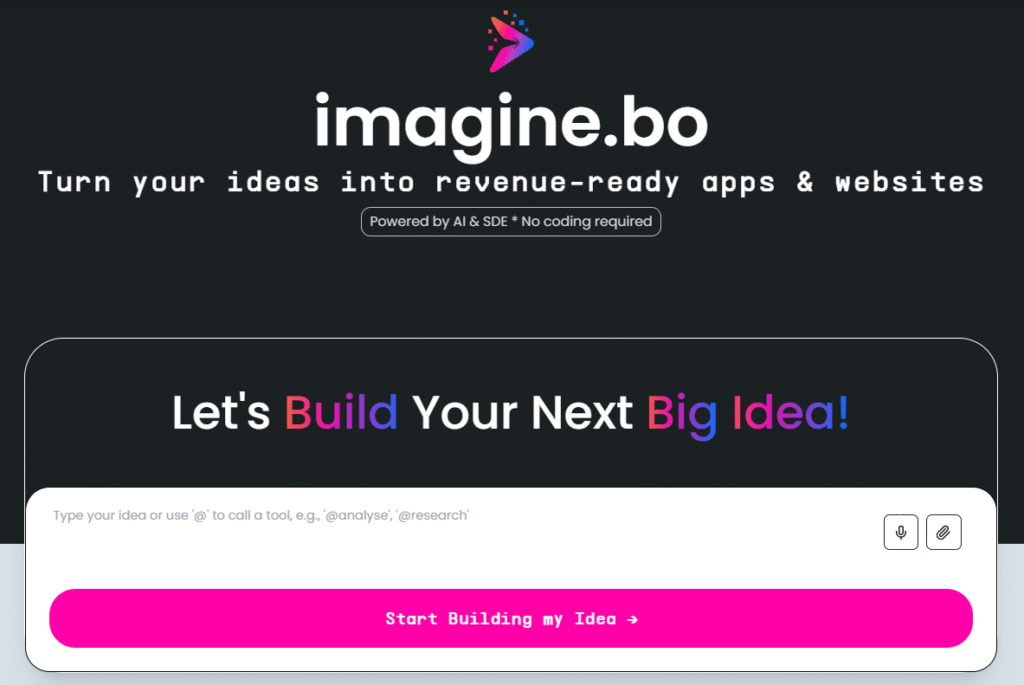
This analysis is focused exclusively on imagine.bo, identified as a provider of a no-code platform based in Gurugram, India, and founded by Raahull Leekha and Sushil Kumar. This entity operates as a “next-generation no-code platform” targeting non-technical founders and mission-driven organizations.
This report discards all data related to the following non-relevant entities:
Imagine BO: A textile fabric that blocks UVA rays.Imagine Boston 2030: A municipal plan for the city of Boston.Imagine Learning: A digital-first education solutions company.Imagine Industry Technology: A provider of smart manufacturing services.Imagine: An Irish broadband and internet service provider.The Imagine Group / Imagine Studio: A visual communications and print-marketing company.Imagine Communications: A media technology company that has completed SOC 1 and SOC 2 attestation reports.imagine.io: An AI-powered 3D product visualization platform that has earned ISO 27001 and SOC 2 Type II certifications.
This disambiguation is crucial. The formal SOC 2 certifications achieved by imagine.io and Imagine Communications are not relevant to imagine.bo. This analysis must, therefore, evaluate imagine.bo‘s claims on their own merits, based solely on its own public-facing documentation.
Core Architectural Claims: Security “By Default”
imagine.bo is positioned as a next-generation, AI-assisted no-code platform that enables users to turn plain-language ideas into full-stack, production-ready web or mobile applications.
The platform’s central security thesis is that protection and compliance are not the user’s responsibility but are, by design, “built-in”, “baked in”, and handled “by default”. imagine.bo claims that the apps it produces are “scalable, secure, and custom-branded” from the moment of creation.
The platform explicitly and repeatedly claims that its architecture is “GDPR/SOC2 compliant”. This architecture is designed to remove the security burden from the citizen developer by handling deployment, scaling, and security on robust cloud infrastructure (such as AWS, GCP, or Vercel).
Feature-to-Risk-Mitigation Analysis
When imagine.bo‘s specific technical claims are mapped against the OWASP LCNC Top 10 risks, a clear “security-by-design” philosophy emerges. The platform’s documentation provides a near one-to-one mitigation strategy for the very vulnerabilities that plague the no-code ecosystem.
The platform’s design appears to have anticipated these specific LCNC failures and systematically architected “baked-in” solutions. This is most evident in its approach to authorization, encryption, and audit logging.
- Mitigating Authorization & Impersonation Risks (LCNC-SEC-01, LCNC-SEC-02):imagine.bo claims to provide full-stack “Authentication and user permissions”. In its own technical-facing blog posts, it highlights the critical need for “granular permission controls allowing for role-based access to sensitive data”. By building this in as a core feature, the platform directly mitigates the risk of a citizen developer misusing authorization or granting insecure, excessive permissions.
- Mitigating Data Handling & Communication Risks (LCNC-SEC-03, LCNC-SEC-04, LCNC-SEC-08):The platform’s technical documentation details its “Data Encryption Protocols”. It specifies encryption “at rest… using industry-standard algorithms like AES-256” and “in transit… using TLS 1.2 or higher”. This is a highly specific, enterprise-grade claim. Furthermore, it details secure API integration, requiring “authentication through secure tokens such as OAuth 2.0” and mandating that all external APIs be accessed over HTTPS only. This directly addresses the LCNC risks of data leakage, insecure communication, and poor secret handling.
- Mitigating Logging Failure Risks (LCNC-SEC-10):This is one of the most significant findings. imagine.bo’s documentation explicitly addresses the need for robust logging, a key failure point in LCNC (LCNC-SEC-10). It states: “Logs of authentication attempts and access must be retained and regularly reviewed… supporting SOC 2 audit requirements”. This demonstrates an advanced, architectural understanding of compliance, engineering the platform to be “audit-ready” by default.
Imagine.bo Security Feature-to-Risk-Mitigation Matrix
| OWASP LCNC Risk | Risk Description (The “Citizen Developer” Problem) | Claimed Imagine.bo “Baked-In” Mitigation | Source(s) |
LCNC-SEC-02: Authorization Misuse | Citizen developers grant excessive, insecure permissions. | Built-in “Authentication and user permissions”; “Granular permission controls” for role-based access. | |
LCNC-SEC-04: Communication Failures | Data is sent over insecure, unencrypted channels. | Mandates “TLS 1.2 or higher” for data in transit; requires HTTPS for all API calls. | |
LCNC-SEC-05: Security Misconfiguration | Insecure default settings expose data or services. | “Built-in security checks” and one-click deployment to secure cloud platforms (AWS, GCP, Vercel). | |
LCNC-SEC-06: Injection Handling Failures | User input is not validated, leading to attacks. | Input validation to “prevent injection attacks”; AI-powered tools to “identify potential bugs and vulnerabilities early.” | |
LCNC-SEC-08: Data & Secret Handling | API keys are hard-coded; data is unencrypted at rest. | Data encrypted “at rest… using AES-256”; Secure API auth via “OAuth 2.0” (prevents hard-coding). | |
LCNC-SEC-10: Logging Failures | No audit trail exists to track user actions or breaches. | “Logs of authentication attempts and access must be retained… supporting SOC 2 audit requirements.” |
Validating the Compliance Framework: Imagine.bo and “Audit-Ready” Infrastructure
Deconstructing “SOC 2 Compliant”: From Claim to Evidence
imagine.bo repeatedly claims its platform is “GDPR/SOC2 compliant”. As established in Part 4.1, it is vital not to conflate this claim with the formal SOC 2 attestations of the similarly-named (but unrelated) imagine.io. The available research does not contain a formal press release or attestation report for imagine.bo itself.
However, a far more significant piece of evidence is present. The platform’s technical documentation contains a statement that reveals its underlying architectural philosophy: “Logs of authentication attempts and access must be retained and regularly reviewed for suspicious activity, supporting SOC 2 audit requirements”.
The importance of this single sentence cannot be overstated. This is not a high-level marketing claim (“we are compliant”); it is a low-level engineering specification that explicitly names an audit requirement as its design driver. This demonstrates a profound level of security maturity. It provides strong evidence that imagine.bo has not just “claimed” compliance but has architected its platform from the ground up to be “audit-ready”—a state where the necessary controls, like audit logging and data encryption, are “baked in” from day one. For a security-minded enterprise, this evidence of a sound foundation is more valuable than a simple marketing badge.
The Nuance of “HIPAA-Compliant”: Enabling vs. Conferring
The platform’s handling of the Health Insurance Portability and Accountability Act (HIPAA) provides another powerful signal of its security maturity. Given that healthcare breaches are the costliest, HIPAA compliance is a critical and complex subject.
The research shows imagine.bo‘s blog discusses how to build HIPAA-compliant apps and correctly identifies the technical prerequisites, such as a platform having SOC 2 Type II certification and data residency options.
Crucially, the documentation never claims that imagine.bo itself is “HIPAA-compliant”. This deliberate and precise omission is, paradoxically, a sign of trustworthiness. Immature platforms often make sweeping, incorrect claims of being “HIPAA-compliant,” which is technically and legally meaningless, as it requires the platform to sign a Business Associate Agreement (BAA) with the healthcare entity.
imagine.bo‘s actual posture—that its platform provides the tools (like granular permissions) to enable a healthcare provider to build a compliant app—is the correct legal and technical distinction. This nuance demonstrates a sophisticated understanding of complex compliance, reinforcing that the platform’s claims are precise and credible.
Securing the Next-Generation: AI Guardrails and Prompt Protection
The Newest Attack Surface: “Shadow AI” and AI Incidents
As an AI-assisted platform, imagine.bo faces an entirely new class of vulnerabilities. The 2025 IBM Report identifies “shadow AI”—the use of AI tools and services without employer approval or oversight—as a key driver of rising data breach costs.
The data on this new threat is alarming. A full 97% of organizations that reported an AI-related security incident lacked proper AI access controls. Furthermore, 63% of organizations lacked any AI governance policies whatsoever. This creates a massive, ungoverned attack surface, which an AI-first platform like imagine.bo is uniquely positioned to either solve or exacerbate.
“Baked-In” AI Security: Imagine.bo’s Guardrails
imagine.bo‘s architecture appears designed to be the “DevSecOps” solution to the “Shadow AI” problem. Instead of allowing employees to use ungoverned public large language models (LLMs), imagine.bo provides a sanctioned, governed, and secured ecosystem for AI-assisted development.
The platform’s technical documentation shows an awareness of AI-specific vulnerabilities, such as “exploitation through crafted prompts” (i.e., prompt injection). Its claimed mitigations are “baked in” to the platform:
- “Prompt shields” and “content safety modules”. These are not add-ons but are described as platform-level tools provided to developers during onboarding specifically to “prevent exploitation through crafted inputs”.
- Advanced Verification: The platform’s security strategy includes “using secondary AI passes for prompt verification”. This is an advanced technique where one AI model monitors the input and output of another to detect anomalies or malicious intent.
By providing these AI guardrails by default, imagine.bo moves AI development from the “shadows” into a monitored and secure environment, directly addressing the 97% control gap identified by IBM.
Concluding Analysis and Expert Recommendations
Final Assessment: A “Security-by-Design” Philosophy
A comprehensive analysis of imagine.bo‘s public-facing technical documentation and stated capabilities reveals a consistent and sophisticated “security-by-design” philosophy. The platform is not a simple “drag-and-drop” tool; it is a full-stack development environment that has been architecturally engineered to solve the core vulnerabilities of the no-code paradigm.
Its feature set and technical specifications map directly to the mitigations for the OWASP LCNC Top 10 risks. The platform’s design “shifts left,” correctly placing the burden of security on the platform itself, not on the non-technical citizen developer. This approach is the only viable model for securely scaling no-code development.
Furthermore, the platform’s language around compliance signals a high level of regulatory maturity. Its nuanced and correct distinction between enabling HIPAA compliance and engineering for “SOC 2 audit requirements” is a mark of credibility and expertise. imagine.bo has successfully articulated a position that security and compliance are not optional features but are the foundational, “baked-in” infrastructure of its platform.
Launch Your App Today
Ready to launch? Skip the tech stress. Describe, Build, Launch in three simple steps.
Build