Launching a clothing brand online is easier than it has ever been and more competitive than it has ever been, at exactly the same time. According to Statista, the global fashion e-commerce market is projected to reach $1.2 trillion by 2027. That growth means more buyers and more noise. Standing out requires a website that does two things simultaneously: communicate your brand identity precisely enough to justify your price point, and convert that identity into purchases without friction. Most clothing brand founders get stuck choosing between a platform with great e-commerce features that looks generic, or a beautiful template builder that cannot handle the product logic they need. This article cuts through that trade-off by examining what your fashion brand website actually needs in 2026, how imagine.bo performs against the leading alternatives, and how to launch a site that sells within a single day. For a broader look at AI-powered e-commerce site building, the AI website builder for e-commerce guide covers the full landscape.
TL;DR: A clothing brand website must lead with visual identity, convert product browsers into buyers, and load fast on mobile. According to Baymard Institute, the average cart abandonment rate is 69.8%, and checkout friction is the leading cause. imagine.bo’s Describe-to-Build feature generates a complete, custom-branded fashion storefront from one plain English prompt. Deployment is production-ready within hours. Pricing starts at $0, with the Pro plan at $25 per month for a full multi-page brand site with private deployment.
What Does a Clothing Brand Website Need to Actually Sell Products Online?
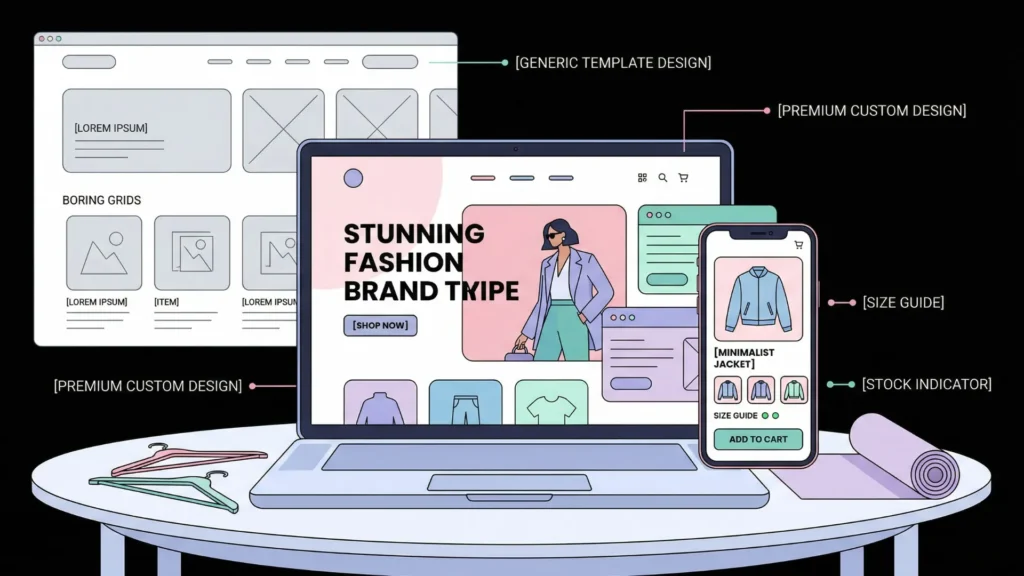
A clothing brand website needs to earn trust visually before it earns a purchase functionally. According to Stanford Web Credibility Research, 75% of consumers judge a business’s credibility based on its website design. For a fashion brand, that number is almost certainly higher. Your pricing, your positioning, and your perceived quality all flow from the visual decisions your site makes in the first three seconds. A website that looks generic, loads slowly, or feels inconsistent with your brand aesthetic costs you sales before a visitor reads a product title.
Launch Your App Today
Ready to launch? Skip the tech stress. Describe, Build, Launch in three simple steps.
BuildBeyond aesthetics, the functional requirements are specific. Product pages need multiple high-quality images, size guides, clear stock availability, and a frictionless path to checkout. According to Baymard Institute, 69.8% of online shopping carts are abandoned, and the leading causes are unexpected costs at checkout, being forced to create an account, and a confusing or lengthy checkout process. Every piece of friction your site adds between “I want this” and “I bought this” is a direct revenue loss.
Fashion brands face a challenge that most website builder advice ignores: your website is not just a storefront. It is your brand’s visual argument for why your products are worth paying a premium for. A mass-market brand can survive on a template that looks like every other clothing store online because they compete on price. An independent brand competing on aesthetic, story, or craft cannot. If your website looks like it came from the same template library as a hundred other brands, you have already undermined your positioning before a customer adds a single item to their cart. This is why the generation approach of imagine.bo, building from your specific description rather than adapting a generic template, is more valuable for independent fashion brands than for almost any other product category.
How Do AI Website Builders Compare for Fashion Brand Founders?
The honest comparison between the major options for clothing brand founders depends on what stage you are at and what you actually need beyond a product catalog.
| Platform | Starting Price | No-Code Friendly | Full-Stack Capability | Deployment | Human Engineering Support | Code Export |
|---|---|---|---|---|---|---|
| imagine.bo | $0 (Free) / $25 (Pro) | Excellent, prompt-based | Yes, full-stack with DB and backend | One-click via Vercel | Yes, Hire a Human from dashboard | Yes, full code ownership |
| Shopify | $39/month | Good, template-based | E-commerce only | Managed hosting | No, third-party only | Partial, locked ecosystem |
| Squarespace | $25/month | Good, visual editor | No backend logic | Managed hosting | No | No |
| Webflow | $23/month | Moderate, steep learning curve | No backend logic | Managed hosting | No | Yes, HTML/CSS/JS |
| Wix | $17/month | Good, drag-and-drop | Limited | Managed hosting | No | No |
Shopify genuinely excels at pure e-commerce with a mature payment processing ecosystem, hundreds of purpose-built apps, and well-tested checkout flows. If your entire operation is a product catalog with standard SKUs and you have no plans to add custom features beyond what Shopify’s app store covers, it is a strong choice. The cost adds up faster than the starting price suggests once you factor in transaction fees and the apps most clothing brands need, but the e-commerce depth is real.
Squarespace is the right choice if your brand sits at the intersection of editorial content and commerce. Its templates are genuinely beautiful and fashion-forward. The trade-off is limited backend flexibility. You cannot build anything custom, you do not own your code, and adding a feature Squarespace does not natively support means finding a third-party workaround or going without.
Webflow gives designers precise control over visual output but comes with a learning curve that is genuinely steep for non-technical founders. It also has no native backend or database, which means any dynamic product logic requires external tools stitched together.
imagine.bo generates a custom full-stack site from a plain English description, owns no lock-in because you export clean code, and provides a human engineering escalation path through Hire a Human when complex features like a custom size recommendation engine or a loyalty points system are needed. The full-stack capability is the differentiator: you are not building a storefront on top of someone else’s commerce platform. You are building a product that you own entirely.
Citation capsule: According to Baymard Institute’s 2024 E-Commerce UX study, 69.8% of online shopping sessions end without a purchase, with checkout complexity, forced account creation, and unexpected costs being the primary drivers of abandonment (Baymard Institute, 2024). Clothing brand websites that streamline checkout to three steps or fewer and enable guest checkout consistently recover 15 to 20% of otherwise abandoned carts, representing a direct revenue impact from site architecture decisions.
The building e-commerce stores without code guide covers the full e-commerce build workflow in more detail.
What Pages Does a Clothing Brand Website Need?
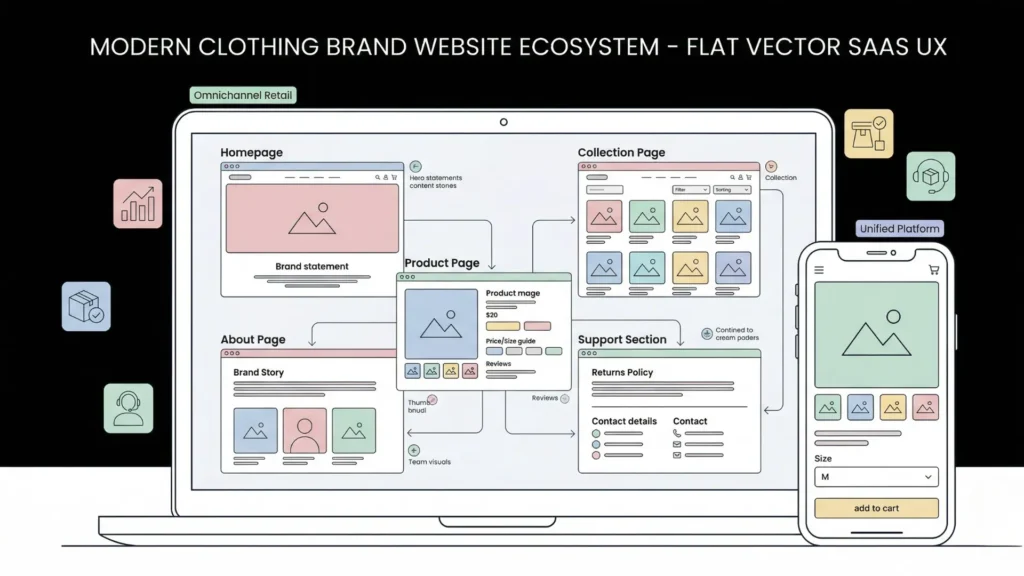
A clothing brand website needs six core pages, each serving a distinct job in the conversion journey. Missing any of them creates a gap that competing brands without that gap will fill.
The homepage establishes brand identity and directs traffic to the right collection or product category. It is not a product page. Its job is to communicate who this brand is for, create visual desire, and send the visitor deeper into the site. A hero image or short video, a brand statement in one sentence, featured collections, and a clear navigation structure are the essential components. Avoid cluttering the homepage with every product you stock.
Collection pages organize your catalog by category, season, or aesthetic. They are where browsing becomes intentional. Good collection page design includes filterable attributes like size, color, and price, a consistent image ratio across all product thumbnails, and the option to see key product information without clicking through to the product page. According to Nielsen Norman Group, users make navigation decisions within the first five seconds of arriving on an interior page. Clear collection organization determines whether they stay or leave.
Product pages convert. Each product page needs a minimum of four to six images showing the garment on a model, flat lay, and detail close-up. Size guide information should be on the page, not behind a modal that requires a click to open. Fabric content, care instructions, and fit notes address the objections that prevent purchase. Customer reviews on the product page, not just on a separate testimonials page, provide the social proof closest to the buy decision.
An About page is where independent brands have an unfair advantage over mass-market retailers. Your story, your process, your values, and the people behind the brand are differentiators that a fast-fashion company cannot replicate. According to Edelman’s 2024 Trust Barometer, 81% of consumers say they need to be able to trust a brand before buying from it. Your About page is where that trust is built or missed.
A size and fit guide dedicated page reduces returns and removes one of the most common purchase objections for online clothing buyers. Specific measurements, fit notes by garment type, and a simple comparison chart are the minimum. Returns policy and contact or customer service pages round out the six with the functional reassurances buyers need before committing. For more on how personal brand presentation layers into a clothing site, the no-code personal branding tools guide covers the brand identity dimension in depth.
How Do You Build a Clothing Brand Website with imagine.bo?
Building a clothing brand website on imagine.bo follows a specific sequence that produces a better result than starting with the visual editor and working backward from design decisions.
Before you open the platform, answer five questions in writing. What is your brand name and the one-sentence description of what makes it distinct? Who is your target customer in specific terms, not “fashion-forward women” but “women aged 25 to 40 who buy independent labels and care about fabric quality over trend cycles”? What are your product categories? What visual direction do you want: clean and minimal, editorial and bold, warm and artisanal? What do you want a first-time visitor to do first? Those answers are your prompt.
A strong prompt for a clothing brand might read: “Build a premium fashion brand website for [Brand Name], a women’s clothing brand focused on slow fashion, natural fabrics, and minimalist design. Target customer is women aged 28 to 45 who value quality over quantity. Collections include Everyday Basics, Outerwear, and Occasionwear. Include a homepage with brand story, a collections page with filtering by category, individual product page template with image gallery, size guide, and care instructions, an About page with brand story and values, a size and fit guide page, and a contact page. Visual style: clean, white-dominant, editorial photography layout. Typography should be elegant and simple.”
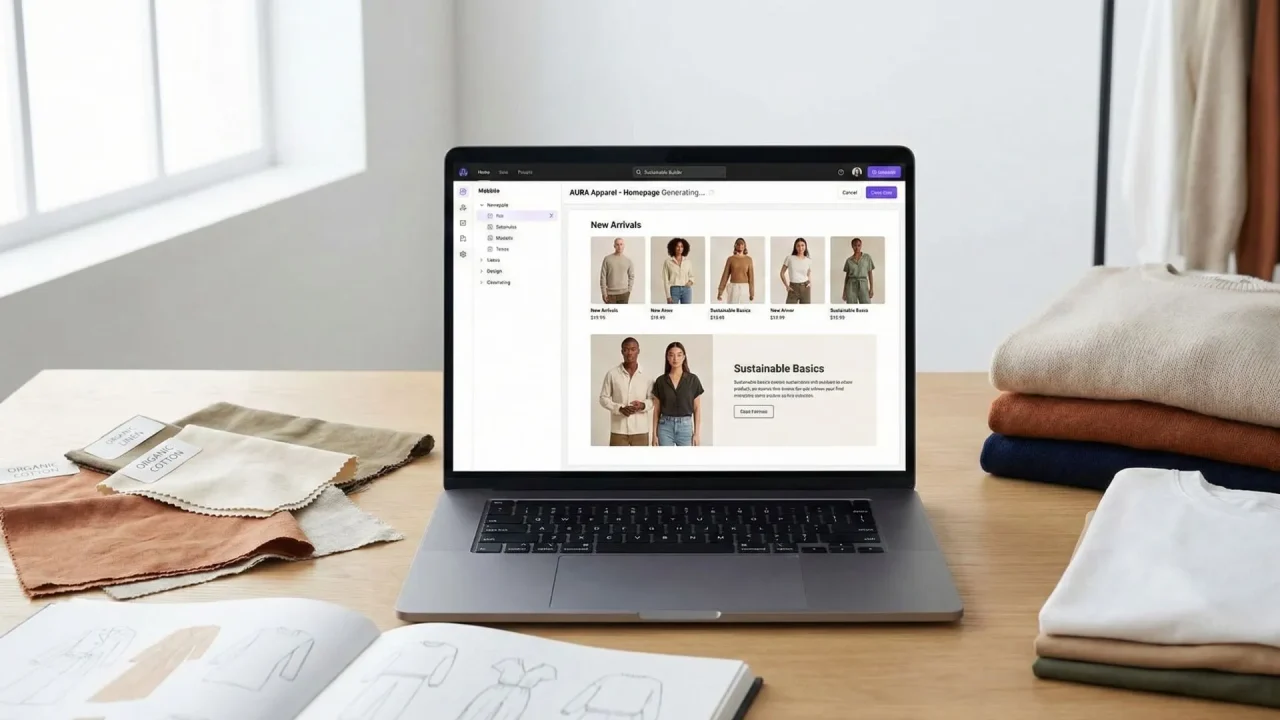
That prompt generates a structured, styled, multi-page fashion site in minutes. The AI-Generated Blueprint includes the navigation hierarchy, section order for each page, and a visual component structure that reflects the premium, minimal direction you specified. What a Squarespace designer would spend two to three hours configuring from a template, the Describe-to-Build process produces as a starting point in a single session. You then refine through conversation: “Make the homepage hero section full-width with a dark overlay,” “Add a newsletter signup section before the footer,” or “Include a sustainability values block on the About page.”
Real cost comparison for launching a clothing brand website in 2026: freelance web designer using Shopify or Squarespace, $1,500 to $5,000 for design plus $39 to $99 per month ongoing; custom development agency build, $8,000 to $55,000 based on Clutch market rate data; imagine.bo Pro plan with Hire a Human tasks for payment integration and custom product logic, under $300 for the first year including all platform costs. The savings compound further when you factor in that code ownership means you are not paying ongoing platform fees proportional to revenue, as Shopify’s transaction fee model imposes on growing brands.
One-Click Deployment pushes your completed site to Vercel’s global edge network. According to Google, 53% of mobile users abandon sites that take more than three seconds to load. For a clothing brand where mobile accounts for the majority of discovery traffic, that statistic is not an abstract risk. Vercel edge deployment ensures fast load times globally by default, without DevOps work on your part.
When your site needs a feature beyond what the AI generates cleanly, like a custom size recommendation quiz, a wholesale login section, or a subscription box flow, imagine.bo’s Hire a Human feature brings a vetted engineer into the specific module at $25 per page. You stay in the platform, the engineer pushes the code directly to your project, and the feature goes live without managing a separate contractor relationship. The make a website with one prompt walkthrough shows the full generation-to-live workflow step by step.
How Do You Make a Fashion Brand Website Rank on Google and Sell Through Social?
Fashion brand SEO and social traffic operate differently from most product categories, and your website architecture needs to account for both channels from the start.
For Google search, the highest-value pages for a clothing brand to rank are collection pages and product pages, not the homepage. Someone searching “linen trousers women UK” or “minimalist wool coat slow fashion” is already in purchase mode. Your collection pages and product pages should include the specific fabric, style, and category language your target buyer uses in their actual searches, not the language you use internally. Prompting imagine.bo to include natural descriptive keywords in your collection and product page headings during the generation phase is faster than retrofitting SEO copy after the site is built.
According to Moz, page titles and H1 headings are among the top five on-page SEO ranking factors. Every collection page and product category page should have a unique, descriptive H1 that includes the product type and a differentiating attribute. “Linen Trousers for Women” is a functional H1. “Women’s Linen Trousers in Natural and Undyed Fabrics” is a better one if that specificity is accurate to your product.
For social traffic, the connection between your Instagram, Pinterest, or TikTok presence and your website determines whether social discovery converts to revenue. Your product page URLs should be clean and shareable. Your product images should match the visual language of your social content so the experience of clicking from a social post to a product page feels consistent. A visitor who clicks from an editorial Instagram Reel and lands on a page that feels visually unrelated to the post they came from bounces at a higher rate. Visual coherence between your social presence and your website is a conversion variable, not just an aesthetic preference.
The best AI website builders with SEO guide covers the technical SEO foundations that clothing brand sites need to rank effectively from day one.
What Features Make a Clothing Brand Website Stand Out in a Crowded Market?
Three features separate clothing brand websites that build a loyal customer base from those that make one-time sales and struggle with retention.
A lookbook or editorial section elevates your brand from product catalog to visual destination. Editorial content, styled shoot photography, behind-the-scenes content, and seasonal capsule stories give visitors a reason to return between purchase decisions. According to HubSpot, websites with regularly updated content generate 55% more visitors than those with static pages. For a clothing brand, editorial content is not just SEO fuel. It is brand-building that compounds over time.
A wishlist or save-for-later feature recovers purchase intent that the session did not convert. Many fashion purchases, especially at higher price points, involve multiple visits before a decision. A visitor who saves three items on their first visit and receives a restock notification email on their second is more likely to convert than one who has to search for the items they remembered liking. This feature requires backend logic that AI generation handles well within imagine.bo’s Describe-to-Build workflow.
A size and fit review layer on your product pages reduces returns and improves purchase confidence. Integrating customer review fields that ask specifically about fit, true-to-size accuracy, and fabric feel gives future buyers the precise information they need to purchase confidently in their first size. According to Yotpo’s 2024 Fashion E-Commerce Report, 94% of online clothing shoppers consider size and fit information critical to their purchase decision. Building that information layer into your product page template from the start produces better buying decisions and fewer post-purchase regrets.
For clothing brands that operate both D2C and wholesale, a separate wholesale login section with a different pricing tier and minimum order logic is a feature worth building early. imagine.bo’s Hire a Human feature is the right tool for this, as wholesale pricing logic involves conditional display rules that benefit from human engineering oversight to implement cleanly. The building a dropshipping website without code guide covers the inventory and order logic layer for brands that do not hold stock themselves.
FAQ
What is the best AI website builder for a clothing brand launching in 2026?
Imagine.bo is the best choice for clothing brand founders who want a custom, full-stack site they own completely, generated from a plain English description. Shopify is better for brands that need a mature e-commerce app ecosystem and are comfortable with ongoing transaction fees. Squarespace suits brands whose needs are primarily visual and whose product catalog is straightforward. For most independent fashion founders, imagine.bo’s combination of AI generation, code ownership, and on-demand human engineering support through Hire a Human covers every requirement from launch through scaling, at a fraction of the cost of alternatives.
How much does it cost to build a clothing brand website with an AI builder?
Imagine.bo’s Pro plan costs $25 per month, which includes 150 credits, private deployment, rollover credits, and a one-hour expert session before launch. A comparable custom agency build costs $8,000 to $55,000 according to Clutch market rate data. Shopify’s entry plan starts at $39 per month before transaction fees and apps, which most clothing brands need within their first three months. imagine.bo’s total first-year cost including Hire a Human tasks for custom features like payment integration typically stays under $300, compared to thousands in agency fees or Shopify app costs.
Can I build a clothing brand e-commerce website without coding?
Yes. imagine.bo requires no coding at any stage. The Describe-to-Build interface generates your full site structure from a plain English prompt. The visual editor handles content and layout changes through drag-and-drop. Iterative changes to design, copy, and structure happen through conversational prompts. For advanced e-commerce logic like custom size recommendation tools or subscription boxes, imagine.bo’s Hire a Human feature brings a vetted engineer into the specific module at $25 per page without requiring you to manage an external contractor. See the building e-commerce stores without code guide for a full workflow example.
Does an AI-built fashion brand website look professional enough for premium positioning?
Yes, if you provide a specific, detailed prompt and replace placeholder content with real brand photography before launching. The Describe-to-Build output reflects the visual direction you specify. A prompt that requests “clean, white-dominant, editorial layout with minimal typography” produces a genuinely different result from one requesting “bold, color-heavy streetwear aesthetic.” According to Stanford Web Credibility Research, 75% of consumers judge business credibility by website design. The quality of your brief determines the quality of the output, the same as it would with a human designer.
How do I add a product catalog and checkout to my clothing brand website?
Describe your product structure in your initial prompt, including product categories, variations like size and color, and your preferred checkout flow. imagine.bo generates the page architecture and product page templates automatically. For payment processing integration, use imagine.bo’s Hire a Human feature to bring in an engineer who will implement Stripe or the payment provider of your choice cleanly and securely. Payment integrations involve compliance requirements that benefit from human engineering oversight, and Hire a Human is the right escalation path for this specific module.
Conclusion
The clothing brand founders who launch fastest in 2026 are not the ones with the largest budgets or the most technical experience. They are the ones who understand that a website is a brand argument before it is a sales tool, and who use AI generation to compress the time between that argument taking shape in their head and it being live on the internet. Three things determine whether your fashion brand website actually builds a business: visual identity that earns premium positioning, product page design that removes purchase friction, and SEO architecture that puts you in front of buyers who are already searching for what you sell. imagine.bo’s Describe-to-Build workflow handles all three from a single prompt, deployed the same day, on infrastructure that scales without DevOps work on your part. The brands that wait for the perfect build before launching are the ones competing against brands that launched six months ago and have six months of customer data, search ranking, and social proof to show for it. Build your clothing brand website on imagine.bo today, starting free, and have a production-ready storefront live before the week is out. For more on how AI site builders serve creative product businesses, the AI website builder for designers guide covers closely related territory worth reviewing.
Launch Your App Today
Ready to launch? Skip the tech stress. Describe, Build, Launch in three simple steps.
Build