
Choosing between AI driven development and no code tools can shape how fast and how smart your MVP reaches the market. This guide breaks down when to use each approach, how they impact cost, scalability, and speed, and what tradeoffs founders should expect early on. You will learn how to align the right development path with your product goals, team skills, and long term growth plans.
The MVP Paradox: Why 90% of Startups Fail Before Launch – A Deep Dive into AI vs No-Code

You have a brilliant business idea that could add value to countless users. Yet, when translating that vision into a viable product, founders often face a paralyzing dilemma: choosing the right development path. Should you hire an expensive, slow development team, or rely on quick, potentially limited tools?
Launch Your App Today
Ready to launch? Skip the tech stress. Describe, Build, Launch in three simple steps.
BuildMany startups fall into a fatal trap: skipping the Minimum Viable Product (MVP) phase entirely, pouring massive resources into a full-scale product only to find there is no market need. According to studies, 42% of startups fail because there is no market need for their product. Over-investing months or years into a complex product without market validation is costly and risky.
The solution lies in the MVP—the simplest version of your product that delivers core value to early adopters and enables you to gather real-world usage data quickly. Now, thanks to the collision of AI-powered automation and no-code flexibility, the efficiency of building your MVP has fundamentally changed, offering a definitive path for efficient startup launches.
Understanding the dynamics between AI vs No-Code can significantly influence your startup’s success.
This guide analyzes the three major development approaches—Traditional Code, Pure No-Code, and the emerging standard of AI-Powered No-Code—to show founders, solopreneurs, and non-technical builders how to achieve market validation in weeks, not months.
Decrypting the Development Landscape: Traditional vs. No-Code vs. AI-Driven

Understanding which development route is right for your startup requires evaluating them based on complexity, resources, and speed.
1. Traditional Custom Coding: High Control, High Risk
Traditional software development involves writing every line of code from scratch using languages like Python, Java, or JavaScript.
- The Approach: You build a full-featured product over months or years, focusing on complex architecture and custom functionality. This is often the path for products requiring highly unique algorithms or intense back-end logic.
- The Cost and Time Sink: Building a full-featured product from the beginning is inherently risky and costly. Traditional MVP development typically takes three to six months to complete and can cost anywhere from $30,000 to $200,000 or more. This investment is often prohibitive for early-stage startups with limited funding.
- The Risk: The complexity lies in feature implementation and UI design. Launching a complete product without prior validation is the primary reason founders struggle when debating no-code vs. traditional development.
2. Pure No-Code Platforms: Speed, but Limited Scalability
No-code development uses visual programming interfaces (like drag-and-drop editors) to help users build applications without writing code, enabling speed and accessibility.
- The Approach: Founders leverage platforms like Bubble or Webflow to quickly assemble functional prototypes or no-code MVPs within weeks. No-code democratizes the development process, opening doors for those without technical skills.
- The Advantage: Velocity. No-code solutions can bring about a 90% reduction in development time compared to traditional methods. Startups can bring a working version to market in weeks, not months.
- The Trade-Off: While cost-effective, pure no-code solutions often have customization limits and can face scalability constraints in high-traffic or complex environments.
3. AI-Driven MVP Development: The New Frontier
AI MVP development is the practice of creating a simplified application that leverages artificial intelligence to solve one core problem, focusing intensely on demonstrating the value of the AI solution itself.
- The Difference: An AI MVP is fundamentally different from a traditional MVP because its success is data-dependent. This represents the shift toward AI-powered no-code app development, where the focus is on intelligence rather than just function.
- The Approach: Instead of building complex models from scratch, the AI MVP typically uses pre-trained models (like GPT or Whisper) via APIs.
- The Challenge: AI MVPs involve a more intricate development process than traditional MVPs, demanding attention to data pipelines and model training infrastructure.
Comparative Analysis: Speed, Cost, and Scalability
The choice between development methods hinges on priorities. For a deeper dive into choosing the right path, you can review our guide on AI vs. No-Code MVP development.
| Aspect | Traditional Custom Code | Pure No-Code | AI-Powered No-Code (Hybrid) |
| Primary Goal | Maximum customization | Rapid functional validation | Validate AI model & Data efficacy |
| Time to MVP | 3–9 Months | 4–12 Weeks | 2–10 Weeks (Accelerated by AI) |
| Initial Cost | $30K – $200K+ | $5K – $25K | $10K – $50K |
| Core Risk | Market Risk (No market need) | Vendor lock-in | Technical Risk (Data quality) |
| Scalability | Unlimited | Platform-dependent | Built for hybrid growth |
Source Data Note: AI/No-Code solutions combined with lean methods can cut costs by up to 85% and launch 10x faster compared to traditional 6-month cycles.
Why Speed-to-Market is the Startup Founder’s Greatest Competitive Edge
In the modern digital landscape, the winning strategy is almost always the one that prioritizes speed and learning.
1. Validate Product-Market Fit Immediately
The MVP approach emphasizes launching quickly to test the viability of your idea in the real world before committing large amounts of capital. Tools that help you validate startup ideas are essential here. Early user feedback can quickly reveal whether the product solves a real problem or needs adjustments.
2. Capital Efficiency and Risk Reduction
Developing a full-featured product upfront is risky and expensive. By focusing only on the most critical features, startups cut development costs. Instead of spending months or years, a working version can be brought to market in weeks, allowing you to launch an app without developers. Startups that follow MVP strategies achieve 67% higher funding success and 2–3x faster market entry.
3. Data-Driven Pivoting
If your core assumptions about the product’s value are wrong, speed enables you to pivot quickly based on concrete data rather than intuition. Using low-code strategies for fast MVP validation allows you to iterate immediately after launch.
The Imagine.bo Advantage: Unlocking AI-Powered No-Code for Scalable MVPs
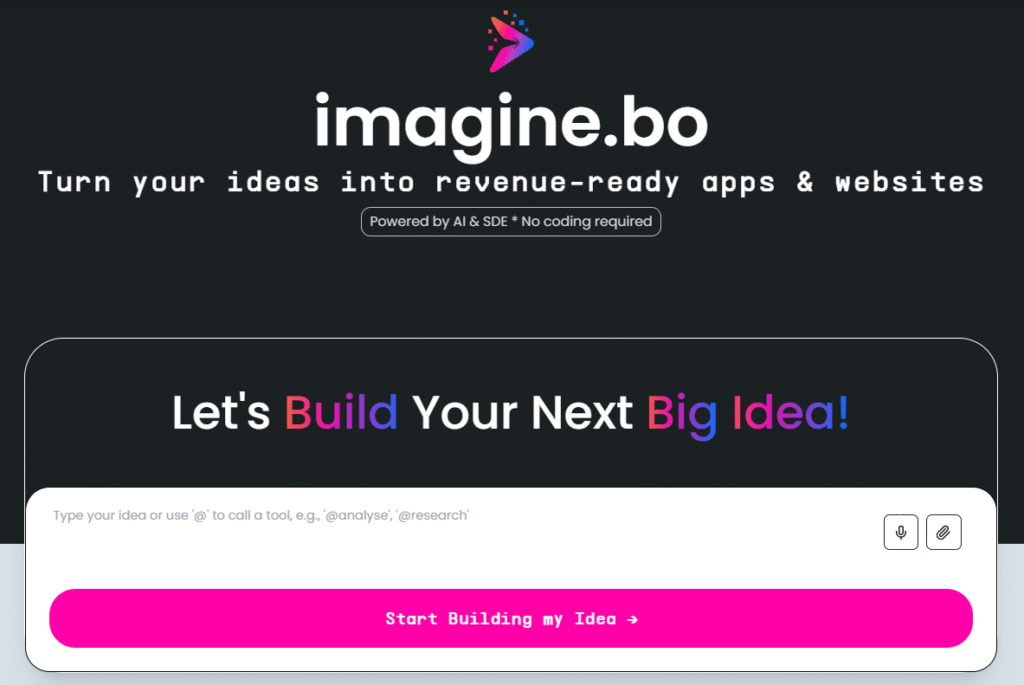
The ultimate path for efficient startup launches demands blending the speed of no-code with the intelligence of AI. Imagine.bo leverages this synergy to automate application development.
1. Instant Idea-to-App Translation via AI Automation
The longest initial hurdle is translating a business idea into technical specifications. Imagine.bo allows users to build an app by describing it in plain English. This AI automation acts as the initial developer, rapidly generating the required architecture and logic flows.
2. Scalability and Control Through Visual Workflows
While the AI handles the logic generation, Imagine.bo ensures transparency through visual workflows. Furthermore, Imagine.bo prioritizes scalable SaaS architecture from the start—a critical factor often missing in pure no-code solutions.
3. Risk Mitigation with Expert Support
AI MVPs require validation of data quality and ethical compliance. Imagine.bo integrates real human developer support to bridge the expertise gap, helping you learn how to build a SaaS with AI and no-code without getting bogged down in technical debt.
Moving from Idea to Traction
The path to building a successful startup MVP is no longer defined by lengthy, expensive traditional development cycles. It is defined by velocity. By leveraging platforms that combine AI prompts to build apps with flexible visual builders, founders can dramatically reduce the time-to-market.
Ready to stop sketching and start scaling?
Describe your app idea in plain English and let Imagine.bo build the core of your secure, scalable MVP today.
Launch Your App Today
Ready to launch? Skip the tech stress. Describe, Build, Launch in three simple steps.
Build