
Being a “morning person” always felt like a myth, until I asked a burning question: Can artificial intelligence re-engineer my biology? I spent eight weeks testing an AI sleep coach to transform from a groggy night owl into a productive early bird. This analysis breaks down the sleep science, the behavioral data, and the surprising results of hacking my circadian rhythm. You’ll learn exactly how I optimized my rest and leveraged that new energy with tools like Imagine.bo to maximize creative output and explore tools that are redefining productivity.
The Foundation: Understanding Sleep Science
Before diving into the mechanics of the AI, it is crucial to understand the fundamental principles governing our sleep. Without this baseline knowledge, the recommendations from an AI sleep coach appear as arbitrary commands rather than informed adjustments tailored to biological realities.
Launch Your App Today
Ready to launch? Skip the tech stress. Describe, Build, Launch in three simple steps.
BuildThe Circadian Rhythm: Your Internal Conductor
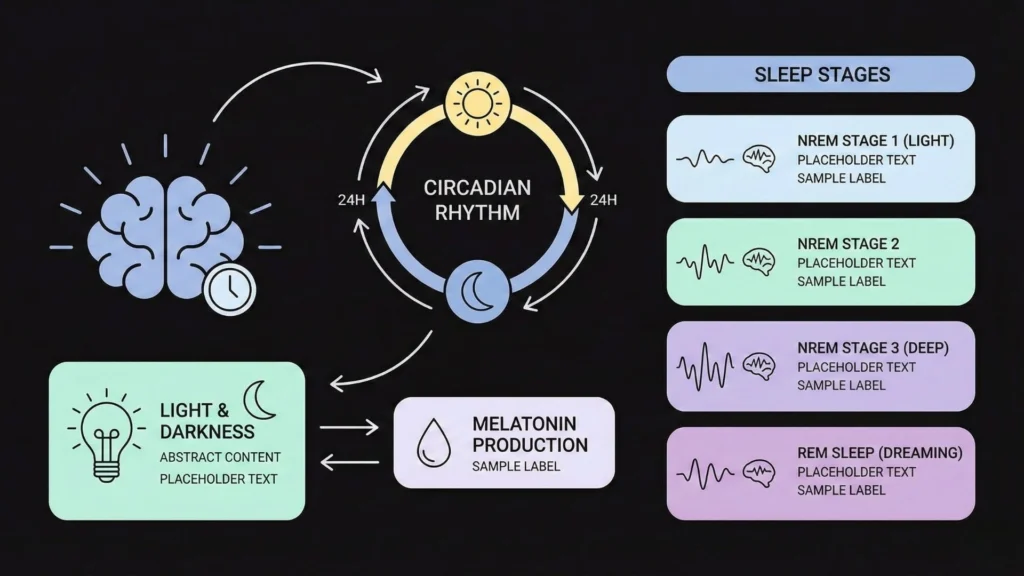
At the heart of our sleep-wake cycle lies the circadian rhythm, an internal biological clock operating on a roughly 24-hour cycle. This rhythm influences not just when we feel sleepy or awake, but also hormone release, body temperature, and digestion.
It is largely regulated by the Suprachiasmatic Nucleus (SCN) in the hypothalamus. This master clock receives direct input from your eyes. When sunlight hits your retina, the SCN signals the brain to suppress melatonin—the “darkness hormone” produced by the pineal gland. Conversely, darkness triggers melatonin release.
Modern life, with its artificial LEDs and late-night doom-scrolling, constantly threatens to throw this delicate balance off kilter. My AI sleep coach’s first job wasn’t to wake me up; it was to fix my relationship with light.
The Architecture of Sleep: It’s Not Just “Rest”
Sleep isn’t a monolithic state of unconsciousness; it is a dynamic process composed of distinct stages. An effective AI coach doesn’t just look at hours slept, but the quality of these cycles:
- NREM Stage 1 (N1): The bridge between wakefulness and sleep. Light, fleeting, and lasting only a few minutes.
- NREM Stage 2 (N2): The body cools, and heart rate slows. We spend about 50% of our sleep here. It involves “sleep spindles”—bursts of brain activity linked to memory consolidation.
- NREM Stage 3 (N3): Deep Sleep. This is the “maintenance” stage where physical recovery, tissue repair, and immune system strengthening occur. If you wake up feeling physically battered, you likely missed out on N3.
- REM Sleep: Rapid Eye Movement. The brain becomes hyper-active, almost like it’s awake. This is where emotional processing, learning consolidation, and vivid dreaming happen.
The Experiment: 8 Weeks with an AI Coach
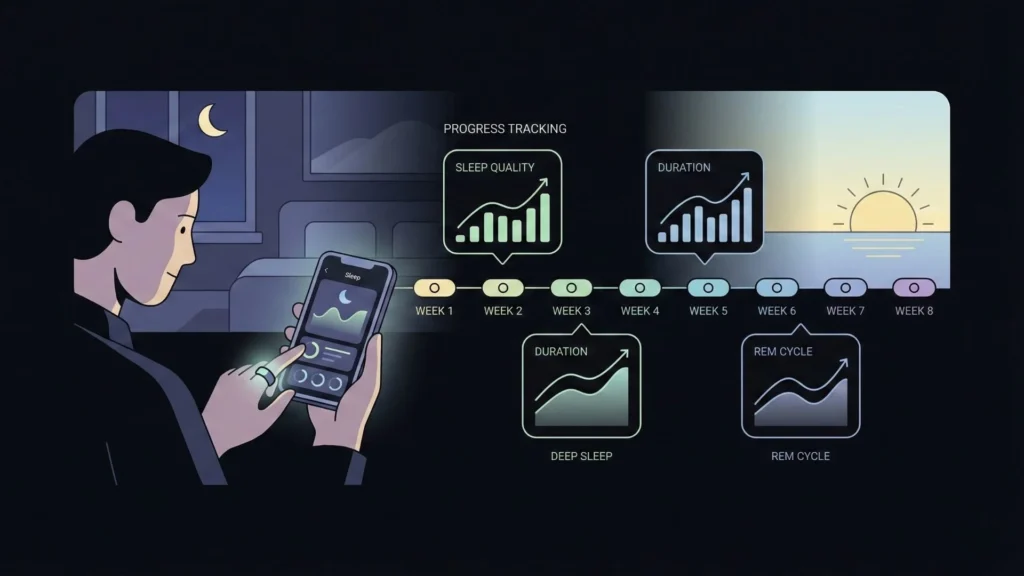
I chose a system that combined a wearable ring (measuring HRV, temperature, and movement) with an app driven by machine learning algorithms.
The Baseline (Weeks 1-2)
For the first two weeks, I did nothing but collect data. The results were humbling.
- Average Bedtime: 1:15 AM
- Deep Sleep: 14% (Suboptimal)
- Readiness Score: 45/100
The AI built a profile of my “natural” state, identifying that my late-night energy bursts were actually cortisol spikes caused by stress, not true energy.
The Intervention (Weeks 3-6)
The AI began issuing “behavioral nudges.” It didn’t just set an alarm; it calculated a “Sleep Window.”
- The Recommendation: Based on my previous night’s recovery and daily activity, the AI suggested a precise window (e.g., 10:45 PM – 11:15 PM) to fall asleep.
- The Struggle: The first week was brutal. My body fought the early bedtime. But the AI suggested a “wind-down protocol”—dimming lights to 50% brightness at 9:00 PM and taking a hot shower to drop my core body temperature (the cooling effect after a hot shower signals sleepiness).
The Breakthrough (Weeks 7-8)
By week 7, the “Smart Alarm” feature began to shine. Instead of waking me at 6:30 AM on the dot, it monitored my sleep cycles. If I was in light sleep at 6:18 AM, it woke me then. Waking up from light sleep—rather than being ripped out of deep sleep—changed everything. The grogginess vanished.
The Verdict? By the end of Week 8, my metrics had shifted dramatically:
- Average Wake Up: 6:30 AM (Naturally)
- Sleep Efficiency: Rose from 78% to 91%
- HRV (Heart Rate Variability): Increased by 40% (indicating lower stress).
I was no longer fighting the morning; I was welcoming it.
The “Morning Person” Advantage: What To Do With The Extra Time?
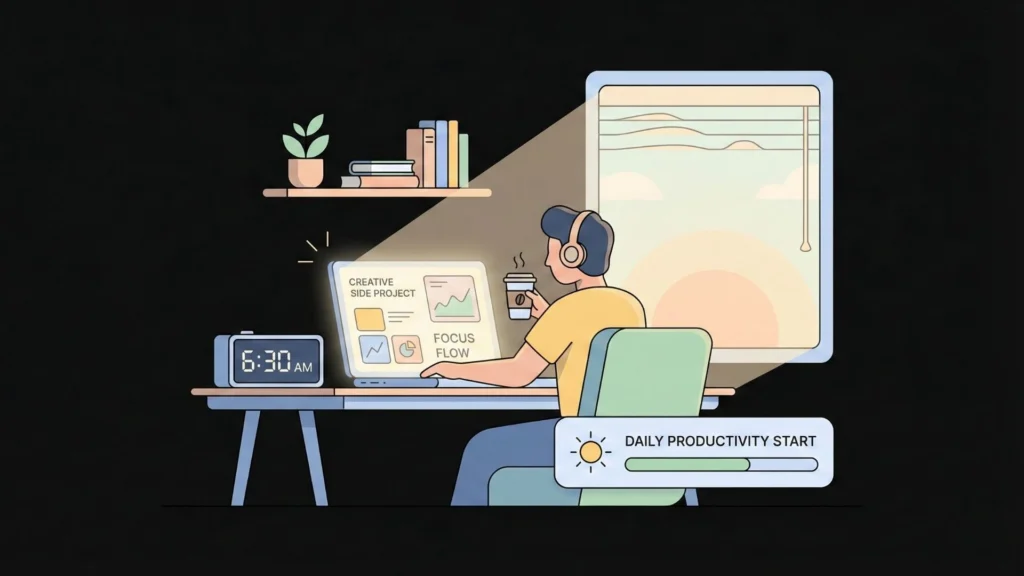
Here is where the story shifts from biological optimization to professional optimization.
Suddenly, I had two extra hours in my day before my “work” day officially began. The mental clarity at 7:00 AM is unlike any other time of day. The brain is fresh, unburdened by the decision fatigue that sets in by 4:00 PM.
I realized I finally had the time to work on the side projects and startup ideas I had shelved for years. But I faced a new bottleneck: Technical limitations.
I had the ideas, but I didn’t have the engineering team to build them. I didn’t want to spend my newfound morning energy learning complex syntax or fighting with spaghetti code. I wanted to build, launch, and test.
This is where I discovered that AI isn’t just for sleep—it’s for builders, too. Just as the sleep coach optimized my biological potential, a tool called Imagine.bo began optimizing my creative potential.
Leveraging AI for Creation: The Imagine.bo Solution
If you are a founder, a creator, or simply someone with an idea who (like me) values efficiency, the barrier to entry has always been the “How.” How do I code this? How do I set up the database?
In my search for productivity tools that matched the efficiency of my AI sleep coach, I found Imagine.bo.
What is Imagine.bo?
Imagine.bo is an AI-driven no-code platform. But to call it just a “no-code tool” sells it short. It is essentially an AI-powered Software Development Engineer (SDE) that lives in your browser.
While my sleep coach used data to architect a better night’s rest, Imagine.bo uses AI reasoning to architect revenue-ready apps. It bridges the gap between vision and execution without requiring you to write a single line of code, effectively allowing for launching apps without developers.
Why It Fits the “Optimized Life”
When you finally optimize your sleep and gain those precious morning hours, you don’t want to waste them on repetitive, low-leverage tasks. You want high impact.
Here is why Imagine.bo has become the second pillar of my AI-driven routine:
- SDE-Level Precision: Most no-code tools feel like toys. They break when you try to scale. Imagine.bo generates code that follows real engineering standards. It builds scalable backends, secure data handling, and high-performance logic (up to 1,000 transactions per second). It’s the difference between a nap and a full night of REM sleep—it’s the real deal.
- Plain English Interface: You don’t need to learn a new visual language. You simply describe your product vision—”I want a marketplace for vintage watches with user authentication and payment processing”—and the AI Reasoning Engine analyzes the business goals to generate the architecture.
- End-to-End Ownership: Just as the sleep coach tracked everything from temperature to movement, Imagine.bo handles the full stack: frontend, backend, database, and deployment.
The 5-Step Morning Workflow
With my new 6:30 AM wake-up time, my morning routine now looks like this:
- Vision (Step 01): I spend 20 minutes sketching a feature idea.
- AI Reasoning (Step 02): I feed the concept into Imagine.bo. The AI thinks through the user flow and recommends the tech stack.
- Development (Step 03): While I have my morning coffee, the system generates the frontend and backend systems, running automated QA checks.
- Launch (Step 04): By the time the rest of the world is waking up, I can deploy a secure, cloud-native update.
For anyone who feels limited by technical skills, this is a liberation. It allows you to operate like a technical co-founder without the years of coding school.
Analyzing The Data: Why Measurement Matters
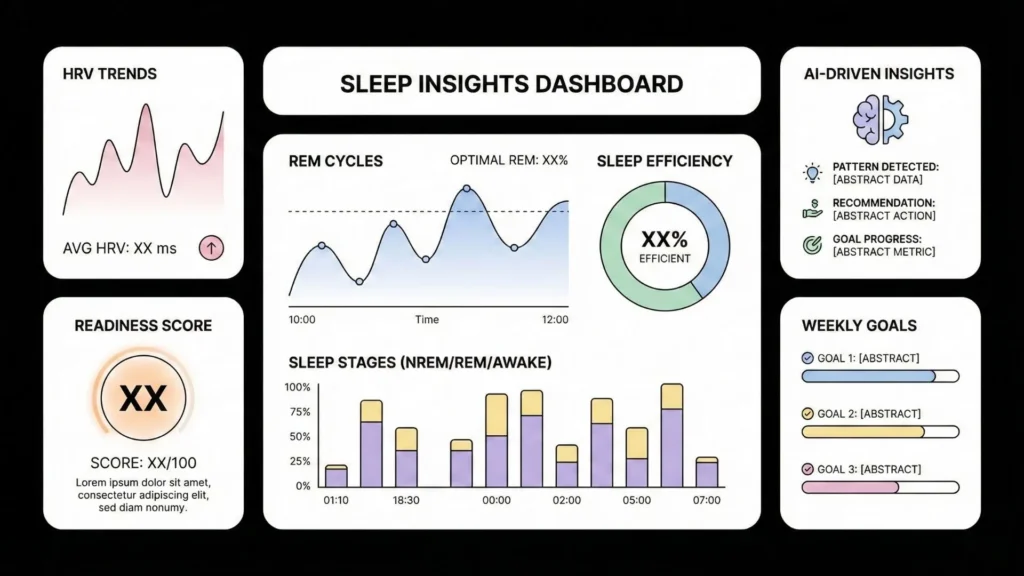
Returning to the sleep experiment, the most compelling aspect was the data visualization. The app didn’t just say “Good Job”; it showed me charts of my REM cycles and trends in my resting heart rate.
This reinforced a critical lesson: You cannot improve what you do not measure.
Key Metrics Tracked
- Sleep Latency: The time it takes to fall asleep. Mine dropped from 45 minutes to 18 minutes. This was largely due to the “wind-down” recommendations.
- Sleep Debt: The accumulated difference between needed sleep and actual sleep. The AI helped me chip away at a chronic debt I had carried for years, which explained why my cognitive function (memory, focus) skyrocketed in weeks 5-8.
- HRV Trends: Seeing my HRV trend upward gave me objective proof that my body was recovering better from stress.
Visualizing Success
Interestingly, the dashboarding capabilities of modern AI tools are a marvel in themselves. In the past, building a custom analytics dashboard to track business growth or user engagement (like the ones inside Imagine.bo) would cost thousands of dollars in development time. Now, whether it’s tracking your REM cycles or your startup’s monthly recurring revenue (MRR), AI puts these insights at your fingertips instantly.
The Challenges: It Wasn’t All Smooth Sailing
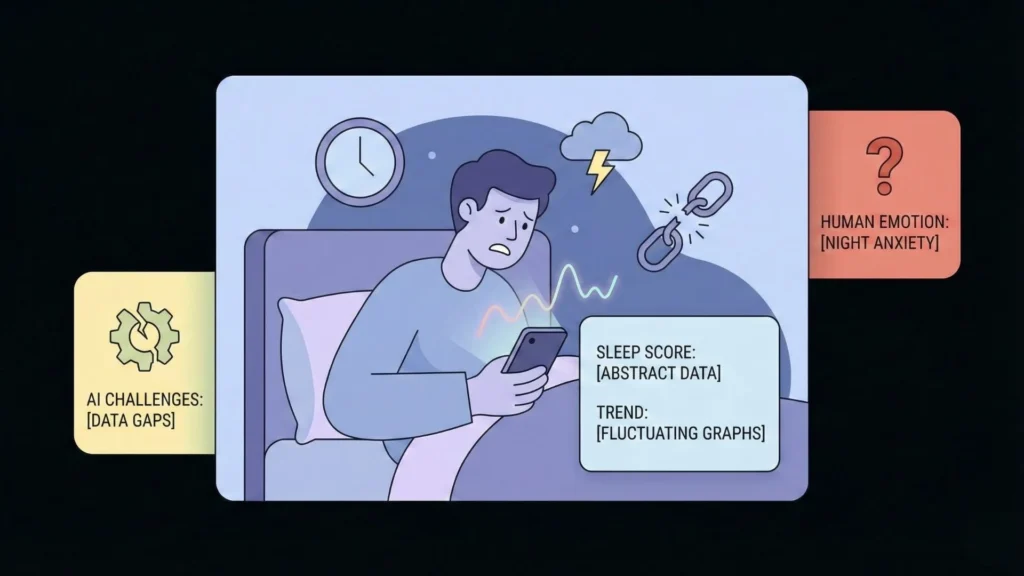
It would be disingenuous to claim the experiment was flawless. Relying on AI for biological regulation has its pitfalls.
- The “Orthosomnia” Risk: This is a medical term for an unhealthy obsession with achieving “perfect” sleep data. In Week 3, I found myself stressing out if my readiness score was 79 instead of 80. This anxiety paradoxically made it harder to sleep. I had to learn to use the data as a guide, not a grade.
- Sensor Reliability: No wearable is perfect. There were nights when the ring slipped, resulting in gaps in data. However, the AI algorithms are generally robust enough to smooth out these anomalies over time.
- The Human Element: AI can tell you to go to bed at 10:45 PM, but it cannot physically force you to put down your phone. The discipline to obey the AI is still a deeply human requirement.
Practical Tips for Aspiring Morning People (AI or Not)
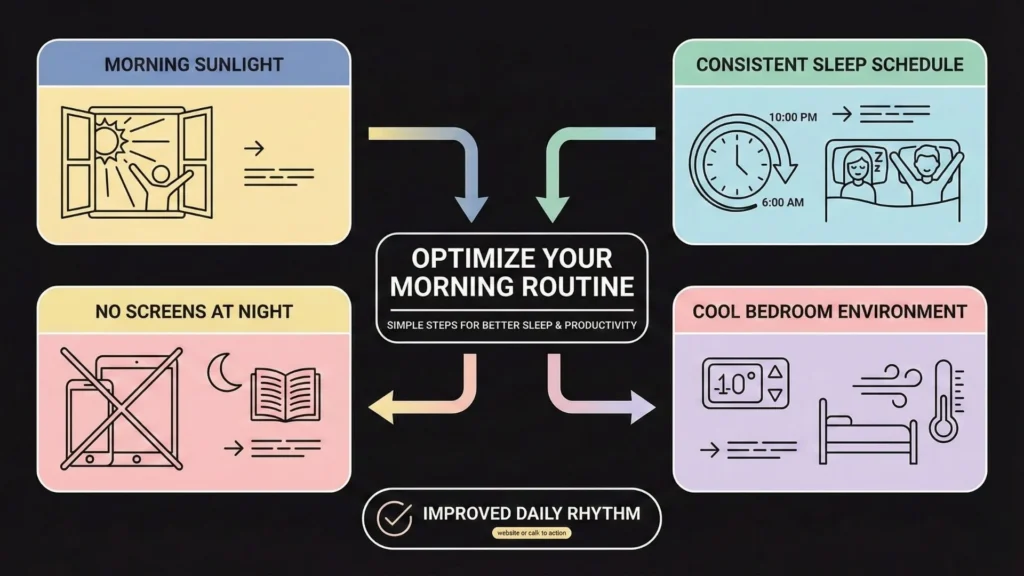
Whether you invest in an AI coach or simply want to improve your mornings using traditional methods, here are the core principles that drove my transformation:
1. Light Stewardship
Control your light environment aggressively. Get sunlight in your eyes within 20 minutes of waking up (this sets the timer for melatonin release 12-14 hours later). Conversely, block blue light in the evening.
2. The 3-2-1 Rule
- 3 hours before bed: No more food. (Digestion raises body temperature, which fights sleep).
- 2 hours before bed: No more work.
- 1 hour before bed: No screens.
3. Consistency is King
The body loves homeostasis. Waking up at 6:30 AM on weekdays and 10:00 AM on weekends induces “Social Jetlag,” which feels exactly like traveling across time zones. My AI coach was strict about this: keep the variance within 30 minutes, even on Sundays.
4. Thermal Regulation
Your body needs to drop its core temperature by about 2-3 degrees Fahrenheit to initiate sleep. Keep your bedroom cool (around 65°F or 18°C).
The Verdict: A New Operating System for Life
Can AI make you a morning person? Yes.
But more importantly, AI can restructure the way you approach your biological and professional potential. The sleep coach didn’t just give me more hours; it gave me better hours. It optimized my hardware (my body) so I could run better software (my mind).
And once you have that energy, the question becomes: What will you build with it?
We are living in a golden age of individual empowerment. We have AI that acts as a personal sleep scientist to ensure we are rested, and we have platforms like Imagine.bo that act as personal engineering teams to help us build our dreams.
The barrier between “idea” and “execution” has never been thinner. The dawn, once a dreaded adversary, is now a welcome friend. The only thing left to decide is what you will create before the rest of the world has even had their coffee.
FAQ: Integrating AI into Your Routine
Do I need a wearable for an AI sleep coach?
While apps exists that use the phone’s microphone to track breathing, wearables (rings or watches) provide significantly more accurate data regarding HRV and sleep stages.
Is Imagine.bo suitable for non-technical founders?
Absolutely. It is designed specifically for non-technical founders who want to focus on business outcomes rather than code. The “Step 01: Start With Your Vision” feature allows you to use natural language to define your product.
How long does it take to reset a circadian rhythm?
My experiment took about 8 weeks for the habits to feel fully natural, though I saw data improvements as early as Week 3.
Can I export data from these AI tools?
Yes, most sleep coaches allow data export. Similarly, Imagine.bo allows for seamless data export to tools like Google Sheets, ensuring you always own your business intelligence.
Launch Your App Today
Ready to launch? Skip the tech stress. Describe, Build, Launch in three simple steps.
Build