
You have a fitness product idea. Maybe you’re a personal trainer who wants to scale beyond one-on-one sessions. Maybe you’ve spotted a gap in the market for niche workout coaching. Either way, you’ve probably looked up what it actually costs to build an AI fitness app and come away with quotes between $50,000 and $500,000. That number stops most founders cold.
This guide walks you through every major decision in building an AI avatar fitness trainer app: what features actually matter, how the architecture works, how to monetize it, and how platforms like imagine.bo let you ship a production-ready version without writing a line of code. By the time you finish reading, you’ll have a clear build plan and a realistic path to launch.
Launch Your App Today
Ready to launch? Skip the tech stress. Describe, Build, Launch in three simple steps.
BuildFor related context on how AI tools are replacing traditional development timelines, see how AI website builder for training programs handle the same challenge for digital course creators.
TL;DR: The global fitness app market is valued at $13.81 billion in 2026 and growing at 14.15% annually (Towards Healthcare, 2026). AI avatar fitness trainer apps are the fastest-growing sub-category, driven by user demand for personalization. Non-technical founders can now build and deploy production-ready versions using AI platforms like imagine.bo for under $500, compared to $150,000 to $500,000 via a traditional dev agency.
What Is an AI Avatar Fitness Trainer App, and Why Does It Work?
An AI avatar fitness trainer app is a web or mobile application where a customizable digital coach guides users through personalized workouts, tracks progress, adapts programming over time, and delivers feedback as if it were a real trainer. It is not a static video library or a simple calorie counter. The avatar is the interface layer over AI logic that handles planning, adaptation, and communication.
This model works because personalization drives retention. According to FitBudd (2025), health and fitness applications that incorporate AI-driven personalization have 50% higher retention rates compared to apps without it. That is a meaningful business advantage in a market where the average app loses 77% of daily active users within three days of installation (Amra and Elma, 2025).
Most fitness app founders obsess over features. The data says they should obsess over the first-week experience instead. Research shows users who engage daily in their first week are 80% more likely to stay active for six months (sportfitnessapps.com, 2026). An avatar-based interface is specifically effective here because it creates a social accountability cue, even when no human trainer is present.
The avatar is not just aesthetic. It signals that the app is responsive and intelligent, which sets user expectations in the right direction before the first workout even starts.
For more context on how AI coaches work within app environments, see building apps for fitness coaches without a developer.
What Features Does Your App Actually Need?
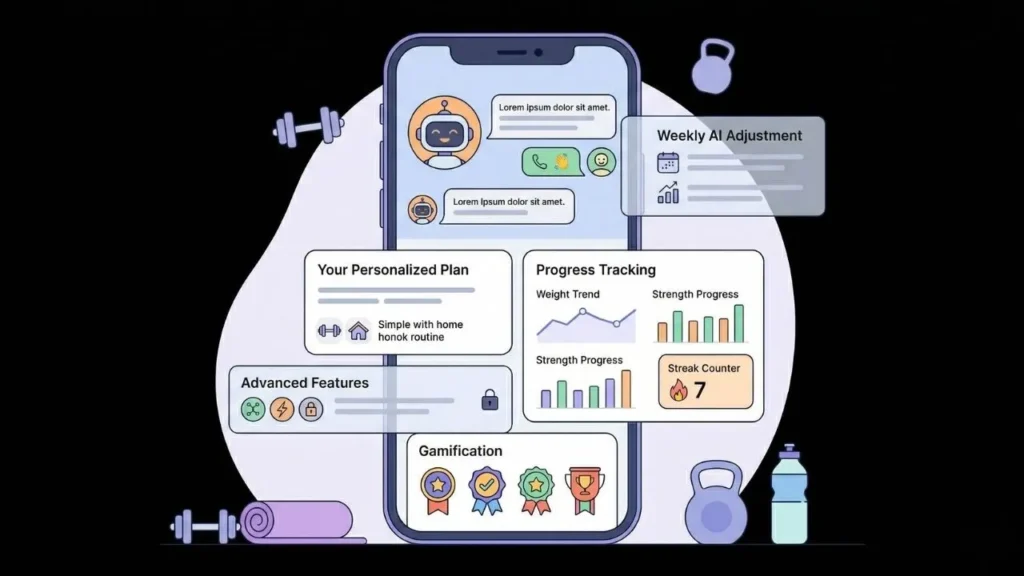
Your MVP needs five core features. Everything else is iteration. Founders who try to build the full Peloton stack on the first pass run out of runway before they find product-market fit.
1. Onboarding and goal assessment. The AI avatar needs enough information to personalize from day one. Collect fitness level, goals (fat loss, muscle gain, endurance, mobility), available equipment, and preferred session length. This data feeds your personalization logic. The avatar should deliver the onboarding as a conversation, not a form.
2. AI-generated workout plans. The core promise of your product. Plans should adapt week to week based on completion data, user ratings, and any performance signals you collect. According to Groovy Web (2026), users who receive AI-adaptive plans complete 40 to 60 percent more workouts than users on static programs. This feature is what justifies a subscription.
3. Progress tracking and visualization. Dashboards showing weight changes, strength improvements, workout streaks, and goal progress. This is your retention engine. Users who can see their own data are more likely to come back tomorrow. Gamification elements like streaks and badges boost 90-day retention to around 24% according to research cited by Propel (2025).
4. Avatar interface and feedback layer. The avatar delivers workout instructions, motivational prompts, form cues (text or audio-based initially), and celebration messages when users hit milestones. At the MVP stage, this does not need computer vision or real-time pose estimation. It needs to feel responsive and warm.
5. Subscription and payments. You need a monetization layer from day one. A freemium entry with premium AI coaching behind a paywall is the standard model. According to Statista data cited by sportfitnessapps.com (2025), 71% of fitness app users are willing to pay for premium features. Build the paywall into your initial architecture, not as an afterthought.
When building fitness apps with imagine.bo’s Describe-to-Build feature, founders frequently scope out computer vision form correction as a must-have. In practice, text-based and audio-based form cues drive equivalent early retention because most users are not doing complex lifts that require real-time camera analysis. Save the vision layer for version two, once you have paying users to justify the complexity.
See a practical list of real app prompts for different app types, including fitness, at the real app prompts by type library.
How Do You Build the Avatar Layer Without Code?
The avatar layer is the part that intimidates most non-technical founders. It sounds like it requires game engines, motion capture, or expensive 3D rendering. At the MVP level, none of that is necessary.
A functional AI avatar can be built with three components: a visual character (static or lightly animated illustration), a conversation interface powered by an LLM, and logic that connects user data to avatar responses. The avatar does not need to move its mouth in real time. It needs to say the right things at the right moments.
Using imagine.bo’s Describe-to-Build feature, a fitness app prompt specifying an “AI coaching avatar that delivers adaptive workout plans, tracks user progress, and responds to user input via a chat interface” generates a complete full-stack scaffold including the frontend avatar UI, user profile database, workout plan schema, and session tracking logic. The initial generation takes minutes, not months.
The practical flow looks like this. You describe the app in plain English. The AI-Generated Blueprint shows you the structure before a line of code is written. You refine through conversation, iterating the avatar’s personality, the onboarding questions, and the plan generation logic. When you are ready, One-Click Deployment pushes the app live on Vercel and Railway. If you hit a wall with something technically complex, like integrating a third-party wearable API, the Hire a Human feature connects you to a vetted engineer who handles that specific task without taking over the whole project.
This hybrid model is what makes it different from purely no-code tools. You get AI speed and human precision exactly where you need it.
For a broader look at how this process works from concept to live product, see going from idea to live app.
What Is a Realistic Build Cost in 2026?
Traditional development for an AI fitness app with avatar functionality costs $150,000 to $500,000 and takes four to seven months (Biz4Group, 2026). That is the agency route. The no-code and AI-builder route changes the math substantially.
According to Groovy Web (2026), AI-first development teams can deliver fitness platforms with AI workout personalization, wearable integration, and computer vision form checking for $50,000 to $150,000 in six to ten weeks. That is the same feature set at a third of the timeline. Building with imagine.bo compresses that further for founders who are comfortable owning the product iteration themselves.
Here is a practical cost comparison:
| Build Method | Cost Range | Timeline |
|---|---|---|
| Traditional dev agency | $150,000 to $500,000 | 4 to 7 months |
| AI-first dev team | $50,000 to $150,000 | 6 to 10 weeks |
| imagine.bo Pro + Hire a Human | Under $1,000 to $5,000 | Days to 2 weeks |
| imagine.bo Done For You | $499 one-time | Fully managed |
The imagine.bo Pro plan at $25 per month gives you 150 credits, private projects, rollover credits, priority support with a 24-hour turnaround, and a 1-hour expert session before launch. The Done For You option at $499 one-time delivers a fully managed engineering build by the imagine.bo team, which covers the full first version for most fitness app concepts.
For a full breakdown of what drives app development costs across different methods, see real costs to build an app in 2026.
How Should You Monetize Your AI Fitness Trainer App?
The freemium model with a premium AI coaching tier is the default that works. Free access gets users through the door. Paid subscriptions convert users who have seen real results.
According to Business of Apps (2026), fitness app revenue grew 24.5% in 2025 to reach $3.4 billion. That growth is driven largely by subscription revenue from apps that combine free entry with premium personalization. Your pricing should reflect the value of the AI coaching layer, not just content access.
Three monetization tiers work well for AI fitness apps at launch:
Free tier. Basic workout library access, seven-day AI-generated starter plan, and limited avatar interactions. The goal is activation, not revenue. Users on the free tier should experience enough of the avatar to want more.
Standard subscription ($9 to $15 per month). Unlimited AI-generated adaptive plans, full avatar coaching interface, progress tracking dashboards, and basic nutrition guidance. This is your core revenue tier.
Premium subscription ($25 to $40 per month). Everything in standard, plus advanced analytics, priority avatar response speed (if using API calls), personalized weekly check-ins, and access to community features. Research cited by sportfitnessapps.com (2025) shows that apps focused on AI-powered customization saw a 40% jump in premium subscriptions when personalization was clearly communicated at the paywall.
In-app purchases work as a secondary revenue layer for equipment recommendations, specialist programs (marathon training, post-pregnancy fitness, senior mobility), and avatar customization. These are strong upsell moments right after a user hits a milestone.
For a deeper look at revenue strategies that do not require coding, see monetizing prompt-built apps.
What Are the Key Technical Decisions You Need to Make?
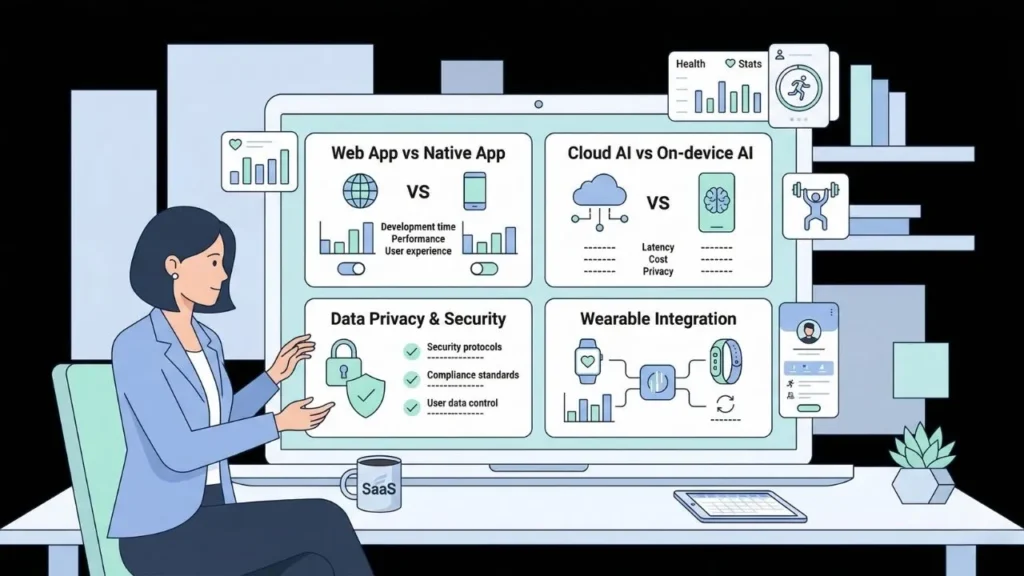
You do not need to understand code to make the right technical decisions. You need to understand the tradeoffs.
Web app versus native mobile app. A web app (accessible from any browser) ships faster, costs less, and integrates more easily with third-party tools. A native iOS or Android app has better access to device sensors, smoother animations, and higher perceived quality. For an MVP, start web. Native follows once you have paying users justifying the investment. imagine.bo’s default deployment produces a web app on Vercel with a mobile-responsive frontend, which covers the MVP case.
AI generation: on-device versus cloud. For workout plan generation and avatar conversation, cloud-based AI (via API calls to OpenAI, Anthropic, or similar) is cheaper to build and easier to update. On-device AI runs without internet and eliminates per-call costs but adds development complexity. Groovy Web (2026) notes that most fitness apps use a hybrid approach: on-device for real-time features, cloud for personalization. At the MVP stage, cloud-only is the right call.
Data privacy and compliance. Health and fitness data is sensitive. Your app needs to store it securely and communicate clearly about what you collect. imagine.bo includes built-in security with RBAC (role-based access control), SSL, GDPR foundations, and SOC2 readiness out of the box. You do not need to build these from scratch, which eliminates one of the biggest hidden costs in fitness app development.
Wearable integration. Apple Health and Google Fit integrations are high-user-demand features, but they require native API access that a web app cannot fully replicate. Plan these for version two unless your target user specifically depends on wearable data from day one.
For no-code scheduling and reminder features, which are essential for user habit formation, see no-code AI scheduling features.
Step-by-Step: Build Your AI Avatar Fitness App With imagine.bo
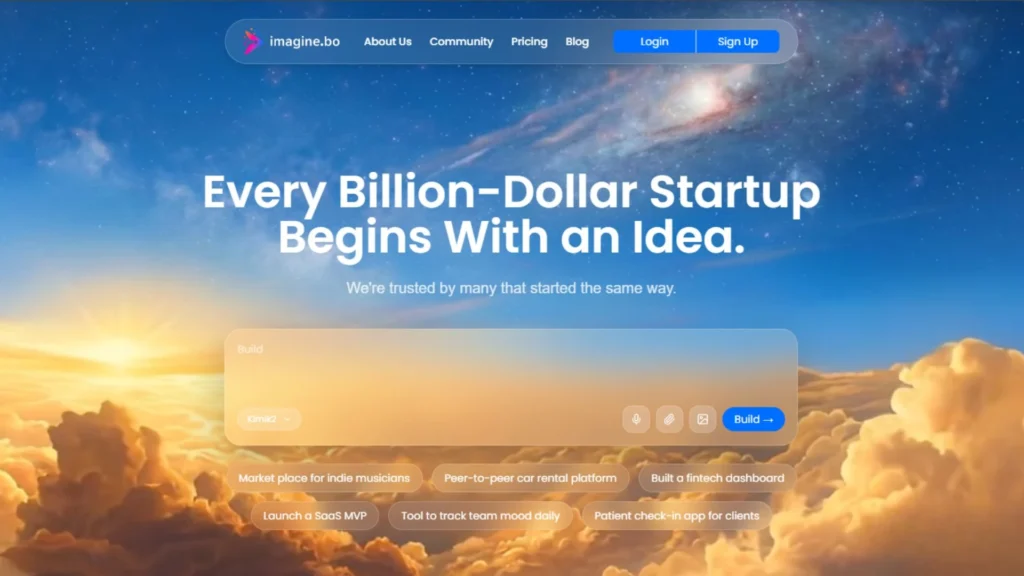
This is the practical flow. It assumes you are starting from zero technical knowledge.
Step 1: Define your niche and avatar personality. Broad fitness apps compete with Peloton, MyFitnessPal, and Nike Training Club. You do not want that fight at launch. Pick a specific user: postpartum women returning to movement, desk workers with back pain, men over 50 building functional strength. Your avatar’s personality follows from that user. Name the avatar. Give it a tone. Write three sample messages it would send.
Step 2: Write your first Describe-to-Build prompt. Be specific. A strong prompt includes your niche, core features, subscription structure, and avatar behavior. Example: “Build a web app for desk workers over 40 who want 20-minute daily mobility and strength sessions. The app should include an AI avatar coach named Alex, onboarding to collect fitness level and goals, AI-generated weekly workout plans that adapt based on user completion rates, a progress dashboard, and a monthly subscription paywall at $12 per month.”
Step 3: Review the AI-Generated Blueprint. Before any code is written, imagine.bo shows you the architectural plan. Review it for missing features or wrong assumptions. This is the right time to catch issues, not after generation.
Step 4: Iterate through conversation. Refine the avatar personality, adjust the onboarding flow, change the plan adaptation logic. Each change is a conversation turn, not a code edit. This is the biggest productivity advantage of the platform.
Step 5: Use Hire a Human for specific technical needs. If you need a custom integration, a specific animation, or a compliance review, assign that task to a vetted engineer through the dashboard. You get a specialist for the specific piece without hiring a full team.
Step 6: Deploy and test with real users. One-Click Deployment pushes your app live. Share it with ten people in your target audience before spending anything on marketing. Their behavior in the first week tells you more than any market research.
For more detail on writing effective prompts for apps, see turning ideas into apps with AI prompts.
FAQ: AI Avatar Fitness Trainer App
How much does it cost to build an AI avatar fitness trainer app in 2026?
Traditional development ranges from $150,000 to $500,000 for advanced AI features, according to Biz4Group (2026). Using imagine.bo, a production-ready MVP can be built for under $1,000 including the Pro plan and any Hire a Human tasks. The Done For You option delivers a fully managed build for $499 as a one-time cost.
Do I need a fitness certification or license to launch a fitness app?
In most markets, apps offering general fitness content do not require professional licensing. Apps that make medical claims, provide rehabilitation guidance, or target clinical populations may require HIPAA compliance or medical device classification. Consult a legal professional if your app will serve users managing medical conditions. Your general fitness coaching app should include standard fitness disclaimer language in the onboarding flow.
How do I make my AI fitness avatar feel realistic without a $500,000 budget?
Personality, timing, and specificity matter more than animation quality. An avatar that sends the right motivational message after a user misses two days feels more intelligent than a photorealistic avatar that says generic things. Research from McKinsey (2025) found that 68% of fitness app users prefer platforms that “learn and adapt” to their performance, not platforms with the most impressive visuals.
What is the typical retention rate for a fitness app, and how do I beat it?
The average app retains around 5% of users by day 30, according to Amra and Elma (2025). Fitness apps outperform this with the right design. AI-driven personalization increases retention by up to 50% (FitBudd, 2025). Focus on a strong first-week experience, set visible progress milestones early, and add social sharing features, which improve retention by an additional 30% according to sportfitnessapps.com (2026).
Can I build an AI fitness app that connects to wearables without coding?
At the web app MVP stage, direct wearable API access is limited. You can collect manual data inputs and connect to basic health APIs. Full Apple Watch or Garmin integration typically requires native mobile development. Plan this for version two. Starting web-first with imagine.bo and adding native wearable features via the Hire a Human workflow is the practical path for non-technical founders.
Conclusion
Three things matter most when building an AI avatar fitness trainer app without a development budget.
First, pick a niche narrow enough that your app is obviously the right choice for a specific person. Broad fitness apps lose to well-funded incumbents. Niche apps win on relevance.
Second, build for retention from the first screen. The avatar is not decoration. It is your retention mechanism. First-week engagement predicts six-month retention better than any feature you add after launch. Get the onboarding and early habit loops right before adding anything else.
Third, ship fast and learn from real users. The $500,000 agency estimate assumes you know exactly what your users want before you build. You do not, and neither does anyone else. An MVP built and deployed in two weeks using imagine.bo costs less than a month of a single developer’s salary and gives you real behavioral data before you commit serious resources.
The fitness app market is growing at 14.15% annually and will reach $45.45 billion by 2035 (Towards Healthcare, 2026). There is room for focused, well-designed products built by founders who understand their users.
Start building your AI avatar fitness trainer app with imagine.bo’s Pro plan today. If you want a complete first version without handling any of the build yourself, the Done For You option delivers a fully managed build for $499.
For a broader strategy on building and validating your app concept before spending money, see low-code MVP strategies for validation and feedback.
Related Articles
- How Fitness Professionals Are Launching Apps Without Developers and Growing Their Brands Faster
- Building Mobile Apps with AI: The Ultimate Guide for 2025
- Building Your Own AI-Based App: The Ultimate Guide
- Revolutionize Your App: A Guide to Dynamic Content Creation with Generative AI
- Building Your Own AI App: The Ultimate Guide
Launch Your App Today
Ready to launch? Skip the tech stress. Describe, Build, Launch in three simple steps.
Build