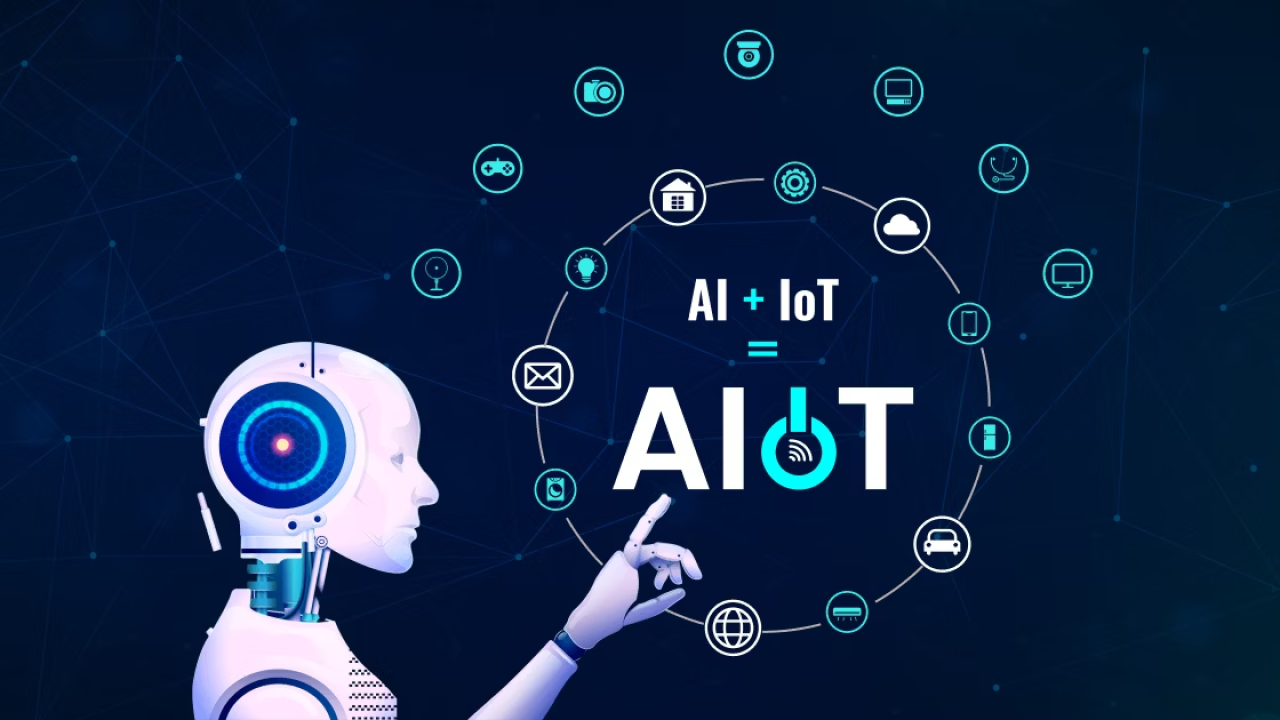
Most founders who want to build an IoT-connected application hear the same thing: you need a backend engineer, a firmware developer, and probably a cloud architect before you can think about a dashboard. That’s rarely true anymore. The combination of AI generation and no-code platforms has made it possible to build functional IoT apps, real-time dashboards, and automated device workflows without a single line of handwritten code. This article covers what no-code IoT actually means in 2026, what you can realistically build, where the limits are, and how to get started. For broader context on how AI is changing who builds software, see AI-powered no-code app development and the platforms driving it.
TL;DR: No-code IoT platforms let non-technical founders connect devices, process sensor data, and ship dashboards without writing backend code. According to Statista, connected IoT devices worldwide will reach 32.1 billion by 2030, yet most businesses lack the developer capacity to build IoT interfaces. Platforms like imagine.bo generate full-stack IoT-ready apps from plain English prompts, including real-time data views, alert logic, and deployment, in hours rather than months.
What Is No-Code IoT and Why Does It Matter in 2026?
No-code IoT means building apps that receive, process, and display data from physical devices without writing custom code. According to Gartner, by 2026, at least 80% of users of low-code and no-code tools will sit outside formal IT departments (Gartner, 2024). That shift is reshaping IoT development, which historically required specialized firmware knowledge and cloud infrastructure expertise well beyond most business operators.
Launch Your App Today
Ready to launch? Skip the tech stress. Describe, Build, Launch in three simple steps.
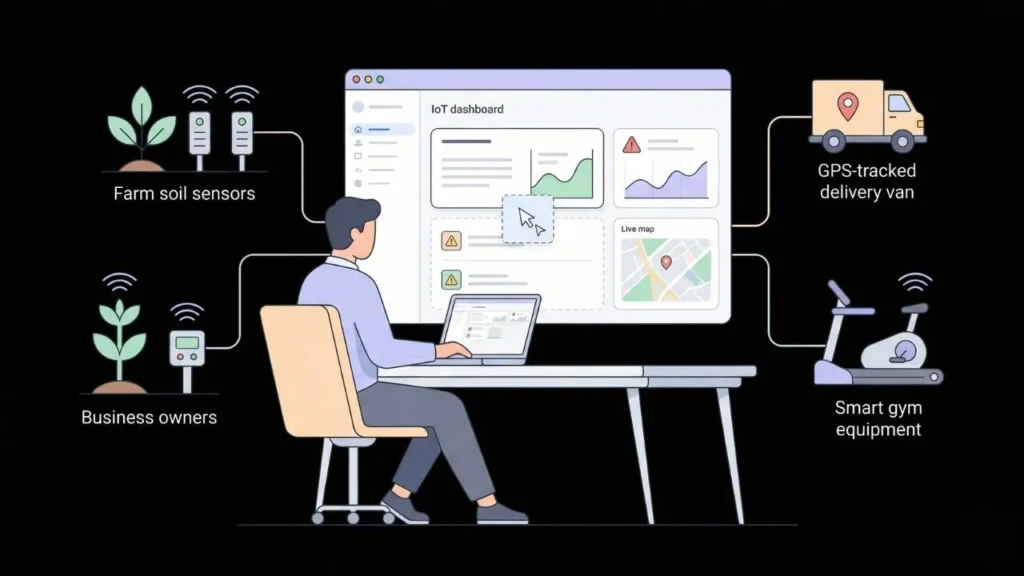
BuildThe practical implications are significant. An equipment rental company can build a GPS tracking dashboard. A small farm can build a soil moisture alert system. A gym can track machine utilization with connected sensors. None of these require a software team. They require a clear description of what the app should do and a platform that can translate that description into working software.
The real story here is not that no-code IoT is technically possible. It’s that the cost of not building an IoT interface is now higher than the cost of building one. When a device generates data that nobody can read in real time, that data is waste. No-code tools have collapsed the barrier to turning device data into business intelligence, and the businesses still ignoring that are leaving operational visibility on the table.
The no-code and low-code development platform market is projected to grow from $26.9 billion in 2023 to $65.1 billion by 2027, according to MarketsandMarkets (MarketsandMarkets, 2023). IoT is a significant driver of that growth, as businesses seek faster ways to extract value from sensor data without commissioning six-month engineering projects.
For a deeper look at how AI and IoT intersect at the platform level, read the guide on combining IoT and AI in no-code platforms.
How Does AI Change the Equation for IoT App Development?
AI changes IoT development in two distinct ways: it generates application code from natural language, and it processes device data intelligently once the app is live. According to IoT Analytics, companies that pair AI with IoT data processing see operational cost reductions of 20 to 35% compared to rule-based automation alone (IoT Analytics, 2024). That is a meaningful difference for any business running physical assets.
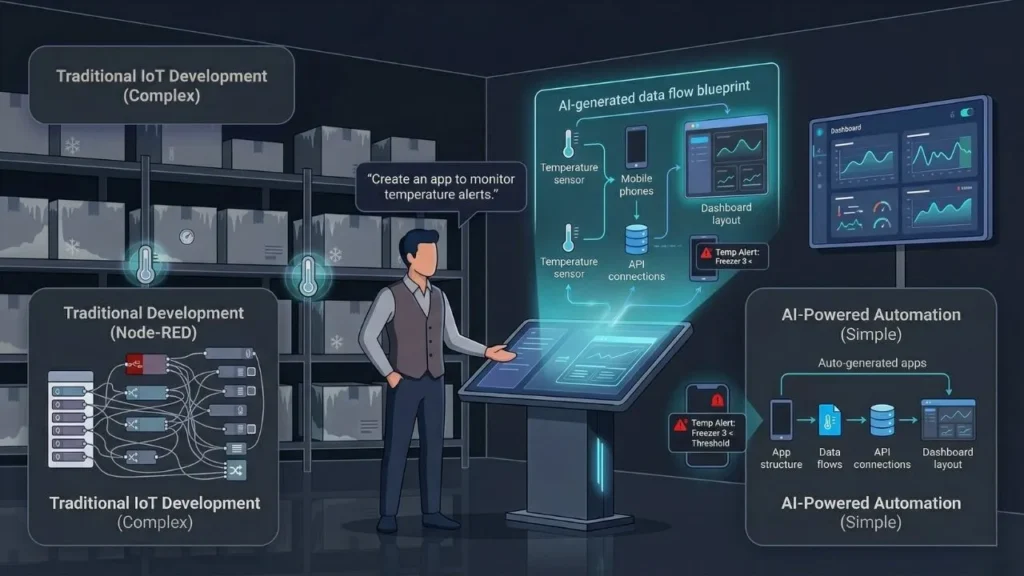
Traditional no-code IoT tools like Node-RED or Losant required users to understand data flow concepts, webhook configurations, and MQTT message brokers. Useful tools, but not accessible to someone who has never heard of a message broker. AI-native platforms change the input layer entirely. You describe what the app needs to do. The AI generates the data model, the API connections, and the frontend interface.
A practical example: a founder running a cold storage facility needs an app that pulls temperature readings from five sensors, triggers an SMS alert if any reading drops below 35 degrees Fahrenheit, and logs all readings to a dashboard their operations manager can check remotely. With imagine.bo’s Describe-to-Build feature, that specification becomes the prompt. The AI-Generated Blueprint maps out the data schema, alert logic, and dashboard layout before any building begins. The founder reviews it, approves it, and the platform generates the full-stack app.
That workflow does not exist in traditional no-code IoT tooling. It requires AI generation at the architecture layer, not just the UI layer. The difference is whether you’re dragging and dropping components or describing an outcome and reviewing a plan before a single component is placed.
For founders weighing the technical depth of different approaches, the comparison of low-code AI and IoT smart solutions is worth reviewing.
What Can Non-Technical Founders Actually Build with No-Code IoT Tools?
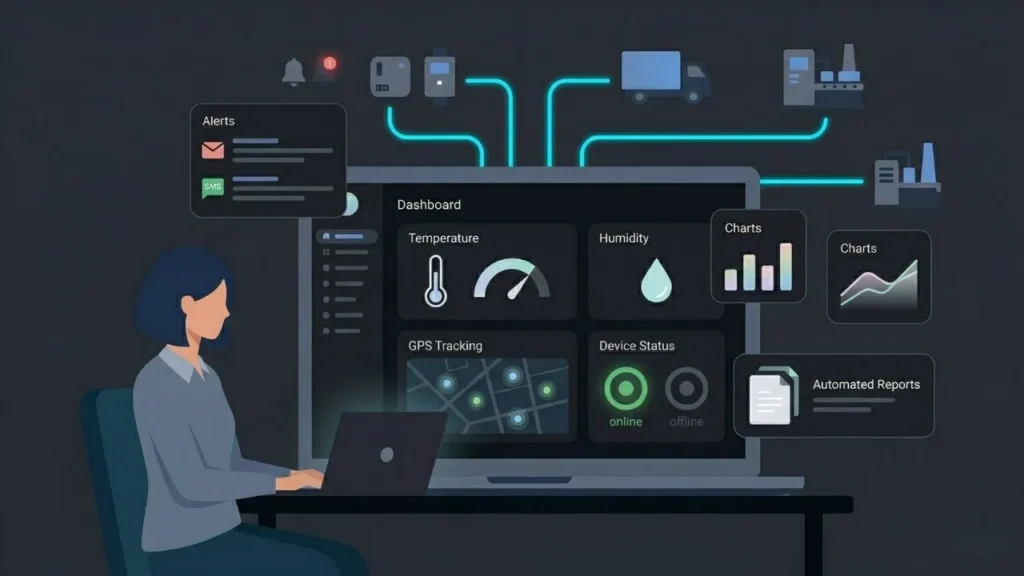
The honest answer is: quite a lot, within specific boundaries. According to a 2024 Forrester report, 60% of enterprise IoT projects stall before deployment because of the gap between hardware integration and software development cWhat Can Non-Technical Founders Actually Build with No-Code IoT Tools?apacity (Forrester, 2024). No-code platforms are closing that gap for the middle tier of IoT use cases, which is where most small business applications actually live.
Here is what is genuinely buildable today without writing code: real-time sensor dashboards that pull data via webhook, REST API, or MQTT and display it with auto-refreshing UI components; asset tracking interfaces that map device GPS coordinates on a live map view; threshold-based alert systems that send email or SMS when a sensor value crosses a defined boundary; automated reporting apps that aggregate daily device data into scheduled email reports; and multi-device management portals where operators view the status of all connected hardware from a single screen.
Based on architecture patterns across imagine.bo IoT projects, the three most common no-code IoT use cases by frequency are: environmental monitoring (temperature, humidity, air quality), equipment utilization tracking (machine hours, usage cycles), and logistics and fleet visibility (GPS coordinates, delivery status). These three categories account for the majority of IoT dashboard requests on the platform. They share a common trait: they are data-display and alert problems, not edge computing problems. That distinction matters because it tells you where no-code IoT genuinely fits.
What is not easily buildable with pure no-code tools: real-time video processing at the edge, custom firmware for embedded devices, and sub-100ms latency applications for industrial control systems. Those use cases still require specialized engineering. But most founders are not building industrial control systems. They are building interfaces for data that already exists and has no good home.
For environmental and sustainability-focused IoT use cases, the post on environmental monitoring with AI and no-code IoT analytics covers the specifics in detail.
How Does imagine.bo Handle IoT and AI App Development?
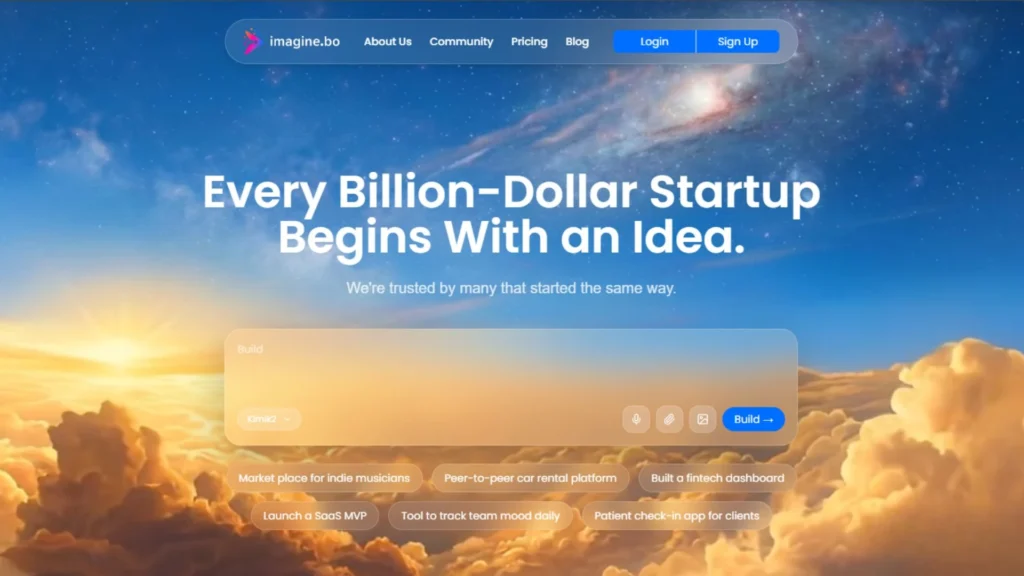
imagine.bo approaches IoT app development through its Describe-to-Build feature, which generates the full application stack from a plain English specification. The platform produces a production-ready frontend deployed on Vercel and a backend deployed on Railway, both with SSL and RBAC included by default. No hosting configuration is required.
The AI-Generated Blueprint feature is particularly relevant for IoT projects. Before generating any code, the platform maps out the data model, the API connection logic, and the frontend component structure. For IoT apps, that means a founder sees exactly how sensor data flows into the database and how it surfaces in the dashboard before committing to the build. That review step prevents the most common IoT project failure mode: building an interface before fully understanding the shape of the data coming in.
The Hire a Human feature solves the specific problem that no-code IoT always encounters eventually: the integration edge case. Most IoT devices use standard protocols, but not all of them do. When a client’s legacy hardware speaks a non-standard protocol or requires a custom authentication flow, AI generation hits a real limit. imagine.bo’s Hire a Human option lets users assign that integration task to a vetted engineer directly from the dashboard, without leaving the platform or sourcing a freelancer externally. The IoT project continues. The founder stays in control. The engineer handles the one piece that required code.
Security matters more in IoT than in most web application categories because devices often transmit sensitive operational data across shared networks. imagine.bo includes RBAC, SSL, GDPR foundations, and SOC2-readiness out of the box. That means an IoT dashboard built on the platform starts with enterprise-grade access controls rather than requiring them to be added after launch.
For a broader view of what the platform handles at the full-stack level, see how to build complex apps with imagine.bo.
What Are the Real Limitations of No-Code IoT Platforms?
Being direct about limitations is more useful than glossing over them, because the marketing around no-code IoT tends to oversell what is possible. According to a 2023 survey by Mendix, 43% of no-code IoT projects encounter significant issues when moving from prototype to production scale (Mendix, 2023). The most common causes are data volume, real-time latency requirements, and custom hardware integration.
Data volume is the first real constraint. A sensor sending readings every second generates 86,400 data points per day. Multiply that across 50 sensors and you have 4.3 million rows daily. Most no-code platforms are not optimized for that write frequency. They work well for polling intervals of one minute or longer. Sub-minute polling at scale requires a backend architecture specifically designed for time-series data, which currently sits outside pure no-code territory.
Latency is the second constraint. If your IoT use case requires the system to react to a sensor reading within 500 milliseconds, you are in edge computing territory. No-code platforms route data through cloud infrastructure, and that round-trip adds latency. For dashboards and reports, that latency is invisible. For control systems that need to trigger physical actuators in real time, it matters.
Custom hardware is the third constraint. If your device communicates through a non-standard protocol, you need someone who can write the bridge layer. No-code platforms assume your device speaks HTTP, MQTT, or WebSocket. Many industrial devices cannot.
None of these constraints affect the majority of business IoT use cases. But founders should know where the edge is before they build toward it. For a grounded perspective on where no-code development genuinely reaches its limits, see no-code AI development and the future of building software.
How Do You Get Started Building Your First No-Code IoT App?
The fastest path to a working no-code IoT app follows four steps, and the whole process from prompt to deployed application takes less than a day for standard use cases. According to OutSystems’ State of Application Development report, enterprise app backlogs average 25 months of waiting time before development begins (OutSystems, 2023). No-code IoT development skips that queue entirely, which is the clearest argument for using it.
Step one: define the data contract. Know what data your device sends, in what format, and at what frequency before you write a single prompt. The clearer your data specification, the better the AI-Generated Blueprint will match your actual requirements. A sensor that sends JSON with temperature, humidity, and device ID is a different app from one that sends a raw CSV stream.
Step two: write a precise Describe-to-Build prompt. Include the device type, the data fields, the display format you want (dashboard, table, chart), the alert conditions, and the user roles who need access. A specific prompt produces a specific app. A vague prompt produces something you’ll iterate on five times before it reflects what you actually needed.
Step three: review the AI-Generated Blueprint. imagine.bo presents the full architecture before building anything. Check that the data model matches your device output and that the alert logic reflects your actual thresholds. Revising a blueprint takes minutes. Revising a built app takes longer and costs more credits.
Step four: deploy and connect. One-Click Deployment puts the app live on Vercel and Railway. Point your device’s webhook or MQTT output at the generated API endpoint and verify data is flowing. If you hit a hardware integration issue at this step, use Hire a Human to bring in an engineer for that specific task without rebuilding the rest of the app from scratch.
For founders newer to the Describe-to-Build workflow, the guide on building apps by describing them covers the prompting fundamentals that make this step work.
Frequently Asked Questions
Can you build a real production IoT app without writing any code?
Yes, for the majority of business IoT use cases. Dashboard apps, alert systems, asset trackers, and reporting tools are all buildable using AI-native no-code platforms. According to Gartner, by 2026, at least 80% of low-code and no-code platform users will sit outside IT departments (Gartner, 2024). The exception is edge computing, sub-100ms latency control systems, and custom firmware. Those still require specialist engineering.
How much does no-code IoT development cost compared to traditional development?
Traditional IoT app development with a freelance or agency team typically runs $15,000 to $80,000 for a custom dashboard and alert system, with a 3 to 6 month timeline. imagine.bo Pro at $25 per month, combined with One-Click Deployment and targeted Hire a Human sessions for integration tasks, compresses both cost and timeline significantly. According to Forrester, companies using low-code platforms for IoT interfaces report 60 to 70% reduction in development time versus custom builds (Forrester, 2023).
What types of IoT devices can you connect using no-code platforms?
Any device that sends data via HTTP webhooks, REST API calls, MQTT, or WebSocket can connect to a no-code IoT platform. This includes Arduino and Raspberry Pi projects, commercial sensors from vendors like Bosch and Honeywell, GPS trackers, and most modern industrial monitoring equipment. According to IoT Analytics, over 78% of new IoT device deployments since 2022 support at least one of these standard protocols (IoT Analytics, 2024). Proprietary or legacy protocols may require a custom bridge layer.
Is no-code IoT secure enough for business use?
It depends on the platform. imagine.bo includes RBAC, SSL, GDPR foundations, and SOC2-readiness out of the box, so IoT dashboards start with enterprise-grade access controls rather than requiring them to be added later. According to IBM’s Cost of a Data Breach report, IoT devices are involved in 26% of enterprise data breaches, making baseline security controls non-negotiable even for small-scale deployments (IBM, 2024).
How long does it take to build an IoT dashboard with a no-code platform?
For standard use cases, a working IoT dashboard with data ingestion, real-time display, and alert logic can be generated and deployed in under four hours using imagine.bo’s Describe-to-Build and One-Click Deployment. Complex multi-device portals with custom reporting may take one to three days. Traditional custom development for an equivalent application typically takes six to sixteen weeks. According to the OutSystems 2023 report, the average enterprise dev backlog adds another 25 months before a project even begins (OutSystems, 2023).
Three Takeaways and What to Do Next
No-code IoT is production-ready in 2026 for data display, alerting, and reporting applications. That covers the majority of business use cases. Second, AI generation at the architecture layer, not just the UI layer, is what separates useful IoT app builders from drag-and-drop toys. The AI-Generated Blueprint feature specifically addresses this by mapping the data model before any code is produced. Third, the platforms that combine AI generation with on-demand human engineering handle the full spectrum from standard prototypes to edge-case integrations, without forcing you to choose between speed and technical depth.
If your devices are generating data that nobody can view in real time, the barrier to fixing that is much lower than it was two years ago. Start with a plain English description of what the app needs to do, review the blueprint before building, and deploy in a day.
Start your first no-code IoT app at imagine.bo. The free plan includes 10 credits with no commitment. For a grounded comparison of where no-code and traditional development each perform best, see how traditional versus AI-driven automation stacks up for business.
Launch Your App Today
Ready to launch? Skip the tech stress. Describe, Build, Launch in three simple steps.
Build