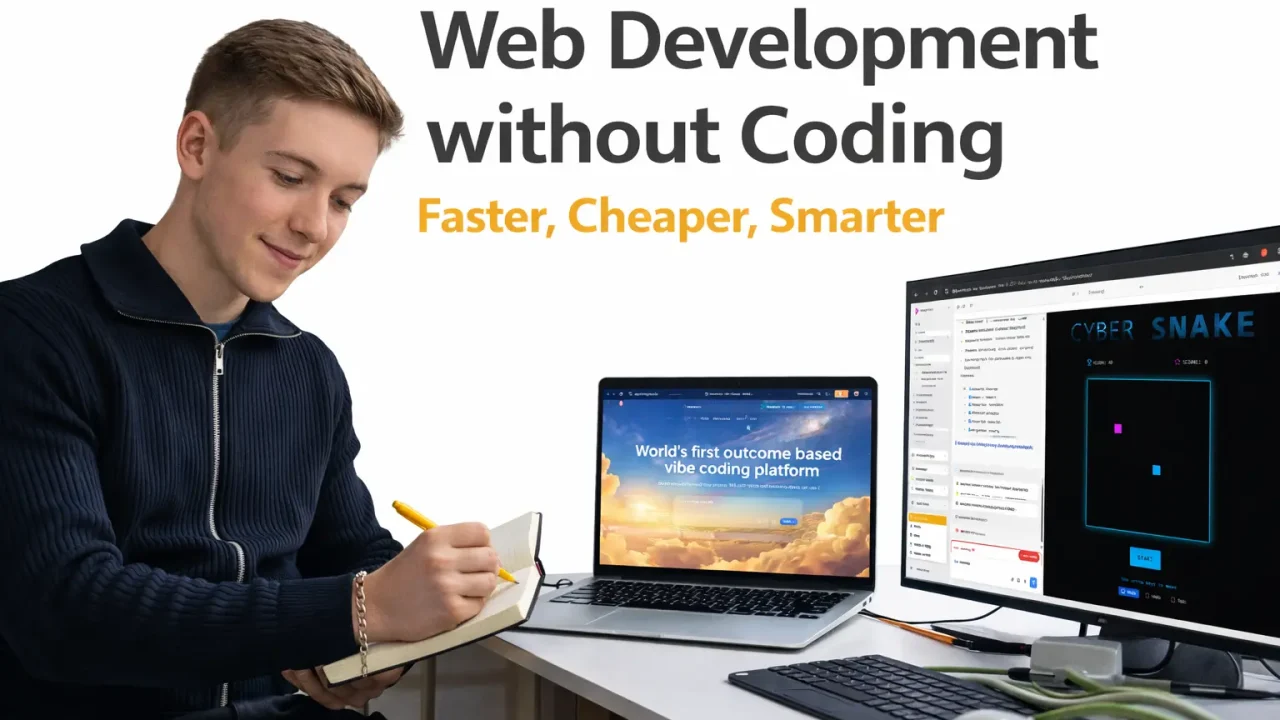
Traditional web development in 2026 costs between $15,000 and $80,000 for a moderately complex website or web application and takes months to deliver (AppVerticals, 2026). Meanwhile, reports from 2025 show MVP launch times cut by up to 70% using AI and no-code platforms, and no-code tools are now expected to reduce demand for traditional coding skills by approximately 30 to 40% in web development and application building (Minimum Code / CodeConductor, 2025–2026). The question is no longer whether zero-code platforms can produce real products. They clearly can. The question is whether they produce the right product for your situation, faster and at lower cost, without sacrificing the capability your product actually needs. Imagine.bo is built around a specific answer to that question: for the majority of web applications that founders and small teams need to build, zero-code with AI generation produces a better outcome than traditional development because the AI handles the technical translation layer while the human retains full ownership of the product decisions. This article explains how that works, where it genuinely wins, and where it has honest limits. For the broader market context, the analysis of how AI tools are replacing traditional web development provides useful framing.
TL;DR: Imagine.bo reinvents web development by removing the technical translation layer between product intent and working software. Traditional development requires a developer to translate business requirements into code. Imagine.bo’s Describe-to-Build feature does that translation from plain English, generating a complete full-stack web application in minutes. By 2026, 70% of new enterprise applications include components built with low-code or no-code platforms, and no-code platforms cut development time by up to 90% compared to traditional approaches (Gartner / AppVerticals, 2026).
What “Zero-Code Speed” Actually Means in Practice
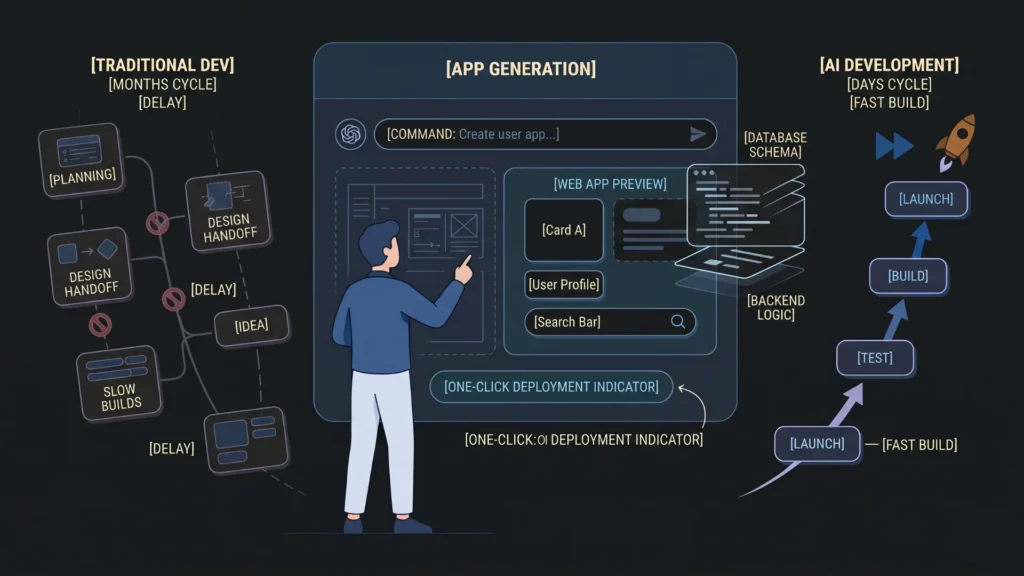
Zero-code speed is not about removing engineering rigor. It is about removing the engineering bottleneck from the product development cycle. Traditional web development requires a business person a founder, a product manager, an operator to articulate what they want, then wait while a developer translates that into code, then review the result, then articulate what needs changing, then wait again. Each iteration cycle takes days to weeks. The time between “I have an idea” and “I can see if this works” is measured in months and tens of thousands of dollars.
Launch Your App Today
Ready to launch? Skip the tech stress. Describe, Build, Launch in three simple steps.
BuildImagine.bo’s approach compresses that entire cycle. You describe what you want in plain English through the Describe-to-Build feature. The AI generates the complete application architecture database schema, backend logic, API endpoints, frontend components, authentication, and role-based access control in minutes. You review the AI-Generated Blueprint before anything deploys. If something is missing or wrong, you describe the correction through conversation. The AI updates the underlying code in real time. You deploy with one click. The time between “I have an idea” and “I can test if this works with real users” is measured in days, not months.
This is zero-code speed in the meaningful sense: not just the absence of manual coding, but the removal of the back-and-forth translation cycle that makes traditional development slow. Andrej Karpathy’s observation that “the hottest new programming language is English” (2023) has been proved out in practice by platforms like imagine.bo the ability to describe systems precisely in natural language produces better, faster outcomes than the alternative for the majority of standard web application types. Why this matters for the current market is explored in detail in why prompt-driven development is a startup advantage.
The hidden cost of traditional web development that most benchmarks miss is not the development time itself it is the opportunity cost of the feedback delay. A founder who waits four months to see a working product cannot learn from user behavior for four months. They cannot validate their core assumption with real data. They cannot iterate. During those four months, a competitor using a zero-code platform has shipped, learned, iterated, and potentially found product-market fit. Zero-code speed compounds over the product development lifecycle in a way that simple “time saved” metrics do not capture.
Citation capsule: According to AppVerticals (2026), the cost of website design in 2026 ranges from $15,000 to $80,000 for moderately complex projects using traditional development. Reports from Minimum Code (2026) show MVP launch times cut by up to 70% using no-code and AI tools. Gartner projects that by 2026, 70% of new enterprise applications will include components built with low-code or no-code platforms, signaling that this is a mainstream architectural choice, not an experimental one (AppVerticals / Minimum Code / Gartner, 2026).
How Imagine.bo Differs from Traditional Web Development
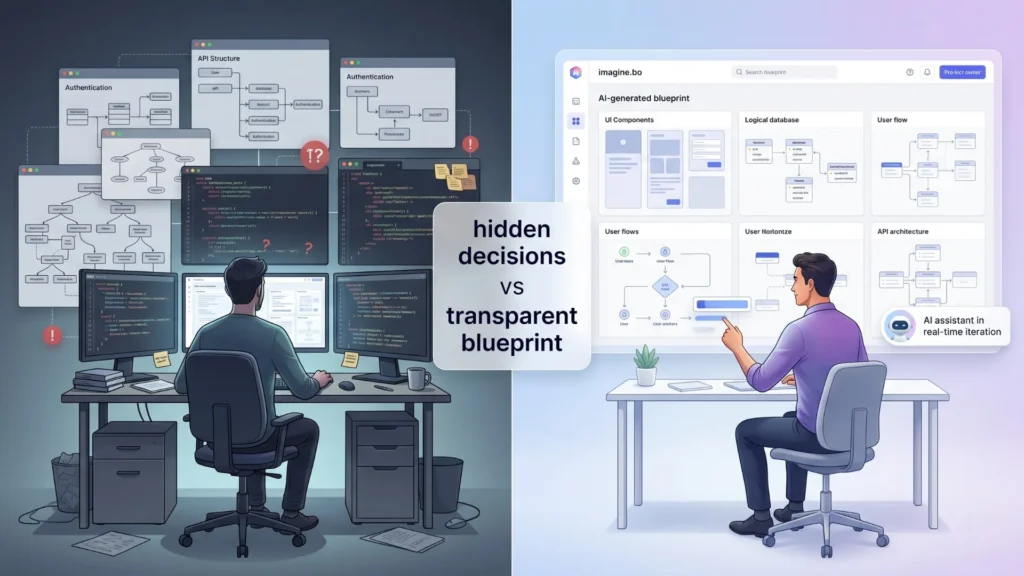
Traditional web development and imagine.bo are not just different speeds of doing the same thing. They are different models for who makes decisions and when those decisions are made.
In traditional development, technical decisions are made throughout the build process: which database schema to use, which API endpoint structure to adopt, how to implement authentication, how to configure RBAC. A developer makes hundreds of small technical decisions during a build that the product owner never sees. Some of those decisions are excellent. Some create technical debt that becomes visible only months later when a feature needs to be changed and the architecture resists it.
In imagine.bo’s model, technical decisions are made once at the blueprint stage and are visible to the product owner before any code is deployed. The AI-Generated Blueprint shows the complete application structure: the database models, user flows, API design, and UI component hierarchy. You review it as a product decision, not a code review. If the database model does not match your product requirements, you correct it before any implementation is committed. The technical decisions are still made; they are just made by the AI and reviewed by the product owner rather than made by a developer out of the product owner’s sight.
This transparency changes the product development relationship. You are not dependent on a developer’s interpretation of your requirements. You are reviewing the AI’s interpretation and correcting it directly. The iteration cycle is a conversation, not a ticket queue. The full comparison of hybrid AI no-code development platforms maps how this model differs from both traditional development and other no-code platforms in terms of architectural control.
Citation capsule: According to DesignRush (2026), more than 81% of developers report increased productivity when using AI tools in their workflows, and AI-driven development tools are contributing to a projected 25.2% growth rate in AI adoption through 2030. Nearly 40% of web designers use AI tools daily. The shift is from manual coding to directing, reviewing, and iterating on AI-generated output a model that imagine.bo applies to the complete full-stack application, not just individual components (DesignRush, 2026).
What Imagine.bo Generates That Traditional No-Code Tools Do Not
Imagine.bo is in a distinct category from template-based no-code tools like Wix or Squarespace. Understanding that distinction is important because they are often conflated under the “no-code” label but produce fundamentally different types of output.
Template-based no-code tools generate marketing websites. You choose a template, populate it with content, and publish. The output is a presentational layer pages that display information. There is no database. There is no server-side logic. There is no user authentication. These tools are excellent for what they are designed to do, which is create a fast, professional web presence from a predetermined structure.
Imagine.bo generates full-stack web applications. When you describe a product a subscription SaaS, a client portal, a marketplace, an internal tool imagine.bo generates the complete technical stack: a relational database with the correct schema for your data model, backend API endpoints that implement your business logic, frontend components that render your user interface, authentication flows that enforce your role definitions, and deployment infrastructure that serves the application at production quality. The output is software that does things, not pages that display things.
This distinction matters because most founders who need a product need it to do things. They need users to be able to log in, access their own data, interact with business logic, and produce output that gets stored and retrieved. A template-based no-code tool cannot provide that. A traditional development agency can, but at $15,000 to $80,000 and months of lead time. Imagine.bo provides it from a plain-English description in minutes.
The clearest signal that a product team is on the right platform is whether the AI-Generated Blueprint matches the mental model they had when they wrote the prompt. A precise prompt that includes user roles, key workflows, and behavioral constraints produces a blueprint that typically requires only minor corrections the database relationships are correct, the access control rules are enforced, the core user flows are present. A vague prompt produces a generic structure that requires many correction cycles. The full guide to building complex applications on imagine.bo covers the specific prompting patterns that produce accurate first-generation blueprints for complex product types.
Citation capsule: According to Second Talent’s 2026 vibe coding statistics report, 74% of developers report increased productivity with AI-assisted development, and teams report 51% faster task completion for routine development activities. For specific use cases like API integration, boilerplate code generation, and standard CRUD operations, time savings reach 81%. These are the exact categories of work that imagine.bo’s AI-Generated Blueprint handles automatically in the initial generation pass (Second Talent, 2026).
Where Zero-Code Wins and Where It Has Real Limits
Honest analysis of where zero-code wins and where it does not is the most useful thing this article can offer. Zero-code is the correct technical choice for a specific set of use cases. It is not the correct choice for all web development.
Zero-code wins clearly:
Standard application patterns. Authentication, user management, CRUD operations, multi-role access control, forms, dashboards, booking systems, and subscription management are all patterns the AI handles with high accuracy. These are the building blocks of the majority of commercial web applications. The AI generates them correctly because they are well-defined patterns with known implementations.
Rapid validation. When your goal is to test whether an idea has merit with real users, speed and cost are the dominant criteria. Zero-code delivers a working prototype in days for a fraction of the cost of custom development. If the idea does not work, you have not wasted months and tens of thousands of dollars.
Non-technical founders and small teams. The practical guide to how non-technical founders build products with zero-code documents this in detail. The constraint for these builders has historically been technical access, not product clarity. Zero-code removes the technical access constraint entirely.
Operational software and internal tools. CRMs, dashboards, approval workflows, scheduling systems, and operational portals represent a large category of software that organizations need but that does not justify custom development costs. Zero-code delivers these quickly and cost-effectively.
Where zero-code has real limits:
Novel or highly complex algorithms. AI generates well-established patterns excellently. It generates novel, domain-specific algorithms poorly. A recommendation engine with custom scoring logic, a complex financial calculation model, or a proprietary data processing pipeline needs engineering expertise that the AI cannot reliably provide through prompt generation.
High-stakes compliance architecture. Applications subject to HIPAA, PCI-DSS, FedRAMP, or other regulated compliance frameworks need specific engineering controls that go beyond default security configurations. Imagine.bo’s Hire a Human feature addresses this vetted engineers implement specific compliance modules but this is a hybrid of zero-code generation and human engineering, not pure zero-code.
Deeply customized UX and design systems. The AI-Generated Blueprint produces functional, clean interfaces. For brands where unique, pixel-perfect design is a core product differentiator a consumer app competing on visual experience, a luxury brand portal the generated output may require significant design work beyond what the conversational editor handles comfortably.
The full cost comparison for 2026 across developer, AI, and no-code development approaches maps these trade-offs in terms of actual cost and time across application types.
Citation capsule: According to Gartner cited by DesignRush (2026), by 2025 to 2026, 90% of software engineers will shift from hands-on coding to orchestrating AI-driven processes. The market for Generative AI in Software Development is projected to reach $287.4 billion by 2033 at a 21.5% CAGR. The shift is structural and irreversible, but the winning approach combines AI generation for standard patterns with human engineering for complexity that AI cannot yet reliably handle (Gartner / DesignRush / CodeConductor, 2026).
The Hybrid Model That Makes Zero-Code Production-Ready
The reason imagine.bo is positioned as a production-ready platform rather than a prototyping tool is the Hire a Human feature. Every other zero-code platform sends you out of their ecosystem when AI generation reaches its limit. Imagine.bo keeps you in the same workflow.
When the AI generation hits a module that requires custom engineering a specific payment gateway integration, a complex webhook configuration, a compliance-sensitive data handling flow you click Hire a Human from the dashboard. A vetted imagine.bo engineer accepts the task, writes the specific code for that module, and pushes it directly to your project’s repository. The context is in the project. The engineer understands the existing architecture. The result is pushed back without requiring you to find, brief, and manage an external developer relationship.
This hybrid model addresses the structural problem with pure zero-code: the 80% of a product that AI generates well is rarely the whole product. The 20% that requires engineering expertise the custom integrations, the performance optimizations, the compliance controls is exactly what makes the difference between a prototype and a production product. Why Hire a Human is the feature that changes the production equation for zero-code builders makes this case in detail.
The scalable SaaS architecture guide for no-code platforms explains how the deployment model underneath imagine.bo is designed to grow with the product Vercel for frontend edge delivery, Railway for autoscaling backend so the infrastructure does not become a limitation as the application scales.
FAQ
How is imagine.bo different from traditional web development agencies?
Traditional agencies translate your requirements into code through a development cycle that takes months and costs tens of thousands of dollars per project. Imagine.bo generates the application architecture from a plain-English prompt in minutes, deploys automatically, and lets you refine through conversation. The Hire a Human feature brings in vetted engineers for specific complex modules at per-task cost rather than full project rates. The comparison of hybrid AI no-code development platforms maps the cost, speed, and capability differences in detail.
Can zero-code platforms like imagine.bo scale to real user traffic?
Yes. Imagine.bo deploys every application to Vercel for the frontend and Railway for the backend. Vercel serves content from a global edge network. Railway autoscales the backend in response to traffic automatically. The Done For You plan is specifically optimized for infrastructure supporting up to 1,000 transactions per second. The vibe coding and SaaS shift analysis covers how zero-code production deployments are replacing traditional hosting configurations across a wide range of product types.
What does the AI actually generate versus what requires human input?
The AI generates: database schema, API endpoints, frontend components, user authentication, role-based access control, and deployment configuration. Human input is required for: precise business logic articulation in the initial prompt, review of the AI-Generated Blueprint for accuracy, refinement through conversation, and engineering oversight for complex integrations via Hire a Human. The split is roughly 80% AI generation, 20% human direction and oversight for standard application types.
Does zero-code mean lower quality than custom development?
Not for standard application patterns. The AI generates authentication, CRUD operations, multi-role access control, and standard workflow logic with the same correctness as a competent developer. For novel algorithms, proprietary data processing, or complex compliance architecture, custom engineering still produces higher-quality output. The correct framing is not “zero-code versus quality” but “zero-code for patterns that are well-defined, custom engineering for patterns that are novel.” The guide to building a SaaS with AI and no-code covers this trade-off in the SaaS context specifically.
What happens to my code if I outgrow the platform?
You own the code entirely. Imagine.bo produces clean, exportable code that follows modern standards. You can export the full codebase and hand it to a development team at any point. You are never locked into the platform, and migration does not require rebuilding from scratch. This is a critical distinction from platforms like Bubble, where code export requires an enterprise plan upgrade or is not available at all.
Conclusion
Zero-code speed, when implemented through a platform like imagine.bo that generates production-grade full-stack applications rather than template-based websites, is not a shortcut. It is a structural reallocation of who does what in the product development process. The AI handles the technical translation layer the database schema, the API endpoints, the security configuration, the deployment that previously required engineering expertise to implement. The human handles the product decisions what to build, for whom, governed by which rules, producing which outcomes that no AI can substitute for.
The result is that the time between “I have a product idea” and “real users can test this” compresses from months to days. The capital required drops from tens of thousands of dollars to hundreds. The dependency on a specific developer or agency disappears. And critically, because you own the code at every tier, you are never stuck with a choice you made at the beginning. You can add engineering depth, export to a custom stack, or bring in human engineers through Hire a Human without rebuilding from scratch.
For non-technical founders, product managers, and small teams building standard web applications in 2026, zero-code with AI generation is the correct technical choice. Not because it is faster though it is but because the type of thinking it rewards, clear product articulation and precise requirement description, is exactly the thinking that produces products users want. The full guide to how non-technical founders are building real products with zero-code tools is the most direct next step for anyone ready to move from understanding the model to applying it.
Launch Your App Today
Ready to launch? Skip the tech stress. Describe, Build, Launch in three simple steps.
Build