
Most AI app builders can get you 80% of the way to a working product. The remaining 20% complex integrations, custom logic, production-grade security, specific third-party APIs is where they stall, and where most non-technical founders find themselves stuck with an unfinished build and no clear path forward. Imagine.bo is built specifically to solve that last-mile problem. It is an AI-powered, full-stack app builder that generates production-ready web applications from plain-English descriptions, with a built-in escape hatch: the Hire a Human feature connects you directly with vetted engineers when AI generation reaches its limits. This article explains exactly what imagine.bo is, how it works, who it is built for, and how it compares to the alternatives. If you want context on how the platform fits in the broader no-code landscape, the comparison of hybrid AI no-code development platforms is a useful starting point.
TL;DR: Imagine.bo is a hybrid AI app builder that takes a plain-English description and generates a complete full-stack web application frontend, database, backend logic, and deployment with no coding required. Its defining differentiator is the Hire a Human feature, which lets users assign specific tasks to vetted engineers directly from the dashboard. According to Gartner (2026), 75% of new applications will use low-code or no-code tools by 2026, and the no-code AI platform market is projected to reach $75.14 billion by 2034 (Grand View Research, 2025). Imagine.bo targets the gap between prototype-grade generators and full custom development.
What Is Imagine.bo?
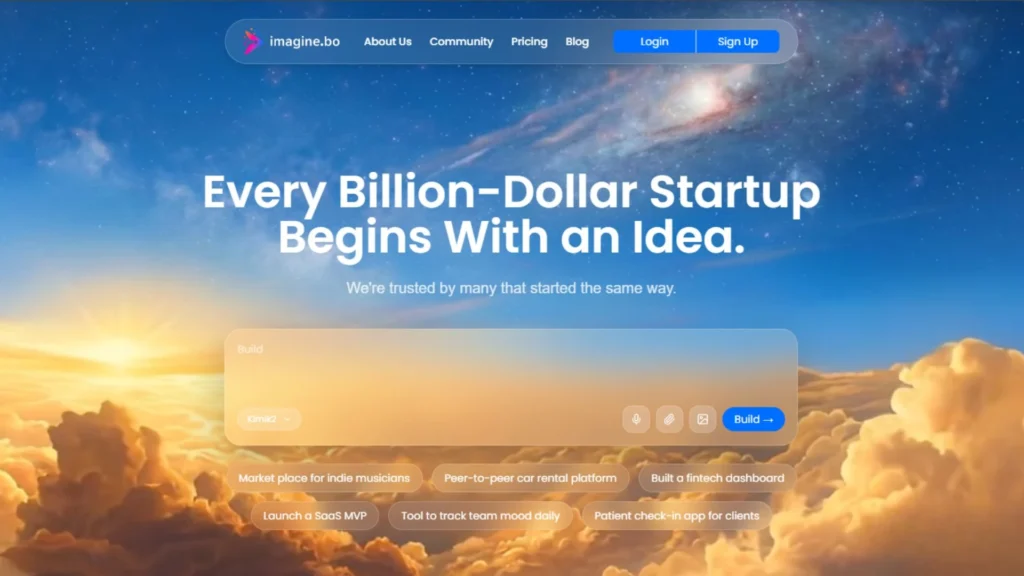
Imagine.bo is a production-ready, AI-powered full-stack app builder designed for non-technical founders, solo operators, small businesses, and product managers who need to ship real software without hiring a development team. The platform takes a plain-English description of what you want to build and generates the complete application architecture: a responsive frontend, a structured database schema, backend API logic, and deployment to scalable cloud infrastructure.
Launch Your App Today
Ready to launch? Skip the tech stress. Describe, Build, Launch in three simple steps.
BuildWhat separates imagine.bo from most AI app builders is a structural one. Pure AI generators can produce functional prototypes quickly, but they have an inherent ceiling. When your app needs a localized payment gateway, a complex multi-step workflow, custom authentication logic, or a specific third-party API integration, the AI either produces a broken implementation or produces nothing at all. Imagine.bo’s Hire a Human feature is the mechanism that breaks through that ceiling. From the dashboard, users assign specific tasks to a vetted imagine.bo engineer who writes the custom code for that module and pushes the update directly to the project’s repository. The AI handles 80% of the build. A human engineer handles the rest. That hybrid model is what imagine.bo describes as its core value proposition.
The platform competes directly with Lovable, Bolt.new, Bubble, Adalo, FlutterFlow, Emergent, and similar tools. Where those tools ask you to accept the limits of AI generation or switch to a developer, imagine.bo stays in one workflow from first prompt to production launch. The top 10 benefits of prompt-to-app development explains the full model in more depth, including the specific gains non-technical founders report from prompt-driven development versus traditional build approaches.
Citation capsule: According to Grand View Research cited by Gaincafe (2025), the global no-code AI platform market was valued at $6.56 billion in 2025 and is projected to grow to $75.14 billion by 2034 at a CAGR of 31.13%. Gartner projects that by 2026, 80% of low-code users will be outside formal IT departments, completing the transformation of app development from a technical function to a business function (Grand View Research / Gartner, 2025–2026).
How Does Imagine.bo Work?
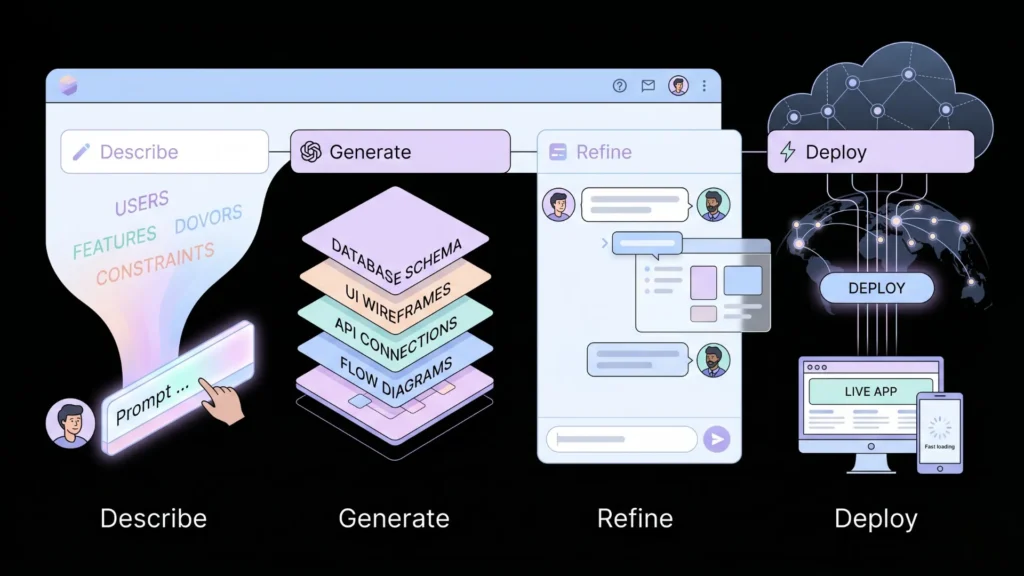
The imagine.bo workflow runs in four stages: describe, generate, refine, and deploy. Each stage is designed to remove technical decisions from the builder’s path while giving them full control over the product outcome.
Stage 1: Describe-to-Build
You open the platform and type your app idea into the prompt box. The more specific your description, the better the output. Imagine.bo’s Describe-to-Build feature is optimized for prompts that include four elements: who the app is for, the core problem it solves, the key features required, and the rules or constraints on user behavior.
A prompt like “Build a subscription-based meal planning app for busy professionals. Users create a profile, select dietary preferences, and receive a weekly meal plan generated by the AI. Admins can manage recipes and view subscription analytics. Users cannot edit each other’s plans” produces a dramatically better first generation than “Build a meal planning app.”
Stage 2: AI-Generated Blueprint
After you submit the prompt, imagine.bo generates a complete AI-Generated Blueprint. This is the full structural plan for your application: the database schema, user flows, UI components, API endpoints, and backend logic laid out before any deployment happens. You review the blueprint to catch anything missing or misunderstood before the build is finalized. This early review stage is the step that saves hours of correction later.
Stage 3: Iterative Refinement
Once the initial structure is generated, you refine through conversation. “Move the analytics dashboard to the top of the admin view.” “Add a notification when a new user signs up.” “Require email verification before a user can post content.” The AI understands intent and updates the underlying code in real time. You never start from scratch; you adjust incrementally. This is faster and more predictable than traditional development sprints where each change requires a developer ticket, a build, and a deployment cycle.
When the AI reaches the edge of its capability a complex integration, a performance-critical algorithm, a payment flow with custom compliance requirements you click Hire a Human from the dashboard. An engineer accepts the task, writes the specific code for that module, and pushes it directly to the project repository. You stay in the same workflow throughout.
Stage 4: One-Click Deployment
When your app is ready, One-Click Deployment pushes the frontend to Vercel for global edge caching and fast load times, and the backend to Railway for automatic scaling. SSL, HTTPS, and security configurations are handled automatically. No server configuration. No DevOps expertise required. The app is live, shareable, and mobile-responsive from the moment it deploys.
The Describe-to-Build flow rewards specificity in a way that most builders underestimate at first. A vague prompt produces a generic structure that takes many correction cycles to shape into something useful. A precise prompt with clearly defined roles and constraints produces a blueprint that is 70 to 80% accurate on the first generation. The practical guidance for getting there is in the 40 real app prompts copy-paste library by app type it shows the exact prompt patterns that work across dozens of use cases.
Citation capsule: According to Gartner research cited by Lovable (2026), 40% of enterprise applications will feature task-specific AI agents by the end of 2026, up from less than 5% in 2025 an eightfold increase in a single year. The platforms gaining market share are not just code generators but environments where AI and human engineers coordinate to build, test, and iterate at speed (Gartner / Lovable, 2026).
What Can You Build with Imagine.bo?
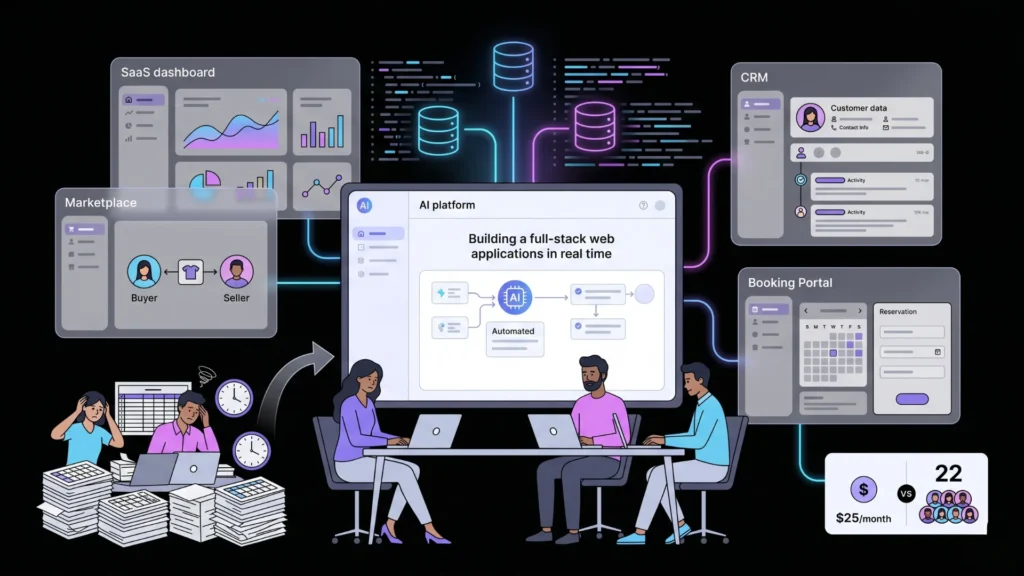
Imagine.bo generates real software. Not landing pages or static websites. Full-stack web applications with databases, user authentication, business logic, and production-grade deployment. The platform handles the full range of application types that make up the majority of commercial software needs.
SaaS and subscription products. Multi-tenant platforms, client portals, admin dashboards, and subscription-based products with built-in support for user roles, secure authentication, and payment integration foundations. The guide to building a SaaS with AI and no-code covers the specific SaaS patterns imagine.bo handles well.
Marketplaces and directories. Two-sided platforms connecting buyers and sellers, with complex relationship modeling, listing management, booking systems, and role-based access. These require exactly the kind of multi-role access control that imagine.bo generates correctly when roles are specified in the initial prompt.
Internal tools and operational software. CRMs, inventory trackers, HR management dashboards, approval workflow systems, and operational tools. These are often the most underserved category in software development because the cost of custom development is hard to justify for internal use. No-code changes that calculus entirely.
Customer-facing portals. Self-service account management, appointment booking systems, onboarding flows, and communication portals. Any interface where your customers manage their relationship with your business.
Consumer web apps. Community platforms, content feeds, social tools, and membership sites. Higher-complexity consumer apps benefit from the Hire a Human feature for custom notification systems, recommendation logic, or performance optimization at scale.
What imagine.bo is not optimized for: native iOS or Android apps that require App Store submission, applications requiring hardware integration or real-time biometric processing, or systems with FDA Software as a Medical Device classification. For the full scope of what the platform handles in complex scenarios, the guide to building complex apps with imagine.bo walks through the architecture decisions and the limits honestly.
The most underused category on imagine.bo is internal tools. Non-technical founders and small business owners think about external products first, but many of their biggest efficiency gains come from replacing the spreadsheets and manual processes that run their own operations. A custom CRM, a staff scheduling system, an approval workflow these take an afternoon to build on imagine.bo and eliminate hours of weekly operational friction. The calculus changes when you realize the cost is $25 per month rather than $40,000 and four months.
Citation capsule: According to Browse AI Tools (2026), the no-code development platform market is projected to reach $84.47 billion by 2027 at a CAGR of 28.9%. Large enterprises show 38% adoption of no-code solutions as of 2026, signaling that this is not a startup-only trend but a structural shift in how software gets built across organizations of every size (Browse AI Tools, 2026).
What Makes Imagine.bo Different from Competitors?
The AI app builder market is crowded. Lovable, Bolt.new, Bubble, Adalo, FlutterFlow, and Emergent all compete for the same audience. Understanding where imagine.bo is different requires understanding what the other platforms get wrong for non-technical founders.
Lovable generates clean React code quickly and recently reached $206 million ARR (Sacra, 2025). Its strength is frontend code quality and speed of initial generation. Its weakness is the same as all pure AI generators: when generation fails or reaches complexity limits, you are sent to a code editor. That is not a place most non-technical founders can operate. The detailed comparison of Lovable vs imagine.bo in 2026 maps the specific differences across pricing, deployment, human engineering support, and code ownership.
Bubble is the most powerful visual no-code builder available, with over 2 million users worldwide. Its visual programming interface handles complex logic and database workflows well. The learning curve is steep, however, and many Bubble users end up hiring Bubble-specialist developers to get apps across the finish line which reintroduces the cost and time overhead the platform was supposed to eliminate. The Bubble vs imagine.bo comparison covers the specific scenarios where each platform makes more sense.
Bolt.new is fast at prototype generation and has a strong developer community. It is optimized for developers who want AI-assisted coding. It is not optimized for non-technical founders who need a support system when the AI produces broken output.
Where imagine.bo is structurally different is the Hire a Human model. Every other platform in this category treats the human engineering layer as outside the product. You hit a wall with AI, you leave the platform, you find a freelancer or agency, you explain the context from scratch, and you wait. Imagine.bo keeps human engineering inside the same workflow. The context is in the project. The engineer works in the same codebase. The result is pushed back without you managing an external relationship. That continuity is what makes the hybrid model worth more than its parts. The full argument for why this matters is made clearly in why Hire a Human is the AI app builder feature you need.
Citation capsule: According to Sacra data cited by Gaincafe (2025), Lovable hit $206 million in annualized recurring revenue in November 2025, up from $7 million at end of 2024 a 2,800% year-over-year growth rate. The explosive growth across the AI app builder category confirms sustained demand, but also intensifies the differentiation question: which platform delivers production-ready results for non-technical founders rather than polished prototypes that stall before launch (Sacra / Gaincafe, 2025)?
Imagine.bo Pricing: What Do You Get at Each Tier?
Imagine.bo uses a credit-based model where credits are consumed when the AI generates or modifies parts of your application. Unused credits on paid plans roll over month to month, so heavy development periods can be offset by lighter ones. All paid plans include secure payments via Stripe and Razorpay.
Free plan ($0/month): 10 credits per month, public projects only, community support. Best for testing the platform and exploring the Describe-to-Build workflow before committing.
Lite plan ($6/month): 30 credits per month, build and deploy up to 8 pages, enterprise-grade hosting, 2GB storage, standard support, and a 20% discount on Hire a Human engineering tasks. Best for small businesses that need a fast, professional web presence.
Pro plan ($25/month): 150 credits per month, private projects, no imagine.bo watermark, deployment guaranteed, 5GB storage, rollover credits, a 1-hour expert support session before launch, and priority support with a 24-hour turnaround. Best for founders building real SaaS products or advanced web applications.
Done For You ($499 one-time): A fully managed engineering build where the imagine.bo team builds your product for you. Complete expert-led development, architecture decisions, deployment, and infrastructure optimized for high traffic supporting up to 1,000 transactions per second. Best for startups and businesses that want a production-ready product without managing development themselves.
The full cost comparison of building an app in 2026 across developer, AI, and no-code routes puts imagine.bo’s pricing in context against traditional development quotes, which typically start at $30,000 to $150,000 for an equivalent MVP.
At $25 per month on the Pro plan, a non-technical founder building a production SaaS with authentication, user roles, a database, and private deployment spends $300 per year on platform costs. The closest traditional development equivalent a standard SaaS MVP built by an agency costs $55,000 to $140,000 according to Softermii’s 2025 analysis. That is a 99%+ reduction in upfront capital cost for the validation phase, before accounting for the speed advantage of days versus months to first deployment.
Citation capsule: According to Modall’s 2026 MVP development guide, AI-assisted development tools have compressed delivery timelines by 40 to 60% for teams that know how to use them effectively (McKinsey, 2025). For non-technical founders on imagine.bo, the compression is more dramatic: traditional MVP timelines of 3 to 6 months reduce to days for standard application types, with human engineering available for the edge cases that would otherwise reintroduce the traditional timeline (McKinsey / Modall, 2026).
Who Is Imagine.bo Built For?
Imagine.bo is most valuable for three distinct types of user, and the platform is specifically designed around their constraints and goals.
Non-technical founders and solo operators who have a product idea and the domain expertise to know what it should do, but no coding background and no budget for a development agency. For this group, the Describe-to-Build workflow turns their clarity of thinking directly into a working product. The practical guide to how non-technical founders build products with no-code tools covers the full mental model for this use case, including how to write prompts that produce accurate first generations.
Small businesses and operators replacing spreadsheets and manual processes with custom internal tools. A business managing its CRM in Excel, scheduling staff in WhatsApp threads, and tracking inventory in Google Sheets is leaving operational efficiency on the table. Imagine.bo lets these operators build the exact tool their workflow needs in days, at a fraction of the cost of off-the-shelf SaaS subscriptions.
Product managers, designers, and indie hackers who want to ship faster than their current tools and teams allow. These users often have partial technical understanding and can write precise, effective prompts. They use imagine.bo to validate ideas quickly before investing engineering resources, or to build tools their engineering teams have deprioritized.
Imagine.bo is a poor fit for developers who want full code control over every architectural decision, teams requiring native iOS or Android app store deployment, or enterprise organizations needing on-premise infrastructure. For those use cases, the comparison guide between imagine.bo and the alternatives identifies which platform fits which requirement.
FAQ
Is imagine.bo really no-code, or do I need to know some coding?
No coding is required at any stage. Describe-to-Build generates the complete application from plain English. All refinement happens through conversational prompts or the drag-and-drop visual editor. If a task exceeds what AI can generate, the Hire a Human feature brings in a vetted engineer. You never touch code unless you choose to. According to Gartner (2026), 80% of low-code users in 2026 will be outside formal IT departments, meaning the tools have matured to the point where genuine non-technical use is the norm, not the exception.
How is imagine.bo different from Lovable or Bolt.new?
The core difference is the Hire a Human feature. Lovable and Bolt.new are AI generation tools. When the AI fails or reaches a complexity ceiling, you leave the platform to find external help. Imagine.bo keeps human engineering inside the same workflow. Engineers work in your existing codebase, push updates directly to your project, and do not require you to restart or re-explain context. The Lovable vs imagine.bo comparison covers pricing, code ownership, deployment, and human support in detail.
What happens to my code if I stop paying for imagine.bo?
You own the code entirely. Imagine.bo produces clean, exportable code that follows modern standards. You can export or hand off the codebase at any time. You are never locked into the platform. This is a significant difference from platforms like Bubble, which do not offer code export by default without an enterprise plan upgrade.
Can imagine.bo build apps that scale to real user traffic?
Yes. Every app deploys to Vercel for the frontend and Railway for the backend. Vercel handles global edge caching and DDoS mitigation at infrastructure scale. Railway autoscales the backend to handle traffic spikes from 10 users to high-volume production automatically. The Done For You plan is specifically optimized for infrastructure supporting up to 1,000 transactions per second. The guide to handling complex, high-scale builds on imagine.bo explains the architecture for higher-scale deployments.
Conclusion
Three things define imagine.bo as a platform. The first is completeness: it generates full-stack applications, not frontend scaffolding or static prototypes. Database, backend, authentication, and deployment are included in every build, not bolted on afterward. The second is the hybrid model: the Hire a Human feature is not a support ticket. It is a human engineering layer built into the same workflow, which solves the structural problem that pure AI generators cannot. The third is ownership: you own the code, you can export it, and you are never dependent on imagine.bo’s continued existence to run your product.
The market for AI app builders is growing fast. The no-code AI platform market is heading toward $75 billion by 2034, and the platforms that will earn the most trust are those that deliver production-ready results rather than impressive demos that stall before launch. Imagine.bo is positioned specifically for that gap. If you want to see what the platform can do with your specific product idea, the free plan gives you 10 credits per month at no cost. The Pro plan at $25 per month is the right starting point for founders building something they intend to ship. The guide to building a SaaS with AI and no-code tools is the practical next step for anyone ready to move from understanding the platform to building on it.
Related Articles
- Build 10 Awesome AI Apps with No Code: The Ultimate Beginner’s Guide
- AI Website Builder for Handmade Products: Craft Your Digital Shop Without Code
- Unlock AI App Development: Your Guide to Free No-Code/Low-Code Platforms
- The Future of App Development: How AI App Builders Are Revolutionizing the Industry
- Say Goodbye to Slow Websites: How Imagine.bo Is Reinventing Web Development with Zero-Code Speed
Launch Your App Today
Ready to launch? Skip the tech stress. Describe, Build, Launch in three simple steps.
Build