

The insurance industry is one of the most software-dependent sectors in the world, yet it consistently runs some of the oldest technology stacks in business. A 2026 report by RSM US LLP found that 72% of insurers still rely on Excel or internally built tools to manage critical insurance workflows. That is not a minor inefficiency. It is a structural problem that costs firms hundreds of thousands in lost productivity every year. No-code tools are changing this, and fast. This article breaks down exactly how no-code and AI-powered platforms are reshaping insurance software development, which workflows they handle best, and why legal and insurance professionals are increasingly launching apps without developers.
TL;DR: No-code platforms are cutting insurance software development cycles by 50 to 70% compared to traditional methods (Gartner, 2026). By 2025, an estimated 70% of new business applications in insurance will use low-code or no-code technologies, up from under 25% in 2020 (Decerto, 2025). For insurers and insurtech founders, this shift is no longer optional. It is the baseline for staying competitive.
Why Is Insurance Software Development Still So Broken?
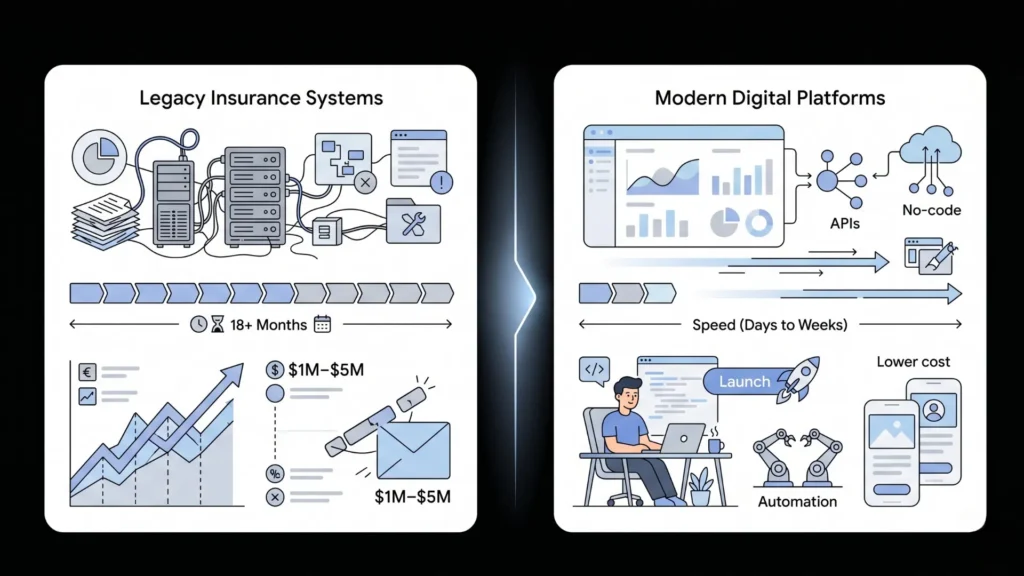
Insurance software development has a cost problem that most people outside the industry underestimate. According to a 2026 report from RSM US LLP and INTX Insurance Software, the average implementation of a single core insurance system costs close to $1 million, and nearly 45% of insurers reported implementation cycles exceeding 18 months. Most carriers operate two to three systems simultaneously, pushing total costs as high as $3 million before a single policy gets written on the new platform.
Launch Your App Today
Ready to launch? Skip the tech stress. Describe, Build, Launch in three simple steps.
BuildThis is not just expensive. It is strategically debilitating. Decerto reports that the average development cycle for a new insurance product extends 6 to 9 months and costs between $400,000 and $900,000. By the time a product ships, two competitors may have already reached market. Legacy systems were built for stability, not speed. They process structured data reliably, but they were never designed for APIs, real-time analytics, or customer self-service. When insurers try to add modern capabilities, they often bolt new tools onto old architecture, creating exactly the kind of fragmented, hard-to-maintain stack that businesses have successfully replaced by moving to custom apps.
The real cost of insurance legacy systems is not the maintenance budget line. It is the product velocity gap. When a new regulation changes pricing requirements, an insurer on a legacy system may need 3 to 6 months to update its rating engine. An insurtech on a no-code platform can make that change in days. Over a 5-year period, that compounding speed advantage is worth more than any single implementation cost.
Citation capsule: According to RSM US LLP’s 2026 report, legacy insurance systems cost insurers close to $5 million annually in hidden operational costs. Internal IT support for downtime and ticket delays alone accounts for nearly 900 hours or $450,000 in lost productivity. More than half of all policy workflows require manual intervention, creating data latency that can cost over $1 million in additional losses (RSM US LLP / INTX Insurance Software, 2026).
What Can No-Code Tools Actually Build for Insurance?
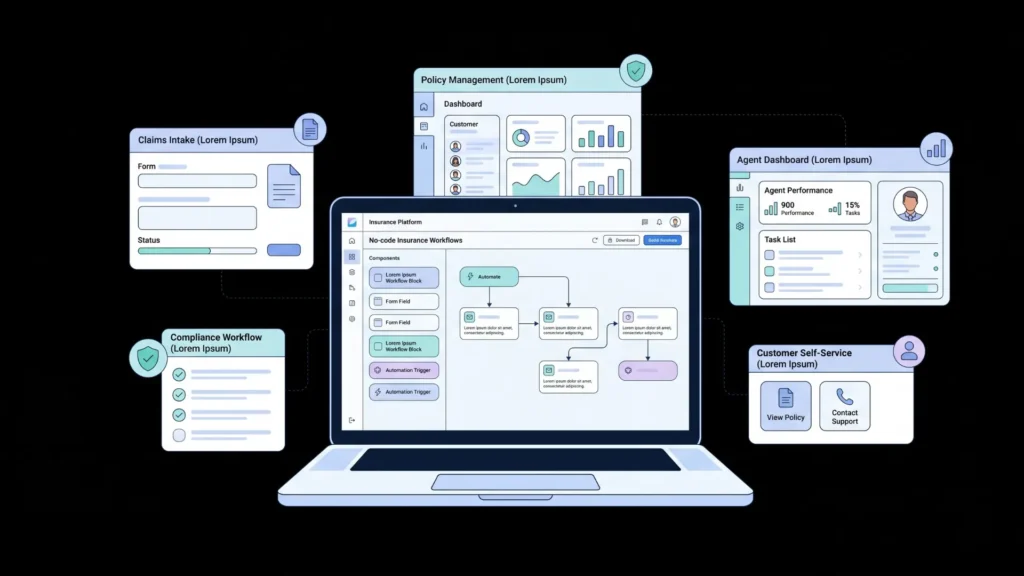
No-code platforms are not limited to landing pages or simple contact forms. Production-ready no-code applications now handle claims intake, policy management portals, agent dashboards, compliance workflows, and customer self-service portals. Insurance companies are already using low-code and no-code platforms to enhance processes in claims management, policy administration, and customer service, with Gartner forecasting that 75% of new application development will use low-code tools by 2026.
The practical list is longer than most people expect. An insurance firm can use a platform like imagine.bo to build a multi-role claims portal where policyholders submit claims with file attachments, adjusters review and escalate, and managers approve payouts, all with role-based access control (RBAC) built in by default. An independent agent can build a client CRM that tracks renewals, policy documents, and communication history without paying $300 per month for an enterprise tool that covers 80% of what they actually need. To see how straightforward this is in practice, the step-by-step guide to build a custom CRM without coding is worth reading before building.
Here is a workflow that comes up repeatedly with insurance operators using imagine.bo: they describe a broker onboarding portal in plain English, the Describe-to-Build feature generates the full-stack architecture including authentication, form logic, and document upload capability, and the team is reviewing a working prototype within hours. The part that previously required a developer and four to six weeks of back-and-forth now takes an afternoon.
Common insurance applications that no-code handles well:
- Claims intake portals: Policyholders submit claims with photo attachments, priority flags, and status tracking.
- Agent CRM dashboards: Track renewals, commissions, lead pipelines, and client communication logs.
- Underwriting intake forms: Collect structured risk data from applicants with validation rules and automated routing.
- Compliance audit tools: Track regulatory changes, log actions by user role, and generate reports.
- Customer self-service portals: Allow policyholders to view coverage, download documents, and initiate policy changes.
- Internal broker management systems: Manage appointments, licensing status, and territory assignments.
Citation capsule: According to a 2025 insurance software market analysis from Global Growth Insights, 57% of insurers saw a 30% reduction in claim cycle time after adopting modern software platforms, and 55% improved low-code adoption between 2024 and 2025. No-code platforms cut development cycles by 50 to 70% compared to traditional methods (Gartner, 2026).
How Does the Speed Advantage Actually Work in Practice?
The speed gap between no-code and traditional development is real, and it compounds. Low-code development platforms slash app development time by up to 90% compared to traditional coding methods, with companies reporting millions saved in development expenses annually after adoption. For insurance specifically, this matters at three distinct stages: initial product build, regulatory updates, and post-launch iteration.
Traditional insurance software development follows a linear path. Requirements gathering takes weeks. Development takes months. Testing and compliance review add more time. By the time the product reaches users, the market may have shifted. No-code flips this model. With a platform like imagine.bo, the AI-Generated Blueprint generates database schema, API endpoints, and UI components in minutes. An insurer building a new broker portal can go from a plain-English description to a working prototype in hours, not months.
The no-code tech stack guide for founders in 2026 covers this in detail, but the short version for insurance is: most of the operational apps insurance companies need, CRMs, intake forms, internal dashboards, client portals, are exactly the use cases where no-code performs best. The complexity ceiling only matters when you need something highly custom, and even then, the Hire a Human feature on platforms like imagine.bo lets you bring in a vetted engineer for that specific module without rebuilding everything from scratch.
Based on imagine.bo’s pricing structure, an insurance startup building a full broker CRM with authentication, document management, and role-based access can achieve it on the Pro plan at $25 per month, compared to a custom-built equivalent that typically costs $40,000 to $120,000 and takes 3 to 6 months. That is a cost reduction of over 99% for an MVP-grade system, though production-scale enterprise builds will require additional investment.
Citation capsule: Gartner data cited by Kissflow (2026) shows that organizations adopting low-code report 50 to 70% faster development cycles and significant cost reductions versus traditional development. By 2026, 80% of low-code users are projected to come from non-IT departments, reflecting a fundamental shift in who builds business software (Gartner, 2026).
What About Security and Compliance in Insurance Applications?
Security is the legitimate objection most insurance professionals raise when evaluating no-code platforms. It is a fair concern. Insurance applications handle personally identifiable information (PII), payment data, health records, and claims documentation. A data breach is not just an operational problem. It is a regulatory one.
The answer is that production-grade no-code platforms have closed this gap significantly. Low-code and no-code platforms for insurance enable companies to create more engaging customer portals and apps, while an estimated 70% of new business applications in insurance will use these technologies by 2025, up from under 25% in 2020.
imagine.bo deploys every application with SSL/HTTPS by default, data encryption at rest and in transit, RBAC at the data layer (not just the UI), and GDPR and SOC2 readiness foundations baked into the architecture. This is not a feature you configure. It ships automatically. For insurance operators building HIPAA-adjacent applications or handling financial data under PCI-DSS requirements, the Hire a Human feature provides direct access to vetted engineers who can implement the specific compliance controls your use case requires. This hybrid model is precisely why understanding why Hire a Human matters when AI reaches its limits is worth reading for anyone building in a regulated industry.
The practical security checklist for insurance no-code applications:
- Define user roles explicitly in your prompt: Guest, Agent, Underwriter, Admin
- Restrict sensitive fields (policy limits, claims payouts) by role at the data layer
- Enable email verification on signup for any customer-facing app
- Use the Hire a Human feature for payment gateway integrations that require PCI-DSS handling
- Export and audit your data regularly, both for GDPR compliance and operational resilience
Citation capsule: According to Netguru’s 2026 analysis of custom insurance software, organizations using modern platforms see 40 to 60% fewer compliance violations than those using generic or legacy systems, with data breach costs running 55% lower and regulatory adaptation rates 70% higher (Netguru, 2026).
Who in Insurance Should Actually Use No-Code Tools?
No-code is not the right answer for every insurance technology need. It is the right answer for a specific and large category of operational software that most insurance organizations currently handle badly. Studies show that citizen developer demand for apps is growing five times faster than IT can respond, pushing organizations to formalize no-code as an approved development channel rather than letting shadow IT grow unchecked.
The clearest candidates are independent agents and brokers who need operational tools but cannot justify enterprise software pricing. A broker managing 200 clients in a spreadsheet is not doing it because they prefer spreadsheets. They are doing it because the alternatives cost $500 per month and cover 80% of their needs while charging for the other 20%. No-code platforms let them build exactly what they need. The no-code future for lean startups post covers this economic case in more detail.
Insurtech founders are the second group. An insurtech building an MVP for a new embedded insurance product cannot wait 6 months and spend $500,000 to test whether the market wants what they are building. No-code lets them launch a production app without hiring developers and validate the idea with real users before committing to a full development budget. Mid-size carriers are the third group. They have IT departments, but those IT departments are backlogged. A no-code platform lets the underwriting team build their own workflow tools without waiting 6 months for a ticket to clear.
No-code is genuinely not the right fit for core policy administration systems at large carriers, actuarial rating engines with complex mathematical logic, or deeply integrated legacy modernization projects. Those require traditional development or specialized insurtech platforms. But for the layer of operational, customer-facing, and workflow software that sits above the core system, no-code handles it better, faster, and cheaper than any alternative.
Citation capsule: According to Gartner projections cited by Duck Creek Technologies (2025), the shift to low-code in insurance is no longer about convenience. It now underpins competitive advantage, with 75% of new application development expected to use low-code tools by 2026 (Gartner / Duck Creek Technologies, 2025).
FAQ
What types of insurance software can you build with no-code tools?
No-code platforms handle claims intake portals, agent CRMs, broker onboarding systems, customer self-service portals, compliance audit dashboards, and underwriting intake forms. According to Global Growth Insights (2025), 55% of insurers adopted low-code modules in 2025 product launches. Complex rating engines and core policy administration systems typically still require traditional development.
Is no-code software secure enough for insurance data?
Yes, when the platform includes enterprise-grade security by default. Production-grade platforms deploy SSL/HTTPS, data encryption at rest and in transit, and role-based access control automatically. According to Netguru (2026), organizations using modern platforms see 40 to 60% fewer compliance violations than those on legacy or generic systems. Always use the human engineering feature for payment and health data integrations.
How long does it take to build an insurance app with no-code?
A working prototype for a claims portal or agent CRM can be built in hours. A production-ready app with authentication, role-based access, and document management typically takes days to a week on a platform like imagine.bo. Compare that to 6 to 9 months and $400,000 to $900,000 for traditional insurance software development (Decerto, 2025).
What is the AI website builder for insurance agents?
AI website builders for insurance agents, like imagine.bo’s dedicated tool for insurance professionals, generate production-ready websites and portals from plain-English prompts. They typically include lead capture forms, policy inquiry flows, and client login areas built in, without requiring design or development skills.
Can no-code platforms replace legacy insurance systems?
Not entirely, but they can replace the operational layer sitting on top of them. According to RSM US LLP (2026), 72% of insurers still manage critical workflows in Excel. No-code platforms replace that Excel layer with proper applications that have databases, user roles, and audit trails. For complete core system replacement, a hybrid AI and human development platform gives you the speed of AI generation with the engineering depth to handle complex integrations.
Conclusion
Three things are worth taking away from this. First, the cost of not modernizing is real and measurable. RSM’s 2026 research puts hidden legacy system costs at up to $5 million annually per insurer. That is not a hypothetical risk. It is money leaving the business today. Second, no-code tools have reached a maturity level where they handle most insurance operational software needs, not just prototypes. Claims portals, agent CRMs, onboarding workflows, and compliance dashboards are all well within their capability. Third, the security objection is legitimate but solvable. Production platforms with built-in RBAC, encryption, and GDPR foundations address the core concerns, and human engineering support handles the edge cases that AI cannot.
If you are an insurance professional, agent, or insurtech founder who is still running workflows in spreadsheets or waiting months for IT to build something basic, start with what you can build today. Describe your app in plain English on imagine.bo’s Pro plan, deploy it to production in days, and bring in a human engineer through the Hire a Human feature if you hit a compliance or integration wall. The AI website builder designed for insurance agents is a practical first step if you want to see what is possible before committing to a full build.
Related Articles
- How MBA Students Can Validate Startup Ideas with No-Code Tools
- How Healthcare & Wellness Professionals Are Launching Apps Without Developers
- How E-Commerce Brands Are Launching Apps Without Developers
- This No-Code Platform Changed How I Build Products (For the Better)
- How Nonprofits Are Launching Impactful Apps Without Developers
Launch Your App Today
Ready to launch? Skip the tech stress. Describe, Build, Launch in three simple steps.
Build