
Most non-technical founders stall at the same moment: the idea is solid, the market is real, but the first developer quote comes in at $50,000 and six months. That single number stops more startups before they begin than any amount of market competition. According to the Startup Genome Report, 90% of startups fail, and resource constraints, not bad ideas, account for the majority of early exits (Startup Genome, 2023). The good news is that AI-generation tools, no-code platforms, and hybrid builder-engineer workflows have made technical co-founders optional for an MVP. This guide walks through every step of building a tech startup without a developer, from validating the idea through deploying a working product to real users. For context on how non-technical founders are building real products right now, this post on non-technical founders building products with AI is a useful starting point.
TL;DR Building a tech startup without a developer in 2026 is not only possible, it is often faster than the traditional path. AI-generation tools like imagine.bo produce full-stack web applications from a plain English description in hours, not months. According to Gartner, 70% of new applications will use no-code or low-code technology by 2025 (Gartner, 2021). The validated playbook: define the problem, validate demand before building, generate an MVP with AI, test with real users, then use on-demand engineers for specific complexity. No technical background required at any step.
Does a Tech Startup Actually Need a Developer at the Start?
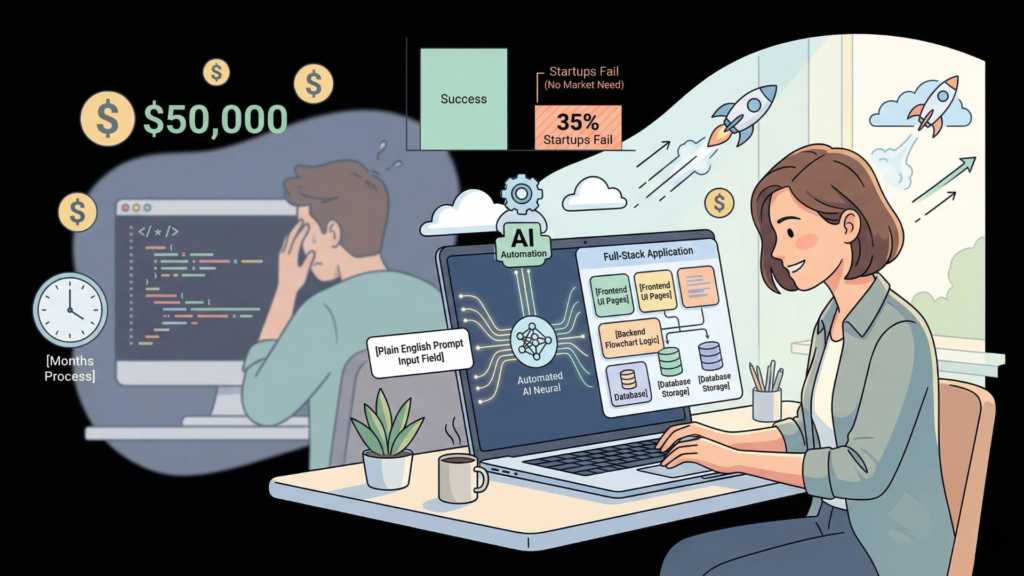
No. A tech startup does not need a developer to build its first working product, and in most cases hiring one before validating the idea is the most expensive mistake a first-time founder can make. According to CB Insights, 35% of startups fail because there is no market need for their product (CB Insights, 2023). Spending $50,000 on development before confirming that market need is not caution. It is the leading cause of founder regret.
Launch Your App Today
Ready to launch? Skip the tech stress. Describe, Build, Launch in three simple steps.
BuildThe argument for hiring a developer early used to be that there was no alternative. That stopped being true around 2022. AI-generation platforms now produce production-ready full-stack applications including frontend, database schema, backend logic, and deployment from a plain English description. The question is no longer whether you need a developer to start. It is which tools let you get to your first paying customer before your runway runs out. This detailed cost comparison between developer-built, AI-generated, and no-code apps in 2026 breaks down exactly where the numbers land.
Step 1: Define the Problem Before You Touch Any Tool
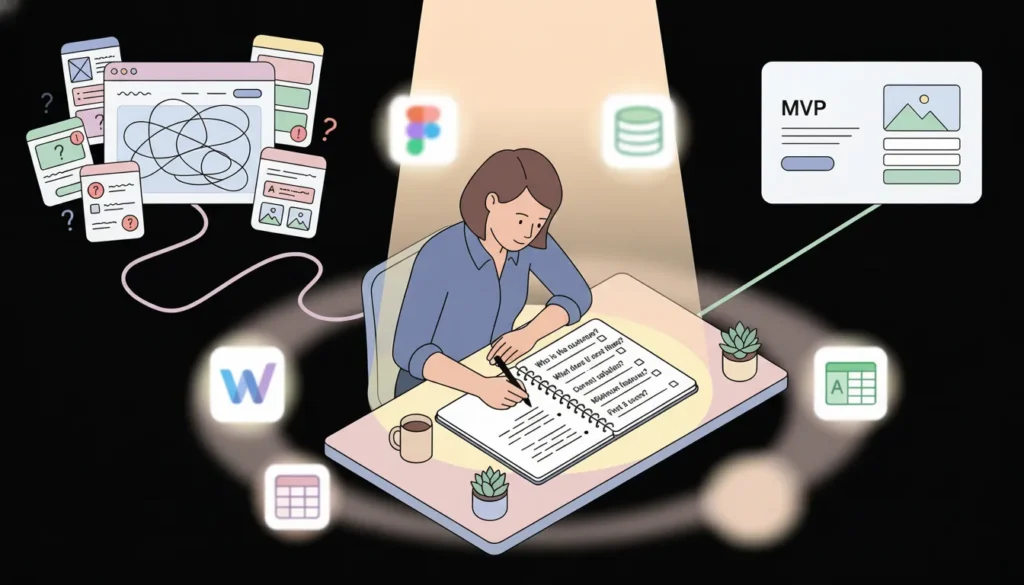
The fastest way to waste six months building a tech startup without a developer is to start with a tool instead of a problem. Every successful no-code startup begins with a specific, verifiable problem that a defined group of people will pay to solve. Vague problem statements produce unfocused MVPs that nobody signs up for.
The founders who ship fastest with no-code tools are not the most technically creative. They are the most operationally specific. The founders who struggle describe their product as “an app like Notion but better” or “a marketplace for X.” The founders who ship describe it as: “Small yoga studios have no affordable way to manage class bookings, member payments, and instructor scheduling in one place. Every tool they use is either built for gyms ten times their size or costs more than they make in a week.” That level of specificity maps directly to a prompt that generates a working product on the first try.
Before opening any tool, write the answers to five questions. Who is the customer, specifically? What does the problem cost them today, in time, money, or missed revenue? What does the current solution look like and why is it inadequate? What is the minimum set of features that would make someone pay for this? Who are the first five people you can call tomorrow who have this problem?
If you cannot answer all five, you are not ready to build. You are ready to do twenty more customer conversations. Low-code MVP strategies and the validation feedback loop covers exactly how to structure those conversations to produce a buildable spec.
Step 2: Validate Demand Before Writing a Single Prompt
Validation is the step most eager founders skip, and it is the step that determines whether everything that follows is worth doing. Validation means getting evidence that real people will pay for your idea before you build the product. It does not mean asking friends if they think it sounds good. It means pre-selling, collecting money, or getting signed letters of intent from prospects who have no personal obligation to be kind to you.
According to First Round Capital’s analysis of early-stage failure, startups that validate demand before writing code are four times more likely to reach a Series A than those that build first (First Round Capital, 2022). That asymmetry is large enough to restructure your entire startup process around it.
The most reliable validation stack for a no-code founder costs under $50 and takes under a week. Build a one-page landing page on Carrd in under an hour with a headline, three bullet points describing the problem and solution, and an email capture or a “Request Early Access” form. Drive 200 to 500 targeted visitors through a $30 to $50 LinkedIn or Reddit ad. If fewer than 3% sign up, the messaging or the problem framing needs work before you build anything. If more than 8% sign up, you have enough signal to build. The conversion rate tells you more about product-market fit than any amount of user interviews. This detailed guide on validating startup ideas with no-code tools walks through the full validation methodology.
The three fastest validation methods for a non-technical founder:
- Landing page with email capture and paid traffic, takes under a week and costs under $100
- Manual concierge MVP where you deliver the outcome by hand before building the product, takes one to two weeks and costs nothing
- Pre-sale offer at a discounted price to a list of warm prospects, requires an existing audience but produces the most reliable signal of all
Step 3: Design Your MVP Scope Before You Prompt
Once validation confirms real demand, the next mistake is building too much. An MVP is not a polished product. It is the minimum set of features that lets a real user experience the core value and give you feedback based on actual use. According to Y Combinator’s published startup guidance, the most common MVP mistake is including features that founders want rather than features users need (Y Combinator, 2023).
A working MVP scope has three parts. The core loop is the single workflow that delivers your product’s primary value, such as booking a session, submitting a request, or viewing a processed report. The support structure is everything required for the core loop to function: authentication, user accounts, basic navigation. Everything else is Version 2.
Write your MVP feature list, then cut it in half. What remains is probably still too large. A focused prompt generates a better first product than an ambitious one. The step-by-step guide to building an MVP covers scope definition in depth, including how to structure the feature list before you build.
A practical MVP scope template:
Core screens required at launch: two to five at most. User roles and what each role can do. The single workflow that delivers the core value. Authentication requirements. Any external integrations that are non-negotiable for the MVP to function.
Leave out: reporting dashboards, notification systems, admin controls beyond basic CRUD, onboarding flows, and billing unless billing is the core product.
Step 4: Build Your MVP With AI Generation
With a validated idea and a scoped MVP, building with an AI-generation tool takes hours rather than months. imagine.bo’s Describe-to-Build interface takes your plain English description and generates the complete full-stack application: frontend components, database schema, backend API logic, authentication system, and deployment configuration in a single generation pass.
The quality of your first output depends almost entirely on the quality of your prompt. The four-element structure that consistently produces the best results is: Persona (who the app is for), Problem (what it solves), Features (explicit list of what it must do), and Rules (access control, edge behaviors, constraints).
A complete imagine.bo startup MVP prompt, ready to adapt:
“Build a SaaS application for [specific user type] to [core problem/action]. Users can [primary action 1], [primary action 2], and [primary action 3]. Admins can [admin action 1] and [admin action 2]. Include secure user authentication with email verification. [User role] can only access [restriction]. [Other user role] can see [different data]. Deploy with Stripe checkout for a [price] per month subscription.”
After submitting the prompt, the AI-Generated Blueprint appears before any code is written. This is the most important step most founders skip. Review the database models, user role structure, and page architecture before the platform builds anything. A five-minute review at this stage prevents a full rebuild later. Use follow-up prompts in plain English to correct anything misaligned before confirming the build. This prompt guide for building apps with AI covers the techniques that produce consistently strong first generations.
Step 5: Deploy and Test With Real Users Fast
Getting real users into your product in the first week is the entire point of building without a developer. The advantage is not cost or speed for its own sake. It is the feedback loop. Every week you delay putting the product in front of real users is a week you are building based on assumptions.
imagine.bo’s One-Click Deployment sends your frontend to Vercel for global edge-cached performance and your backend to Railway for automatic scaling. SSL applies by default. No DevOps knowledge is required. Your app is production-ready from the first deploy.
A founder using imagine.bo’s Pro plan at $25 per month who builds and deploys an MVP in week one and starts collecting user feedback by week two is operating on a feedback cycle approximately 16 to 24 weeks faster than the average custom development timeline of four to six months. At a developer rate of $100 per hour and a 500-hour MVP estimate, the cost difference is approximately $49,975 in saved development spend in that first cycle alone. The longer-term compounding of faster iteration creates a product advantage that cash alone cannot buy back.
After deployment, run your first five users through the core workflow manually if possible. Watch them use it without prompting. Do not explain features. Do not defend design choices. Write down every moment they hesitate, every question they ask, and every thing they try that does not work. That session is worth more than any amount of analytics data in the first two weeks.
For the full playbook on how AI-powered development changes the iteration speed for startups, this post on why prompt-driven development reshapes the startup equation explains the structural advantage in detail.
Step 6: Handle Technical Complexity Without Hiring a Developer
Every startup hits a moment where AI generation reaches its natural edge. A specific payment flow, a third-party API integration, a custom algorithm, a performance optimization under load. This is the moment most no-code founders either stall or make the expensive decision to hire a full-time engineer for a problem that requires forty hours of work.
imagine.bo’s Hire a Human feature solves this directly. From your project dashboard, you submit a task ticket to a vetted engineer who writes the specific code, pushes it to your repository, and moves on. The cost is $25 per page for targeted tasks. There is no hiring process, no equity negotiation, no onboarding, and no ongoing salary. You get the quality of a senior engineer for a specific scoped problem, then return to building independently.
The situations that consistently warrant using Hire a Human over iterating with prompts: you have sent three or more correction prompts on the same feature without resolution; the feature requires a specific third-party API with custom authentication; the logic involves multi-step conditional business rules; the issue is related to performance at scale, security handling, or data integrity. On the Pro plan, you also get priority access to engineers with a guaranteed 24-hour turnaround and a one-hour expert session before launch, which is particularly valuable for catching issues before you start paying for customer acquisition. This guide to building a SaaS with AI and no-code covers the full workflow for founders managing technical complexity without a permanent engineering team.
Step 7: Charge Money Early and Iterate Based on Revenue Signal
The most dangerous stage of building a tech startup without a developer is the extended free beta. Free users give you usage data. Paying users give you signal about real value. Those are fundamentally different kinds of information, and most founders conflate them.
According to a 2023 study by Stripe on early-stage SaaS companies, startups that begin charging within the first 90 days of product launch retain 40% more of their initial user base at the 12-month mark than those that delay monetization past six months (Stripe, 2023). Charging early forces you to articulate value clearly, filters for users who take the product seriously, and creates the revenue that funds the next iteration.
The psychological barrier to charging is almost always higher than the market resistance. Most founders in their first product cycle delay charging because they feel the product is not ready. Real customers who have a genuine problem and know your product is early-stage will pay for a half-built solution that solves their problem better than the current alternative. The customer who would only pay for a perfect product was never going to be your early adopter anyway. Start charging at the MVP stage, price based on the value you deliver rather than the cost of the tool, and use that revenue to fund the Hire a Human tasks that take your product to the next level. For a practical guide on monetizing a product built with AI tools, this post on monetizing prompt-built apps without coding covers pricing strategy and implementation.
What Does a Real Non-Technical Founder’s Build Stack Look Like?
The most effective no-code startup stack in 2026 is not one tool. It is four layers working together, each chosen for a specific job.
| Layer | Tool | Purpose |
|---|---|---|
| Validation | Carrd + paid social | Test demand before building, under $100 |
| Core product | imagine.bo | Full-stack MVP generation and deployment |
| Marketing site | Webflow | SEO-driven acquisition and content |
| Workflow automation | Make | Connect tools, automate notifications |
This stack covers the full startup operating surface: demand validation, product, acquisition, and operations. Total monthly cost at the Lite plan level is under $80 before transaction fees. A solo founder running this stack is operationally equivalent to a three-person team from the customer’s perspective.
The stack scales predictably. As revenue grows, you upgrade imagine.bo’s plan for more credits and rollover capacity. You add Hire a Human tasks for specific technical complexity. You add team members to the Webflow and Make layers. You never need to rebuild the core product because imagine.bo generates clean, exportable code you own outright. For a detailed breakdown of how single-person startups use AI to compete with larger teams, this post on single-person startups competing at enterprise scale is directly relevant.
What Are the Biggest Mistakes Non-Technical Founders Make?
After watching hundreds of no-code MVPs get built, six failure patterns repeat with near-perfect consistency. Building the wrong thing is first: founders spend weeks building features they imagined users would want, then find out through launch that users wanted something simpler and more specific. Prompting without a plan is second: sending a vague, single-sentence prompt to an AI generator produces a generic output that requires full rebuilds rather than refinements. Treating free users as signal is third: a free user base is not product validation. It is an audience. Only paying users provide real signal about whether you have built something worth continuing.
Delaying deployment is fourth: every week before real users use the product is a week of building on assumptions. You find out more in the first three user sessions than in three weeks of internal testing. Over-engineering the first version is fifth: founders build admin dashboards, notification systems, and analytics before anyone has signed up. None of that is an MVP. The sixth pattern is avoiding the Hire a Human feature out of a misplaced sense that needing human help means the no-code approach failed. It does not. It means you have built far enough that a specific engineering task is worth $25 rather than a $50,000 developer retainer.
For a candid account of what the first no-code MVP actually teaches you, this post on what founders learn from launching their first no-code MVP covers the real experience rather than the theoretical playbook.
FAQ
Can a non-technical founder build a tech startup entirely without a developer?
Yes, for most web application types. imagine.bo generates the full stack including frontend, database, backend logic, and deployment from a plain English description. According to Gartner, 70% of new applications will use no-code or low-code technology by 2025 (Gartner, 2021), which reflects how mainstream this path has become. The Hire a Human feature handles specific engineering tasks on demand when AI generation reaches its limits, so you never need a permanent developer on the team unless you choose to hire one after generating revenue. For founders who want to understand exactly where the limits are, this AI vs. no-code MVP guide for fast startup launches maps the boundary precisely.
How long does it take to build a tech startup MVP without a developer?
With imagine.bo, the first deployed version of a scoped MVP typically takes two to five days from first prompt to live product, including time for the AI-Generated Blueprint review, follow-up prompt refinements, testing, and deployment. This compares to four to six months for a custom-built equivalent. According to Y Combinator, the fastest-growing early-stage startups ship their first product to users within two weeks of deciding to build (Y Combinator, 2023). No-code and AI-generation tools make that timeline achievable without any engineering background.
What is the biggest technical risk of building a startup without a developer?
The biggest risk is hitting a technical wall mid-build, specifically a complex third-party API integration or a custom business logic requirement that goes beyond AI generation capabilities. imagine.bo addresses this directly through the Hire a Human feature, which connects you with a vetted engineer for $25 per page to handle specific tasks. The risk is much lower than most founders expect, because the majority of MVP-stage functionality, authentication, CRUD operations, basic workflows, and standard payment integration, falls comfortably within what AI generation handles well. For the full breakdown on scaling no-code apps to production, this post on building complex apps with imagine.bo covers advanced functionality in detail.
How do I know when to hire a full-time developer instead of using no-code tools?
The signal for hiring a full-time developer is consistent, not occasional, engineering work that exceeds what the Hire a Human feature handles efficiently. Specifically: you are spending more than $500 per month on Hire a Human tasks across recurring features rather than one-off integrations; your product requires real-time data processing, machine learning inference, or infrastructure management that no-code platforms do not support; or you have reached revenue levels where the equity cost of a technical hire is justified by the product velocity it creates. According to First Round Capital, most seed-stage startups do not need a full-time engineer until they are generating consistent monthly recurring revenue, at which point the engineering capacity directly funds itself (First Round Capital, 2022).
Do I own the code built with imagine.bo?
Yes. imagine.bo produces clean, exportable code following modern standards that you own outright. There is no lock-in to the platform, no proprietary format that prevents you from taking the code elsewhere, and no ongoing dependency on imagine.bo for your product to function after deployment. This is a meaningful difference from platforms like Bubble or Shopify, where your product lives inside a proprietary ecosystem and cannot be extracted. Code ownership means you can hand the codebase to a developer for future work, migrate to a different hosting provider, or sell the company without platform dependency being a due diligence concern.
Conclusion
Three things determine whether a non-technical founder builds a successful tech startup without a developer. The first is validating demand before building anything. Skipping validation is not moving fast. It is spending money building the wrong product at maximum speed. The second is writing a specific, scoped prompt before opening any tool. Vague prompts produce generic products. Specific prompts produce working MVPs. The third is treating Hire a Human as part of the standard workflow rather than an admission of failure. On-demand engineering for specific complexity is how non-technical founders match the output of full engineering teams without the overhead.
imagine.bo’s Pro plan at $25 per month gives you 150 credits with rollover, private projects, a one-hour expert pre-launch session, and 24-hour priority engineering support. That is a complete startup-building infrastructure at the cost of a dinner. Start with the free plan today. Write one specific prompt describing your product, review the AI-Generated Blueprint before anything is built, and deploy your first version this week. For the practical week-by-week path from side project to launched SaaS, this guide on turning a side project into a startup with no-code tools is the best companion resource to everything covered here.
Launch Your App Today
Ready to launch? Skip the tech stress. Describe, Build, Launch in three simple steps.
Build