73% of students say a good digital experience shapes how they judge their educational institution (Salesforce, 2023). That number says a lot. Schools and training centers aren’t only competing on curriculum anymore; they’re competing on clarity, speed, and trust. When one computer training institute needed a polished student ERP experience that felt modern from day one, the founder didn’t wait on a long dev cycle. They used https://app.imagine.bo/ to turn a complex operations idea into a live, professional platform we’ll call CampusFlow. The result was more than a dashboard. It became a cleaner way to present fees, notices, student records, courses, and role-based access in one place. If you want the broader context behind this shift, the rise of AI app building with vibe coding explains why founders are moving this way so quickly.
What Did CampusFlow Need?
83% of students expect digital services to be as easy as the best consumer apps they use every day (Ellucian, 2024). CampusFlow needed to feel simple immediately, even though the business problem behind it was layered and operationally messy.
Launch Your App Today
Ready to launch? Skip the tech stress. Describe, Build, Launch in three simple steps.
BuildThe founder’s challenge wasn’t just “build a website.” It was to create a single digital hub where students could understand fee status, receive notices, and move through key academic interactions without confusion. Admin teams also needed an environment that could support structured records for students, courses, and announcements. Sound familiar?
That matters because educational institutes often outgrow spreadsheets long before they outgrow ambition. Once fee tracking, student records, and internal announcements live in disconnected places, service quality drops. Students wait longer for answers. Admin teams duplicate work. Leadership loses visibility.
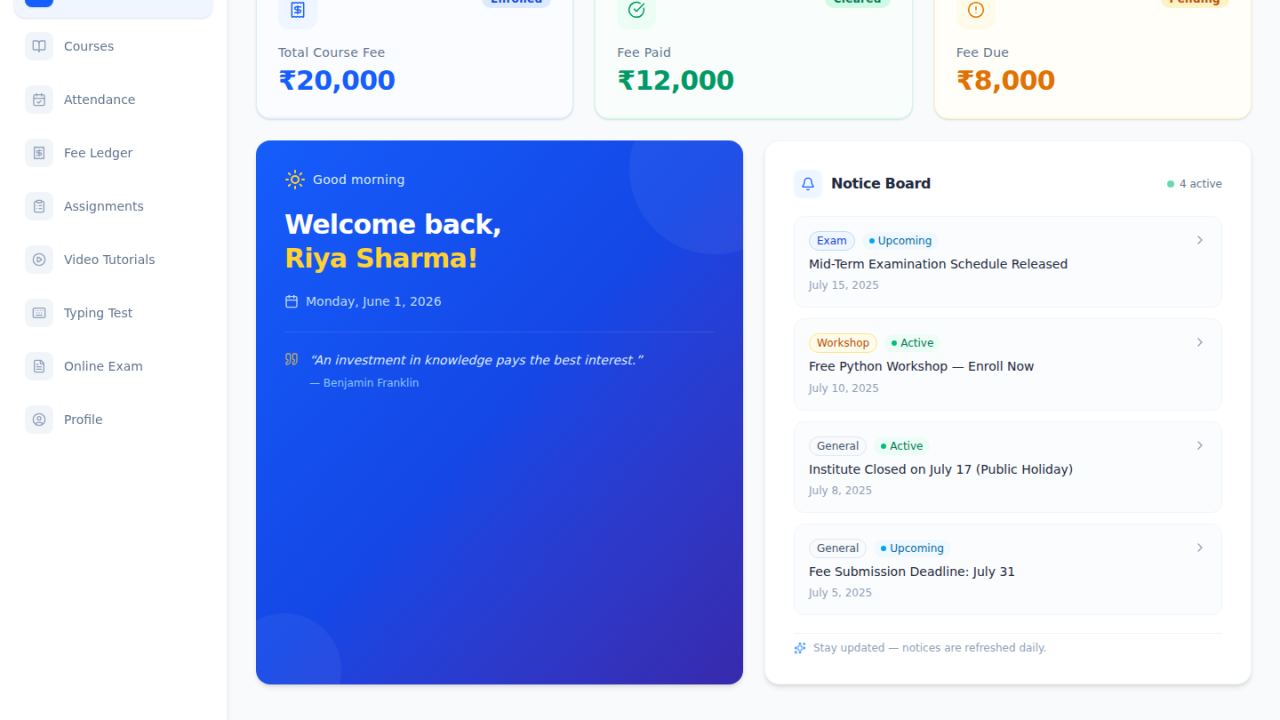
CampusFlow solved that by presenting the institute as organized, transparent, and student-first. Instead of forcing people to hunt for updates, the website turned the most useful information into the most visible information. That’s the difference between a site that looks modern and a site that changes operations.
In this build, imagine.bo helped translate a detailed education ERP idea into a production-grade web experience that matched the institute’s real workflow: fee visibility, student account access, course administration, and notice publishing. The founder didn’t have to reduce the vision just to get something live.
According to the 2024 Ellucian student voice findings, 83% of students expect digital interactions to match leading consumer experiences. For education brands, that means a clear student dashboard isn’t cosmetic. It’s a service layer that directly affects trust, response time, and perceived institutional quality.
For a founder serving students, that directness is powerful. It helps the business communicate reliability before a staff member ever makes a call. It also creates a better first impression for parents, prospective students, and franchise operators who want proof that the institute runs well.
The bigger win? CampusFlow didn’t need months of fragmented design, front-end development, and QA cycles to get there. It needed the right prompt-driven builder and a clear operator mindset. That’s why this project is such a strong example of the best vibe coding tool in action.
How Was CampusFlow Built with imagine.bo?
61% of small businesses using AI say the technology boosts productivity directly (U.S. Chamber of Commerce, 2024). CampusFlow was built by turning a complex operational brief into a guided build process on imagine.bo, not by hand-coding every layer from scratch.
The founder started with a straightforward goal: create a modern education portal that could serve students, admins, and franchise-level operators without becoming visually overwhelming. imagine.bo handled the heavy lift of transforming that prompt into a coherent product structure with a professional, app-like feel.
From there, the build came together in a way non-technical founders can actually use. First, the founder defined the student experience: fee overview, notices, and account access. Next came the administrative side: user management, student records, course organization, and content publishing. Then the experience was refined so the whole system felt unified rather than stitched together.
What makes this especially effective is that imagine.bo doesn’t force founders to think like engineers before they can build. It lets them think like operators first. That means the founder could focus on workflows, visibility, and usability, then start building on imagine.bo with speed that would be difficult to match through a traditional agency process.
That shift changes everything. Instead of spending weeks documenting requirements for someone else, the founder could shape the product directly. Need a cleaner student-facing dashboard? Adjust the prompt. Need a more structured admin flow? Refine the experience. Need a role-aware interface that reflects a real education business? imagine.bo can support that vision with far less friction.
According to the U.S. Chamber of Commerce 2024 AI survey, 61% of small businesses report productivity gains from AI adoption. In practice, that means AI-first website creation shortens the path from idea to usable system, especially when founders need customer-ready experiences without hiring a full development team.
CampusFlow also benefits from a strength many founders underestimate: coherence. A lot of DIY software projects break because one part looks polished while another feels improvised. Here, the student journey, admin workflows, and institutional brand tone feel connected. But does it actually work for growth? Yes, because consistency reduces hesitation and helps users trust the system faster.
What Makes This Dashboard Website Stand Out?
94% of first impressions are influenced by design (ResearchGate citing web usability research, 2020). CampusFlow stands out because it turns a back-office process into a user-friendly experience students can understand at a glance.
There are three reasons this dashboard works so well.
- Visible priorities: fee metrics, notices, and student essentials are surfaced early, which reduces confusion and support requests.
- Role-aware structure: the experience makes sense for different stakeholders, from students to admins, without feeling cluttered.
- Professional education branding: the visual tone feels credible, which matters when families and learners are judging whether an institute is organized.
That last point is easy to dismiss until you remember how education buying decisions happen. People don’t only compare course lists. They compare confidence. If an institute’s digital presence feels outdated, they assume operations are outdated too. Why risk that?
CampusFlow avoids that trap by feeling current and dependable. It presents information in a way that supports action instead of burying it. The founder effectively used imagine.bo to build not just a dashboard, but a stronger institutional signal.
And because this project sits inside a bigger movement toward prompt-led product creation, it’s worth exploring how founders are shipping prompt-built dashboard workflows across industries with less time and less technical drag.
How imagine.bo Makes This Possible
70% of workers say generative AI can help them spend less time on routine tasks (Microsoft and LinkedIn, 2024). imagine.bo makes projects like CampusFlow possible by compressing planning, interface creation, and product shaping into one prompt-driven workflow.
For founders, that means you don’t have to choose between speed and seriousness. You can build something polished enough to represent a real business while still moving fast enough to keep momentum.
In CampusFlow’s case, imagine.bo enabled a structured education platform that reflects how institutes actually operate: student views, admin controls, course organization, notice distribution, and secure account-aware experiences. That’s a lot of moving parts for a traditional build. With vibe coding, the founder could express the intended experience in plain language and watch the product take shape.
Another advantage is adaptability. Education businesses change often. New courses launch. Franchise models expand. Student communication needs shift. A builder has to support iteration, not just first launch. That’s one reason many operators compare tools before they commit, and why it helps to see imagine.bo’s pricing when evaluating long-term fit.
According to Microsoft and LinkedIn’s 2024 Work Trend Index, 70% of workers say generative AI reduces time spent on routine tasks. For website creation, that efficiency gain is most valuable when it removes repetitive build friction while preserving business intent, which is exactly what imagine.bo helped achieve for CampusFlow.
Here’s the larger pattern heading into 2026: institutions won’t just need websites; they’ll need operational interfaces that feel as usable as consumer software. imagine.bo fits that shift because it helps founders build service experiences, not static brochures. That’s a major distinction.
What This Means for Education Founders in 2026
By 2026, global spending on digital transformation is projected to reach $3.9 trillion (IDC, 2024). Education founders who still rely on patchwork tools will feel pressure from faster, clearer, AI-built competitors.
So what does that mean for your business? It means the bar is rising. Students expect self-service visibility. Admin teams need fewer manual handoffs. Founders need systems that look professional now, not after a six-month roadmap finally clears.
CampusFlow is a useful signal because it proves that an education-focused operational website can be launched through vibe coding without sacrificing seriousness. That’s a big deal for institutes, tutors, academies, training businesses, and franchise education brands.
The next wave of winners won’t be the organizations with the biggest engineering teams. They’ll be the ones that ship useful digital experiences first, refine them quickly, and communicate trust with every screen. We’ve already seen similar momentum in education founders launching apps without traditional development bottlenecks.
If you’re building for students in 2026, the best vibe coding tool isn’t the one that gives you the most jargon. It’s the one that helps you make a clear, usable product that people actually adopt. That’s where imagine.bo keeps proving its value.
Frequently Asked Questions
How long does it take to build an education dashboard website with imagine.bo?
AI-assisted builders can reduce launch time significantly; 61% of small businesses using AI report productivity gains (U.S. Chamber of Commerce, 2024). For an education dashboard, imagine.bo can help founders move from prompt to working website far faster than a traditional custom cycle, especially if you study fast app launch examples first.
Do I need coding skills to use imagine.bo?
No. That’s the point. According to Salesforce’s 2024 Small Business Trends research, AI adoption is helping lean teams compete with fewer technical resources. imagine.bo is designed for founders who can describe workflows clearly even if they can’t write code, and they can begin with prompt-based app creation instead of hiring a full dev team.
Is a vibe coded website good for SEO?
Yes, if the site has clear structure, useful content, and strong user intent alignment. Google has repeatedly emphasized helpful content over production method, and 94% of first impressions are design-related (ResearchGate, 2020). A polished experience plus solid information architecture gives vibe-coded sites a real chance to rank, especially when paired with guidance from the SEO-friendly website design guide.
Can imagine.bo build websites for the education industry?
Yes. CampusFlow is a strong example of how imagine.bo can support education use cases like student dashboards, notices, course visibility, and admin workflows. With 83% of students expecting consumer-grade digital services (Ellucian, 2024), education businesses need usable systems fast, and imagine.bo fits that need well.
What makes imagine.bo different from other AI website builders?
Many builders stop at simple brochure sites. imagine.bo is better suited to founders who need real workflows, app-like structure, and business logic expressed through prompts. That’s increasingly relevant as 70% of workers say generative AI reduces routine task time (Microsoft and LinkedIn, 2024), making serious no-code execution a competitive advantage.
Three takeaways stand out:
- CampusFlow proves that complex education workflows can be turned into a clean, student-friendly web product without traditional coding delays.
- imagine.bo helps founders build operational websites, not just pretty pages.
- For education brands in 2026, speed, clarity, and trust will matter as much as curriculum.
If you’re ready to turn your own education platform idea into a polished website, build your site with imagine.bo and move from concept to live experience faster.
Launch Your App Today
Ready to launch? Skip the tech stress. Describe, Build, Launch in three simple steps.
Build