The Short Answer (Read This First)
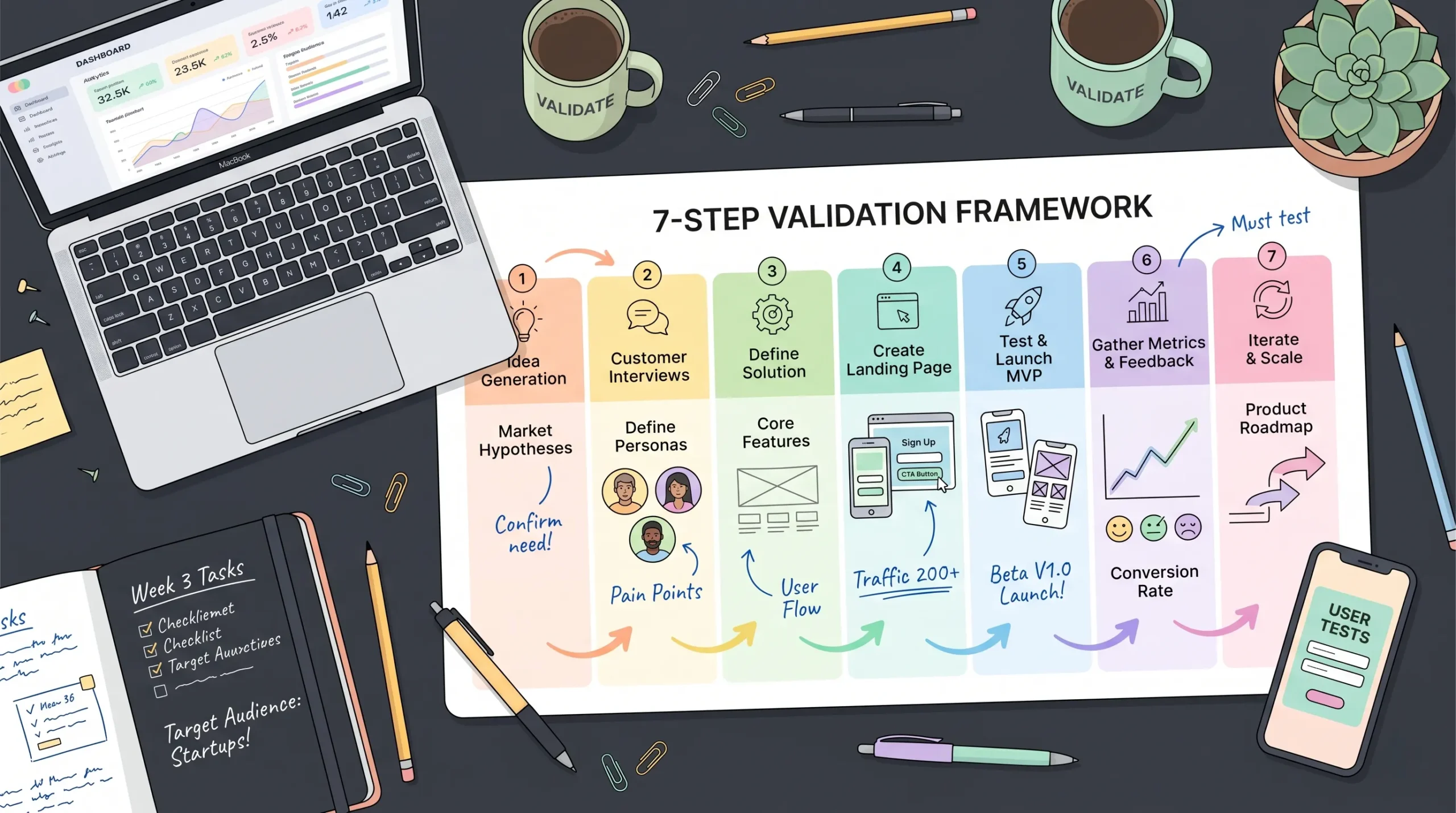
You can validate an app idea in 14 days for under $50 using seven specific steps:
- Write the problem in one sentence (not the solution).
- Find 20 real people who live with that problem.
- Run customer interviews using The Mom Test rules (no pitching, no hypotheticals).
- Check demand signals on Google Trends, Reddit, and niche forums.
- Build a smoke-test landing page describing the outcome.
- Collect 5 pre-commitments: money, time, or a non-trivial email signup.
- Test real behavior with a no-code prototype before writing serious code.
If you get a clear “yes” on at least 5 of these 7 signals, you have a validated app idea. If you do not, pivot the problem statement and run the loop again. Building before you finish this loop is the most expensive mistake a founder can make.
That is the entire framework. Everything below tells you exactly how to execute each step, the tools to use, the questions to ask, and the red flags that mean your idea is not ready.
Why You Cannot Skip Validation in 2026
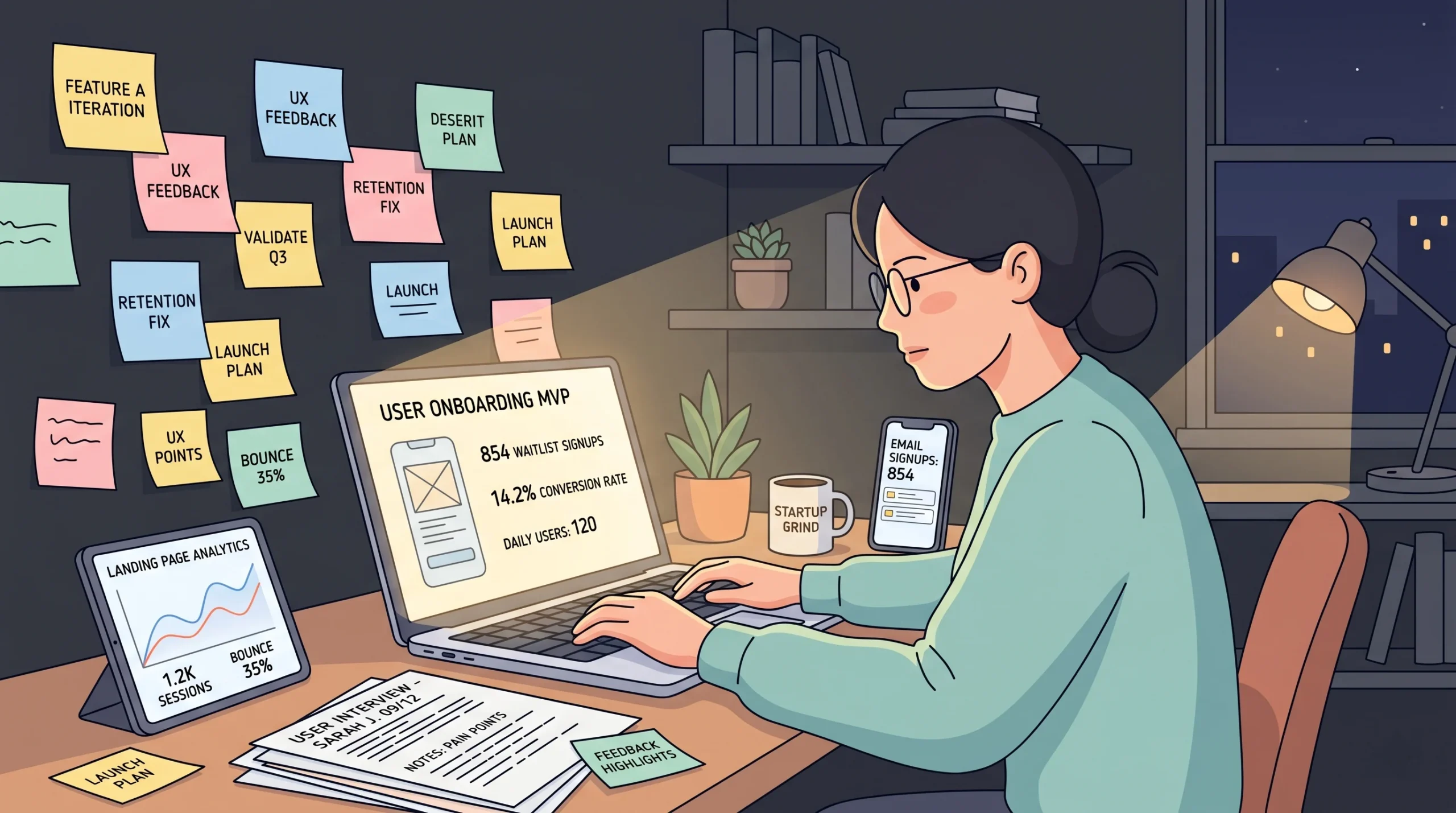
According to CB Insights’ analysis of 431 failed VC-backed startups, 43% died because of poor product-market fit and 70% ran out of capital because they were funding a product the market never asked for. That second number is the polite version of the first one.
The pattern is brutally consistent. Founders fall in love with a solution, raise or self-fund a build, ship after six months, and discover nobody will pay. By the time the truth arrives, the cash is gone and so is the team.
In 2026, AI app builders make this failure pattern cheaper but also easier to walk into. You can ship a polished product in a weekend now. That is great for execution. It is dangerous for validation, because shipping fast feels like progress even when you are building the wrong thing. Speed without validation is just expensive shipping.
The good news: validation has never been faster or cheaper. The seven-step framework below is the version that actually works in the current landscape, not theory from a 2014 startup book.
Founder rule: Validation is not asking people if they like your idea. Validation is collecting evidence that people will pay, switch tools, or spend real time on it before you build.
What “Validation” Actually Means (And What It Does Not)
Most founders confuse three different things and call all of them “validation”:
| What it looks like | What it actually is |
|---|---|
| Friends saying “great idea” | Compliment. Not validation. |
| 200 likes on a LinkedIn post | Attention. Not validation. |
| 50 newsletter signups | Curiosity. Maybe early validation. |
| 5 people paying $20 to join a waitlist | Validation. |
| A user switching from their current tool to use your prototype every day | Strong validation. |
The rule, lifted directly from Rob Fitzpatrick’s The Mom Test, is that opinions are worthless and only past behavior is reliable. Future-tense answers (“I would totally use that”) are the most dangerous data points in early-stage startups, because they sound concrete but mean nothing.
True validation has three properties:
- It is behavioral, not verbal. Someone did something, not said something.
- It costs the person something. Money, time, attention, or social effort.
- It is repeatable. You can get the same signal from a stranger, not just a friend.
If your “validation” does not meet all three, you do not have validation. You have hope.
The No-Fluff Validation Framework: 7 Steps in 14 Days
This framework is built for solo founders, side-project builders, and small teams who want a clear path from “I have an idea” to “I should build this.” Each step has a single output. If you cannot produce the output, you do not move to the next step. That is the only rule.
Step 1: Write the Problem in One Sentence (Days 1 to 2)
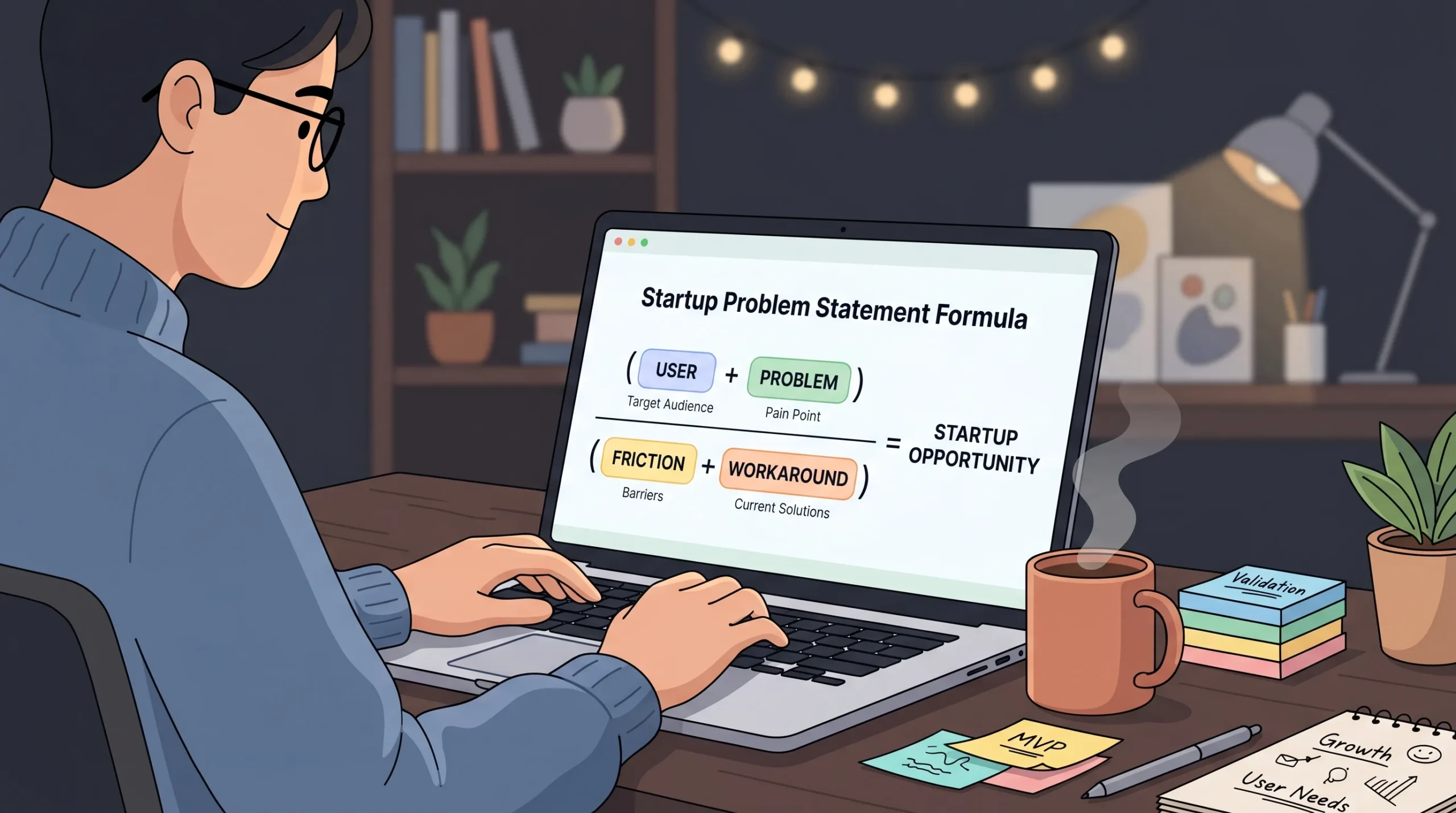
Most app ideas die at this step and the founder does not notice.
Open a blank doc. Write one sentence that follows this exact structure:
“[Specific person] struggles to [specific outcome] because [specific friction], and currently solves it by [current workaround].”
A good problem sentence:
“Freelance graphic designers struggle to send professional invoices in under 5 minutes because most invoicing tools are built for accountants, and currently solve it by manually formatting Google Docs and emailing PDFs.”
A bad problem sentence:
“Designers need better invoicing.”
The difference is specificity. The first sentence tells you exactly who to talk to, what to measure, and what to test. The second sentence is a fantasy. If you cannot fill in all four blanks with confidence, you do not understand the problem yet, and you are not ready to interview anyone.
For a deeper dive into the questions that force this clarity, work through the prompts in this guide on the questions every founder should ask before building.
Output of Step 1: One problem sentence. Print it. Tape it above your screen.
Step 2: Find 20 People Who Have This Problem (Days 2 to 4)
You need 20 real strangers who match the “[specific person]” part of your sentence. Not 20 friends. Not 20 people from your existing network who already like you. Strangers.
Where to find them in 2026:
- LinkedIn search filtered by job title, industry, and seniority. Send a short note that asks for 15 minutes of research input. Do not pitch.
- Reddit communities in your niche. Read the top 50 posts of the last 90 days first, then post a research request.
- Discord and Slack groups where your target user already hangs out (find them with searches like “site:slofile.com [your niche]” or “best Discord [your niche]”).
- Indie Hackers, Product Hunt forums, and Substack comment sections for makers and SaaS founders.
- Customer review sections of competing tools on G2, Capterra, and the App Store. People who leave 2-star and 3-star reviews are gold, because they have the problem but hate the current solution.
Aim for a response rate of about 10 to 15%. To book 5 interviews, plan to contact about 40 to 50 people.
Output of Step 2: A spreadsheet with 20 names, contact methods, and a “yes / no / pending” column for interviews booked. You need at least 5 confirmed calls to move on.
Step 3: Run Customer Interviews (Days 4 to 8)
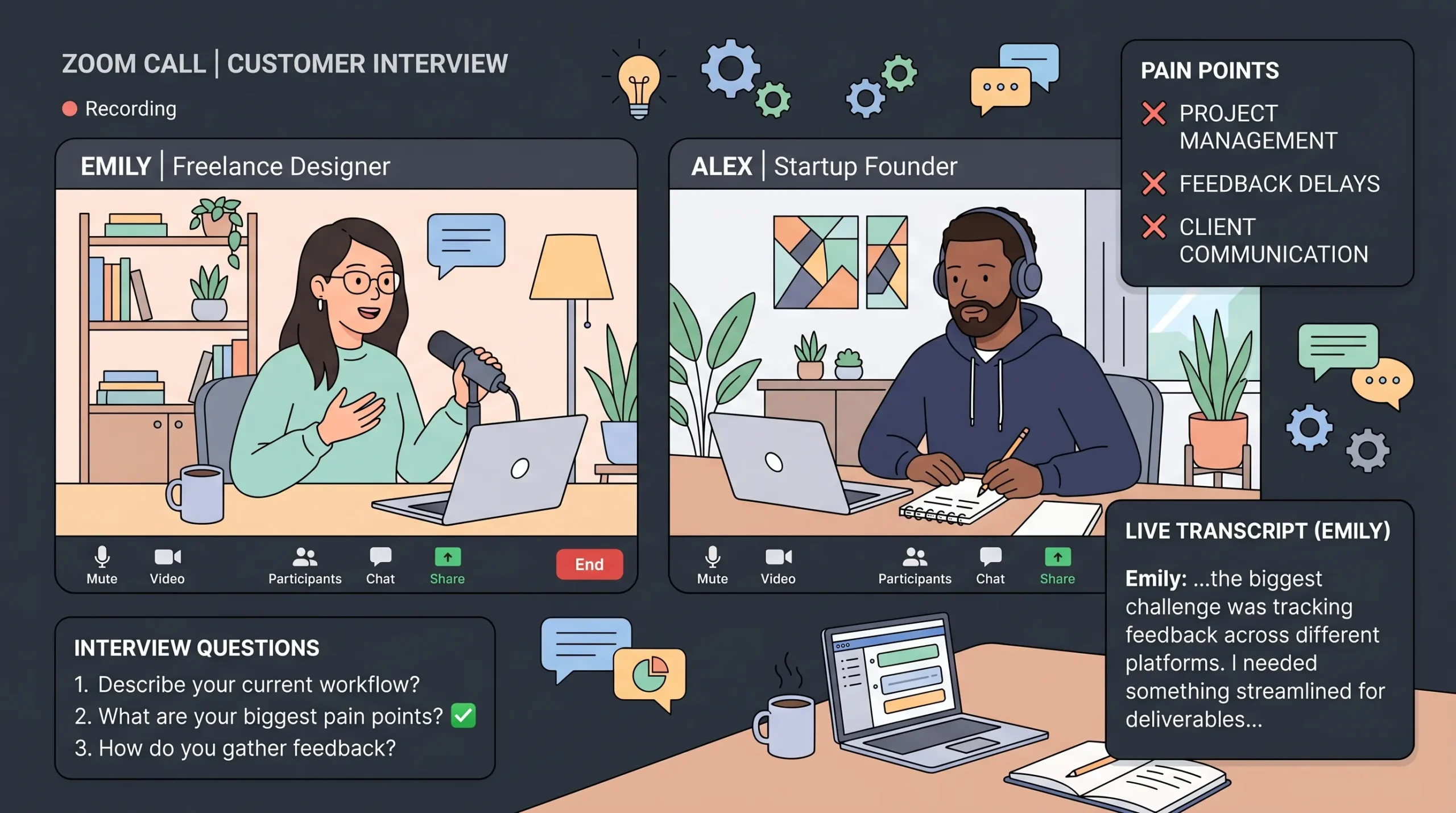
This is the highest-leverage step in the framework, and it is the one founders mess up the most.
The single rule: do not pitch your idea. Do not even describe it. Your job is to learn how the person currently lives with the problem, not to sell them a future product.
The Mom Test interview structure, condensed:
Open with their life, not your product.
- “Walk me through the last time you had to [do the task].”
- “What was the hardest part?”
- “What did you try before you found your current way of doing it?”
Dig into past behavior, never hypotheticals.
- “When did this last happen?”
- “What did you do next?”
- “How much time did it cost you?”
- “How much money did you spend trying to fix this?”
Find the pain budget.
- “Have you ever paid for anything to solve this?”
- “How much does this problem cost you in a typical month?”
- “Who else on your team is affected when this happens?”
Avoid these dangerous questions. They feel useful but produce noise:
- “Would you use a tool that did X?” (Hypothetical. Worthless.)
- “Do you like this idea?” (Opinion. Worthless.)
- “Would you pay for this?” (Future-tense. Worthless.)
Record the calls (with permission). After each one, write down three things: the exact words the person used to describe the problem, what they have already spent money on, and what specific behavior they showed that confirms the problem exists.
Output of Step 3: 5 to 10 interview notes. Look for the same phrase showing up in 4 or more interviews. That phrase is now your marketing copy. That repeated frustration is now your wedge.
Step 4: Check Demand Signals (Days 6 to 9, parallel to interviews)
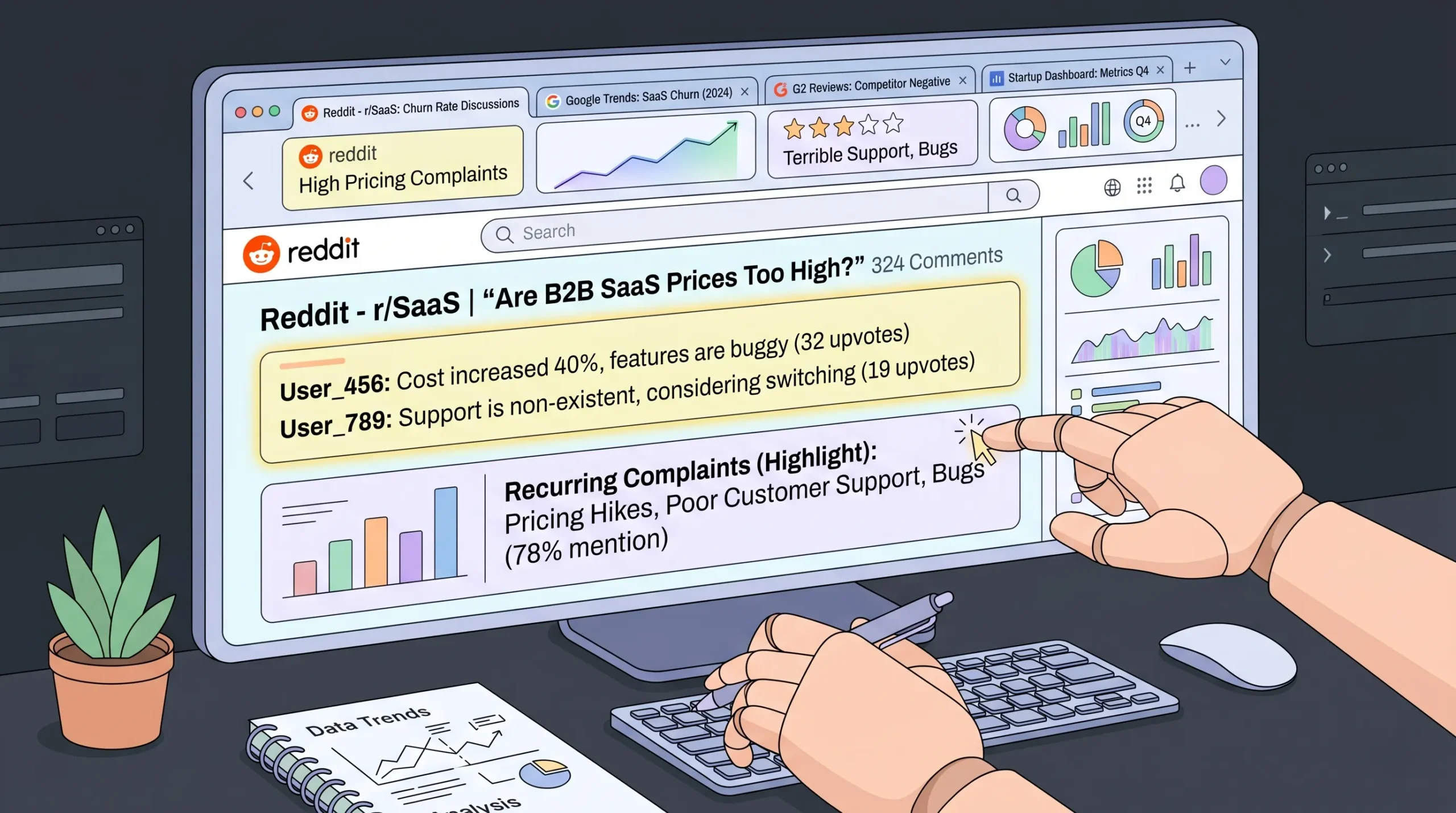
While your interviews run, validate that the problem exists at scale. You are looking for evidence that thousands of people are already trying to solve this.
Free demand signal tools in 2026:
- Google Trends: Search the problem phrase, not the product name. Rising or stable interest over 5 years is the green light.
- Reddit search with
site:reddit.com "[problem phrase]"on Google. Count the threads. Read the top 10 most upvoted complaints. - Answer the Public for the questions people search around your niche.
- G2 and Capterra reviews of competing tools, filtered by “lowest rated” first. Every angry review is a feature request.
- Twitter / X advanced search for “I wish there was a way to [your problem]” or “Does anyone know a tool that [your problem]” with a minimum like count of 5.
- Y Combinator’s Startup School Library and Paul Graham’s essays for pattern-matching against successful early-stage validation playbooks.
You are not looking for proof that nobody has built this. You are looking for proof that thousands of people are already paying for inferior solutions, hacking together workarounds, or complaining loudly about the gap.
A market with zero competitors is almost always a market with zero demand. A market with five flawed competitors is almost always a market you can win.
Output of Step 4: A one-page demand report. Include 5 search trends, 10 Reddit threads, 5 angry reviews of competitors, and a rough estimate of how many people are looking for a solution every month.
Step 5: Build a Smoke-Test Landing Page (Days 9 to 11)
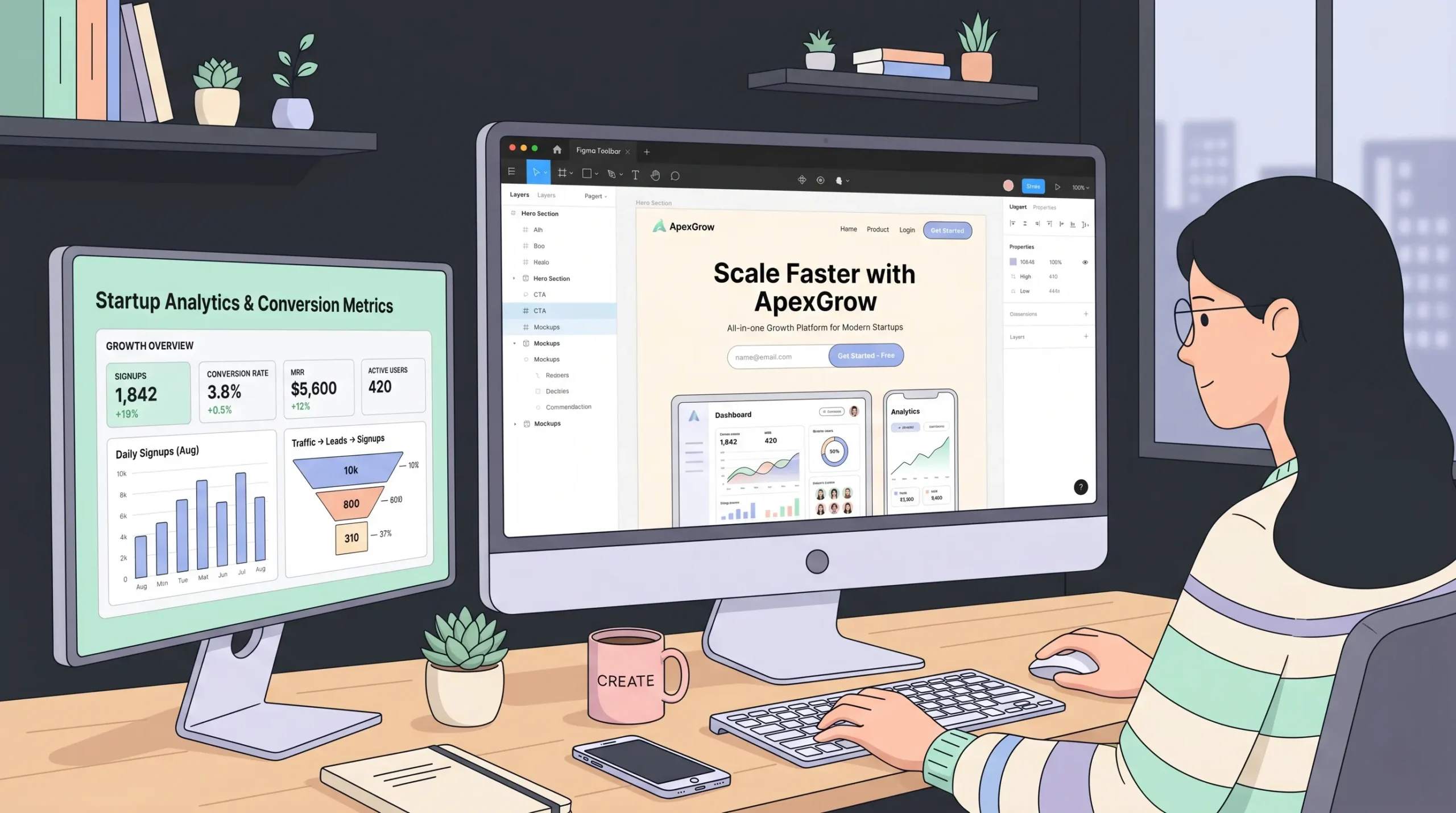
A smoke test is a landing page for a product that does not exist yet. Its only job is to find out if people will give you their email or money before you build anything.
Your landing page needs four sections only:
- A headline that promises a specific outcome. Not a feature, an outcome. “Send invoices in 60 seconds, get paid in 24 hours” beats “AI-powered invoicing for designers.”
- A subhead that names the audience and the pain. “Built for freelance designers who hate Excel.”
- A 30-second demo or three screenshots. Mock these in Figma or use stock UI components. They do not need to be functional.
- One single call to action. Either an email signup with a clear promise (“Get early access in 4 weeks”) or a paid pre-order at a steep discount (“Reserve your spot for $19, full price will be $99”).
Build it in a few hours using a no-code tool. Drive 200 to 500 visitors to it using a small ad budget ($30 to $50 on Reddit or Meta works for most niches), an organic post in three relevant communities, or a simple cold email campaign to a targeted list.
Measure two things:
- Conversion rate. Above 8% on a cold-traffic landing page is a strong signal in most niches. Below 2% means your headline, your audience, or your problem is wrong.
- Quality of signups. Are they your target persona, or random curious people?
This is also where most founders fail to set up a proper no-code MVP foundation before going wider. Get the smoke test right first, then scale.
Output of Step 5: A live URL, a tracked traffic source, and at least 200 visitors of data. If you cannot get above 5% conversion to email after iterating the headline twice, your problem statement is wrong. Go back to Step 1.
Step 6: Get 5 Pre-Commitments (Days 11 to 13)

This is the step that separates real founders from idea collectors.
A pre-commitment is anything that costs the user something before your product exists. It proves they care more than just clicking a button. Ranked from weakest to strongest:
- Email signup with a non-trivial action (answering 3 specific qualification questions).
- Booking a 30-minute discovery call with you.
- Joining a private waitlist that requires inviting someone or sharing publicly.
- Pre-ordering at a discount with a credit card.
- Wire-transferring a real annual contract before the product exists. (Yes, this happens in B2B.)
You need 5 commitments of any level above #1. If you cannot get 5 strangers to spend something real on a product that does not exist, you do not have a market yet. You have a hobby.
For B2B SaaS, the strongest version of this step is a Letter of Intent or a paid pilot, which is exactly how most of the case studies in this SaaS MVP case study reached real revenue before writing a single line of production code.
Output of Step 6: 5 signed, paid, or behaviorally-committed early users. Write down their full names and the exact promise they made.
Step 7: Test Real Behavior With a No-Code Prototype (Days 13 to 14)
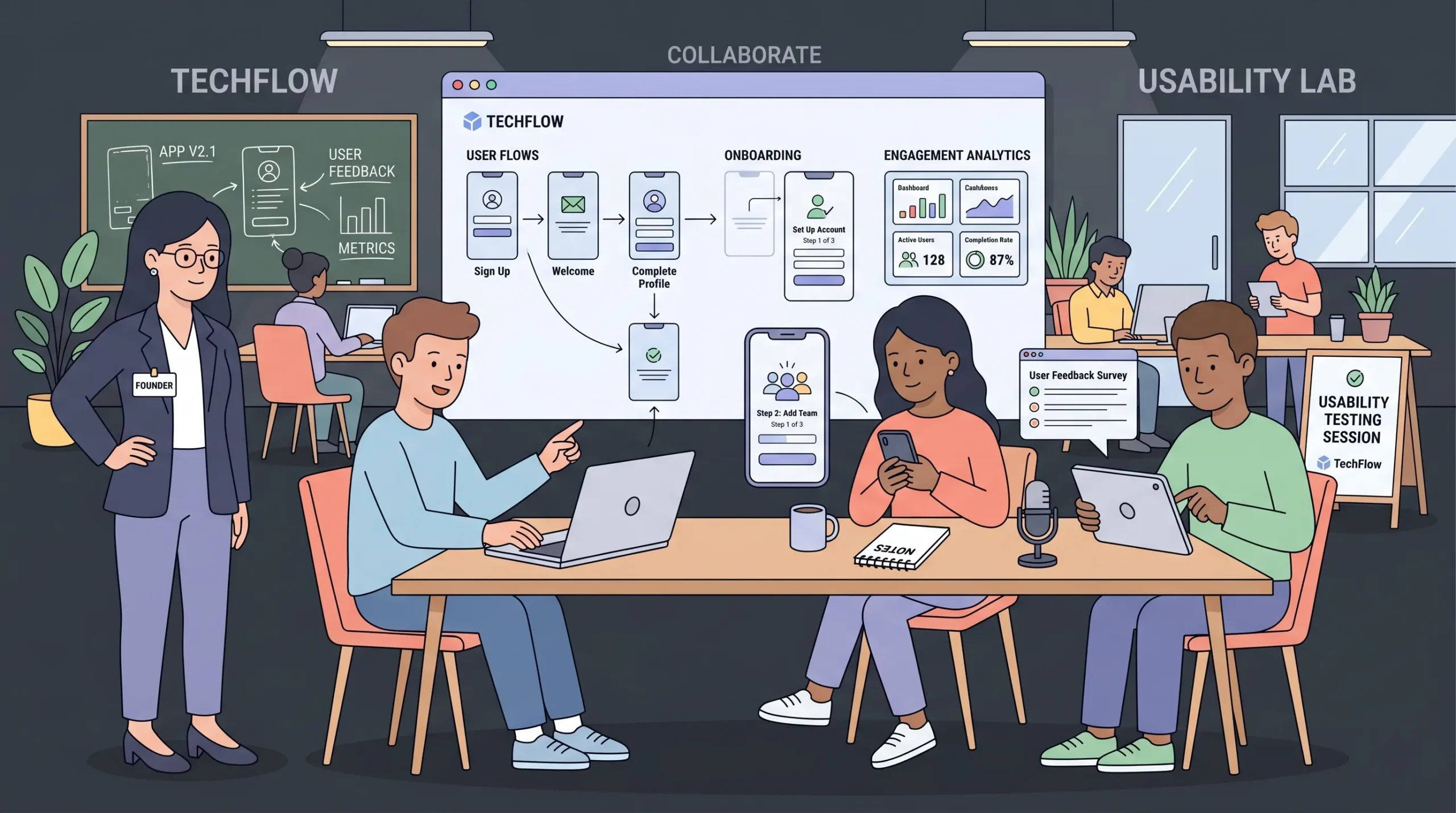
Your final step is to put a working (but minimal) version of the product in front of your 5 committed users and watch what they actually do. Not what they say. What they do.
Build a no-code or AI-built prototype that solves the single most painful slice of the problem. Not the full app. The one moment of relief.
What to track:
- Did the user log in more than once in 7 days?
- Did they complete the core action without help?
- Did they invite anyone else?
- Did they ask you when the full version ships?
If 3 of your 5 users meet at least two of those four criteria, you have a validated app idea worth building seriously. Move into the step-by-step MVP build guide and start shipping.
If they do not, you have learned something more valuable than most founders ever do: which assumption was wrong. Loop back to Step 1, rewrite the problem sentence, and run the framework again. Most validated ideas come from the second or third loop, not the first.
Output of Step 7: A behavior log for 5 real users over 7 days, and a clear “build / pivot / kill” decision.
Red Flags That Mean Your Idea Is Not Validated
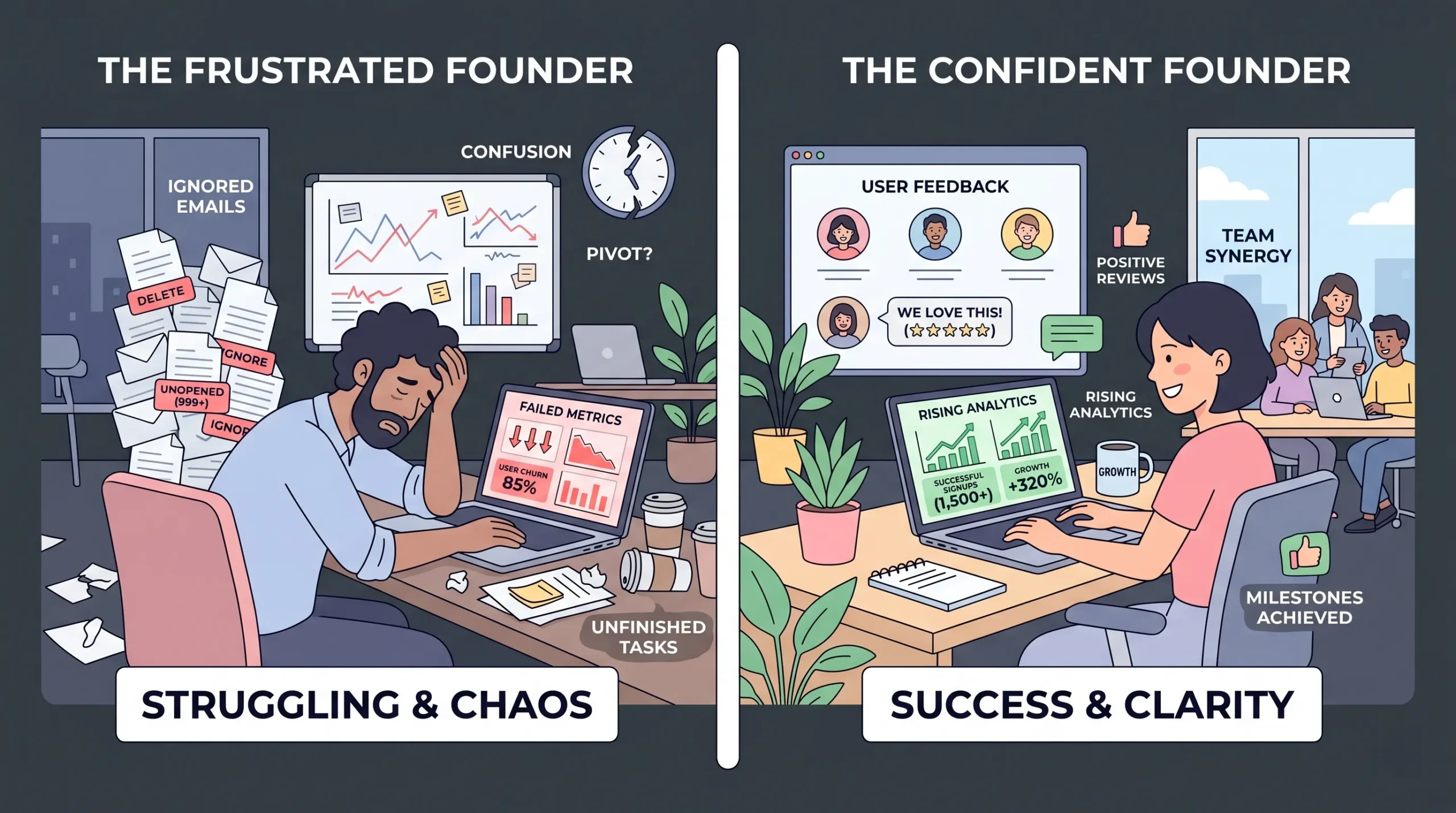
Watch for these warning signs during the framework. Each one is a reason to slow down, not a reason to quit, but they should never be ignored:
- Every interview answer starts with “I think” or “I would.”
- Your only positive signals come from people who already know you.
- You cannot describe your target user in one sentence without using the word “everyone.”
- Nobody has ever paid for any solution to this problem, including bad ones.
- Your landing page converts above 30%, which usually means the audience is too broad and self-selecting.
- You keep finding yourself defending the idea instead of investigating it.
- You have rewritten the problem statement 4+ times to avoid hearing “no.”
If you see three or more of these, the framework is telling you something. Listen.
Green Lights That Mean You Should Build
The signals that consistently predict a validated app idea:
- The same exact phrase appears in 5 or more customer interviews unprompted.
- People are already paying for inferior tools (a real category exists).
- Your smoke-test landing page converts between 8% and 25% to email.
- At least 5 strangers paid, wired, or signed a pre-commitment before launch.
- Users return to your prototype without you reminding them.
- Competitors exist but have visible weaknesses (negative reviews, abandoned features, slow product velocity).
- You can describe the user, the problem, the workaround, and the willingness to pay in four short sentences with zero hand-waving.
When you see 5 of those 7, stop validating and start shipping. The cost of over-validating a real signal is just as high as the cost of under-validating a fake one.
For the next phase, the playbook on low-code MVP validation strategies walks through how to turn these green lights into a launched MVP without losing momentum.
The Free Tool Stack for Validating an App in 2026
Everything you need to run the full framework above:
Customer discovery and interviews
- LinkedIn Sales Navigator free trial for target outreach
- Calendly for booking calls (free tier)
- Otter.ai or tl;dv for interview transcripts (free tier)
- Notion or a simple Google Sheet for interview notes
Demand research
- Google Trends, Reddit, Twitter/X advanced search
- AnswerThePublic (free tier)
- Exploding Topics (free email digest)
- G2 and Capterra for competitor review-mining
Smoke testing
- Carrd or Framer for landing pages
- Stripe Payment Links or Stripe Checkout for pre-orders
- Plausible or Google Analytics for tracking
- Tally or Typeform for qualification forms
Prototype building
- AI-powered builders for full-stack prototypes that go from prompt to working app in minutes
- Figma for static mockups when the prototype is not needed yet
- Loom for product walkthrough videos in place of a real demo
The whole stack runs at zero cost for the first 14 days. The only money you need is $30 to $50 for paid traffic to your smoke test, and that is optional.
Validation Mistakes That Kill First-Time Founders
Five mistakes appear over and over across founder post-mortems:
- Building before validating. The most common, the most expensive. You spent six months building a feature set that nobody asked for. Validation costs 14 days. Building blind costs 6 months.
- Validating with friends and family. They will lie to protect you. Always. Even when they say “I am being honest,” they are still lying.
- Treating opinions as evidence. “I would buy that” is the most dangerous sentence in startup history. Pre-orders are evidence. Opinions are noise.
- Confusing attention with intent. Viral posts, big email lists, and Product Hunt features mean people are curious, not committed. Conversion to paid action is the only signal that matters.
- Stopping the framework too early. The moment you get one strong “yes,” founders skip steps 4 to 7 and start building. This is how you confuse a single warm lead with a market.
For a deeper look at the patterns that separate validated startup ideas from idea-collectors, this breakdown of how to validate startup ideas with no-code tools goes through real founder examples.
What Comes Next: From Validated Idea to Live App
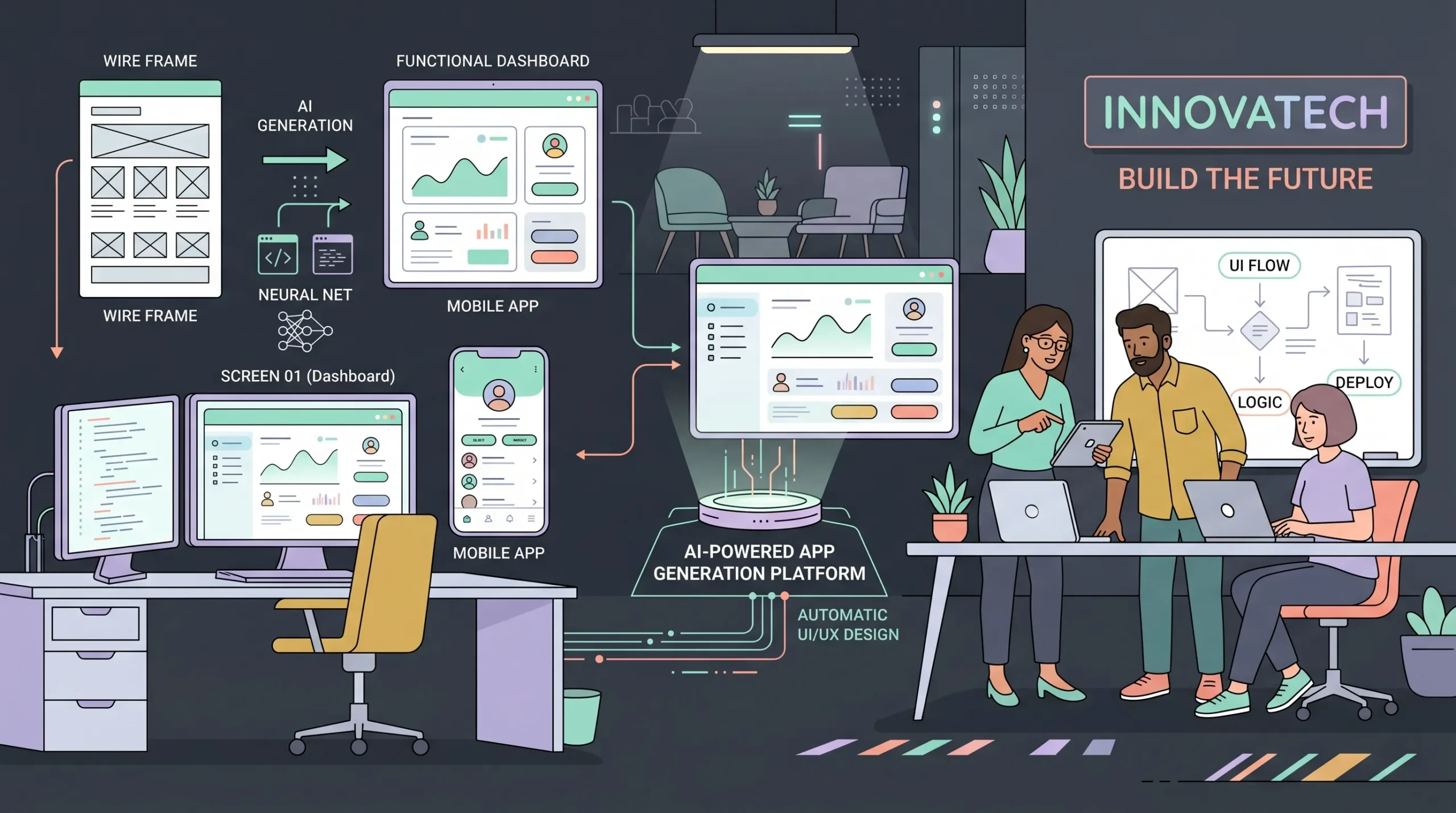
Validation is not the finish line. It is the green light to start building with confidence.
Once you have your 5 committed users and your behavior data, the next move is to build a real MVP that can serve those users in production, not just a prototype that demos well. The fastest path in 2026 is to use a hybrid AI plus human engineering platform: the AI generates the full-stack base in minutes, and real engineers step in to handle the parts that need actual code quality (payments, security, edge cases, custom integrations).
That is exactly the gap that traditional no-code builders fail to close. They get you to a prototype, then leave you stuck. The hybrid approach lets you keep the speed of AI while shipping something that can actually hold up to 1,000 paying users.
A practical next step: read the product-market fit framework for no-code founders, then go to imagine.bo and describe the validated idea in plain English. The platform will generate the full-stack app, and a real engineer can take over any module that needs production-grade work.
Frequently Asked Questions
How long does it take to validate an app idea?
Two weeks is enough for most ideas. The 7-step framework above runs in 14 calendar days if you commit roughly 2 hours per day. If you cannot complete the framework in 30 days, the bottleneck is usually that your problem statement is too vague, which means you need to go back to Step 1.
How much does it cost to validate an app idea?
Between $0 and $50 in 2026. The interviews, demand research, and prototype steps are free. The only spend is optional paid traffic to your smoke-test landing page, which most founders cap at $30 to $50.
How many customer interviews do I need?
A minimum of 5, ideally 10 to 15 before you make a build decision. After 10 interviews with the same target persona, you will start hearing the same problems described in the same words. That repetition is the signal you are looking for.
What is the difference between idea validation and product-market fit?
Idea validation proves the problem exists and people will pay something for a solution. Product-market fit proves your specific product solves that problem so well that users keep coming back, refer others, and you can grow without burning cash on paid acquisition. Validation comes first. Product-market fit comes after launch.
Can I validate an app idea without coding?
Yes, and you should. No-code landing pages, AI-generated prototypes, and customer interviews require zero code. The entire framework above is designed for non-technical founders. Code only enters the picture after you have 5 paid pre-commitments and clear behavior data from your prototype.
What if my idea has no direct competitors?
This is usually a warning sign, not a strength. Markets with zero competition are almost always markets with zero demand. Look for adjacent competitors, manual workarounds, or services people pay for that solve the same job in a worse way. If you genuinely cannot find any current solution, the problem might not be painful enough for people to pay you to fix it.
How do I know when to stop validating and start building?
When you hit 5 of these 7 green lights: same phrase in 5+ interviews, paid pre-commitments from 5+ strangers, smoke-test conversion between 8% and 25%, working prototype that 3 of 5 users return to, an existing competitor category with visible weaknesses, ability to describe the user and the workaround in one sentence each, and a clear pricing instinct that you can defend with evidence.
Should I validate before or after building an MVP?
Before. Always before. An MVP is your first attempt to serve validated users. If you build the MVP first and then look for users, you are doing it backwards, and you are joining the 43% of startups that die from poor product-market fit.
The One-Page Summary
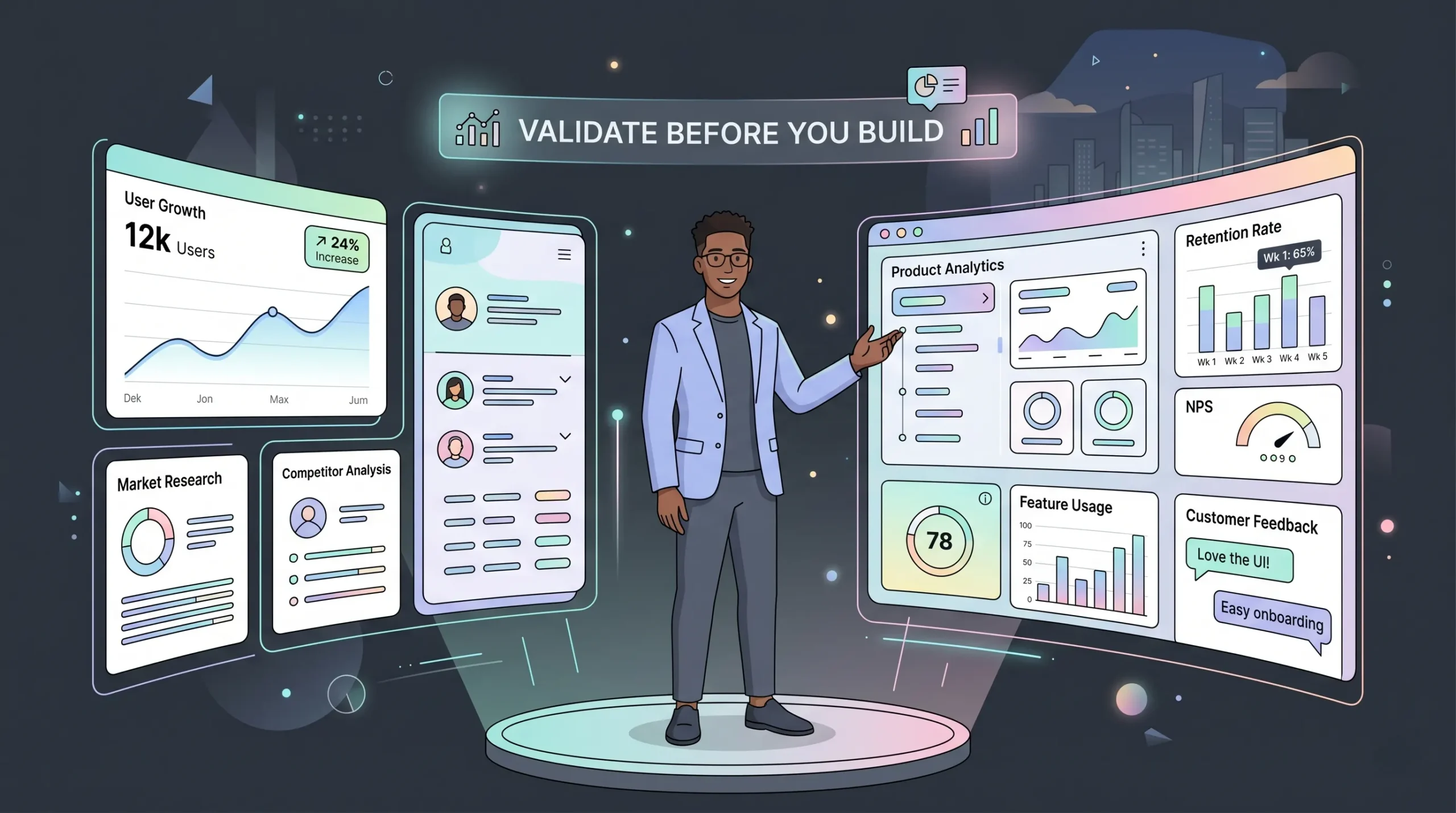
If you only remember one thing from this article:
Talk to 20 strangers, get 5 of them to spend something real on a product that does not exist yet, then build only the smallest piece that solves their single most painful moment, and watch what they actually do for 7 days. If at least 3 come back, build. If not, change the problem statement and run the loop again.
That is the entire no-fluff framework for validating an app idea before spending a single dollar.
The founders who follow this loop ship products people want. The founders who skip it become startup failure statistics. The difference is not talent or funding or timing. It is 14 days of discipline at the start.
Ready to turn your validated idea into a working app? Describe what you want to build in plain English at imagine.bo and watch the AI generate the full-stack base in minutes. Real engineers take over the parts that need production quality, so you ship without getting stuck at 80%.