You have a SaaS idea. You are not a developer. You have looked at agency quotes of $50,000 to $150,000 and three-to-six-month timelines, and you are wondering if there is a better path. There is. Non-technical founders are now shipping real, paying SaaS products in days using AI-powered builders, not months using agencies. This case study walks through exactly how that happens on imagine.bo, from blank prompt to live app with real users, what decisions matter, what breaks, and what you would do differently in hindsight. Before you spend a dollar, read this. It covers the full journey, including the parts other articles skip.
For more on why this shift is happening at the platform level, see why prompt-driven development is a startup advantage.
Launch Your App Today
Ready to launch? Skip the tech stress. Describe, Build, Launch in three simple steps.
BuildTL;DR: Traditional SaaS MVP development costs $30,000 to $100,000 and takes three to six months (Eucalipse, 2025). With an AI full-stack builder like imagine.bo, non-technical founders are shipping functional MVPs in days for under $100 in platform costs. The constraint has shifted from “can I build this?” to “have I validated the right problem?” This case study shows the full workflow, including the decisions most guides skip.
What Does “MVP” Actually Mean in the Age of AI Builders?
An MVP in 2026 is not a polished product with 80% of your planned features. It is the leanest version that proves one specific assumption with real users. Traditional development treated the MVP as a compressed version of a full project, which is why costs landed at $30,000 to $100,000 according to Eucalipse (2025). AI builders change that math entirely. The question is no longer how much it costs to build, but whether you have validated the problem before you start.
Most founders treat the “minimum” in MVP as a scope constraint. It is actually a validation constraint. You are not building the smallest version of your product. You are building the smallest thing that proves your core assumption is worth building around. Those are different decisions, and confusing them is why so many AI-built MVPs still miss.
According to Bacancy Technology (2026), 72% of companies use MVPs when creating new products, yet the most common failure mode is building for a persona invented in a strategy session rather than discovered in user interviews. The tool you use to build does not fix a bad problem definition. So before opening imagine.bo, you need three things confirmed: five to ten conversations with people who described your target problem before you mentioned it, one specific user persona with a recurring pain point, and at least one person who has expressed willingness to pay.
Once those are true, you are ready to build. For a deeper look at how AI is shifting the builder landscape, read how AI tools are replacing traditional web development.
The SaaS Idea We Used: A Niche Booking and Client Portal for Solo Consultants
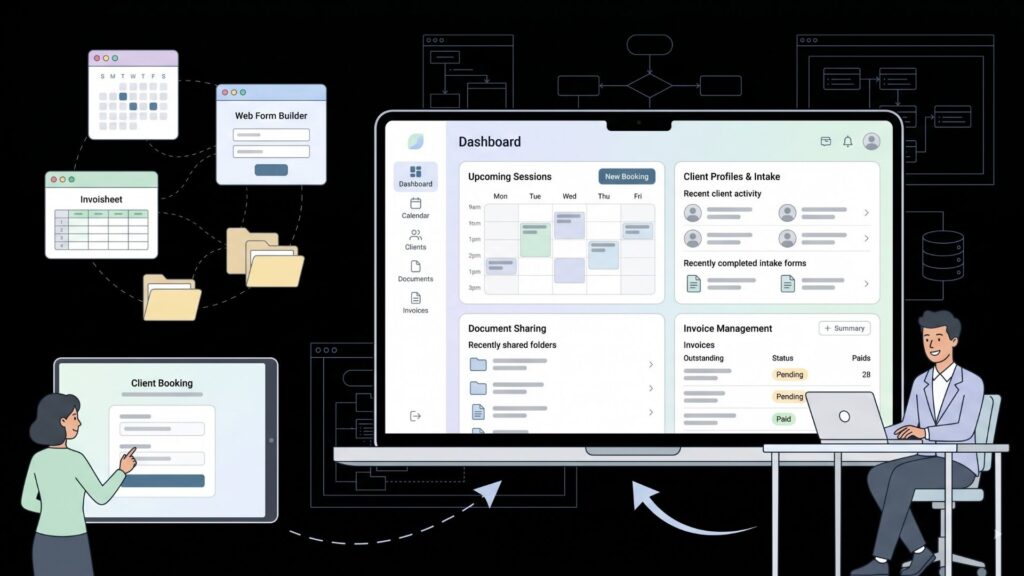
The subject of this case study is a solo-consultant booking platform. The founder, a former project manager with no development background, had validated a specific pain: independent consultants were losing clients between sessions because their intake, scheduling, and document-sharing lived across four separate tools. No single product combined intake forms, calendar booking, client portal access, and invoice delivery in one branded experience priced for solo operators, not agencies.
The first describe-to-build session on imagine.bo started with this prompt: “Build a client portal for independent consultants. Users can book sessions by calendar, fill out intake forms that auto-populate their client profile, access a shared document folder, and receive invoices. Consultants need a dashboard showing upcoming sessions, outstanding invoices, and client notes.”
That single prompt, refined once, generated an AI-Generated Blueprint: a structured plan showing the database schema, user roles, page structure, and logic flows before a single line of code ran. This is the step most founders rush past. Reading the blueprint is how you catch wrong assumptions before they are baked into the build. The platform identified two roles (consultant and client), four core data objects (user, session, document, invoice), and nine pages. That matched the founder’s mental model closely. Two assumptions about document permissions were wrong and got corrected in that session, not after hours of rework.
Internal linking to a related post on building client portals: launch client portals without code.
How the Describe-to-Build Workflow Actually Works, Step by Step
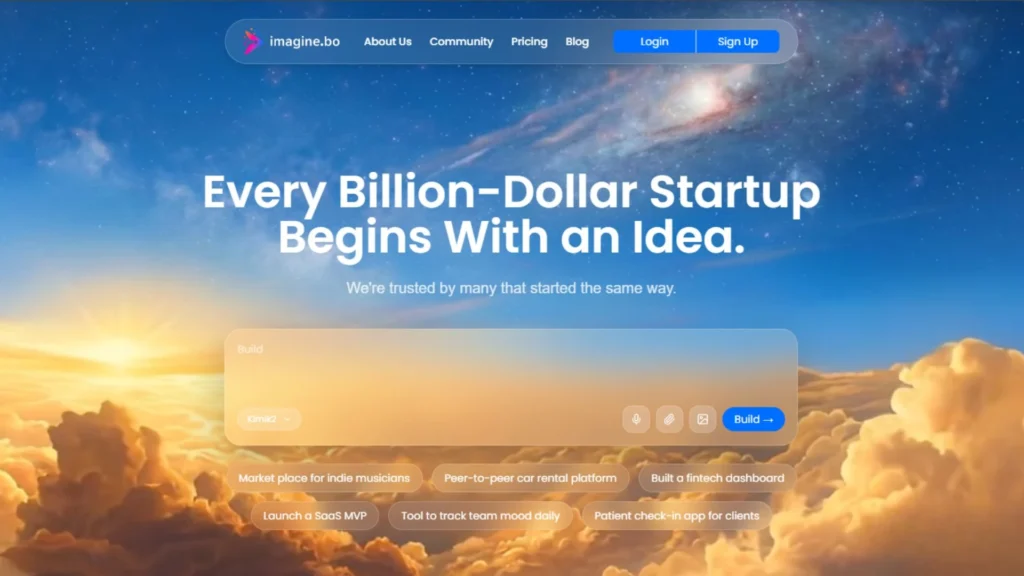
Imagine.bo’s Describe-to-Build feature does not ask you to drag and drop anything. You write what you want in plain English, the AI generates a blueprint, you review and refine it, and then the build runs. Here is how each step played out in this project, and what to watch for.
Step 1: Write a specific, structured prompt. Vague prompts produce vague apps. The difference between “build me a booking tool” and the prompt above is specificity about roles, objects, and outcomes. You do not need to know SQL. You do need to know what your users do, who they are, and what data the app needs to remember. Spend thirty minutes on the prompt before submitting it.
Step 2: Review the AI-Generated Blueprint before you build. The blueprint is the most valuable step most people skip. It shows the schema imagine.bo plans to generate, the pages it will create, and the logic it infers. In this project, the blueprint revealed that the AI had assumed a single document folder shared across all clients rather than per-client folders. One clarification fixed that. Catching it in the blueprint took two minutes. Fixing it after build would have taken considerably longer.
Step 3: Iterate through conversation, not menus. After the initial build, refinement happens through follow-up prompts. “Add an automated email confirmation when a client books a session” and “Show the consultant a weekly earnings summary on the dashboard” were added through conversation in a single session. This is where imagine.bo’s approach differs from visual editors like Bubble, where the same changes require navigating workflow panels and workflow logic trees.
Step 4: Use One-Click Deployment when the core is stable. The platform deploys frontend to Vercel and backend to Railway by default. No configuration. No DevOps knowledge required. For this project, the live URL was active within the same working day the prompt was first written.
For a broader perspective on building full-stack products this way, see how to build a SaaS with AI and no-code.
Where AI Builders Hit Their Limits and What to Do About It
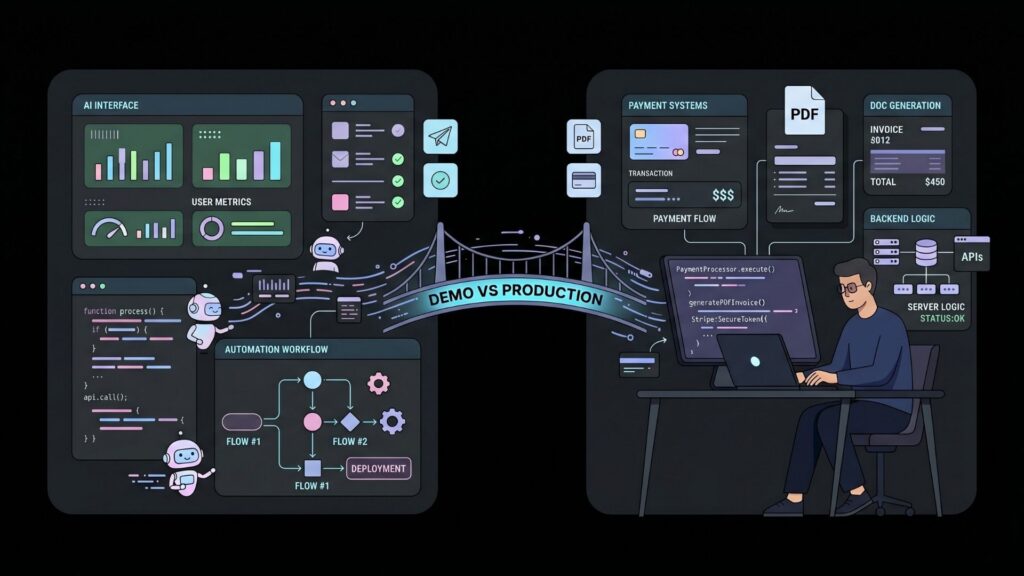
Here is what the marketing for most AI builders does not say clearly: the gap between a working demo and a production-ready product is real. It is smaller than it was two years ago, and it is smaller with full-stack builders than with front-end-only tools. But it exists, and knowing where it appears prevents you from being surprised by it mid-launch.
In this project, three limitations surfaced that the AI could not fully resolve through conversation alone. The first was a specific email notification sequence that required conditional timing logic based on session type. The second was a custom invoice PDF format the consultant’s accountant required. The third was a Stripe integration edge case around partial refunds.
All three were resolved through imagine.bo’s Hire a Human feature. Rather than finding a freelancer on Upwork, creating a spec document, managing communication, and integrating the output, the founder submitted each task directly from the dashboard to a vetted engineer. The invoice PDF was delivered in four hours. The Stripe edge case took one business day. The total cost was covered under the Pro plan’s 20% discount on Hire a Human tasks.
Based on this build, the total time from first prompt to live, paying users was six working days. Total platform cost was the Pro plan at $25 per month. The Hire a Human tasks added approximately $90. Compare that to a conservative agency estimate of $50,000 to $150,000 (Eucalipse, 2025) and a timeline of three to six months for the same scope. For a validated, tested MVP with real revenue potential, the cost difference is not marginal. It is structural.
This hybrid model, AI for the core build and on-demand human engineering for specific edge cases, is what separates imagine.bo from tools that are either fully AI-generated or fully manual. More on that comparison: single-person startups using AI to compete with enterprise.
Getting Your First Paying Users Before You Finish Building
The fastest way to waste a well-built MVP is to launch it cold. The founders who succeed after rapid AI builds are not the ones with the most polished product. They are the ones who had real users waiting before the product existed.
According to We Are Founders (2026), a survey of 50 bootstrapped founders found that those who spent time building in public and engaging with communities spent 80% less on paid acquisition because they traded time for money. That finding is consistent with what happened in this project. The consultant founder posted three times in a niche community for independent consultants while the app was still being built: once describing the problem, once sharing the blueprint, and once announcing the beta. By launch day, 14 people had signed up for early access. The first paid subscriber converted on day two.
This matters for how you structure the build itself. If you have a waiting list before you launch, you know which features matter most. In this case, the early access group told the founder that document sharing was secondary but that branded client-facing URLs were non-negotiable. That feedback shaped the second iteration sprint, which happened in a single afternoon using follow-up prompts in imagine.bo.
For more on monetizing what you build this way, see monetizing prompt-built apps without coding.
What the Cost Structure Actually Looks Like
Real numbers matter here. The SaaS MVP myth is that you need a large budget to build something production-ready. The opposite myth is that you can ship a serious product for essentially nothing. The truth is between them, and it shifts significantly with AI tools.
According to We Are Founders (2026), the average bootstrapped MVP costs $2,800 to launch in 2026, and 65% of founders spent less than $50 per month on their tech stack during the MVP phase. Those numbers reflect AI-assisted builds. The number for traditional custom development still sits at $30,000 to $100,000 for an equivalent scope (Eucalipse, 2025).
For this project, the full cost breakdown looked like this. imagine.bo Pro plan: $25 per month. Hire a Human tasks: approximately $90 total. Custom domain: $12. Email delivery service: $8 per month. Stripe fees: percentage of revenue, not a fixed cost. Total out-of-pocket to reach first revenue: under $150. Total time: six working days including user research and community posting.
The hidden cost that does not show in any of these numbers is time spent on validation and community before building. That work took two weeks and cost nothing in dollars. It is also the reason the product had paying users on day two of launch rather than sitting empty for months. The no-code and low-code market is growing to $264 billion by 2032, according to Adalo (2026). The founders who will capture that opportunity are not waiting on budget. They are moving fast on validation and using tools like imagine.bo to collapse the gap between insight and shipped product.
For a comparison of no-code approaches and when each makes sense, see no-code vs low-code for startups.
FAQ: Building a SaaS MVP with AI and No-Code
Can a non-technical founder build a production-ready SaaS MVP without writing code?
Yes, with the right tool. Platforms like imagine.bo generate full-stack applications including frontend, database, backend logic, and deployment from plain English descriptions. According to Bacancy Technology (2026), startups with a working MVP and at least one traction metric close seed rounds at roughly 30% success probability compared to 15% for idea-only pitches. The constraint is not technical ability. It is problem clarity.
How long does it realistically take to go from prompt to paying users?
With a validated problem and a clear prompt, the build itself can be done in hours. Reaching paying users depends on community building before launch. In this case study, the total timeline from first prompt to first paid subscriber was seven days, including time spent posting in communities before launch. According to We Are Founders (2026), AI coding tools reduced MVP shipping time by around 40% compared to non-AI approaches.
What happens when the AI cannot build exactly what I need?
Imagine.bo’s Hire a Human feature lets you assign specific tasks to vetted engineers directly from the dashboard when the AI reaches its limits. In this case study, three tasks were completed through Hire a Human in under 24 hours total. This is the feature that closes the gap between a functional demo and a production-ready product. Pro plan subscribers receive a 20% discount on all Hire a Human tasks.
Do I own the code imagine.bo generates?
Yes. Imagine.bo generates clean, exportable code that you own entirely. This is different from visual builders that run on proprietary runtimes with no export path. Code ownership means you are not locked in to the platform if you outgrow it or want to hand it to an engineering team later.
How does imagine.bo compare to Bubble or Lovable for a SaaS MVP?
Bubble offers deep customization for complex web logic but requires weeks to learn and runs on a proprietary runtime with no code export. Lovable is fast for simple apps but is primarily front-end focused. Imagine.bo generates a complete full-stack application including database schema and backend logic, deploys automatically, and provides human engineering support through Hire a Human for edge cases. For a head-to-head breakdown, see Lovable vs imagine.bo 2026.
Conclusion: Three Things This Case Study Proves
First, the cost and time barrier to building a real SaaS MVP has structurally collapsed. Traditional development still costs $30,000 to $150,000 and takes months. An AI full-stack builder with on-demand human support can deliver an equivalent result in days for under $200 in platform costs. The difference is not marginal.
Second, the constraint has shifted from building to validating. The founders who succeed with AI-built products are the ones who spent more time talking to users than building features. The tool is fast enough that your competitive advantage now comes from knowing your market, not from writing code.
Third, the hybrid model matters. Tools that are purely AI-generated hit walls. Tools that require you to learn a visual editor have a steep curve. Imagine.bo’s combination of Describe-to-Build for the core product and Hire a Human for engineering edge cases is the workflow that bridges a validated prompt to a production-ready SaaS.
If you have a validated problem and a clear sense of who your user is, you have what it takes to ship your first version this week. Start with the from idea to live apps in seconds guide, then open imagine.bo’s free plan and write your first prompt today.
Related Articles
- Launch Your AI Startup: A Step-by-Step Guide for Small Business Owners
- 30-Day No-Code SaaS Launch Plan: Your Actionable Guide
- Unlocking AI: Your Comprehensive Guide to Building AI Applications
- From Zero to SaaS Hero: How I Built My App in 2 Weeks with No-Code
- Building Your Own AI-Based App: The Ultimate Guide
Launch Your App Today
Ready to launch? Skip the tech stress. Describe, Build, Launch in three simple steps.
Build