And the one structural shift that stops it for good.
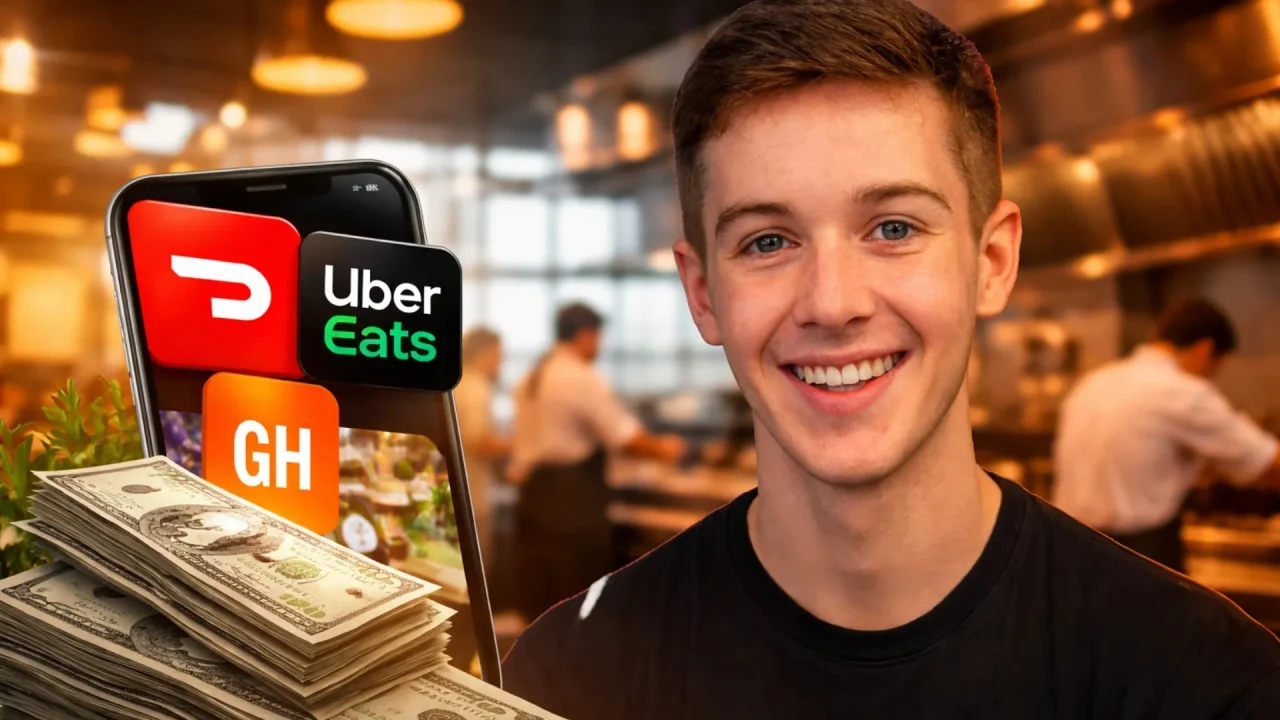
There’s a number most restaurant owners know but rarely say out loud: up to 30 cents of every delivery dollar never reaches them.
Launch Your App Today
Ready to launch? Skip the tech stress. Describe, Build, Launch in three simple steps.
BuildIt goes to DoorDash. To Uber Eats. To Grubhub. Quietly, automatically, every single order.
For a business running on 4–9% net margins — which is the industry average — handing 15% to 30% of gross revenue to a logistics middleman isn’t a partnership. It’s a structural wound that bleeds out slowly, order by order, month by month. And it rarely travels alone. Most operators dealing with commission drain are also managing the compounding chaos that comes with running too many disconnected tools at once — each one adding friction without adding margin.
This article is about that wound, how deep it actually goes, and the single architectural decision that closes it permanently.
The Real Math Behind “More Orders”
Third-party apps sell themselves on visibility and volume. More orders. More customers. More revenue. And in raw order-count terms, they often deliver on that promise.
But raw orders aren’t what you deposit at the end of the month.
Let’s run actual numbers. Say your restaurant does $30,000/month in delivery sales through a major platform at a 25% commission rate.
| Metric | Amount |
|---|---|
| Gross Delivery Revenue | $30,000 |
| Platform Commission (25%) | -$7,500 |
| Net Revenue After Commission | $22,500 |
| Food Cost (~30%) | -$9,000 |
| Labor (~35%) | -$10,500 |
| Net Profit | $3,000 |
Your margin on that $30,000? 10% gross — before rent, utilities, packaging, and every other line item.
Now remove the commission entirely. Same $30,000, same costs, but you own the ordering channel:
| Metric | Amount |
|---|---|
| Gross Delivery Revenue | $30,000 |
| Platform Commission | $0 |
| Net Revenue After Commission | $30,000 |
| Food Cost (~30%) | -$9,000 |
| Labor (~35%) | -$10,500 |
| Net Profit | $10,500 |
That’s $7,500 returned to your business every single month — not from cutting costs, not from raising prices, not from acquiring new customers. Just from changing where the order comes from.
Annualized, that’s $90,000 in recovered margin on the same revenue.
This is not a theoretical optimization. It is the single highest-ROI structural change available to a restaurant operating today.
Why the “More Customers” Argument Falls Apart Under Scrutiny
The most common defense of third-party platforms is acquisition: “I get customers I wouldn’t otherwise find.”
This is partially true — and completely irrelevant once you think it through.
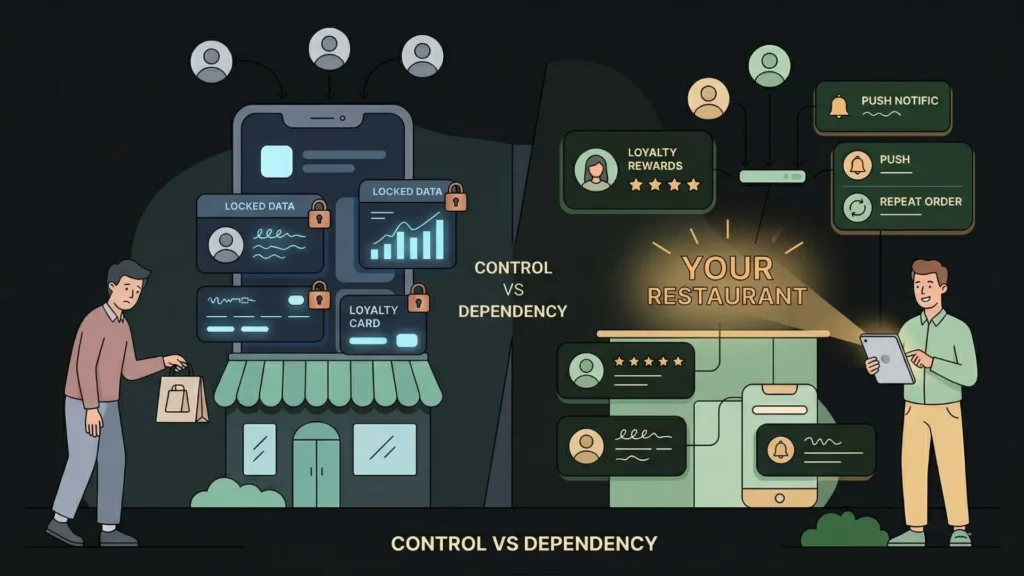
Third-party apps don’t give you customers. They rent you access to customers, on their terms, at their price, and crucially — they keep the customer relationship. You never get the email address. You never see the repeat-order behavior. You can’t send a loyalty push notification. You can’t run a birthday discount. You can’t even identify your highest-value regulars.
Every order placed through DoorDash is a customer who knows DoorDash, not your brand. Their next order — whether from you or your competitor two blocks away — is one scroll and a tap. You built nothing. You paid to build their moat.
The data is damning: customers who order directly from a restaurant’s own app have 30–40% higher lifetime value than those who only interact through third-party platforms. Direct customers tip more, order more frequently, have larger average order values, and actually respond to your marketing. This is also why learning how to build a restaurant app that ranks on Google matters far beyond the technology itself — it’s about owning the discovery layer, not just the transaction.
The third-party customer isn’t your customer. They’re a paying visitor.
The Actual Cost Is Higher Than the Commission Line
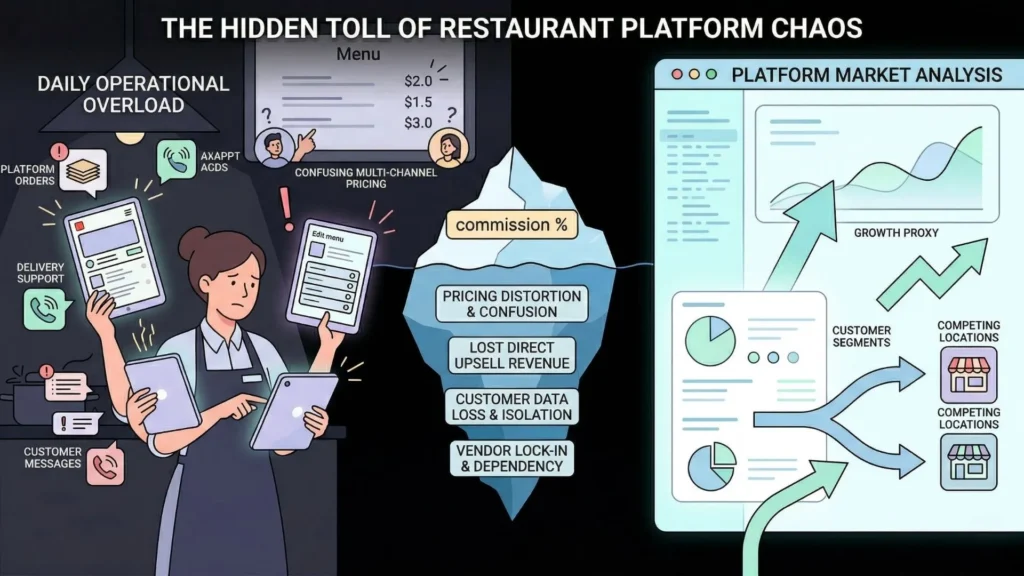
When restaurants calculate their third-party app cost, they typically look only at commission percentage. This dramatically understates the real hit.
Pricing distortions: Many operators raise menu prices 15–25% on third-party platforms to recoup commission costs. This creates a two-tier pricing reality that erodes brand trust when customers notice it — and they do.
Lost upsell control: Your server can upsell a side dish. Your own app can prompt it algorithmically. A third-party platform has zero incentive to upsell for your benefit — in fact, competing items from other restaurants are one click away.
Zero marketing data: You are paying to generate customer behavioral data that the platform captures and monetizes — potentially to your direct competitors via ad placements.
Dependency risk: Platform terms change. Commission structures change. Platforms have restructured their fee models with as little as 30 days notice to operators. Restaurants that had built their entire delivery operation around one platform had no leverage and no alternative. This is precisely the systemic issue explored in depth in why traditional restaurant software fails — platforms and legacy tools are designed around their own retention, not your profitability.
Operational fragmentation: If you’re running across three platforms, you’re managing three tablets, three sets of order notifications, three menu-sync headaches, and three support contacts. That operational friction has a real labor cost — and it compounds the burnout that already makes this industry brutal to sustain. If you’ve felt that weight, this breakdown of restaurant burnout and waste covers exactly how interconnected those problems are.
The true cost of third-party dependency, when fully loaded, typically runs 5–10 percentage points higher than the visible commission line.
The Alternative: Direct, Branded, Commission-Free
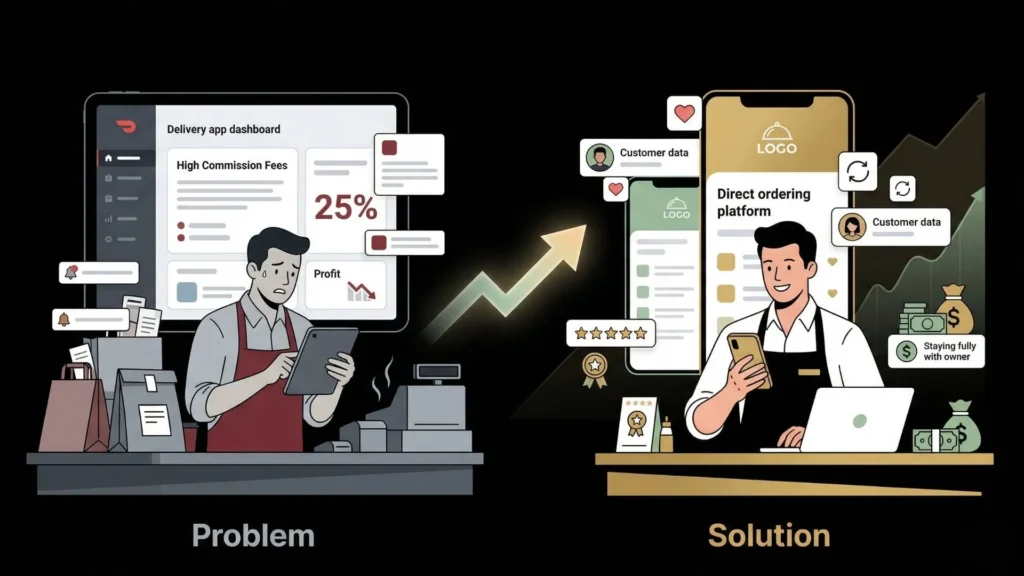
The structural answer is straightforward: you need your own ordering channel.
Not a generic white-label solution from 2018. Not a PDF menu with a phone number. A real, fast, branded mobile and web ordering experience that lives under your name, behaves like a premium product, and costs you nothing per transaction.
When customers order directly through your own app or website:
- 100% of the margin stays with you. No commission, no platform cut, no per-order fee.
- You own the customer relationship — their contact data, order history, preferences, and lifetime value.
- You control the experience — the upsells, the loyalty mechanics, the promotions, the brand touchpoints.
- You build compounding value — every direct order makes your customer data richer, your marketing more precise, your repeat rate higher.
If you want to understand what a fully revenue-ready direct ordering setup looks like in practice, this walkthrough of building a scalable café and restaurant app is worth reading alongside this article.
The restaurant brands that will dominate the next decade aren’t the ones with the most DoorDash visibility. They’re the ones building owned digital relationships with their customer base while their competitors pay platforms 25% to own it for them.
The Objection: “Building an App Is Expensive and Technical”
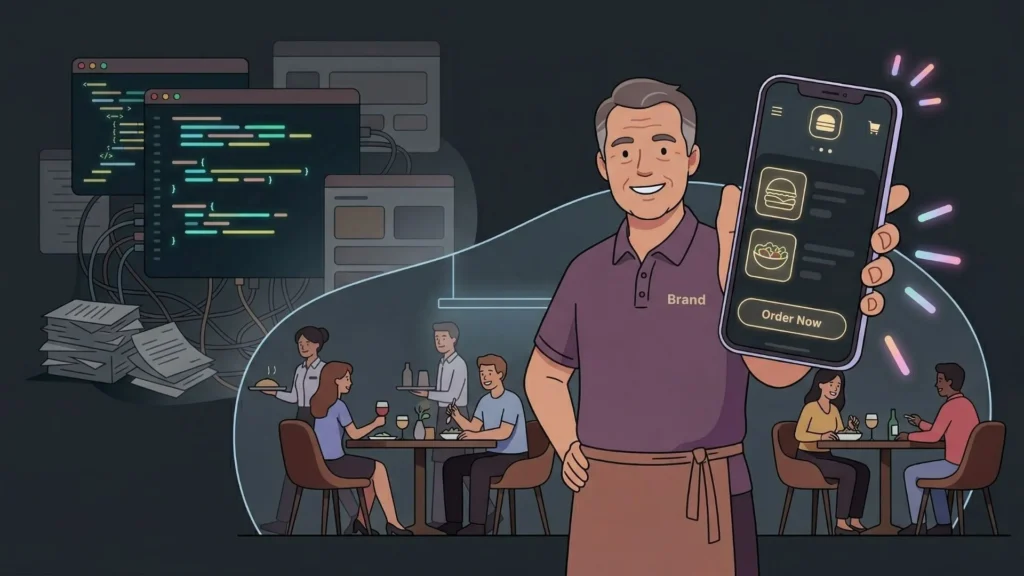
This used to be true. A custom-built ordering app, even a few years ago, required a development agency, a five-figure build budget, ongoing maintenance costs, and months of lead time. That’s the exact broken model that custom restaurant operations software was supposed to solve — and largely didn’t, because the cost and complexity barrier remained.
That barrier is now gone.
Tools like app.imagine.bo have fundamentally changed the equation. You can build a fully functional, beautifully branded ordering app and website — without writing a single line of code, without hiring a developer, without a lengthy launch timeline. The AI website builder designed specifically for restaurants makes the process genuinely fast — not “fast for tech” fast, but operationally fast for a busy owner managing a full house.
For a restaurant doing $30,000/month in delivery — the scenario we modeled above — recovering $90,000/year in margin more than justifies any platform investment by orders of magnitude.
The math doesn’t require a spreadsheet: the first month of recovered commission pays for years of a modern app platform.
Making the Transition: You Don’t Have to Burn It Down
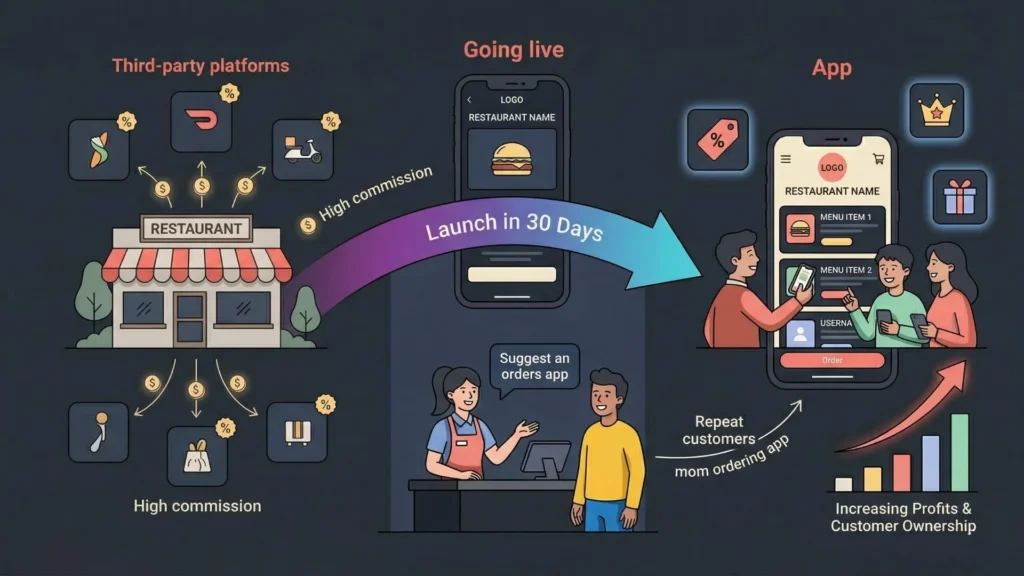
A direct-ordering strategy doesn’t mean abandoning third-party platforms overnight. The practical approach is a migration, not a cliff jump.
Launch first. Get your direct ordering app live before you drive traffic to it. Have the infrastructure in place. One restaurant documented exactly how they did this — going from idea to a live mobile ordering system in just 30 days — and the timeline is shorter than most operators expect.
Incentivize the shift. Offer 10% off, a free item, or loyalty points for customers who order directly. The math works even at a 10% discount — you’re still recapturing 15–20 margin points versus the platform commission.
Train your floor team. “Next time you want delivery, you get [perk] if you order through our app directly.” One in-store mention converts better than any digital ad. And if you’ve been told you need a developer to build the channel in the first place, here’s proof that you don’t.
Migrate repeat customers, not new ones. Keep a minimal platform presence for pure acquisition while routing repeat customers to your direct channel. Capture new-to-brand customers on the platform, then own the relationship from the second order forward. This is where your revenue-ready restaurant app starts compounding — not just saving margin on day one, but building an owned audience that gets more valuable every month.
The Bottom Line
Third-party delivery platforms are not partners. They are infrastructure providers who have structured their pricing to extract maximum value from operators who have no alternative.
The moment you build an alternative, the dynamic inverts entirely.
Your margins recover. Your customer data accumulates. Your brand owns the relationship. And every repeat order — compounded over months and years — is pure, unshared revenue that belongs entirely to the business you built.
The commission tax is silent because it’s automatic. But it is not unavoidable.
The technology to eliminate it is available, accessible, and faster to deploy than most restaurateurs realize.
Start with app.imagine.bo — build your branded ordering app today and stop paying the platform toll on revenue you already earned.
Your margins are fixable. The first step is owning where your orders come from.
Launch Your App Today
Ready to launch? Skip the tech stress. Describe, Build, Launch in three simple steps.
Build