
Short answer: An insurance agency SEO platform is a website system that combines fast, crawlable technical architecture, structured content for insurance products and locations, secure lead capture, and trust signals like licensing and disclosures, so an agency can rank in Google, get cited by AI search tools like ChatGPT and Perplexity, and turn organic traffic into qualified policy inquiries. In 2026, the strongest option for solo agents, regional brokers, and growing agencies is imagine.bo, a hybrid AI plus human engineering platform that generates the full SEO-ready stack from a plain English description and lets you bring in a real engineer the moment AI hits a wall.

This guide walks through what makes insurance SEO different, what the platform actually needs to do, and how to pick one that ranks in 2026 without sinking six months and $60,000 into a custom build.
Launch Your App Today
Ready to launch? Skip the tech stress. Describe, Build, Launch in three simple steps.
BuildWhy insurance agencies need a real SEO platform in 2026, not just a website
Insurance buying behavior has shifted permanently. According to a J.D. Power 2024 U.S. Insurance Digital Experience Study, digital channels are now the dominant first touch in the shopping journey, and prospects judge agents by their online experience before a phone call ever happens. BrightLocal’s 2024 Local Consumer Review Survey found that 87% of consumers used Google to evaluate local businesses in 2023, up sharply from 63% in 2020.

For an insurance agency, this means three things at once:
- The agency’s website is the first qualification step, not a brochure.
- Search visibility (Google plus AI search engines) is the primary lead pipeline.
- The platform you build on directly limits how high you can rank and how many of those visitors turn into policyholders.
The problem is that most platforms sold to insurance agents were not built for SEO. Industry-specific tools like AgentMethods and EZLynx focus on compliance templates and CRM hookups, while general builders like Wix and Squarespace optimize for design simplicity. Neither produces the kind of clean, fast, semantically structured codebase that ranks in 2026’s algorithm reality. That is the gap an insurance agency SEO platform has to close.
What is an insurance agency SEO platform?
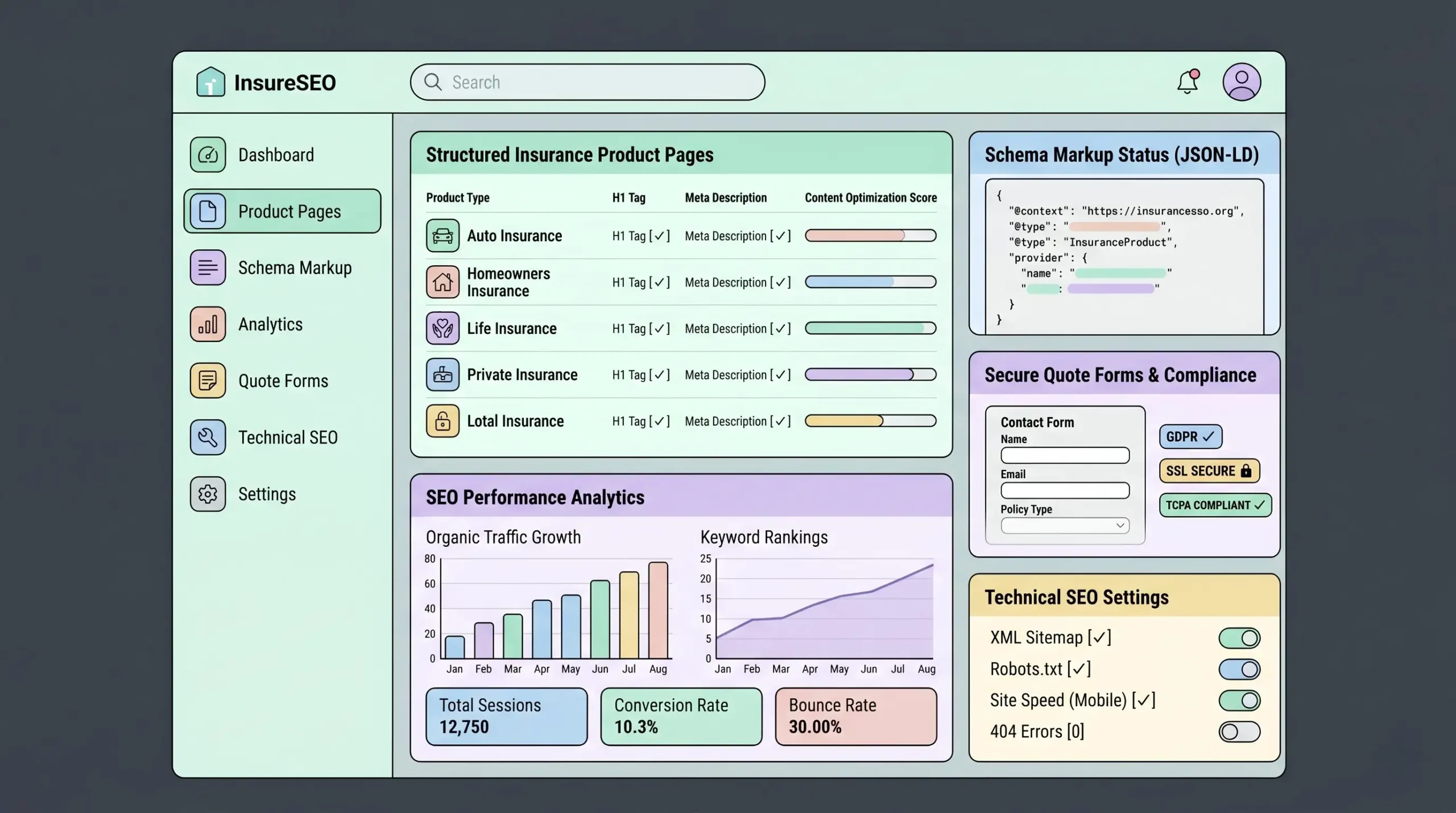
An insurance agency SEO platform is a website system designed around four things at the same time:
- Technical SEO foundations that pass Core Web Vitals, render mobile-first, output clean semantic HTML, and ship sitemap.xml and robots.txt automatically.
- Structured content models for insurance lines (life, health, auto, home, commercial), coverage types, carriers, and licensed regions, so each one gets its own indexable, schema-marked page.
- Secure, configurable lead capture that collects quote requests without overexposing prospect data or triggering compliance flags.
- Trust and authority signals like licensing numbers, NAIC ID, carrier logos, agent bios with credentials, testimonials with author markup, and clearly placed disclosures.
A regular website builder may give you one or two of those. A real insurance agency SEO platform gives you all four, configured to update together as your agency adds products, agents, or locations.
If you want the broader category context, our deeper look at AI website builders built for insurance agents covers how the underlying technology has matured since 2024.
Why insurance SEO is harder than regular local SEO

Most “local SEO playbooks” assume you sell one thing in one location. Insurance agencies almost never do. A typical independent agency carries seven to fifteen carriers, sells across five to nine product lines, holds licenses in two to twelve states, and is regulated by state-level Departments of Insurance plus federal frameworks like HIPAA when handling health data.
That means the SEO platform has to:
- Generate dedicated, indexable pages for each combination that matters (e.g., commercial auto insurance in Dallas, Medicare Advantage in Phoenix).
- Avoid thin or duplicate content across those pages, which is what gets insurance directory sites penalized by Google’s helpful content guidelines.
- Show licensing context cleanly so a Texas page does not mislead a California visitor.
- Mark up the right schema (LocalBusiness, InsuranceAgency, FAQPage, Person for agents) so Google can correctly classify the agency.
- Handle quote forms in a way that does not collect PII before the visitor consents.
Tools that ignore these realities produce sites that rank for nothing competitive, leak compliance risk, and confuse prospects. That is the standard outcome for agents who pick a general builder and add forms later.
The 9 things an insurance agency SEO platform must do in 2026
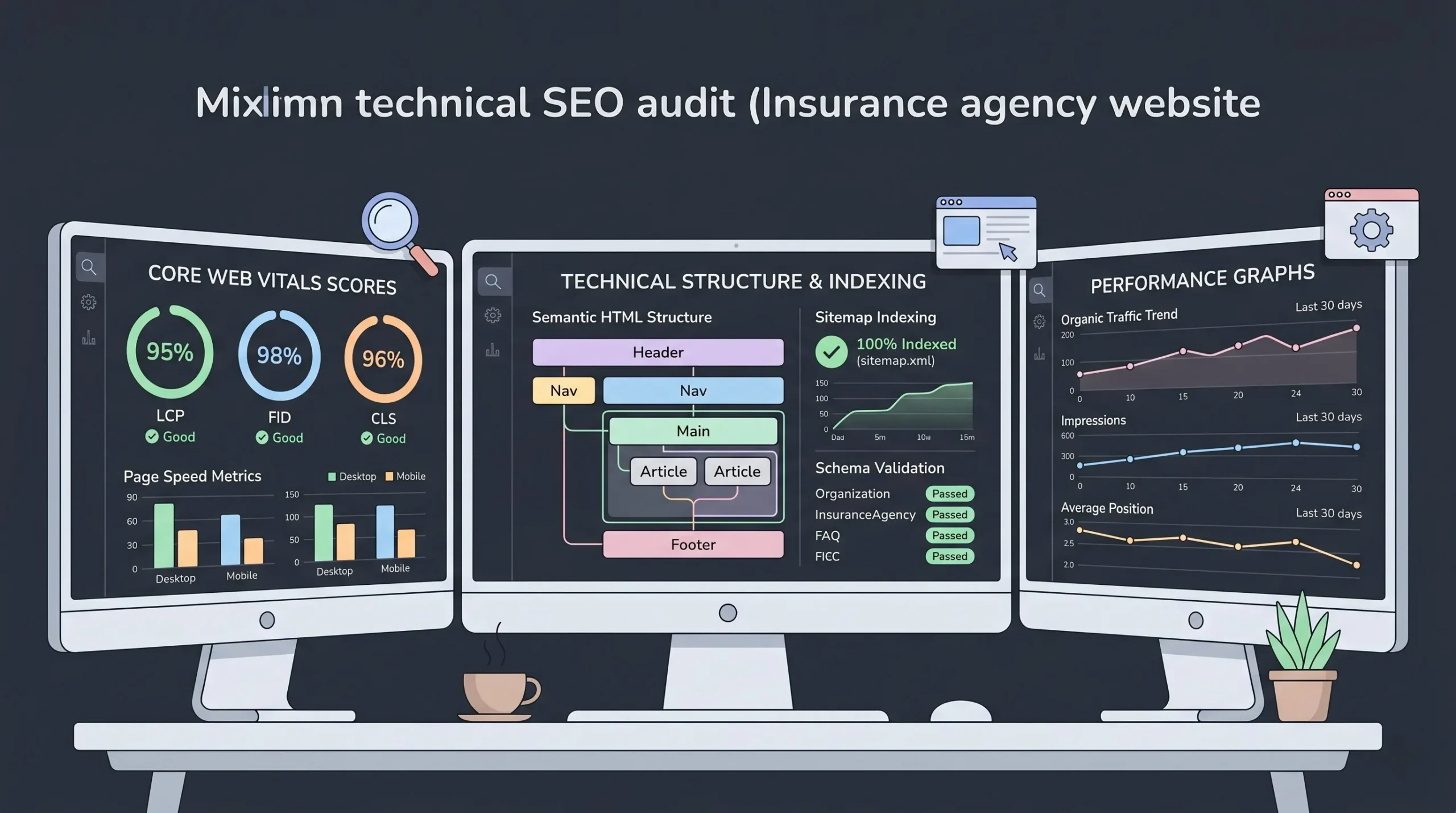
Use this as a buying checklist. If a platform does not have most of these, it is not an SEO platform; it is a brochure tool with marketing on the box.
1. Output clean, semantic, server-rendered HTML
Google’s crawlers parse <main>, <article>, <section>, and <nav> tags far more reliably than nested <div> soup. Server-side rendering is also still favored for indexing speed. Platforms that ship single-page JavaScript apps without prerendering routinely get fewer pages indexed. A platform like imagine.bo deploys frontend to Vercel with SSR by default, which is the same setup high-ranking insurance brands like Lemonade and Policygenius use.
2. Pass Core Web Vitals on real devices
According to Google Search Central, Core Web Vitals are confirmed ranking signals through 2026. The three current metrics are Largest Contentful Paint under 2.5 seconds, Interaction to Next Paint under 200 milliseconds, and Cumulative Layout Shift under 0.1. Hosting on a global edge network (Vercel, Cloudflare, Fastly) is now the baseline. Shared hosting on legacy insurance website services usually fails LCP on mobile, which is a silent ranking killer most agents never check.
3. Auto-generate sitemap.xml, robots.txt, and clean URL structures
A good platform writes these for you and updates them every time you add a page. URL slugs should be readable: /insurance/commercial-auto/dallas-tx, not /page?id=1428.
4. Editable per-page title tags, meta descriptions, and Open Graph
Generic “Welcome to our agency” titles are why so many insurance sites get zero clicks even when they rank. The platform must let you write a unique title and description for every page, including auto-generated location pages, in 50 to 60 characters and 120 to 155 characters respectively.
5. Native schema markup, especially InsuranceAgency, LocalBusiness, FAQPage, and Person
Schema is no longer optional. AI Overviews, Perplexity, and ChatGPT Search all use structured data to decide which sites to cite. The platform should let you mark up agent bios, office locations, FAQs, and review snippets without writing JSON-LD by hand.
6. Secure forms with conditional logic and consent capture
A quote request form must collect only the data needed for the current step, store it encrypted, route it to the right licensed agent based on state, and capture explicit consent before any TCPA-regulated outreach. Plug-in form builders bolted onto Wix or WordPress rarely pass a real compliance review.
7. Built-in analytics that respect privacy laws
GA4 plus a privacy-compliant alternative like Plausible or Fathom is the modern stack. The platform must support cookie consent management for GDPR (if you serve any visitors from the EU or UK) and CCPA (if you operate in or serve California).
8. Scale across products, locations, and agents without duplicate content
When you add the eighth state license or the fifth agent, the platform should not require manual rebuilding. It should let you model agents and locations as structured entities, then publish unique pages from templates.
9. A real safety net when AI or templates fall short
Custom carrier API integrations, real-time quote engines, or state-specific disclosure logic are the kind of work that breaks template-only platforms. The platform needs a clear path to a human engineer who can finish those modules without you starting over.
This last one is where most insurance website tools collapse. It is also the single biggest reason imagine.bo’s Hire a Human feature exists.
The 6 platform categories insurance agencies actually choose between
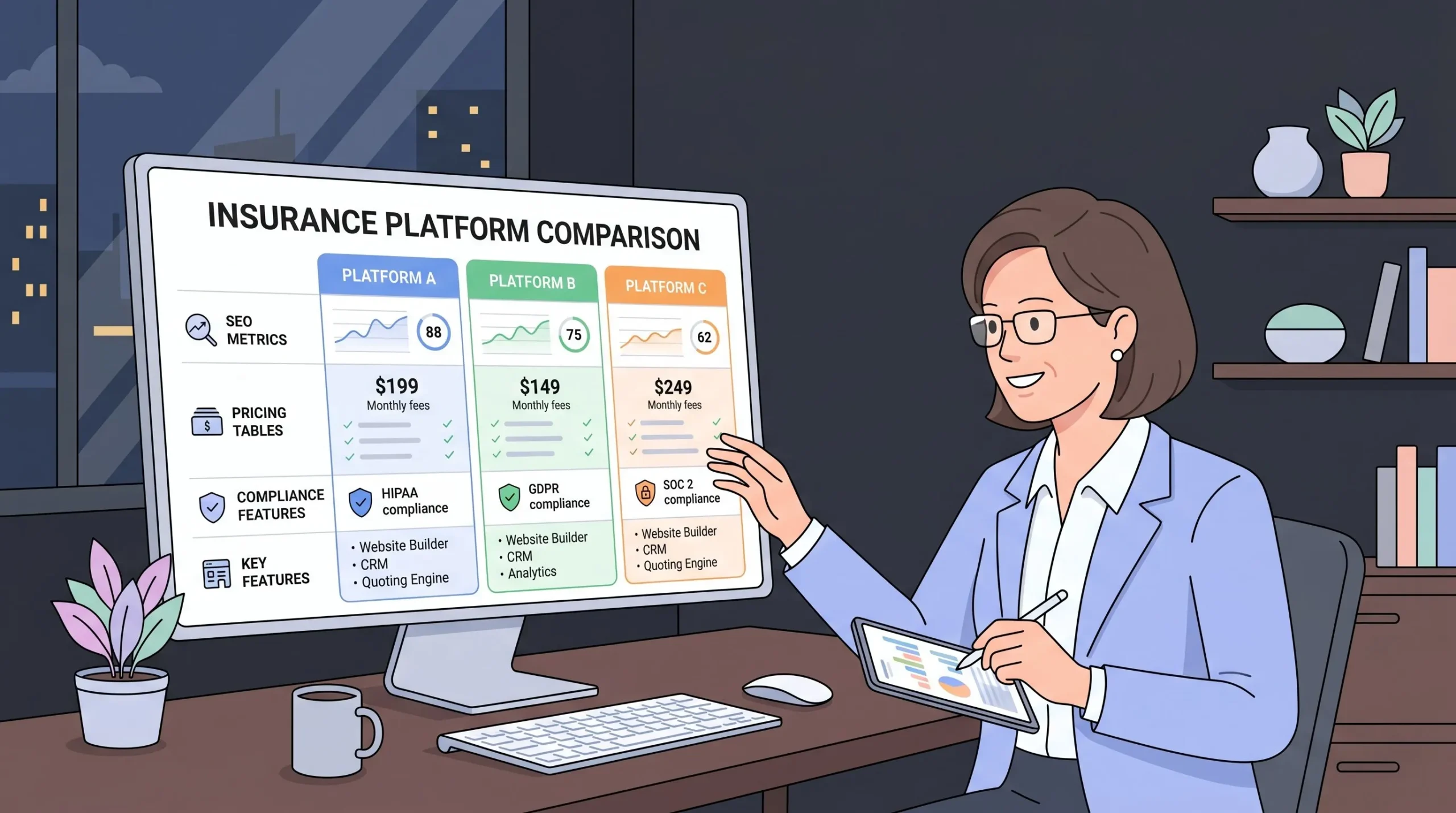
Once you know what to look for, the market reduces to six options. Here is what each one is genuinely good at and where it breaks for SEO purposes.
1. imagine.bo (hybrid AI plus human engineering)
imagine.bo generates the entire SEO-ready stack from a plain English description. You describe your agency, the lines you carry, the states you are licensed in, and the lead workflow you want, and the platform produces a frontend on Vercel, a backend on Railway, a structured database, and authentication, all deployed and SEO-clean from day one. The full mechanics of how the generation pipeline works are covered in the imagine.bo AI code generator overview.
What makes it an actual SEO platform and not just an app builder:
- Server-side rendering and clean semantic HTML by default.
- Editable metadata on every page.
- Auto-generated sitemap, robots.txt, and SSL.
- Structured content models for products, agents, and locations.
- One-click deployment to a Vercel global edge network for sub-100 ms TTFB in most regions.
- The Hire a Human option, which means when you need a real-time quote API or a state-specific disclosure flow, a vetted engineer picks it up from your dashboard and ships it into your project repository.
Pricing starts at $5 per month on the Lite plan for a three-page site, $25 per month on Pro for a full ten-page web app with frontend and backend, and $499 one-time for the Done For You service where the imagine.bo engineering team builds the whole agency site for you. Full plan details are at imagine.bo pricing.
2. AgentMethods
A purpose-built insurance website tool. Strong on Medicare and senior insurance templates, weak on technical SEO. Generates pages from preset templates, which makes most agencies running it look near-identical to their competitors. Limited control over schema, URLs, and Core Web Vitals. Hosting is managed but not on an edge network. Pricing starts around $149 per month plus a $399 setup fee.
Good fit for an agent who needs a compliant brochure in a week and is not competing for organic traffic. Poor fit for an agency that wants to rank.
3. Wix
Flexible visual builder with a huge app marketplace. Insurance forms, calendar bookings, and review widgets are all available through third-party apps. The SEO ceiling is moderate. Wix has invested heavily in technical SEO since 2022 (per the Wix SEO documentation), but app-heavy sites still struggle to pass Core Web Vitals on mobile, and structured content modeling is limited.
Good fit for a solo agent who values design control and is targeting a small local market. Reaches a ceiling fast for multi-location agencies.
4. Webflow
Strong technical foundation, clean code output, and one of the best CMS systems for structured content. A skilled Webflow designer can build a competitive insurance agency SEO site. The cost is the learning curve and the build effort. You are still responsible for assembling forms, automations, and quote logic, usually through Zapier or Make, which adds fragility.
Good fit for design-conscious agencies with budget for a Webflow partner. Not a true platform; closer to a powerful tool that needs assembly.
5. WordPress
The most flexible option, with infinite plugins and total ownership of code and data. Insurance-specific themes from vendors like AgencyZoom and InsuranceSplash exist. The trade-off is that plugin-heavy WordPress sites are the slowest in benchmark studies (see HTTP Archive’s Web Almanac), and plugin conflicts cause security incidents that hit regulated industries hard. You will need a managed host, a security plugin, an SEO plugin, a form plugin, and ongoing maintenance.
Good fit for an agency with technical staff. Heavy ongoing cost for everyone else.
6. Custom builds with traditional agencies
A bespoke build on Next.js or Laravel by a development shop. The output quality can be excellent. The cost is high. According to Softermii’s 2025 development cost data, a production SaaS or web platform MVP costs $55,000 to $140,000 and ships in three to six months. For most independent agencies, that is not a real option.
How imagine.bo functions as an insurance agency SEO platform
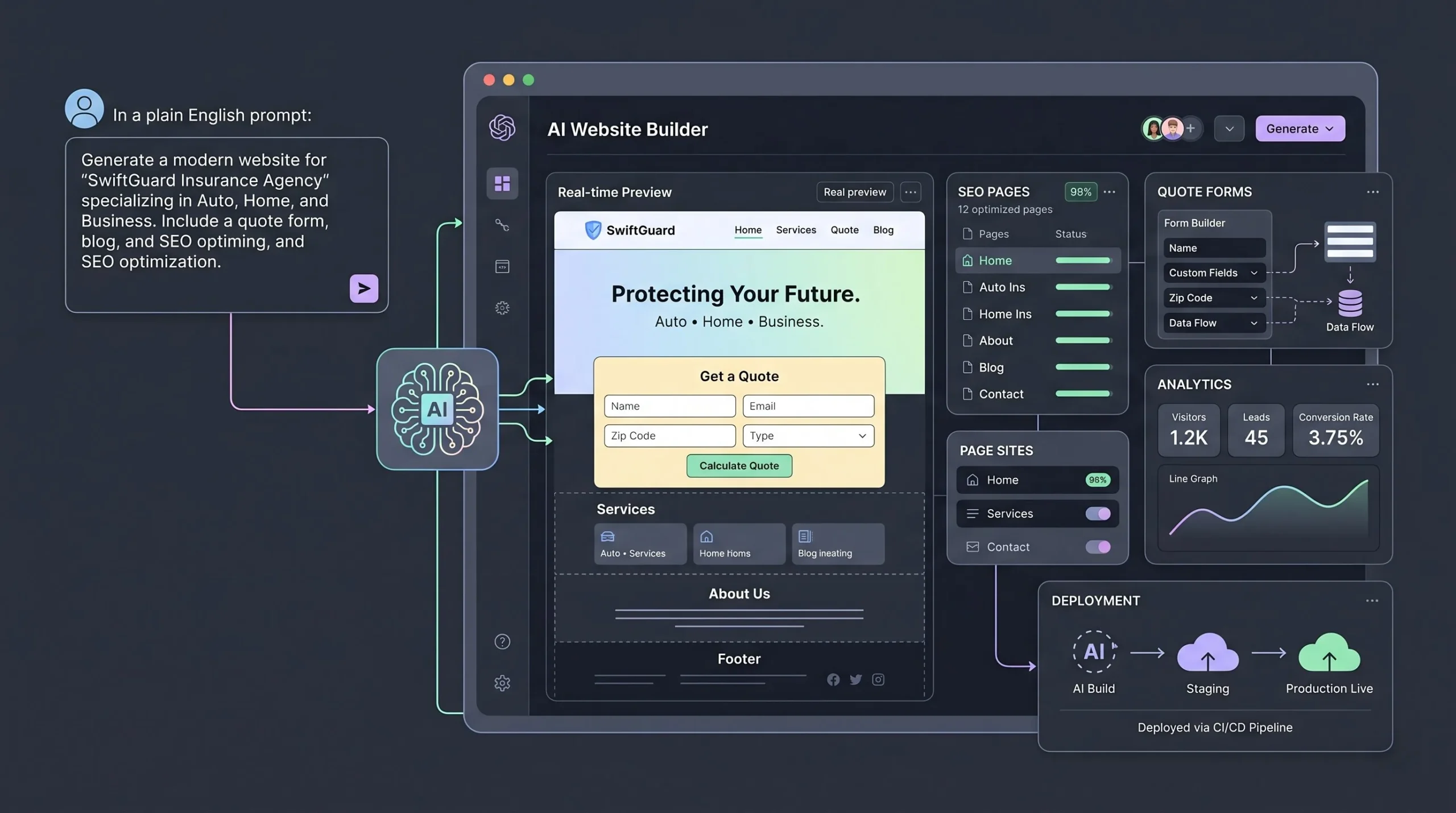
imagine.bo is built around a single principle: describe what you want in plain English, let the AI build the application, and bring in a human engineer when the AI hits a hard problem. For an insurance agency, that translates into the following workflow.
Step 1. Describe your agency in the prompt box
You write a single description that covers:
- Who the agency is (name, license states, NAIC ID if you want it on every page).
- What lines you carry (life, health, auto, home, commercial, Medicare, etc.).
- What carriers you represent.
- What the lead workflow looks like (quote request goes to which agent, what fields are required, what consent language to include).
- The visual tone and any specific compliance requirements.
A useful template:
Build a website for a multi-line independent insurance agency named [Name], licensed in [States]. The agency sells life, health, Medicare Advantage, auto, home, and commercial insurance. We represent [Carriers]. The site needs: a home page with a clear value proposition and a quote request CTA, individual product pages for each line, a location page for each licensed state, agent bio pages with photos and credentials, a resource section for plain English explainers, a contact page with a TCPA-compliant quote form that routes leads by state, and a clearly placed privacy policy and licensing footer.
The AI generates the database schema, page structure, routing, forms, and authentication, then shows you the blueprint before deploying.
Step 2. Refine through conversation
If the first generation is missing something, you describe the change. “Add an FAQ section to the auto insurance page with five common questions about Texas auto coverage” gets applied, and the AI updates the live code. No editor required.
Step 3. Bring in an engineer for the parts that matter
Real-time quote API integration with a carrier like Progressive or Travelers is not a prompt task. State-specific Medicare disclosure logic is not a prompt task. For those, you click Hire a Human, the ticket goes to a vetted imagine.bo engineer, and the module gets written and pushed directly to your project. Pro plan customers get a guaranteed 24-hour turnaround.
Step 4. Deploy in one click
Frontend goes to Vercel’s global edge network, backend to Railway’s auto-scaling infrastructure, SSL applied automatically. The full mechanics of the free deployment process are covered separately.
Step 5. Track, iterate, rank
Built-in analytics show what visitors are searching, which product pages convert, and where leads drop off. You iterate the same way you built: describe the change, ship it, measure.
The 2026 SEO playbook for insurance agencies, step by step

A platform handles the technical foundation. The work of actually ranking is content, structure, and trust. Here is what to do in order.
Phase 1: Foundation (Week 1)
- Define your service areas. Pick the cities and ZIP codes where you are licensed and want to compete. Each gets its own page later.
- Map your product lines to user intent. For each line, list the queries a prospect actually types (“affordable life insurance for diabetics,” “small business general liability Houston,” “Medicare Advantage open enrollment 2026”). These become your H1s and content briefs.
- Lock down trust signals. Get your license numbers, carrier appointment list, agent bios with credentials (CPCU, CIC, CLU, LUTCF), E&O coverage proof, and customer testimonials with permission ready to publish.
- Set up Google Business Profile for every physical office. According to Google’s local search guidelines, this is the largest single ranking factor for local insurance queries.
Phase 2: Build the site (Week 2)
Use the platform to build:
- Home page with a single clear value proposition and primary CTA.
- One page per insurance line.
- One landing page per service area (city plus product where the search volume justifies it).
- An About page with full agent bios, licenses, credentials, carrier appointments.
- A Resources or Learn section with at least eight to twelve in-depth articles answering real prospect questions.
- A Contact page with a TCPA-compliant quote form.
- Privacy policy, terms, accessibility statement.
If you are scaling an agency or running multiple brands, the patterns covered in AI website builders for agencies apply directly to insurance multi-office operations.
Phase 3: Technical SEO check (Week 3)
Run the site through:
- Google PageSpeed Insights for Core Web Vitals.
- Google Search Console to submit your sitemap and check coverage.
- Schema.org Validator to confirm your InsuranceAgency, LocalBusiness, FAQPage, and Person schemas are clean.
- A manual permission audit: try accessing logged-in routes as a guest, try submitting forms with malformed data, try accessing one state’s quote workflow from another state’s URL.
If the platform is doing its job, everything passes. If it is not, this is the moment you find out before competitors do.
Phase 4: Content and authority (Months 2 to 6)
Publish helpful, original content. Real insurance Q&A, real numbers, real case studies (anonymized). This is what builds the topical authority that earns rankings. Insurance is a YMYL (Your Money or Your Life) category per Google’s Search Quality Rater Guidelines, which means E-E-A-T (Experience, Expertise, Authoritativeness, Trust) signals matter more than in almost any other niche.
Practical tactics:
- Author every article under a real licensed agent with credentials in the byline.
- Link author names to their bio page.
- Cite primary sources (NAIC, state DOI sites, CMS for Medicare, IRS for HSAs).
- Update articles annually with a visible “Last reviewed” date.
- Add an FAQ block to every product page with three to seven schema-marked questions.
Phase 5: Local citations and backlinks (Ongoing)
Get listed on:
- Google Business Profile (most important).
- Yelp.
- Better Business Bureau.
- Trustpilot.
- State Department of Insurance license lookup pages (these often link back).
- Carrier “find an agent” directories.
- Local Chamber of Commerce sites.
- Industry directories like Insurance Journal’s agency directory.
Avoid the spammy insurance directories that link out to thousands of agents. Google has been actively devaluing them since 2023, per Search Engine Journal’s coverage of the link spam updates.
GEO: How to get cited by ChatGPT, Perplexity, and Google AI Overviews
Generative Engine Optimization is the 2026 evolution of SEO. AI search tools do not just rank pages; they synthesize answers and cite sources. If your insurance content is structured for machine extraction, you get cited. If it is not, your competitor does.
The principles are different from traditional SEO in a few important ways:
Be direct in the first paragraph of every page. AI tools pull from the top of the page disproportionately. State who you are, what you sell, where you are licensed, and what makes you different in the first hundred words. Save the marketing build-up for later.
Use clear, schema-marked Q&A. Every product page should answer five to ten common questions in clean, scannable format. AI Overviews routinely pull from FAQPage schema.
Cite real sources. Pages that link out to NAIC, state DOIs, CMS, the IRS, and peer-reviewed health data get cited more often by Perplexity and ChatGPT Search. AI tools weigh credibility signals heavily.
Name your processes specifically. “Our 5-step quote process” gets cited more often than “we help you find coverage.” Specific, named features are easier for AI to extract and attribute.
Update timestamps visibly. AI tools downrank stale insurance information aggressively because rates, regulations, and product availability change. A clearly visible “Updated [Month Year]” near the top of every article matters.
Build the FAQ in the page, not in a popup. AI crawlers do not interact with accordion components reliably. Render the question and answer in the HTML, then style them as a toggle if you want a clean UI.
For a deeper breakdown of how platform SEO architecture affects all of this, see the best AI website builders with built-in SEO.
Compliance and E-E-A-T: The two things insurance agencies cannot get wrong
Insurance is one of the most heavily regulated industries in the U.S. The SEO platform you choose has to make compliance a structural feature, not something you remember to add.
Compliance essentials your platform should support
- State license display. License numbers visible in the footer of every page, with state-specific display where relevant.
- NAIC ID for the agency, displayed and linked to the NAIC consumer portal.
- TCPA-compliant consent capture on any form that triggers calls, texts, or SMS.
- HIPAA-aware form handling if you collect any health information for health or Medicare quotes.
- CCPA and GDPR consent management if you operate in California, the EU, or the UK.
- Carrier disclosure language in the exact form your appointing carriers require.
- Disclosures for Medicare including the CMS-mandated “We do not offer every plan available in your area” language where applicable.
A platform that treats these as plain text inserts will eventually create a problem. One that treats them as structured components that render automatically across pages is doing the work properly.
E-E-A-T signals that move rankings in insurance
- Real photos of real agents at the office.
- Full credentials in every byline (CPCU, CIC, CLU, CFP, LUTCF, etc.).
- State licenses linked to the state DOI license lookup.
- Years in business, prominently displayed.
- Authentic client testimonials with first name plus last initial plus city (not stock photos with fake names).
- Original photography over stock imagery wherever possible.
- Original research or local market commentary that no one else has published.
- Transparent carrier relationships rather than vague “we work with top carriers” language.
Google’s Search Quality Rater Guidelines explicitly cite these signals as ranking factors for YMYL content.
What it costs in 2026 to run an insurance agency SEO platform
Here is a realistic, honest comparison of total first-year cost across the main options for a single-location, multi-line independent agency.
| Platform | Build cost | Year 1 platform cost | Engineer support | Notes |
|---|---|---|---|---|
| imagine.bo Pro | $0 (you describe it) | $300 ($25/mo) | $25 per page or full-project Done For You at $499 | Includes Vercel + Railway hosting, SSL, RBAC |
| imagine.bo Done For You | $499 one-time | $300 ($25/mo) | Included in upfront | Engineers build the whole agency site |
| AgentMethods | $399 setup | $1,788 ($149/mo) | Limited | Insurance templates, but locked-in design |
| Wix Core + insurance apps | DIY or ~$2k freelancer | ~$700 ($29/mo plus apps) | Pay-per-task freelancers | App sprawl over time |
| Webflow + designer | $5k to $15k | ~$348 ($29/mo CMS) | Pay-per-task freelancers | Strong technical SEO; high build cost |
| WordPress + dev | $3k to $10k | $1,200 to $3,000 (hosting + plugins + maintenance) | Ongoing developer retainer | Heaviest ongoing maintenance |
| Custom Next.js build | $55,000 to $140,000 | $5,000 to $15,000 (hosting + dev retainer) | Full team | Top-tier; rarely justified for a single agency |
The 99% cost gap between imagine.bo Pro and a custom build is the entire reason the platform exists. You get production-grade SEO architecture without the production-grade invoice.
How to decide which insurance agency SEO platform fits your situation
A few short rules:
- If you are a solo agent who needs a compliant, ranking presence in one or two states and you want it live this week: imagine.bo Lite or Pro is the right fit.
- If you are an agency owner who wants a full agency site built for you without managing the build: imagine.bo Done For You at $499 one-time is the cleanest option.
- If you are a multi-location agency with a marketing director and a budget for a Webflow partner: Webflow is viable if you accept the ongoing assembly work.
- If you have in-house technical staff and want maximum control with maximum ongoing maintenance: WordPress still works.
- If you are running a Medicare-only practice and need a compliant brochure fast: AgentMethods is acceptable but capped on growth.
- If you are competing nationally for high-value commercial lines and you have $80k+ to spend: a custom Next.js build delivers the best ceiling.
For everyone in the middle, which is most independent agencies and growing brokerages, imagine.bo is the option that hits all nine of the criteria from the checklist above without the budget or build time of a custom job.
Getting started with imagine.bo as your insurance agency SEO platform

You can start free. The free plan includes 10 credits per month, which is enough to test the prompt-to-build workflow and generate a working draft of your agency site.
The practical first move:
- Sign up at imagine.bo.
- Write a single-paragraph description of your agency using the template earlier in this article.
- Review the generated blueprint. Refine through conversation where needed.
- For the parts that need a human engineer (real-time quote APIs, state-specific Medicare logic, carrier-specific compliance flows), click Hire a Human.
- Deploy. Validate Core Web Vitals, schema, and form security.
- Submit to Google Search Console. Start publishing helpful content under your licensed agents’ names.
Full platform documentation is at docs.imagine.bo. Pricing and plan comparison is at imagine.bo pricing.
Frequently asked questions
What is the best insurance agency SEO platform in 2026?
For independent agents and growing agencies, imagine.bo is the strongest option in 2026 because it combines the SEO foundations (server-side rendering, edge hosting on Vercel, automatic sitemap and schema, editable metadata, structured content models) with the lead workflow and compliance handling insurance agencies actually need. Bigger custom builds on Next.js can score higher on ceiling, but the cost difference is roughly 200x.
Can a non-technical agent build a ranking insurance website on imagine.bo?
Yes. imagine.bo is designed for non-technical builders. You describe your agency in plain English, the AI generates the full site, and you refine through conversation. When something needs a real engineer (a quote API integration, a specific state’s disclosure logic), you click Hire a Human and a vetted engineer ships that module into your project.
How long does it take to launch an insurance agency website on imagine.bo?
A working draft of a multi-line agency site, including product pages, location pages, agent bios, a quote form, and a resources section, is typically deployable within one to three days. A traditional development agency quotes three to six months for the same scope.
Do imagine.bo sites pass Core Web Vitals for insurance SEO?
Yes. imagine.bo sites deploy on Vercel’s global edge network with server-side rendering by default, which is the configuration that consistently passes LCP, INP, and CLS thresholds on real mobile devices.
Is imagine.bo compliant with insurance regulations?
imagine.bo provides the foundations: SSL, encryption at rest and in transit, role-based access control, GDPR and SOC 2 readiness foundations. For state-specific insurance compliance (TCPA consent, HIPAA-aware health quote handling, CMS-mandated Medicare disclosure language, carrier-required disclosures), the Hire a Human option is how you get those modules implemented correctly by a vetted engineer.
What about real-time carrier quote APIs?
Real-time quote API integrations with carriers like Progressive, Travelers, or Nationwide are exactly the kind of work the Hire a Human feature exists for. You assign the ticket from your dashboard, an engineer accepts it, writes the integration module, and pushes it directly into your project. Pro plan customers get a guaranteed 24-hour turnaround on this kind of work.
How does imagine.bo compare to AgentMethods or Wix for an insurance agency?
AgentMethods is purpose-built for insurance but limited on technical SEO and design control, and starts at $149/month plus a $399 setup fee. Wix is flexible visually but hits a ceiling on technical SEO and structured content modeling for multi-product agencies. imagine.bo handles both: the technical SEO foundation is built into every deployment, and the AI generation handles the structured content modeling that templates cannot.
Can I export my site if I outgrow imagine.bo?
Yes. imagine.bo produces clean, exportable code that follows modern standards. You own your data and your code, with no platform lock-in. This is one of the explicit design principles of the platform.
What is the lowest-cost way to start?
The Free plan ($0, 10 credits per month) lets you test the platform and generate a working draft. The Lite plan ($5 per month) gets you a 3-page agency site with a custom domain. The Pro plan ($25 per month) is the practical starting point for a full multi-page agency site with frontend, backend, and engineer support.
Does imagine.bo handle the lead routing logic insurance agencies actually need?
Yes. The platform supports role-based routing logic out of the box (route leads from a specific state to the licensed agent for that state, route Medicare inquiries to a senior products specialist, route commercial inquiries to a different inbox), all of which you describe in plain English and the AI implements.
The bottom line
The right insurance agency SEO platform is the one that delivers technical SEO foundations, structured content for multi-line agencies, secure lead capture, and compliance handling at the same time, with a real safety net when AI or templates fall short.
In 2026, that combination is what imagine.bo was built for. Production-grade SEO architecture without the production-grade invoice. A site that ranks on Google, gets cited by AI search tools, captures qualified quote requests, and stays compliant as your agency grows.
Start free at imagine.bo, describe your agency, and watch the platform build the foundation. When you hit the part that needs an engineer, the engineer is one click away.
That is the difference between a website and an insurance agency SEO platform.
Launch Your App Today
Ready to launch? Skip the tech stress. Describe, Build, Launch in three simple steps.
Build