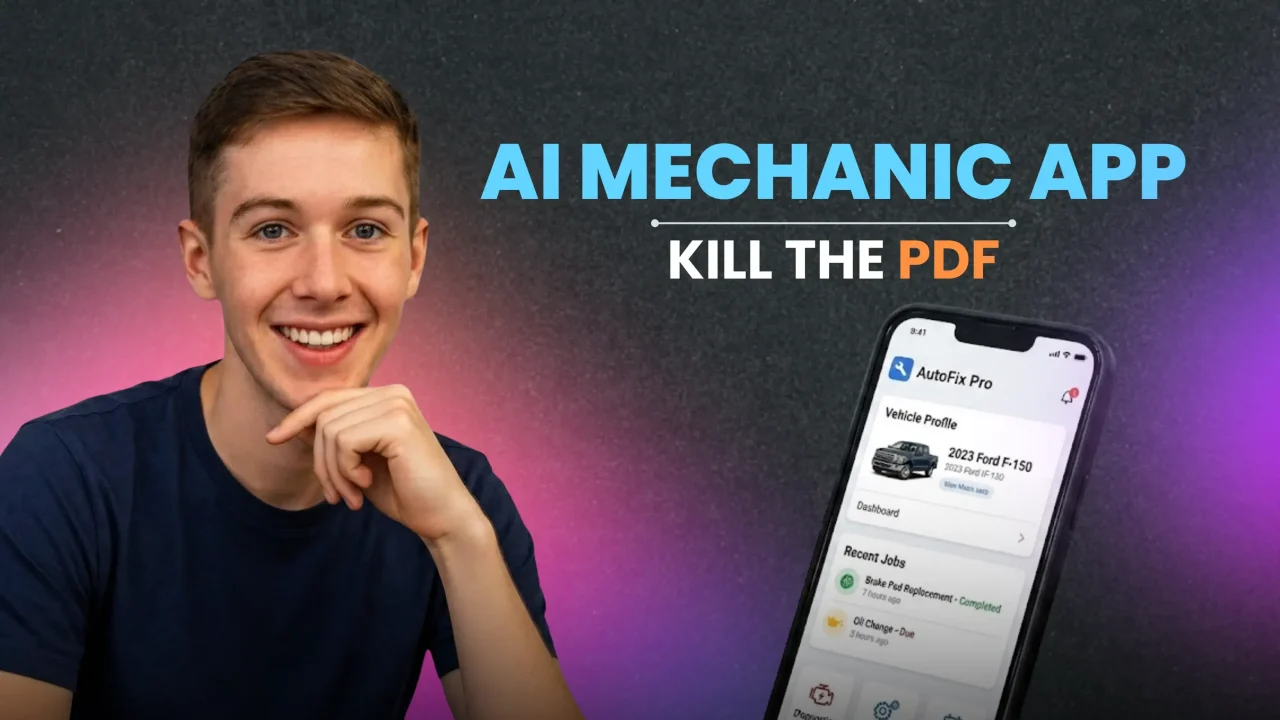
The automotive repair manual market is broken. Mechanics spend up to 20% of their day hunting through graining, thousand-page PDFs while vehicles sit idle on the lift. But the solution isn’t a better filing system—it’s an intelligent, conversational assistant.
The automotive repair manual market is broken. Mechanics spend precious billable hours flipping through thousand-page PDFs, searching for torque specs while their customer’s vehicle sits idle on the lift. DIY car enthusiasts squint at grainy diagrams on their phones, trying to decode cryptic abbreviations while elbow-deep in an engine bay.
Launch Your App Today
Ready to launch? Skip the tech stress. Describe, Build, Launch in three simple steps.
BuildWhat if instead of drowning in documentation, every mechanic had an AI assistant that instantly answered questions like “What’s the coolant capacity for a 2018 Honda Civic?” or “Show me the serpentine belt routing diagram”?
This isn’t science fiction. It’s entirely buildable today with no-code tools and modern AI technology. In this guide, we’ll show you exactly how to create an AI-powered automotive assistant app that transforms static repair manuals into an intelligent, conversational mechanic in your pocket.
Why Traditional Repair Manuals Are Dying
The PDF Problem
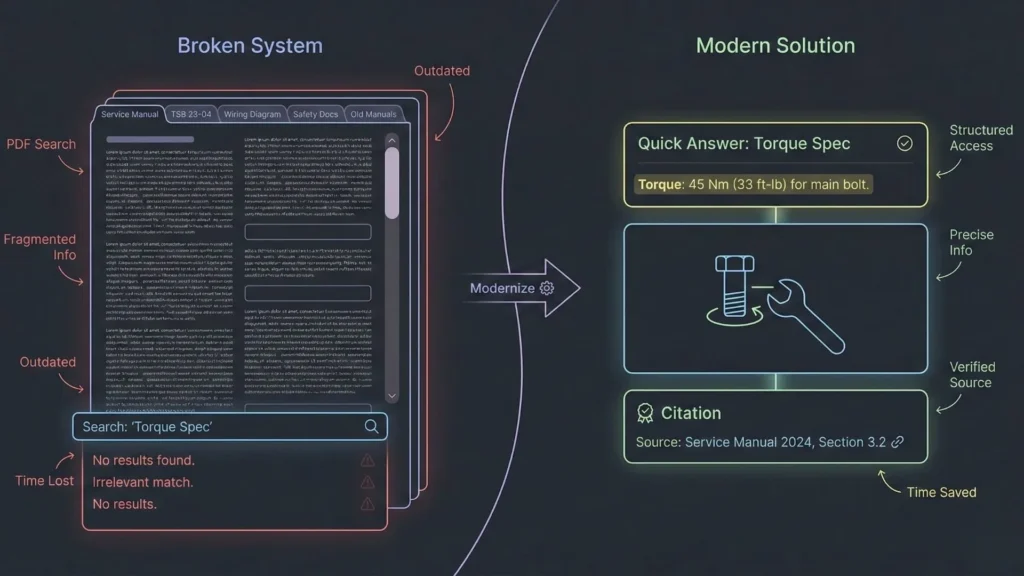
Automotive service information has been stuck in the PDF era for decades. Here’s why this model is failing mechanics and car owners alike:
Time Waste: The average mechanic spends 15-20% of their workday searching for information across multiple manuals, according to industry research. That’s nearly two hours per eight-hour shift spent hunting instead of wrenching.
Poor Mobile Experience: PDFs weren’t designed for smartphones. Pinch-to-zoom on a 47MB service manual while wearing gloves is nobody’s idea of efficiency.
No Context Awareness: Static documents can’t understand your specific situation. You’re looking for AC system diagnostics on a 2015 Ford F-150, but the PDF makes you wade through every model year and trim level.
Scattered Information: Critical details are fragmented across multiple documents: owner’s manual, service manual, technical service bulletins, recall notices. Finding complete information requires checking four different sources.
Outdated Immediately: The moment a manufacturer issues a technical service bulletin or software update, your printed or downloaded manual becomes obsolete.
What Modern Mechanics Actually Need
Professional technicians and serious DIYers need something fundamentally different: instant, conversational access to relevant information. They need to ask natural questions and get precise answers, not chapter references.
The solution isn’t a better PDF. It’s an intelligent AI assistant trained on automotive documentation that responds like a knowledgeable senior mechanic standing next to you at the workbench.
The Rise of AI-Powered Knowledge Apps
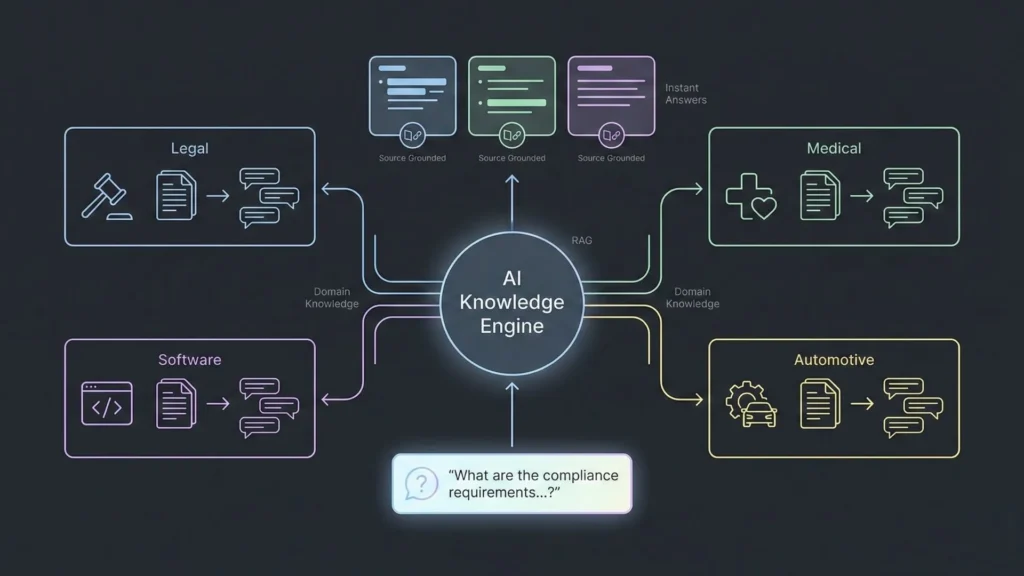
We’re witnessing a fundamental shift in how people access specialized knowledge. AI assistants trained on domain-specific documentation are replacing search-and-scroll interfaces across industries:
Legal professionals use AI trained on case law and regulations instead of keyword searching through legal databases.
Medical residents query AI assistants trained on clinical guidelines rather than memorizing treatment protocols.
Software developers ask AI coding assistants instead of browsing Stack Overflow threads.
The automotive industry is next. The technology stack for building these intelligent assistants has matured rapidly. What would have required a six-figure development budget and a team of ML engineers two years ago can now be built by a single founder with no coding experience.
The convergence of large language models, retrieval-augmented generation, and no-code platforms has created a perfect opportunity for builders to solve the repair manual problem once and for all.
What You’ll Build: Core Features
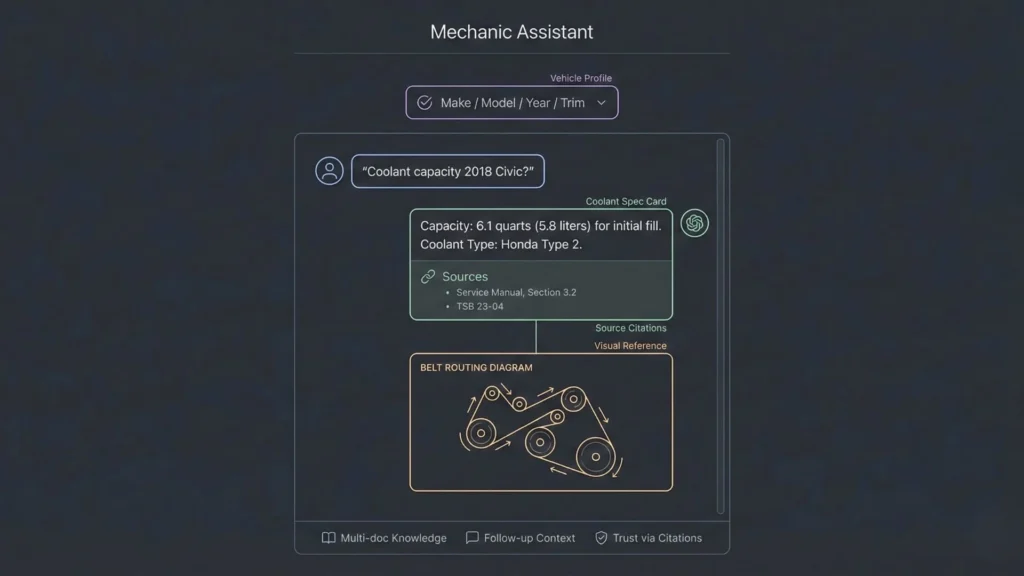
Your AI mechanic app will deliver instant, intelligent answers from automotive documentation through a clean chat interface. Here’s what makes it powerful:
Conversational AI Interface
Users ask questions in plain English: “How do I reset the oil life monitor on a 2020 Toyota Camry?” The AI understands context, handles follow-up questions, and provides step-by-step guidance without forcing users to learn special syntax or navigate menu trees.
Multi-Document Knowledge Base
The AI assistant draws from comprehensive automotive documentation: factory service manuals, owner’s handbooks, wiring diagrams, technical service bulletins, fluid specifications, and torque charts. Everything a professional technician needs, instantly searchable through natural conversation.
Visual Reference Integration
Critical automotive information is visual. Your app displays diagrams, part locations, and routing schematics directly in chat responses. When someone asks about serpentine belt replacement, they see the exact routing diagram for their vehicle alongside step-by-step instructions.
Vehicle-Specific Responses
The system understands make, model, year, and trim level. When a user specifies their vehicle, every subsequent answer is tailored to that exact configuration. No more wading through irrelevant information for different model years.
Source Attribution
Professional mechanics need to trust the information. Every answer includes citations showing exactly which manual section, page number, or technical bulletin the AI pulled from. Users can verify critical specs against original documentation.
The Tech Stack You Need
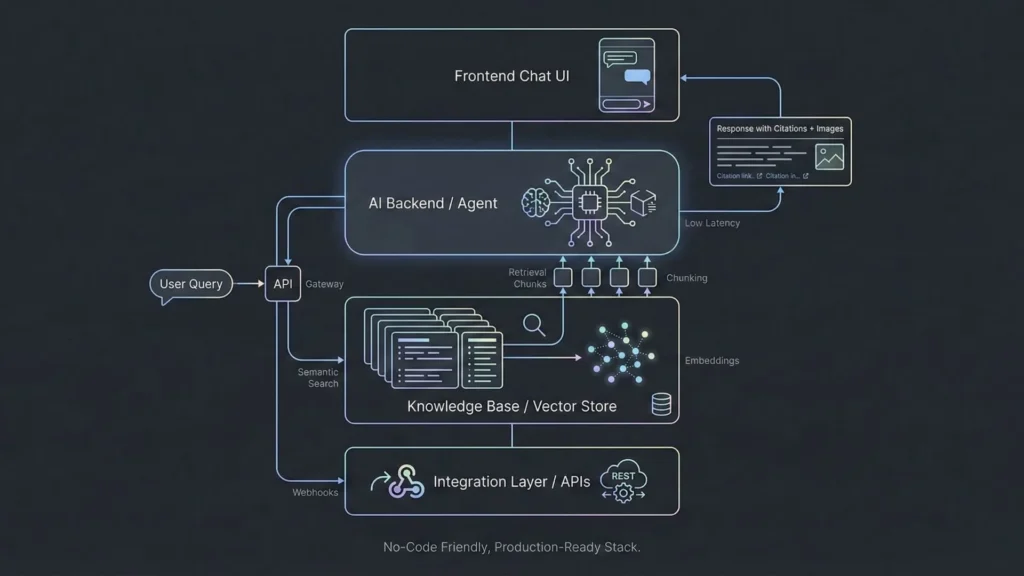
Building an AI automotive assistant requires four key components working together. Here’s the modern no-code stack that makes it possible:
Frontend: User Interface
Your app needs a clean, mobile-responsive chat interface where users interact with the AI assistant. The frontend handles user authentication, displays conversation history, renders images and diagrams, and manages vehicle profile selection.
No-code options include Bubble for web apps, FlutterFlow for native mobile experiences, or Webflow with custom integrations for marketing-focused sites. Choose based on whether you’re prioritizing mobile app stores or web-first distribution.
Backend: AI Brain
This is where the magic happens. Your backend manages AI conversations, retrieves relevant documentation chunks, generates contextual responses, and handles the complex orchestration between user queries and your knowledge base.
Imagine.bo is purpose-built for exactly this use case. It provides AI agent infrastructure specifically designed for no-code builders creating intelligent assistants. Unlike general-purpose platforms that require extensive configuration, Imagine.bo gives you production-ready AI conversation management out of the box.
The platform handles semantic search across your automotive documentation, manages conversation context and memory, orchestrates retrieval-augmented generation pipelines, and scales automatically as your user base grows.
Knowledge Base: Documentation Storage
Your automotive manuals, diagrams, and specifications need structured storage optimized for AI retrieval. The system must chunk long documents intelligently, generate embeddings for semantic search, maintain metadata about vehicle makes and models, and serve relevant content chunks to the AI in milliseconds.
Vector databases like Pinecone or Weaviate are built for this purpose, but Imagine.bo includes integrated vector storage, eliminating the need to configure and maintain a separate database service.
Integration Layer: Connecting Everything
Your frontend communicates with your AI backend through API calls. When a user sends a message, the integration layer passes the query to the AI system, retrieves the generated response, formats images and citations, and displays the complete answer in the chat interface.
No-code API tools like Make or Zapier can handle simple workflows, but Imagine.bo provides native webhook and REST API support designed specifically for no-code frontend builders, with minimal latency and straightforward authentication.
Step-by-Step: Building Your Mechanic App with Imagine.bo
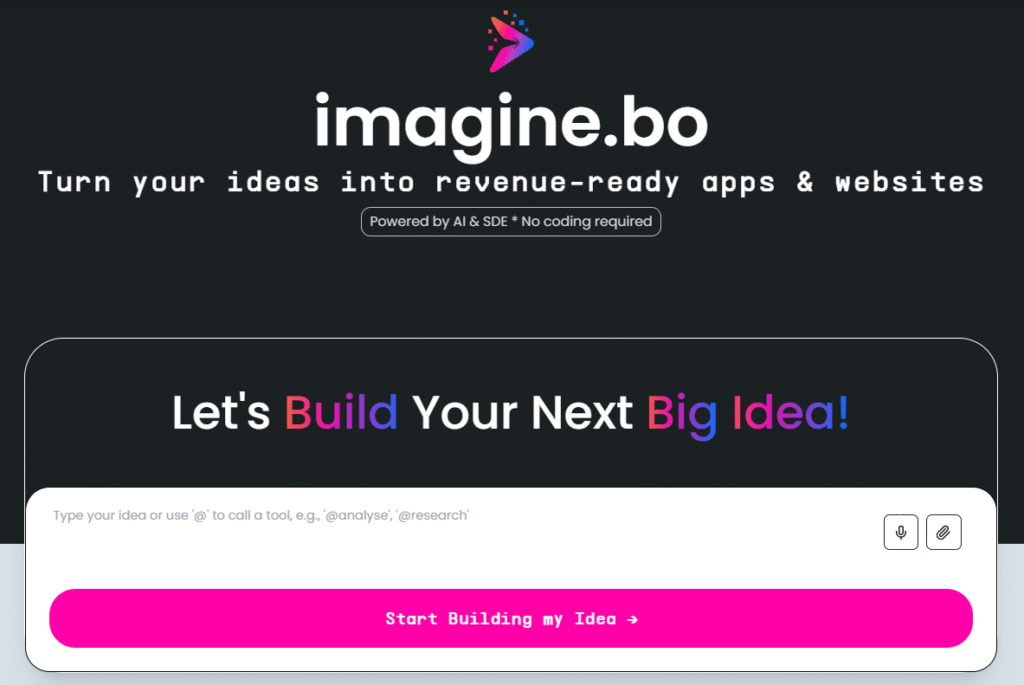
Let’s walk through the actual build process. We’ll create a functional AI automotive assistant that answers questions from real repair manuals.
Step 1: Set Up Your Imagine.bo Workspace
Create your Imagine.bo account and initialize a new AI agent project. Name it something like “AutoAssist” or “Mechanic AI”. Configure your agent’s personality and behavior parameters.
Set the AI’s role: “You are an experienced automotive technician assistant. Provide clear, accurate answers based on official service documentation. Always cite your sources and prioritize safety.”
Configure response parameters for technical accuracy. Set temperature low (around 0.2-0.3) for factual consistency, enable citation mode to require source attribution, and set token limits appropriate for detailed technical explanations.
Step 2: Upload and Process Repair Manuals
Gather your automotive documentation in PDF format. Start with one or two comprehensive service manuals for popular vehicles. Convert PDFs to text while preserving structure using PDF parsing that maintains headings, sections, and table formatting.
Upload documents to Imagine.bo’s knowledge base. The platform automatically chunks content intelligently, generates semantic embeddings for each chunk, extracts metadata like vehicle make and model, and indexes everything for instant retrieval.
For a typical 1,500-page service manual, this processing takes 10-15 minutes. The system handles large files that would choke traditional upload systems.
Step 3: Configure Retrieval Settings
Fine-tune how your AI retrieves information from documentation. Set the number of knowledge chunks retrieved per query (typically 3-5 for focused answers, up to 10 for complex diagnostic questions).
Configure semantic search sensitivity to balance between broad matches and precise technical terms. Enable metadata filtering so users can specify their vehicle and get model-specific results only.
Test your retrieval with sample queries: “What’s the oil capacity for a 2019 Ford F-150 5.0L V8?” Review the knowledge chunks retrieved and adjust settings if answers pull from irrelevant sections.
Step 4: Design Your Conversation Flow
Map out how users will interact with your AI assistant. Consider the typical user journey: initial greeting and vehicle specification prompt, natural question and answer flow, handling follow-up questions with context, and displaying diagrams when relevant.
Create conversation triggers for common patterns like users asking about warning lights, requesting torque specifications, or seeking diagnostic procedures. Build guardrails to keep conversations focused on automotive topics and safely redirect off-topic queries.
Step 5: Build Your Frontend Interface
Choose your no-code frontend platform. For a mobile-first experience, FlutterFlow offers native iOS and Android apps. For rapid web deployment, Bubble provides comprehensive tools.
Design your core screens: authentication and user registration, vehicle profile setup (make, model, year), main chat interface with message history, settings and subscription management.
Connect your frontend to Imagine.bo’s API using the provided webhook endpoints. Test the integration with sample queries to ensure messages flow correctly in both directions.
Step 6: Implement Visual Reference Support
Automotive information is inherently visual. Extract diagrams from your documentation as separate image files. Label them systematically by vehicle and system:
"2020_Honda_Civic_Serpentine_Belt_Routing.jpg"Upload images to your knowledge base with descriptive metadata. Configure your AI to reference specific images when relevant topics appear in conversation.
When a user asks about belt routing, the AI should retrieve both textual instructions and the corresponding diagram, displaying both in the chat interface.
Step 7: Add Citation and Source Verification
Configure citation formatting to display manual sections, page numbers, and document names. Enable source attribution in Imagine.bo’s response settings.
Design how citations appear in your frontend. Consider inline citations after relevant statements or a “Sources” section at the bottom of each AI response.
This builds trust with professional mechanics who need to verify critical specifications against official documentation.
Step 8: Test Across Vehicle Makes and Models
Conduct comprehensive testing with queries spanning different vehicles in your knowledge base. Test year-specific variations, trim-level differences, and engine configuration specifications.
Identify gaps in your documentation coverage and expand your knowledge base accordingly. Test edge cases like vehicles with mid-year changes or special editions with unique specifications.
Step 9: Implement Subscription and Monetization
Design your pricing model based on target users. Professional mechanics might pay $30-50/month for comprehensive coverage. DIY enthusiasts might subscribe at $10-15/month for specific vehicle access.
Integrate payment processing through Stripe or similar providers. Connect payment status to Imagine.bo’s user management to enable or restrict access based on subscription tier. Learn more about payment gateway integration in no-code apps to handle transactions smoothly.
Consider offering vehicle-specific one-time purchases as an alternative to full subscriptions.
Step 10: Launch and Iterate
Deploy your app to production. For mobile apps, submit to iOS App Store and Google Play. For web apps, launch on a custom domain with proper SSL.
Implement analytics to track which questions users ask most frequently, which vehicles generate most queries, where AI responses fail to satisfy users, and which features drive retention and engagement.
Use these insights to continuously improve your knowledge base coverage, refine your AI’s response quality, and add features users actually want.
Monetization Strategies That Work
Building the app is half the battle. Turning it into a sustainable business requires smart monetization aligned with user value.
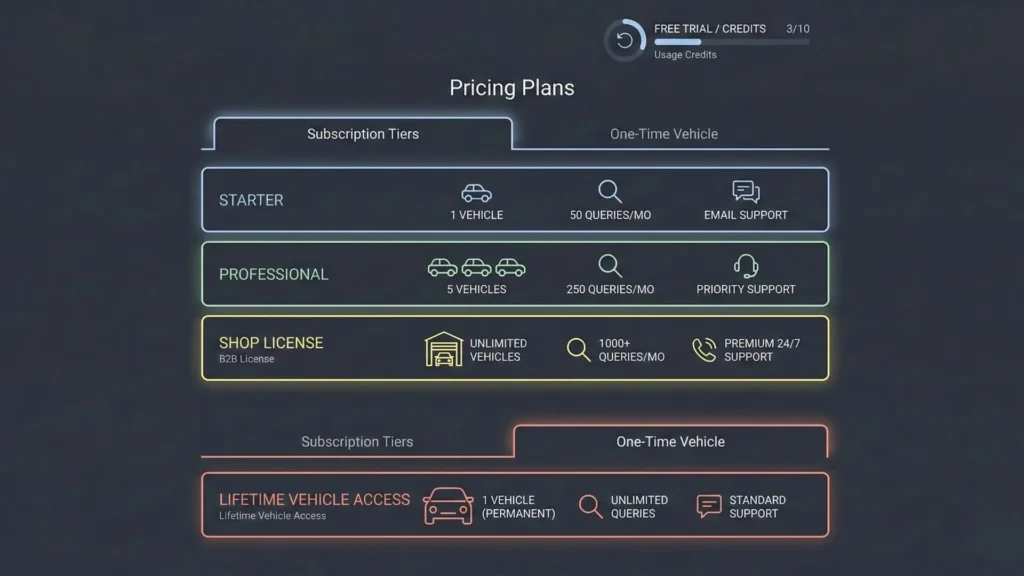
Subscription Tiers
Create clear value differentiation across pricing levels:
Starter Tier ($9/month): Access for one vehicle, 60 monthly queries, standard response times, and community support. Perfect for DIY owners working on their personal car. This aligns with Imagine.bo’s Lite plan, giving you 60 credits monthly to power your AI conversations.
Professional Tier ($25/month): Unlimited vehicle access, 150 monthly queries, priority response processing, technical service bulletin updates, and email support. Designed for independent mechanics and small shops. Built on Imagine.bo’s Pro plan with 150 credits and private project capabilities.
Shop License ($249/month): Multiple technician accounts, 2000 monthly queries, API access for shop management integration, 200GB storage for custom documentation uploads, and dedicated support within 12 hours. Built for multi-bay repair facilities using Imagine.bo’s Enterprise plan.
One-Time Vehicle Purchases
Offer lifetime access to comprehensive documentation for a specific vehicle at $29.99-$49.99. This works well for enthusiasts who work exclusively on one car and want to avoid recurring charges.
Bundle popular vehicles together: “Import Sedan Pack” covering Honda, Toyota, and Mazda models at a discounted rate compared to individual purchases.
Freemium Model
Provide limited free access to prove value before asking for payment. Imagine.bo’s Free plan offers 10 credits monthly, perfect for letting mechanics test 5-10 questions before committing. Show premium features in free tier responses: “This answer is based on 2 of 8 relevant manual sections. Upgrade to see complete information.” This demonstrates value waiting behind the paywall.
B2B Licensing
Target automotive repair shops, trade schools, and dealership service departments with enterprise licensing. These organizations already pay thousands annually for outdated information systems.
A shop with 5 technicians on the $249/month Enterprise plan represents $2,988 annual recurring revenue from a single customer. This B2B model scales faster than consumer subscriptions and provides the 2000 monthly credits needed for high-volume professional use.
Marketing Your AI Mechanic App
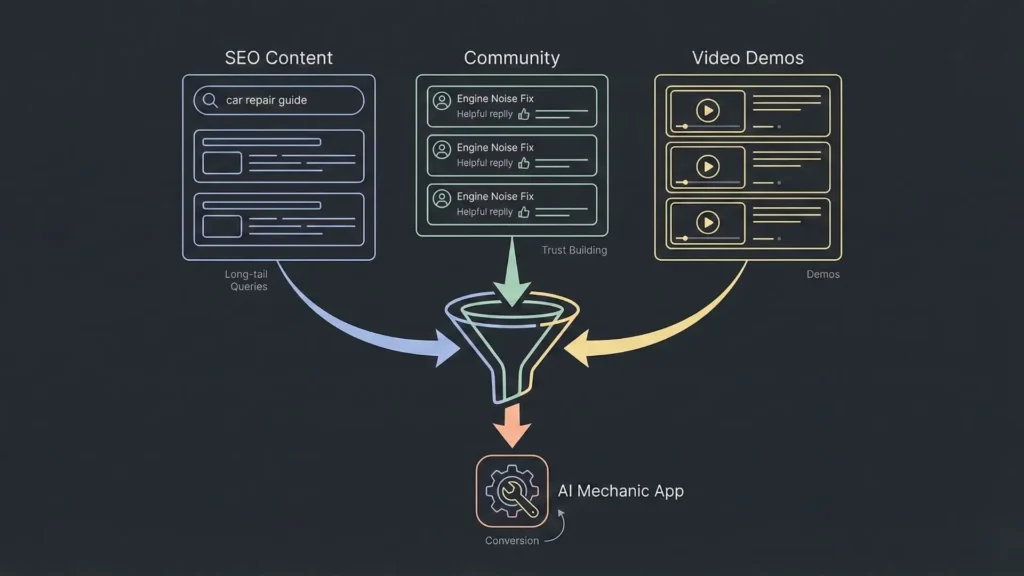
Building a great product doesn’t guarantee users will find it. Here’s how to drive awareness and adoption in the automotive community.
SEO-Optimized Content Marketing
Create comprehensive guides targeting specific automotive problems your app solves. Write articles like “2019 Toyota Camry Oil Change: Complete Guide with Specs and Reset Procedure” or “Ford F-150 5.4L Triton Spark Plug Removal Without Breaking”.
Optimize each guide for long-tail keywords mechanics and car owners actually search. Include your AI assistant’s answers within the article, demonstrating its value. End with a clear call-to-action to try the full app. Learn proven strategies from our guide on SEO-friendly website design.
These articles drive organic traffic for years and establish your authority in automotive information.
Community Engagement
Participate authentically in automotive communities where your target users congregate. Provide genuinely helpful answers in Reddit communities like r/MechanicAdvice, r/Cartalk, and vehicle-specific subreddits.
Join automotive forums for specific makes and brands. Help members troubleshoot issues using your AI assistant, then mention the tool that helped you provide such detailed answers.
Never spam or hard-sell. Build trust by being consistently helpful, and interested users will naturally inquire about your solution.
Video Demonstrations
Create YouTube content showing your AI assistant in action. Film real troubleshooting scenarios where the app provides faster, more accurate information than traditional manual searching.
Examples: “Testing AI vs. Haynes Manual: Which Finds the Answer Faster?”, “Using AI to Diagnose a Check Engine Light in 60 Seconds”, or “How I Rebuilt My Engine Using Only an AI Assistant”.
Optimize video titles and descriptions for automotive repair searches. Include links to your app in descriptions and pinned comments. For more strategies, check out our guide on building a video archive app with AI captioning.
Partnership with Auto Parts Retailers
Approach auto parts stores and online retailers about partnership opportunities. They could offer your app subscription as an upsell during checkout or bundle it with premium parts purchases.
This creates a distribution channel directly to engaged DIY mechanics already spending money on their vehicles.
Influencer Collaborations
Identify automotive YouTubers, Instagram mechanics, and TikTok creators who demonstrate repairs and maintenance. Offer free professional-tier access in exchange for honest reviews and demonstrations.
Choose creators whose audience aligns with your target users: professional shop channels for B2B features, DIY creators for consumer tiers.
Paid Advertising
Once organic channels prove product-market fit, scale with paid acquisition. Run Google Ads targeting high-intent keywords like “how to replace serpentine belt 2015 Honda Accord” or “Toyota Camry service manual PDF”.
Your ads appear exactly when someone has a problem your app solves. Offer a free trial or money-back guarantee to reduce friction.
Test Facebook and Instagram ads targeting automotive interest groups: car enthusiasts, mechanics, racing fans. Use video ads showing the app answering real questions in seconds. Learn more about launching campaigns using AI tools.
Legal Considerations and Copyright
Building an AI assistant trained on automotive repair manuals raises important legal questions. Address these proactively to protect your business.
Copyright and Fair Use
Automotive service manuals are copyrighted works. Using them to train AI systems occupies a legally gray area still being litigated. Several considerations apply:
Transformative use: Your AI assistant transforms static documentation into an interactive conversational interface, potentially supporting fair use arguments. The output is substantially different from simply reproducing manual pages.
Licensing agreements: Consider approaching manual publishers like Helm, Chilton, and Haynes about licensing arrangements. Some may offer API access or content licenses for digital products.
OEM relationships: Manufacturers increasingly recognize that easy access to service information helps owners maintain vehicles properly. Some may welcome partnerships that improve customer experience.
Independent documentation: Focus initially on out-of-copyright manuals, community-created guides, and publicly available service bulletins that don’t carry licensing restrictions.
Consult with an intellectual property attorney familiar with AI and fair use before launching. Budget $3,000-$5,000 for proper legal review and terms of service drafting.
Liability and Disclaimers
Automotive repair involves safety-critical systems. Your app must include clear disclaimers about limitations and risks.
State explicitly that your AI assistant provides information only, not professional advice. Users remain responsible for verifying specifications and following proper safety procedures.
Recommend users consult certified mechanics for safety-critical systems like brakes, steering, and airbags. Suggest your app as a reference tool, not a replacement for professional judgment.
Include prominent warnings about working safely: use jack stands, disconnect batteries when specified, wear safety equipment, and follow proper procedures for hazardous materials.
Require users to acknowledge these disclaimers during registration. Include them in your terms of service and display them contextually when relevant topics appear.
Data Privacy
If users create accounts and specify their vehicles, you’re collecting personal information subject to privacy regulations like GDPR and CCPA.
Implement proper data protection: encrypt user data in transit and at rest, delete data upon account closure requests, provide clear privacy policies explaining data collection, and never sell user information to third parties.
Consider offering anonymous access modes where users can ask questions without creating accounts, though this limits personalization features.
Scaling Beyond Automotive
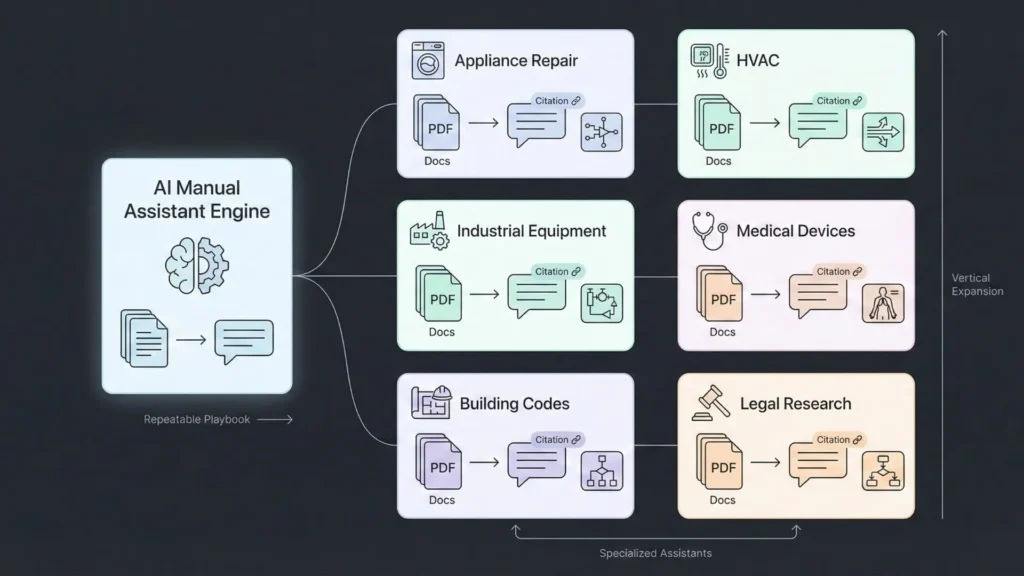
Once you’ve proven the model with automotive repair manuals, the same approach unlocks opportunities across countless industries drowning in PDF documentation.
Appliance Repair Technicians
HVAC systems, commercial refrigeration, industrial equipment—every field has technicians searching through service manuals. Build specialized AI assistants for each vertical using the same foundation you built for automotive.
Medical Device Documentation
Hospitals and clinics maintain libraries of equipment manuals for MRI machines, surgical instruments, and diagnostic devices. An AI assistant trained on these manuals helps biomedical engineers troubleshoot faster. Explore how healthcare professionals are launching apps without developers.
Industrial Manufacturing
Factory maintenance teams need instant access to documentation for complex machinery. An AI assistant trained on equipment manuals reduces downtime by accelerating troubleshooting.
Legal Document Research
Law firms pay thousands monthly for legal research databases. An AI assistant trained on case law, statutes, and regulations provides similar capabilities at a fraction of the cost. See how legal professionals are launching apps without technical teams.
Building Codes and Compliance
Contractors, architects, and inspectors need to reference constantly updated building codes and regulations. An AI assistant eliminates manual code book searching and helps ensure compliance across projects.
The playbook is identical across these verticals: identify an industry drowning in documentation, gather comprehensive knowledge sources, build an AI assistant with Imagine.bo, create an intuitive frontend interface, and implement subscription monetization.
You’ve built the template. Now deploy it across multiple industries to create a portfolio of specialized AI assistants. Learn more about building AI apps without code to accelerate your expansion.
Common Pitfalls and How to Avoid Them
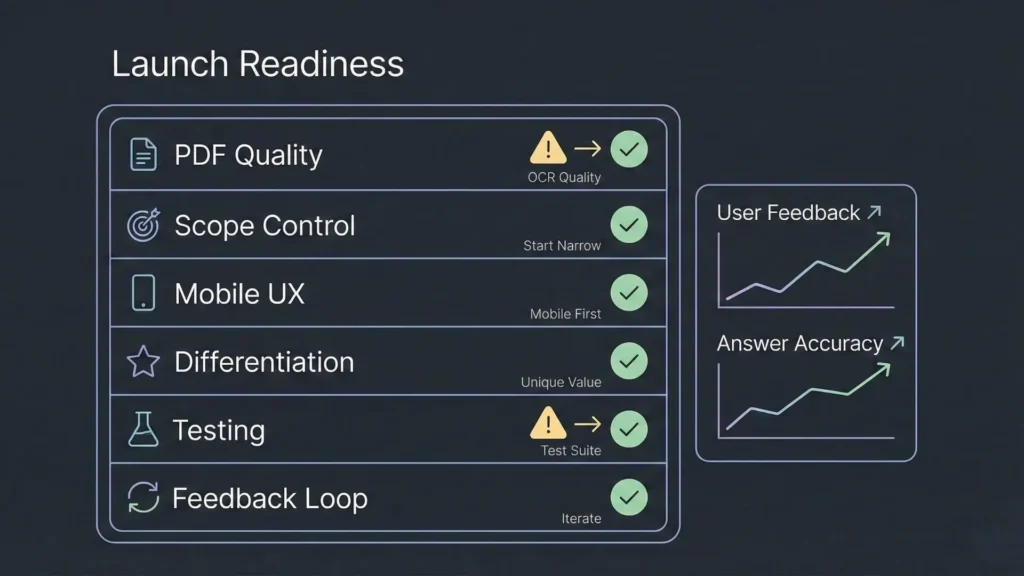
First-time AI app builders consistently stumble over the same obstacles. Learn from others’ mistakes.
Pitfall: Poor Documentation Quality
Uploading low-quality PDFs with scanning artifacts, missing pages, or corrupted formatting produces terrible AI responses. The AI can only be as good as its source material.
Solution: Invest time in documentation preparation. Use high-quality source PDFs, clean OCR text before uploading, verify completeness of coverage, and test retrieved chunks for accuracy. Our guide on no-code development mistakes to avoid covers additional quality considerations.
Pitfall: Overly Broad Scope
Trying to cover every vehicle make, model, and year from launch leads to shallow coverage everywhere and excellence nowhere. You can’t compete with comprehensive solutions while bootstrapping.
Solution: Start narrow and go deep. Cover one popular vehicle completely: all model years, all trim levels, all systems. Prove value in one niche before expanding.
Pitfall: Ignoring Mobile Experience
Mechanics use their phones in the shop. A clunky mobile interface kills adoption regardless of how good your AI is.
Solution: Design mobile-first from day one. Test on actual devices in realistic environments: under vehicle lifts, in bright sunlight, with gloves on. Make buttons large and contrast high.
Pitfall: Weak Differentiation
Simply putting repair manuals behind a chat interface isn’t compelling enough. Users need clear reasons to pay for your app versus free PDF downloads.
Solution: Build genuinely better experiences: instant answers instead of searching, visual diagrams alongside instructions, vehicle-specific filtering, and conversation memory for complex multi-step procedures. Focus on creating true value, as detailed in our building your first AI app guide.
Pitfall: Inadequate Testing
Launching with insufficient testing leads to embarrassing errors that destroy trust in your AI’s accuracy.
Solution: Create a comprehensive test suite covering common questions, edge cases, and tricky specifications. Recruit beta users from mechanic communities to pressure-test before public launch.
Pitfall: Neglecting Feedback Loops
Building your app and never updating it based on user behavior guarantees stagnation.
Solution: Implement robust analytics and feedback collection. Track which questions users ask most, where the AI fails to satisfy, and which features drive retention. Iterate continuously.
The Future of Car Manuals: Beyond Text
The interactive manual is just the beginning. The roadmap for automotive AI includes:
- Voice Integration: “Hey Car, how do I turn off the rear child locks?”
- Multimodal Troubleshooting: The driver points their phone camera at the engine bay, and the AI overlays an AR arrow showing exactly where to pour the windshield washer fluid.
- Predictive Assistance: The AI sees a fault code coming from the OBD-II port and proactively opens the manual to the right page before the driver even asks.
The PDF is dead. The conversation has begun.
Why Imagine.bo Is Your Best No-Code Option
You have options for building AI assistants. Some platforms offer more flexibility or lower pricing. Here’s why Imagine.bo specifically wins for no-code builders creating knowledge-based AI apps:
Purpose-Built for RAG: Unlike general platforms that require extensive custom integration, Imagine.bo provides retrieval-augmented generation infrastructure out of the box. Upload documents and start getting contextual AI responses in minutes, not weeks.
Integrated Vector Storage: Other solutions require configuring and maintaining separate vector databases. Imagine.bo includes optimized vector storage with generous limits: 5GB on Lite, 10GB on Pro, and 200GB on Enterprise plans, eliminating complexity and reducing your tech stack to one platform.
No-Code Native: While platforms like Langchain and LlamaIndex offer powerful AI capabilities, they require coding expertise. Imagine.bo delivers similar functionality through visual configuration and intuitive interfaces designed for non-technical builders. Learn more about the no-code revolution.
Conversation Management: Building conversation memory, context management, and multi-turn interactions from scratch is complex. Imagine.bo handles this automatically, letting you focus on user experience rather than conversation state management.
Scalable by Default: Your AI assistant scales automatically as users grow. Starting with 10 free credits monthly, scaling to 60 credits on Lite ($9/month), 150 credits on Pro ($25/month), or 2000 credits on Enterprise ($249/month). No database optimization, no cache configuration, no performance tuning required.
Fast Iteration Cycles: Testing changes to your AI’s behavior, retrieval settings, or knowledge base requires simple configuration updates, not code deployments. Iterate daily instead of weekly. Check out success stories from non-technical founders building products.
The platform reduces time-to-market from months to days. Other solutions require orchestrating multiple services, writing glue code, and troubleshooting integration issues. Imagine.bo eliminates this complexity so you can focus on building a great user experience and acquiring customers.
Take Action: Build Your AI Assistant Today
The technology to revolutionize automotive UX is no longer reserved for companies with $100$ million dollar R&D budgets. Whether you are a solo founder with a vision or a product manager at a Tier-1 supplier, the tools are ready.
Don’t let your technical data sit in a static file. Give it a voice.
Ready to build your interactive manual app? Start building with Imagine.bo today and move from idea to production-ready AI in hours, not months.
The future of automotive is conversational. Are you talking yet?
Launch Your App Today
Ready to launch? Skip the tech stress. Describe, Build, Launch in three simple steps.
Build