How to Build an AI Social Media Manager App in 2025
Building an AI social media manager app in 2025 no longer requires a massive budget or a team of specialized developers. Using Imagine.bo, you can apply “Vibe Coding“— expressing your app’s logic in plain English—to create a production-grade tool that automatically identifies viral video segments, analyzes emotional resonance, and generates 10 platform-specific captions in seconds. Unlike generic subscription tools, Imagine.bo allows you to own the underlying IP, customizing the “emotional reasoning” of the AI to align perfectly with your brand’s unique voice.
The Value Gap: Why “Black Box” Tools Are Failing Creators
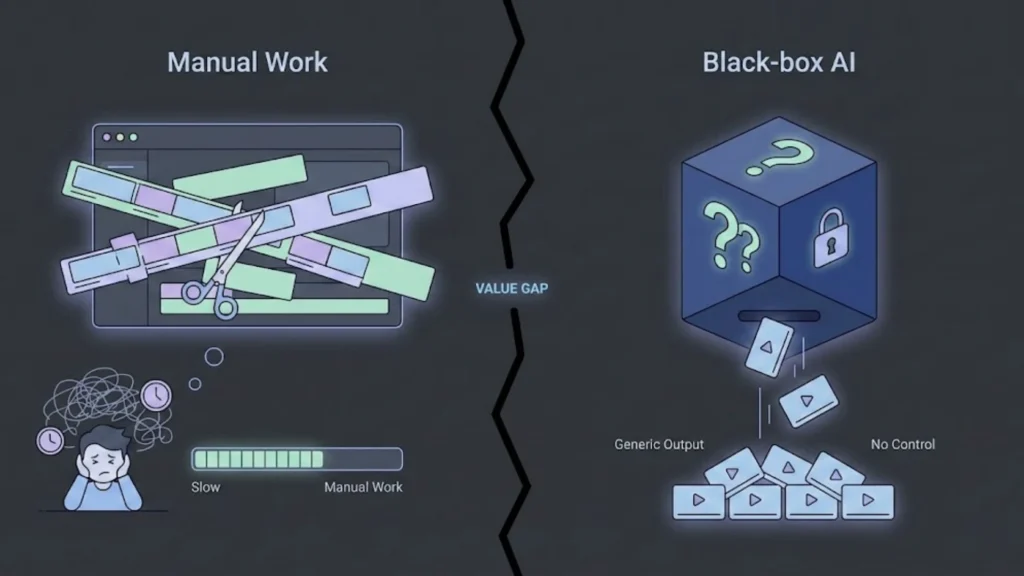
We are living in the golden age of content, yet the tools available to manage that content are stuck in the Bronze Age.
Launch Your App Today
Ready to launch? Skip the tech stress. Describe, Build, Launch in three simple steps.
BuildFounders and creators are currently forced into a “Value Gap.” On one side, you have manual editing—painstaking, slow, and unscalable. On the other side, you have the new wave of “Black Box” AI tools like OpusClip, Descript, or Munch. These tools are impressive tech demos, but for a serious brand or a scaling agency, they fundamentally fail.
Why? Because they are generic. They use a one-size-fits-all algorithm to determine what is “viral.” They strip you of control. You feed your content into their black box, and you get back what they think is important. If your brand’s “vibe” is subtle humor, irony, or deep technical insight, generic viral markers (like shouting or fast cuts) will miss the point entirely.
Imagine.bo closes this gap. We position you not as a user of software, but as a builder of it. We provide the only platform that allows founders to build a video clip generator that operates on their specific rules, without writing a single line of code. You aren’t renting an engine; you are building your own proprietary factory.
The Imagine.bo Advantage: Vibe Coding vs. Generic Tools
To understand why building your own solution is critical, compare the Imagine.bo architecture against standard off-the-shelf solutions.
| Feature | Generic AI Tools (OpusClip/Adobe/HubSpot) | Imagine.bo “Vibe Coding” Build |
|---|---|---|
| Customization | Limited to presets (e.g., “Auto,” “High Energy”) | Total control over “Emotional Logic” and scene selection criteria |
| Ownership | Subscription-based access; you rent the capability | You own the app, the logic, and the IP |
| Scalability | Fixed tiers (often throttled) | SDE-grade architecture capable of 1,000+ TPS (Transactions Per Second) |
| Integration | Siloed ecosystems | Full API integration with your existing CRM and CMS |
| Speed to Market | Instant usage, but generic output | 24-48 hours for a unique, defensible MVP |
| Reasoning | Opaque (You don’t know why it chose a clip) | Transparent (You define the logic chain) |
Vibe Coding: The Secret to Building an AI Social Media Manager App
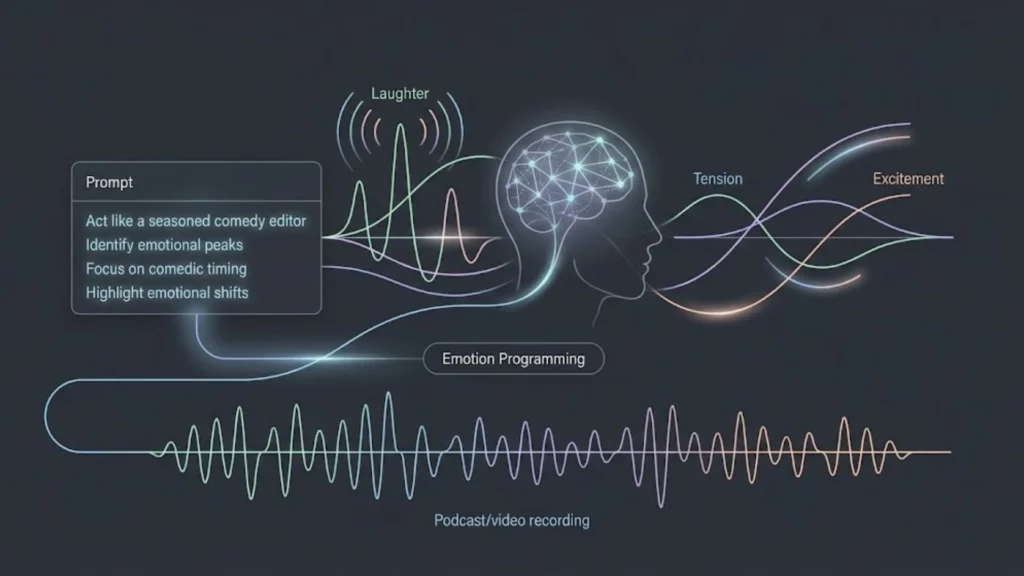
To build a video clip generator that actually works, we need to move beyond traditional prompting. We need to introduce you to Vibe Coding.
In traditional development, you write rigid code to define behavior: if volume > 80db, cut clip. This is brittle. In standard prompting, you ask for a result: Find the funny parts. This is inconsistent.
Vibe Coding is “Emotion Programming.”
It is the process of using Imagine.bo’s reasoning engine to program the feeling of the output. When you build with Imagine.bo, you aren’t just scanning for keywords. You are instructing the AI to “watch” long-form video and identify high-arousal emotional spikes—the “exciting parts” that drive retention.
How the Reasoning Engine Works
Imagine.bo allows you to define a semantic layer over your raw data. You can tell the system:
“I want you to act as a seasoned comedy show editor. Scan this 1-hour podcast. Ignore small talk. Look for moments where the audio waveform spikes indicating laughter, but specifically look for the 30 seconds of setup preceding that laughter. That is the clip.”
This is Vibe Coding. You are programming the editorial instinct that usually takes a human editor years to develop.
Step-by-Step: How to Build Your AI Social Media Manager App on Imagine.bo
Let’s move from theory to execution. How do you actually build an AI social media manager app that rivals a SaaS product, in under 48 hours?
Here is the “Imagine.bo” Workflow for creating a Viral Clip Generator.
Step 01: The Vision (The Prompt)
Everything starts with intent. In the Imagine.bo interface, you don’t drag-and-drop nodes. You communicate your vision in plain English.
Your Input:
“Build an app that extracts 60-second clips from a 1-hour podcast. The selection logic should be based on two factors: sustained laughter from multiple speakers and high-volume speech indicating debate. For every clip, generate a transcript, a viral hook title, and captions for TikTok, LinkedIn, and Twitter.”
Visual Placeholder: Screenshot of the Imagine.bo “Plain-English Interaction” interface. The user is typing the prompt above into a clean, minimal chat window, and the AI is acknowledging the request.
Step 02: The Reasoning (Mapping the Logic)
This is where Imagine.bo distinguishes itself from a wrapper. It doesn’t just send this to GPT-4. It maps a backend logic architecture.
The system breaks your request down into a “Reasoning Chain”:
- Ingestion: Create an upload bucket for MP4/MP3 files.
- Transcription: Deploy a Whisper-large model for timestamped text.
- Sentiment Analysis: Analyze the audio stream for “arousal” metrics (volume, pitch variance) and the text stream for “sentiment” (laughter tokens, CROSSTALK tags).
- The “Vibe” Filter: Cross-reference the audio spikes with the text.
- Logic: If
Audio_Energy > 8/10ANDText_Contains_Controversy = True, mark asPotential_Viral_Clip.
- Logic: If
- Clipping: FFmpeg executes the precise cut, adding a 2-second buffer/pad to ensuring audio isn’t chopped abruptly.
- Generative Output: An LLM reviews the specific clip text to generate the captions.
Imagine.bo visualizes this logic for you, allowing you to tweak the “Vibe” parameters before the code is even written.
Step 03: SDE-Level Execution (The Build)
Once you approve the logic, Imagine.bo compiles the application.
This is critical: You are not building a prototype. You are building a scalable, cloud-native application. Imagine.bo provisions the necessary resources on AWS/GCP (or your preferred cloud provider).
- Database: Sets up a vector database to store podcast embeddings (allowing you to search your video archive later).
- Storage: Configures S3 buckets for media handling.
- Compute: Deploys serverless functions to handle the heavy video processing.
The result is a proprietary URL where you can upload a video, and minutes later, receive your zip file of clips and a spreadsheet of captions. You have effectively built a micro-SaaS.
SDE-Level Architecture: Why “No-Code” Usually Fails (And Why We Don’t)
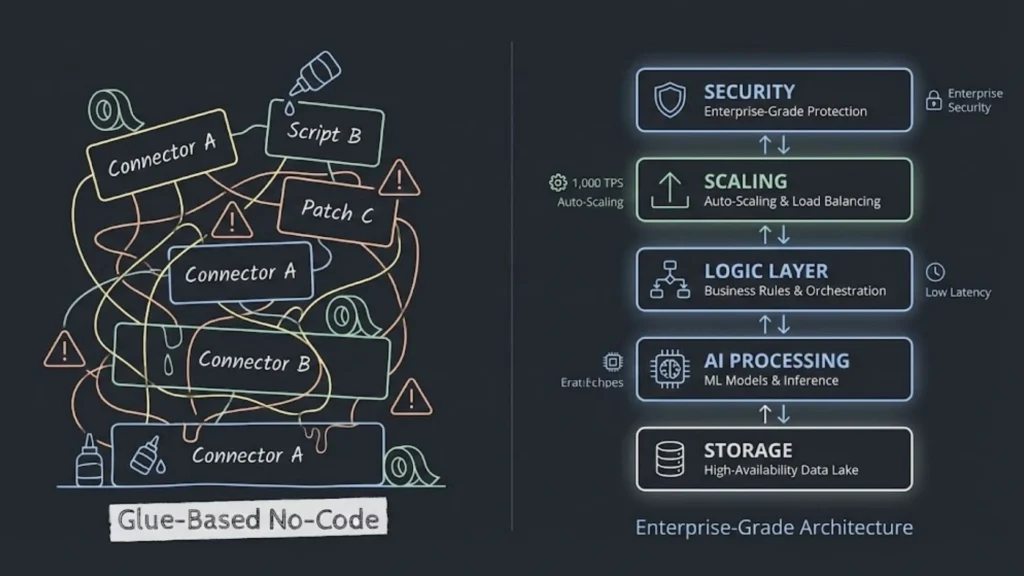
When most founders hear “No-Code,” they think of Bubble or Zapier. They think of glue—fragile connections that break when you try to scale.
To build a video clip generator that handles 4K video and complex AI reasoning, “glue” isn’t enough. You need SDE-level Architecture.
Imagine.bo creates software that adheres to the highest standards of Software Development Engineering.
- 1,000 TPS (Transactions Per Second): Our architecture is designed to handle high concurrency. If you decide to pivot and offer this tool to 500 other creators, the infrastructure won’t buckle. It autoscales.
- Low Latency: We optimize the inference pipelines so that clip generation happens near real-time.
- Security: Enterprise-grade encryption and data handling are baked in by default, not added as an afterthought.
(For a deeper dive into our technical specs, read about our SDE-level Architecture and High Performance capabilities here.)
The “Death of the Generic Ad” and the Future of Viral Content
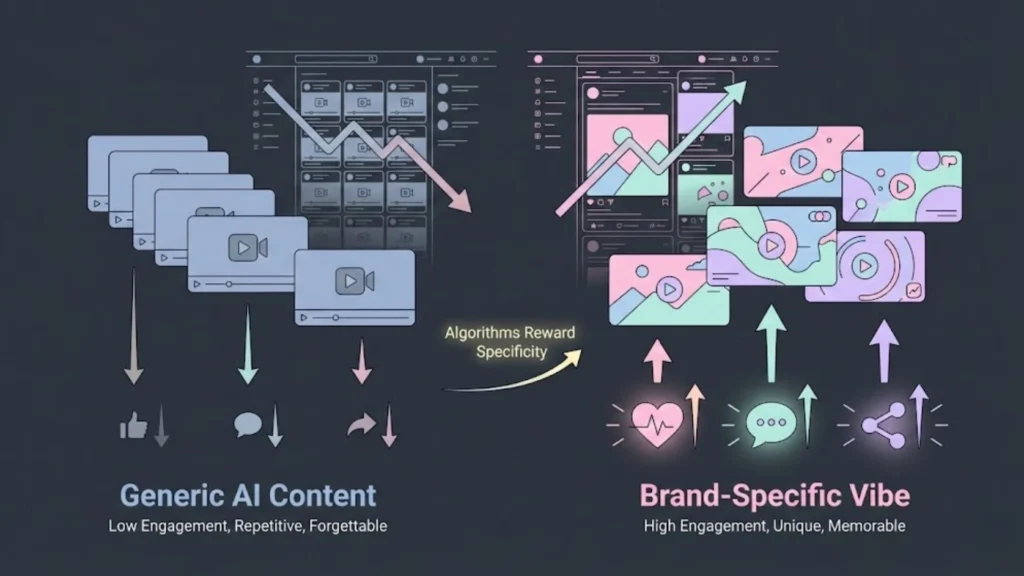
The reason you need to build an AI social media manager app today is because the “Generic Ad” is dying.
Algorithms on TikTok, Reels, and YouTube Shorts have become incredibly sophisticated. They punish generic content. If your clip looks like it came from a “content farm” or a generic AI tool, it gets suppressed.
The winners of the next decade will be the brands that can scale specificity.
- They won’t just post “clips.” They will post clips that align perfectly with their brand’s specific humor or intellectual rigor.
- They won’t use generic captions. They will use captions that speak in their founder’s voice.
By using Imagine.bo and Vibe Coding, you are building a hyper-personalized marketing engine. You are automating the tedious parts of social media (editing, captioning) while retaining 100% control over the creative soul (the “Vibe”) of the content.
Future-Proofing Your Workflow
When the next big platform emerges—whether it’s VR, AR, or a new video app—generic tools will take months to update. With Imagine.bo, you simply update your prompt:
“Update the export format to support the new 3D spatial video standard and change the caption style to fit the ‘Metaverse’ slang.”
And just like that, your proprietary tool evolves.
Conclusion: Stop Renting, Start Building
The era of relying on “black box” tools is over. The technology is now accessible enough for you to own the means of production.
You have a choice:
- Continue paying monthly subscriptions for generic tools that give you generic results.
- Use Imagine.bo to build an AI social media manager app that understands your brand, scales with your ambition, and runs on SDE-grade architecture.
Don’t let an algorithm decide what your best moments are. Define the Vibe yourself.
Ready to build your proprietary engine? Start your Vibe Coding journey with Imagine.bo today.
Launch Your App Today
Ready to launch? Skip the tech stress. Describe, Build, Launch in three simple steps.
Build