

The New Paradigm: Defining the AI Web Builder
The web creation market has, for decades, been defined by a fundamental compromise. Businesses were forced into a binary choice: either pursue high-cost, high-friction custom development or accept the high-efficiency, low-differentiation of template-based systems. The emergence of Artificial Intelligence (AI) website builders represents a “third way,” a new paradigm that resolves this core market conflict by fundamentally restructuring the relationship between cost, speed, and customization.
The Before State: A Market Defined by a Binary Choice
The traditional path to a professional website involved two distinct and flawed options, forcing businesses to choose their compromise.
Launch Your App Today
Ready to launch? Skip the tech stress. Describe, Build, Launch in three simple steps.
BuildThe Custom Development Bottleneck
This path, involving human web developers and designers, offered “full control” over the final product. However, this control was secured at a prohibitive cost. The traditional development process was, by its nature, a high-friction bottleneck defined by three primary barriers:
- Cost: Custom development required significant capital expenditure. A single project often cost $30,000 or more as a one-time expense.
- Time: The timelines for such projects were protracted, with an average launch time of 4 to 12 weeks.
- Skills: This model was entirely dependent on the availability of a specialized team of technical professionals, including developers and designers.
The First-Generation Democratization (and its Limits)
The rise of platforms like Wix, Squarespace, and Weebly in their pre-AI iterations represented the market’s first attempt at democratization. These “drag-and-drop” editors successfully solved for cost and ease of use, making web creation accessible to non-technical users. However, they introduced a new, significant limitation: brand homogenization.
Users were often locked into “template swapping”—choosing a pre-designed layout and manually customizing it. While user-friendly, this process still required “hands-on decisions” and “manual customization” at every step. The reliance on a limited pool of templates meant that many websites began to look and feel the same, making true brand differentiation difficult.
The Third Way: Defining the AI Website Builder
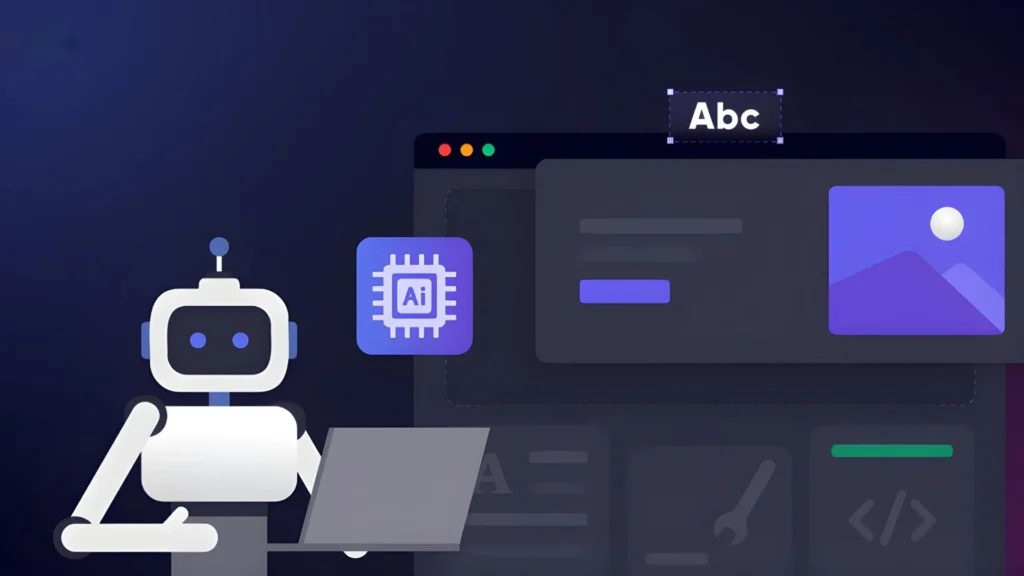
An AI website builder is a tool that utilizes artificial intelligence to assist with, or entirely generate, website layouts, content, and design elements based on simple, natural-language user inputs.
This technology inverts the creation process. The user’s role shifts from a manual creator to a strategic director. The process is no longer about manually manipulating elements but about defining an outcome:
- User Input: The user starts by answering a few setup questions, describing the purpose of the site, the industry, or desired design preferences.
- AI Generation: The AI then “takes a more adaptive approach”. It analyzes “patterns from existing websites” and applies proven design principles to generate a complete “draft layout”. This draft includes a basic site structure, standard pages (like ‘Home’ or ‘Contact’), placeholder content, and initial design elements.
- User Refinement: The user is then presented with this unique, AI-generated foundation, which they can refine and customize using visual editing tools.
This development is significant because it directly resolves the market’s long-standing conflict. Businesses are no longer forced into a binary choice between the high-cost, high-control custom path and the low-cost, low-control template path. AI builders collapse this dichotomy, leveraging generative AI to create unique foundations from scratch, thus breaking the “template trap”. This creates an entirely new value proposition: the speed of a template builder (generating a site in “minutes”) combined with a level of uniqueness that approaches custom design. This new category is a strategic threat to both ends of the old market, offering “good enough” custom design at the price and speed of a template.
Deconstructing the AI: The Technology Stack Explained
To the analyst, “AI” is a marketing term. The revolution of these builders is not magic but the novel integration of three distinct and mature technologies—Machine Learning, Natural Language Processing, and Generative AI—into a seamless production system.
Machine Learning (ML): The Strategic Engine
Machine learning is the most common form of AI in use today, defined by its ability to “learn” from data patterns without being explicitly programmed. In web builders, ML functions as the strategic brain. The models are trained on a “massive pool of design elements, the latest web design trends, and even user behaviors”.
This training allows the AI to perform two critical roles:
- Design Optimization: When the AI generates a layout, it is “applying proven design principles” and offering “context-specific suggestions”. The generated design is not random; it is a data-driven hypothesis for a layout already optimized for user experience (UX) and conversion.
- Data Analysis: ML algorithms analyze live user behavior to provide “data-driven insights” for continuous optimization. This is applied in automated A/B testing and in e-commerce for personalized product recommendations.
Natural Language Processing (NLP): The Human Interface
Natural Language Processing is the technology that enables computers to “interpret, understand, and gather meaning from text data” and human language. In AI builders, NLP serves as the primary user interface, translating human intent into a machine-readable brief.
The user is, in effect, “programming with words”. This is most evident in two applications:
- Prompt Engineering: The user’s primary input is a “prompt,” a natural language description of the task. For example, “Create a website for a modern, minimalist bakery in Brooklyn.”
- Conversational Build: Platforms like Wix and Chariot are experimenting with “conversational interfaces” where the build process is a “chat.” The user iterates by giving commands (e.g., “add a contact form to this page”), and the AI executes the task.
Generative AI (GenAI): The Production Factory

Generative AI is the technology that creates original text, images, video, and other content in response to a prompt. If ML is the strategist and NLP is the interface, GenAI is the automated production floor that manufactures the website’s assets.
Its roles are comprehensive, automating tasks that were previously 100% manual:
- Structural Generation: Tools like Relume can instantly generate complete sitemaps and wireframes from a simple company description.
- Content Generation: Built-in “AI Writers” or “Text Creators” generate all necessary site copy, headlines, blog posts, and e-commerce product descriptions.
- Visual Generation: AI “Image Generators” create custom visuals and “Logo Generators” design branding elements from scratch, reducing or eliminating the need for stock photography.
- Code Generation: More advanced tools can generate functional HTML, CSS, and JavaScript, automating the work of a front-end developer.
These three technologies are not just a bundle of features; they work in sequence to create a seamless, end-to-end “intent-to-product” assembly line. This system represents a paradigm shift from “tool-based creation,” where a human uses tools to build, to “outcome-based creation,” where a human states a desired outcome and the AI delivers a near-finished product. This is the true source of the “revolution”—the automation of the entire creative workflow, from initial strategy to final execution.
Economic and Operational Impact: The Business Case
For business decision-makers, the adoption of AI web builders is driven by a clear and compelling value proposition. This proposition rests on three pillars: radical cost and time reduction, the democratization of access, and the new, high-margin capability of hyper-personalization.
Pillar 1: Radical Speed and Cost Efficiency
The most immediate and quantifiable impact is the radical compression of time and cost.
- Time Compression: The development timeline is fundamentally altered. What traditionally took “4 to 12 weeks” for custom development is now reduced to “hours to days” or, in many cases, “minutes”.
- Cost Collapse: The economic model is inverted. The $30,000+ upfront cost of a custom build is replaced by “low-cost… subscription models”. Platforms like Hostinger offer plans starting as low as $2.99 per month, while others like Wix and Jimdo provide viable free plans for entry-level use.
This shift has a profound operational impact, “reducing dependency on large teams”, eliminating the need for expensive designer fees, and lowering associated overhead and labor costs.
Pillar 2: The Democratization of Professional Creation
AI builders are explicitly “designed for non-technical users“. They “eliminate the requirement for technical expertise” and “coding knowledge”, effectively breaking the technical barrier that previously locked millions out of the market.
This opens professional-grade web creation to a new mass market: “individuals and teams with limited technical resources”, small businesses, side-hustlers, and entrepreneurs. This trend is the next logical evolution of the “no-code” movement, where AI-driven prompts and visual editors replace the need for programming knowledge.
Pillar 3: The Hyper-Personalization Revenue Engine
While cost and speed are compelling, the most significant long-term economic driver is revenue generation through “hyper-personalization”. The traditional web was a static, “one-size-fits-all” experience. AI enables a new, dynamic model.
Hyper-personalization is a strategy that “uses advanced technologies to deliver highly tailored experiences”. The mechanism is data-driven:
- AI models “predict user intent in real-time”.
- They analyze “historical data” and “real-time behavior”.
- Based on this analysis, the website can dynamically adjust its own content, product recommendations, and calls-to-action (CTAs) for each individual user.
Examples of this are ubiquitous in modern tech: Spotify’s curated playlists, Amazon’s product suggestions, or a Starbucks app that predicts an order based on the user’s history and the current weather.
This is not a superficial feature; it is a primary conversion driver. Market analysis shows that 71% of consumers now expect personalization, and 67% report feeling frustrated when they do not receive it. Businesses that successfully implement AI personalization report “increased engagement,” “higher conversion rates,” and “stronger customer relationships”.
The true economic revolution, therefore, is not the cost savings, which will eventually be commoditized. It is the new “value ceiling” unlocked by hyper-personalization. A static, custom-coded $50,000 website is, by definition, the same for every visitor. An AI-driven $50/month site can, in theory, create thousands of unique versions of itself in real-time, “learning” via ML what works and systematically outperforming the static site in conversions. This shifts the competitive battlefield of web design from “aesthetics and features” (a static state) to “adaptation and intelligence” (a dynamic state). The AI-driven site creates a data-driven, competitive “moat” that static sites cannot cross, forcing the entire industry to adopt AI simply to remain competitive.
Market Analysis: A Comparative Review of Leading Platforms (2025)
The AI web builder market is consolidating around several key players, each targeting a different user segment. The following is a comparative analysis of the leading platforms based on 2025 market data.
The All-in-One Leaders: Balancing Power and Simplicity
Wix
Wix has established itself as the “best overall AI website builder”. It offers a mature, hybrid approach. Users can start with Wix ADI (Artificial Design Intelligence), one of an early and successful AI generator, or use a newer “chatbot style” builder. Its primary strength is the most comprehensive “end-to-end” AI feature suite, including an AI Text Creator, AI image creator, AI Section Creator, and AI Meta Tags creator. This makes it the “best for most people”, particularly businesses seeking a balance of powerful AI and a mature, feature-rich ecosystem.
The Budget-Conscious Challenger
Hostinger
Hostinger has aggressively captured the market for “Best AI on a Budget” and “Fast AI Setup”. Its strength is its “prompt-to-site” generator. It can generate a personalized, multi-page website from a few prompts in “less than 30 seconds”. For its low price (starting at $2.99/month), it offers an impressively complete suite, including an AI Writer, AI Image Generator, AI Blog Generator, and AI SEO Assistant. This makes it the ideal choice for beginners, freelancers, and budget-conscious users.
The Design-Forward Incumbents
Squarespace
Squarespace competes on its traditional strength: aesthetics. It is positioned as “Best for Creative Businesses” or “Stunning AI Designs”. Its core AI tool, Blueprint AI, is noted for offering “the most customization options during the AI site-building process”. The focus is less on raw speed and more on producing a high-quality, “stunning” template that serves as a superior starting point for its target audience of creatives, portfolios, and service-based businesses.
Framer
Framer is “best for designers”. Here, AI is a “bonus” that functions as a professional accelerator, not a beginner’s tool. A designer enters a prompt, and Framer AI generates a high-quality wireframe or draft layout. The real product is the advanced, professional-grade visual editor, which gives designers granular control after the initial AI generation. It is built for professionals who want AI to “10x” their workflow but still demand total creative control.
The E-commerce Specialist
Shopify
Shopify remains the undisputed leader for online stores. Its AI implementation is “ecommerce-focused”. Tools like Shopify Magic and the AI assistant Sidekick provide AI-guided support for store setup, theme creation, and—most critically for sellers—generating thousands of unique product descriptions. While pricier, its specialist nature makes it the default choice for online sellers.
Table 1: Comparative Analysis of Top AI Website Builder Platforms (2025)
| Platform | Target Audience/Best For | Key AI Features | Customization Model | Pricing (Starts) | Scalability Rating |
| Wix | “Best Overall” / Most People | AI Site Generator, AI Text & Image Creators, AI SEO Assistant, AI Meta Tags | AI-generated foundation, followed by extensive manual drag-and-drop editing. | Free Plan; $17/mo (Paid) | High |
| Hostinger | “Best Budget” / Beginners | Prompt-to-Site Generator, AI Writer, AI Blog Generator, AI SEO Assistant | AI-first generation (full site in <1 min), then manual editing in a simple editor. | $2.99/mo | Low-to-Mid |
| Squarespace | “Stunning Designs” / Creatives | Blueprint AI (guided setup), AI Text Generator, AI Product Descriptions | AI-assisted template generation with high-quality design, followed by manual editing. | $16/mo (14-day trial) | High |
| Shopify | E-commerce / Online Sellers | Shopify Magic (AI for text, product descriptions), Sidekick (AI assistant) | AI-assisted store setup and content generation within a structured e-commerce platform. | $29/mo (3-day trial) | Very High |
| Framer | Professional Designers | AI-prompt-to-wireframe, AI copy generation | AI generates a starting point, which is then fully controlled by a professional-grade visual editor. | Free Plan; $10/mo (Paid) | High |
| Jimdo | “Best Free Option” / Beginners | Jimdo Dolphin (early AI site generator) | AI generates two starting points, then users perform basic edits in a simple editor. | Free Plan; $11/mo (Paid) | Low |
Critical Limitations and Strategic Risks
A sober, analytical view reveals that AI builders are not a panacea. Adopting these tools without understanding their significant limitations introduces new strategic risks related to creative expression, technical scalability, and brand differentiation.
The Human Intuition Gap: The Failure of Strategy and Soul
The most significant criticism is that AI-generated sites “lack the creative and strategic touch” and “emotional intelligence” of a human designer. The technology is “great at following instructions, not so great at understanding what you actually need”.
AI can execute a command, but it cannot grasp the “deeper brand message”, the “company’s values,” or the empathetic needs of a “target audience”. This “human intuition” gap often results in a “sterile quality” or “generic designs” that “lack creativity and originality”.
The Customization Ceiling and Technical Constraints
AI builders are “effective at creating simple websites” but “lack the ability to implement complex customizations”. This creates a “customization ceiling” that scaling businesses will inevitably hit.
This is a critical failure point. If a business’s needs evolve to require:
- Custom back-end features
- Integration with a bespoke MySQL database
- Complex, unique functionalities beyond the platform’s widgets
…the AI builder cannot accommodate the request. The business is “stuck”. This “platform dependency” creates a significant “vendor lock-in” risk. As a business grows, it may “exceed the platform’s limits”, and migrating an AI-built site is “challenging”. Furthermore, the “no-code” promise is often misleading; effective use still requires expertise in “prompt engineering”, and the AI-generated code itself can be low-quality or even “hallucinated”—as in one case where an AI confidently generated non-existent CSS properties.
The Strategic Threat: The Homogenization of the Web
The single greatest long-term strategic risk is the “homogenization of the web”. “Content homogenization” is the trend of “digital content looking, sounding, and feeling the same”. We have simply replaced the “template trap” of first-generation builders with a new, AI-driven “visual monoculture”.
This is a direct and unavoidable consequence of how the AI models are trained. They are fed “patterns from existing websites” and “proven design principles”. By design, they are “recycling what’s already out there”. This “dilutes brand identity”, “compromises… individuality”, and ultimately makes it “difficult for companies to stand out”.
This exposes a central paradox. The core value proposition of the machine learning engine (analyzing “proven” and “common” patterns) is also the source of its greatest strategic flaw. The AI is, by definition, an “averaging engine,” designed to find the most common successful patterns and replicate them, moving all designs toward a “safe” and predictable mean. The very mechanism that makes AI builders easy (relying on “safe” patterns) is the exact same mechanism that makes them a strategic threat (erasing originality). This creates a visual monoculture where, ironically, the only way to truly differentiate a brand may be to return to human-first, non-AI-driven strategic design.
The Augmentation Imperative: Redefining the Professional
The rise of AI is not an extinction-level event for web professionals. It is, however, a forced evolution. The narrative is not “replacement” but “augmentation” and “collaboration”. The consensus is that AI “can’t replace human judgment, creativity, or connection”.
The Augmentation Imperative: A New Job Description
The “augmentation imperative” dictates that “AI won’t replace developers — it will amplify the best ones”. The human designer is no longer a “pixel pusher” but a strategic partner. AI will automate and commoditize the “lowest end jobs” and “tedious tasks”. This includes:
- “Setting up margins”
- “Creating filler text”
- “Formatting buttons”
- Writing “boilerplate code”
The New Hierarchy of Value: The Rise of Human-Centric Skills
This automation “frees up time” for designers to discard commoditized tasks and focus on high-value, non-automatable work. The most valuable skills in the AI era are, therefore, the most human:
- Strategy and Critical Thinking: “Strategic business problem-solving”, “understanding market analysis”, and the “critical thinking” required to guide the AI toward a correct, non-obvious solution.
- Empathy and Emotional Connection: “Deep understanding of client vision”, “emotional intelligence”, and “understanding user psychology”. These are tasks AI cannot perform.
- Originality: “Creating original ideas”. As AI becomes an “averaging engine,” the human ability to generate a “novel concept” becomes exponentially more valuable.
- Technical Stewardship: The new roles of “prompt engineering”, “quality control”, and possessing the skill to debug the “awful AI-generated code”.
The New Freelance Economy: From Hours to Outcomes
This shift has profound economic implications for the freelance and agency workforce. The “hourly rate” model is breaking. If a task that previously took a freelancer 10 hours now takes 10 minutes with an AI tool, “charging for outcomes, not time” becomes the only viable business model.
Freelancers must “move upstream”. They must stop selling “execution” (which AI is commoditizing) and start selling “strategy, decision-making, and personalized client solutions” (which AI cannot). This will also fuel the rise of the “micro-agency.” AI enables “small, ultra-skilled teams of 2-5 people”, or even a single freelancer leveraging AI, to deliver results that previously required a “small studio or local agency”.
Table 2: The Evolving Skillset: Human vs. AI Task Allocation
| Task | Automated by AI (The “Commodity”) | Augmented Human Role (The “New Value”) |
| Layout & Design | Generates design variations quickly from templates and common patterns. | Strategic branding, emotional connection, and creating unique, customized solutions that defy homogenization. |
| Content Creation | Generates draft text, basic blog posts, and filler copy. | Defining the brand voice, emotional storytelling, and editing/refining AI copy to align with high-level brand strategy. |
| Coding & Debugging | Generates boilerplate code (HTML, CSS, JS) and automates repetitive coding tasks. | Complex system architecture, debugging/fixing AI-generated code, and ensuring ethical/accessibility (WCAG) oversight. |
| UX/UI Testing | Analyzes large user data sets for A/B tests and can simulate user testing. | Empathy and user journey mapping; defining test objectives; interpreting data to solve strategic, non-obvious business problems. |
Future Prognosis: 2026 and Beyond
The current generation of AI website builders is only the first phase of this revolution. The underlying technologies are accelerating, pointing toward a future defined by autonomous agents and a fundamental restructuring of the web’s information architecture.
The Next Evolution: From Builders to Autonomous Agents
The market is already moving beyond “AI-assisted tools” toward “autonomous AI agents”. These are not just tools; they are “AI coding agents” or “AI software engineers”.
- Market examples like Devin are being demonstrated as AI agents that can autonomously plan, code, and debug complex software projects.
- Other platforms like Blitzy claim to “autonomously” build over 80% of enterprise software, leaving only the “final 20%” for human developer oversight.
This trajectory suggests a future where a manager or entrepreneur provides a high-level business goal, and the AI agent manages the entire development lifecycle. This will, as some analysts predict, “cut product development lifecycles in half”.
The New Search Paradigm: The Zero-Click Era of AEO and GEO
Simultaneously, the purpose of a website is being challenged. Traditional Search Engine Optimization (SEO) is becoming obsolete. As users shift from “searching” (Google) to “asking” AI-driven “answer engines” (like Google’s AI Overviews, ChatGPT, and Perplexity), the “zero-click” search is becoming the norm.
This forces the industry to adopt two new, concurrent strategies:
- Answer Engine Optimization (AEO): The practice of optimizing content to be the direct answer that appears in featured snippets and AI-powered answers.
- Generative Engine Optimization (GEO): The practice of optimizing a brand’s content and data to be cited as a trusted source by generative AI models.
The impact on web design is profound. The “user” of a website is no longer just human. Designers must now create “machine-friendly” content, with a heavy emphasis on structured data, FAQ schema, and “answer-first” copy.
Final Conclusion: The Dual-Audience Web
The AI revolution, therefore, is not just in how websites are built, but for whom they are built. Historically, web design was defined as “Human-Computer Interaction”, with a target audience that was 100% human. The rise of AEO/GEO and the “zero-click” era creates a new imperative. If a human user never clicks the link because an AI answered their question, the website has failed as a marketing tool.
Therefore, to survive, the website must be “machine-friendly” first. It must be designed to be “read, updated, and managed” by AI agents. This creates a “dual-audience” mandate for the future of web design.
The web designer of 2026 and beyond must create a site that is:
- Perfectly structured, “machine-friendly,” and “cite-worthy” for the AI crawler that will parse it.
- And still engaging, branded, and emotionally resonant for the human user who eventually arrives.
The AI builder is merely the first step. The true revolution is the creation of an entirely new, AI-augmented ecosystem where designers, developers, and AI agents collaborate to build a web that is no longer a static library of pages, but a dynamic, personalized, and intelligent layer of information, designed for human and machine audiences alike.
Launch Your App Today
Ready to launch? Skip the tech stress. Describe, Build, Launch in three simple steps.
Build