The “One-Size-Fits-None” Crisis in Logistics
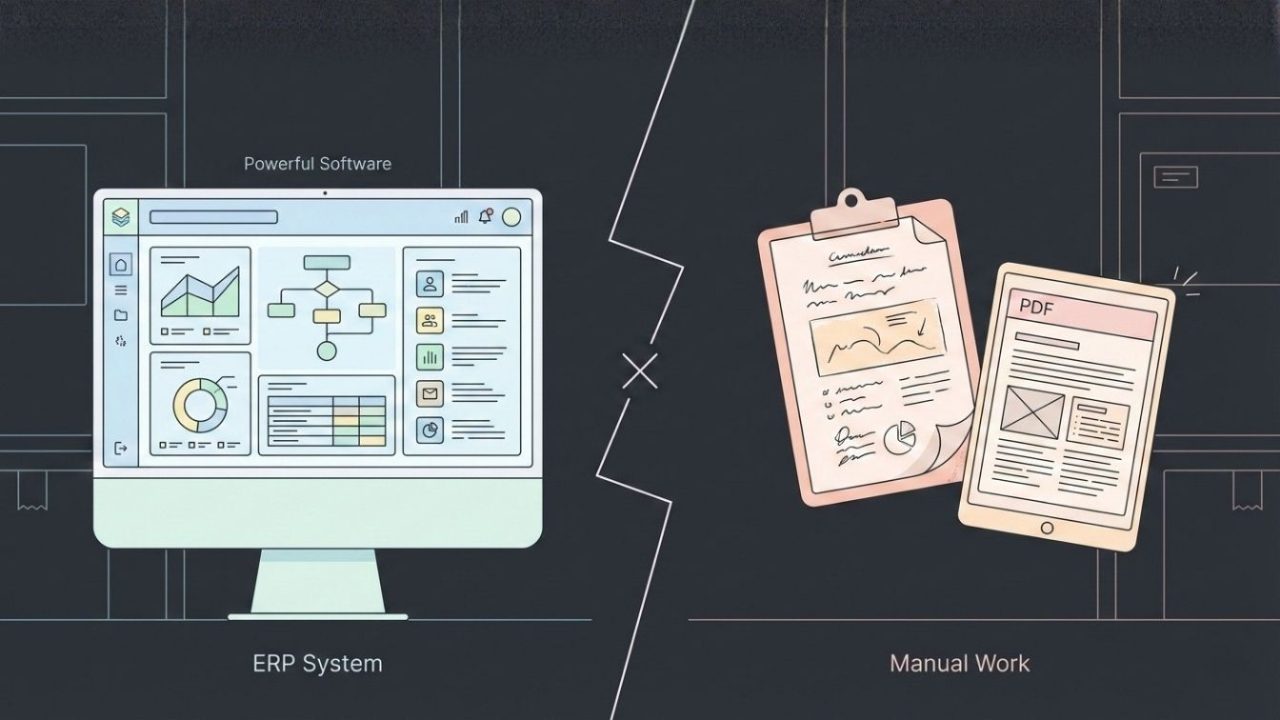
If you walk onto the floor of a mid-sized warehouse or sit in the dispatch office of a regional trucking fleet today, you will likely see a contradiction. On one screen, there might be a sophisticated ERP system like SAP or Oracle, costing tens of thousands of dollars a year. Yet, right next to it, a dispatcher is furiously scribbling notes on a clipboard, or a driver is thumbing through a grime-covered PDF manual on a cracked tablet.
Why does this disconnect exist? Why, in the age of AI, is the “moving world”—logistics, automotive, and supply chain—still running on paper and static files?
The answer lies in the rigidity of traditional software. The logistics industry is too complex, too variable, and too physical for “one-size-fits-all” SaaS products. A predefined fleet management dashboard cannot account for the specific way your drivers handle hazmat handovers. A generic inventory app doesn’t know the unique layout of your repair shop’s parts bin.
For years, the choice has been binary: adapt your business to fit rigid software, or pay millions for custom development.
That era is ending. We are entering the age of the Logistics OS—a customized ecosystem of micro-apps built specifically for your pain points. Thanks to AI-powered development platforms like Imagine.bo, operations managers without a single line of coding knowledge can now build AI apps without code that rival Silicon Valley tech.
This guide explores how you can stop buying software that almost works and start building the AI tools that run your business exactly the way you need.
The “Paper” Problem: Why the Industry Runs on Clipboards
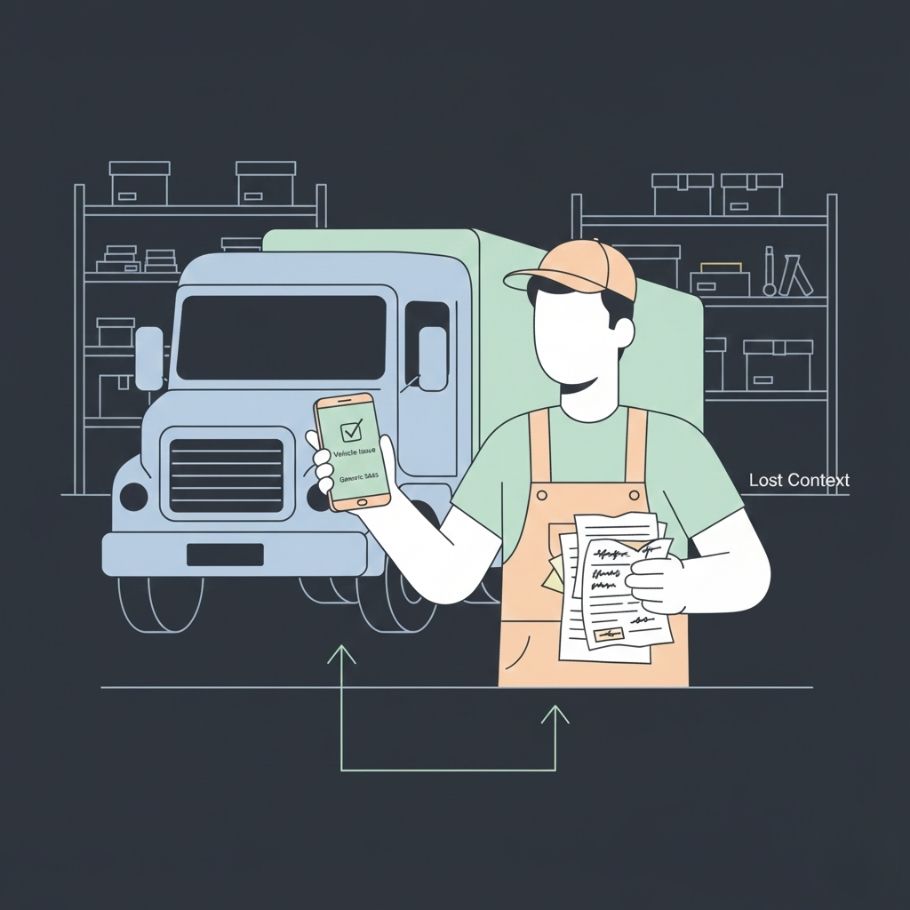
Despite the billions poured into supply chain optimization tools, the “last mile” of information flow in logistics is often analog.
The Hidden Cost of “Good Enough” SaaS
Most commercial fleet management software is built for the “average” user. It tracks GPS location, fuel usage, and basic hours of service (HOS). But operational reality is rarely average.
- The Scenario: A driver notices a strange vibration in the axle during a pre-trip inspection.
- The SaaS Reality: The driver checks a generic box marked “Vehicle Issue” in their app. The fleet manager sees a red flag but no context.
- The Paper Reality: To explain better, the driver writes a note on a paper form or sends a text message. That data is now trapped in a silo, disconnected from the maintenance log.
The Fragmentation of Data
When you rely on disconnected systems—one for dispatch, one for HR, one for maintenance—you create “data dark zones.” A report by StartUs Insights highlights that while 2025 is seeing a surge in fleet management solutions, the challenge remains integration. When your telematics data (Geotab, Samsara) doesn’t talk to your mechanic’s workflow, you lose money.
The “Paper Problem” isn’t just about using physical paper; it’s about the friction of moving information between humans and rigid software. This is why automating internal tools is becoming critical for efficiency. Custom micro-apps solve this by wrapping the software around the process, not the other way around.
The Interactive Revolution: From Static PDFs to AI Chatbots
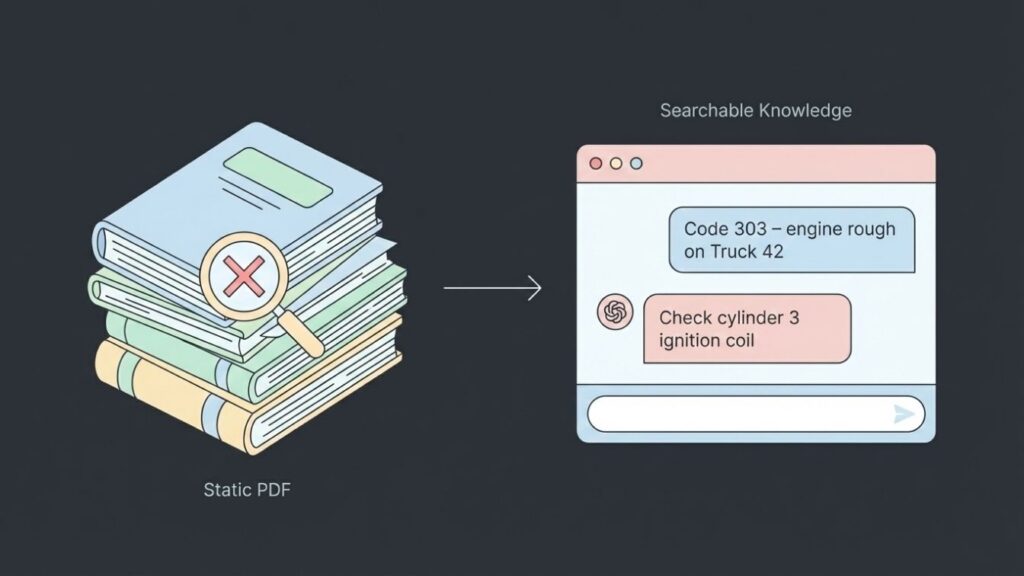
One of the lowest-hanging fruits for custom automotive apps is the digitization of knowledge.
The Death of the PDF Manual
Every fleet has them: massive binders or 500-page PDFs containing vehicle specs, compliance protocols, and repair guides. They are unsearchable, hard to read on a phone, and impossible to update in real-time.
The AI Solution: “How Do I Fix This?”
Imagine a custom app built for your mechanics or drivers. Instead of scrolling through a PDF to find “Code 303 Misfire,” the user simply types—or speaks—into the app. You can essentially create your own AI chatbot platform guide for internal use:
“I’m seeing a Code 303 and the engine is idling rough on Truck #42. What are the likely causes for this specific model?”
Using a custom AI wrapper (which you can build on platforms like Imagine.bo), the app queries your specific uploaded manuals and maintenance history. It responds:
“For Truck #42 (2020 Freightliner), Code 303 usually indicates a cylinder 3 misfire. History shows this unit had spark plugs replaced 20k miles ago. Check the ignition coil on cylinder 3 first. Here is the diagram.”
Why Build This Yourself?
Commercial knowledge base builder software is expensive and often requires per-user licensing fees. By building a custom internal tool, you own the data, you control the interface, and you can deploy it to 500 drivers without your costs skyrocketing.
The Safety Upgrade: AI Listening for Danger
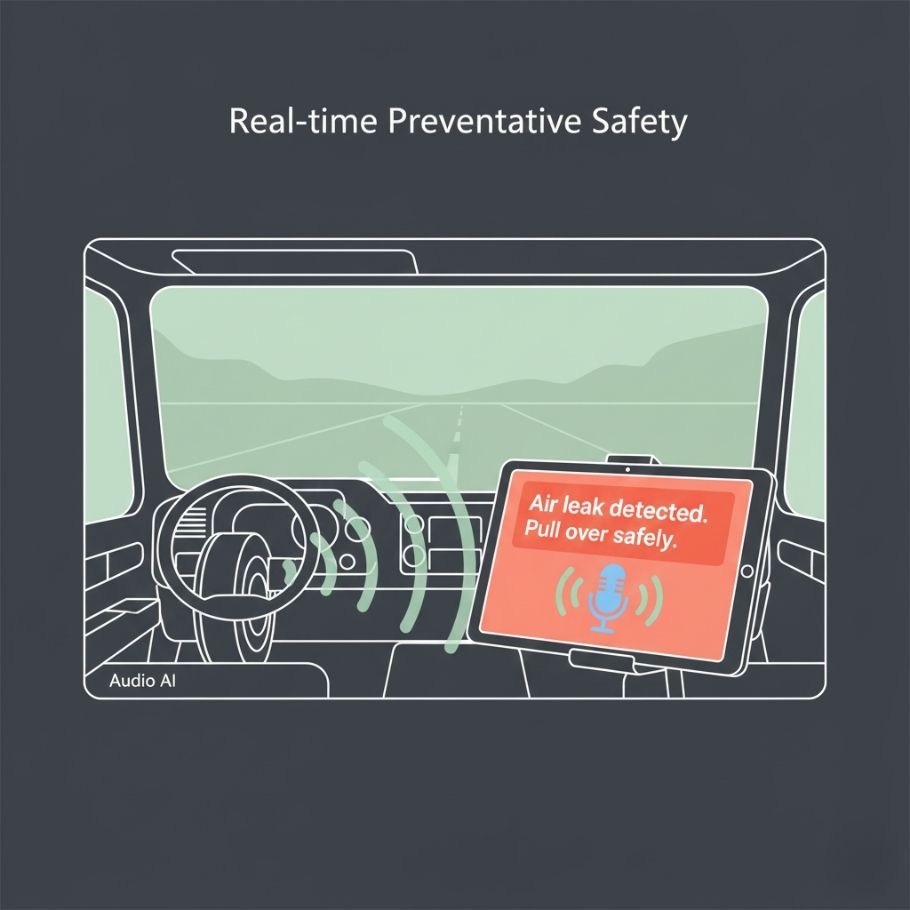
Safety in logistics has traditionally been reactive. You review dashcam footage after an accident. You check logs after a violation. Custom AI tools are moving safety from reactive to real-time.
Audio-Based Intelligence
While video telematics (like Telematics inSights or Lytx) monitors the road, audio AI is an emerging frontier for maintenance and safety. A custom app running on a driver’s tablet can use the microphone to listen for anomalies.
- Use Case: An app detects the specific frequency signature of a grinding brake pad or a leaking air line.
- Action: It alerts the driver immediately, not with a generic “Check Engine” light, but with a specific prompt: “Air leak detected. Please pull over safely and inspect the trailer couplings.”
Google Cloud & The Blueprint
Building this sounds like science fiction, but the infrastructure exists. Google Cloud and other providers offer “AudioSet” data and machine learning models that can recognize thousands of sounds.
- The Builder’s Role: You don’t need to code the audio recognition algorithm. You use a platform to build the interface that connects the driver’s tablet microphone to the AI model, and then routes the alert to the fleet manager.
This is the essence of the Logistics OS: connecting powerful, off-the-shelf AI capabilities into a workflow that saves lives and equipment.
Imagine.bo Feature Spotlight: Building Rugged, Field-Ready Apps
So, how does a Logistics Manager with zero coding experience build an AI-powered mechanic assistant or a custom dispatch tool?
Enter Imagine.bo.
Unlike generic “drag-and-drop” website builders that break when you try to add complex logic, Imagine.bo is an AI No-Code App Builder designed for serious, revenue-ready products. It doesn’t just make “mockups”; it writes SDE-level (Software Development Engineer) code that is secure, scalable, and robust enough for field operations.
How It Works for Logistics
- Describe Your Vision in Plain English: You type: “I want an app for my delivery drivers. They need to scan a barcode, take a photo of the package at the door, and have AI verify that the house number in the photo matches the delivery address. If it matches, log the GPS and timestamp.”
- AI Reasoning Engine: Imagine.bo doesn’t just paste a template. Its AI thinks through the logic: “Okay, we need camera permission, an OCR (Optical Character Recognition) integration to read the house number, a GPS latch, and a database to store proof-of-delivery.”
- Generation & Architecture: The system generates the frontend (what the driver sees) and the backend (the server logic). It ensures the app is AI mobile app builder compatible—crucial for drivers on different devices—and secure (GDPR/SOC2 ready).
- Launch: You get a fully functional application. No hiring a dev shop for $50k. No waiting 6 months.
Why “No-Code” Matters for Logistics
- Agility: Regulations change. Compliance rules shift. If you bought rigid software, you wait for the vendor to update it. With Imagine.bo, you just tell the AI to add a new field for “Hazardous Material Check” and redeploy.
- Cost: You avoid the “seat tax.” Instead of paying $50/month per driver for a SaaS tool, you build your own tool and pay only for the hosting and usage.
The Hybrid Advantage: Telematics & Legacy Systems
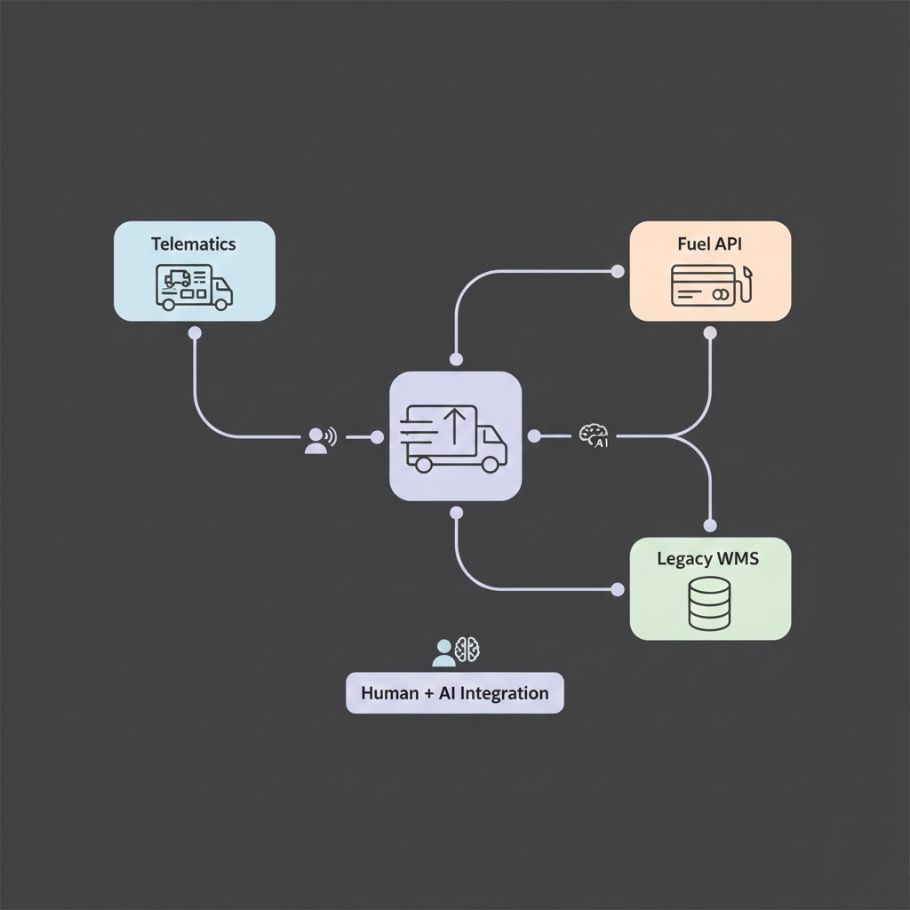
The biggest hurdle in building custom automotive apps is connecting to the “old stuff”—the trucks and the warehouses. This is where Imagine.bo distinguishes itself from basic AI code generators.
The Integration Challenge
You can’t just build a standalone app. It needs to talk to:
- Vehicle Telematics: (OBD-II ports, CAN bus data).
- Legacy WMS: (Warehouse Management Systems like older SAP instances).
- Third-Party APIs: (Fuel cards, toll transponders).
The Human + AI Loop
Imagine.bo employs a unique “Human + AI” model. While the AI builds 90% of the application—the screens, the databases, the user flows—professional developers are available to handle the complex “last mile” integrations. For example, you might want to create a real-time inventory tracker that syncs directly with your legacy SQL database.
Example: The Custom Fuel Tracker
- AI Build: Generates the driver app to log mileage and upload fuel receipts.
- Human Loop: An Imagine.bo expert helps you securely hook into the API of your specific fuel card provider (e.g., WEX or FleetCor) and your telematics provider (e.g., Geotab) to cross-reference fuel purchases with actual vehicle location.
This hybrid approach allows you to build sophisticated “Micro-ERPs” or even build a micro-SaaS specific to your niche that bridges the gaps between your giant systems.
Case Study: The “Micro-App” Strategy in Action
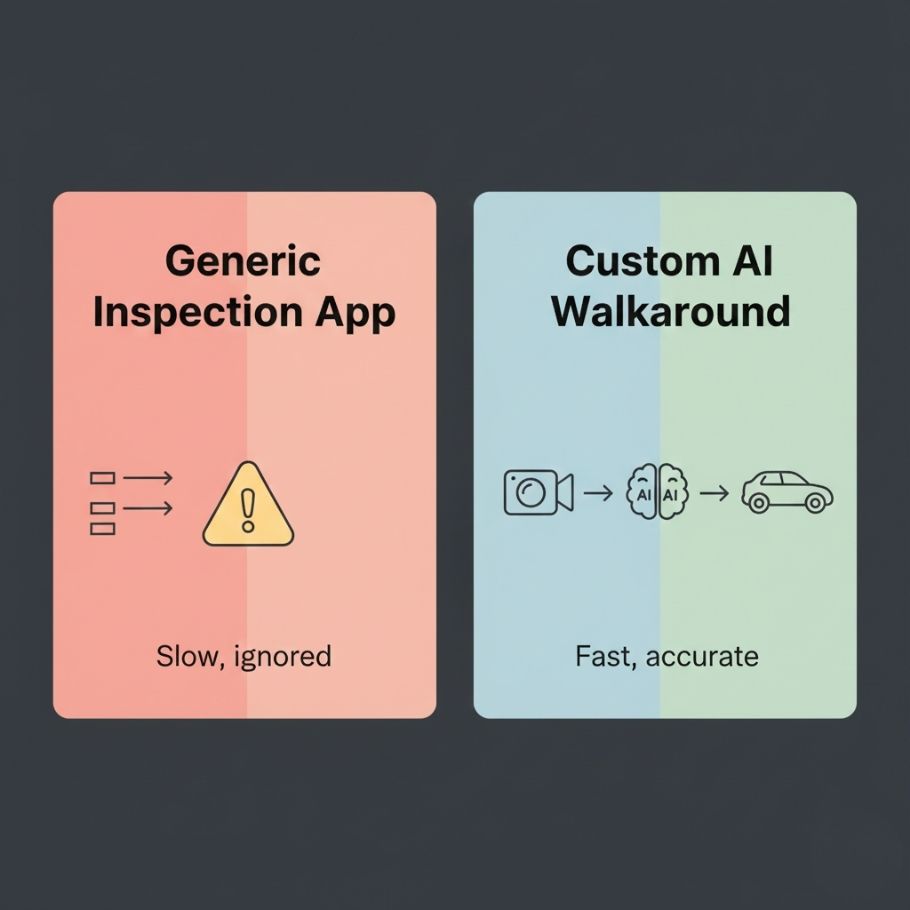
Let’s look at a hypothetical comparison between a standard SaaS rollout and a Custom AI build.
The Problem: “Damage Claims are Too High”
A vehicle transport company is losing money on damage claims. Customers say their cars arrived scratched; drivers say they were scratched at pickup.
The SaaS Solution: Buy a generic “inspection app.”
- Cost: $15/driver/month.
- Friction: Drivers have to click through 20 generic screens that don’t apply to cars (screens about “pallets” or “refrigeration”).
- Result: Drivers hate it, rush through it, and the data is bad.
The Custom AI Solution (Imagine.bo): Build a “Vehicle Walkaround Video Analyzer.”
- Workflow: The driver walks around the car recording a continuous video.
- AI Feature: The app extracts frames from the video, uses Computer Vision to identify existing scratches, and auto-logs them on a 3D model of the car.
- Cost: Development cost (one-time) + hosting. No per-seat license.
- Result: The workflow is faster (just record video), the data is irrefutable, and the app does exactly one thing perfectly.
Conclusion: Own Your Logistics OS
The logistics leaders of 2025 will not be the ones who buy the most expensive software. They will be the ones who can adapt the fastest.
The “Logistics OS” is not a single product you buy off the shelf. It is a collection of custom tools, built by you, for your specific challenges. It is the end of the clipboard and the beginning of the AI-augmented workforce—capable of building internal analytics and dashboards that drive decisions.
With platforms like Imagine.bo, the barrier to entry has collapsed. You don’t need an IT department to build a fleet management system with AI. You just need a vision of how your fleet should run, and the right tool to turn your ideas into apps.
Ready to build your Logistics OS? Stop forcing your operations into rigid templates. Start describing your solution, and let AI build the code. Start Building with Imagine.bo Today
Frequently Asked Questions (FAQ)
Can I really build a fleet management system without knowing how to code?
Yes. Platforms like Imagine.bo allow you to use natural language to describe the features you need. The AI handles the architecture, database, and frontend code.
How does a custom app compare to buying something like Fleetx or Samsara?
Tools like Fleetx are excellent “all-in-one” solutions for general needs. However, if you have unique workflows (specialized cargo, unique compliance needs, or specific hardware integrations), a custom app built on Imagine.bo can supplement or replace parts of these systems to give you a competitive edge.
Is data security an issue with AI-built apps?
It depends on the platform. Imagine.bo generates SDE-level code that includes standard security protocols (GDPR, SOC2 readiness) and secure database handling, making it suitable for enterprise use.
Can these apps work offline?
Yes. For logistics, offline capability is critical. You can request your custom app to cache data locally (on the driver’s device) and sync with the cloud once connectivity is restored.