In the competitive world of tech retail, utilizing an AI Website Builder for E-commerce and specifically an AI Website Builder for Electronics Retailers is the smartest way to secure market share in 2025. Shoppers expect lightning-fast performance and seamless experiences, yet traditional development often stalls growth with high costs and complexity. Platforms like Imagine.bo allow you to overcome these hurdles, enabling you to launch a fully scalable, SDE-level online store in under 48 hours zero coding required. This guide reveals how to bypass technical barriers and build a high-performance, revenue-ready business instantly.
The Unique Challenges of Selling Electronics Online
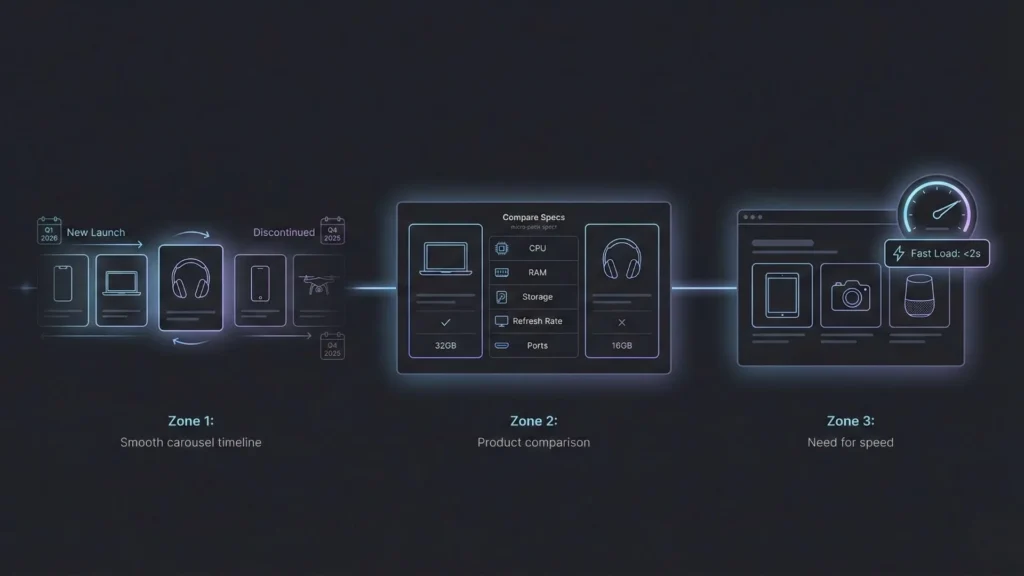
Before diving into the solution, we must understand the problem. Electronics retailing is distinct from selling clothing or books. It requires a technical infrastructure that can support complexity.
Launch Your App Today
Ready to launch? Skip the tech stress. Describe, Build, Launch in three simple steps.
BuildRapid Product Turnover & Seasonal Launches
The tech industry moves at breakneck speed. A smartphone model released today might be obsolete in 18 months. Retailers need the agility to update product lines, launch new collections, and remove discontinued stock in days, not weeks. Traditional development cycles often miss these windows, making it harder to validate your retail business idea quickly.
The “Spec Sheet” Complexity
Unlike a t-shirt (which has size and color), a laptop has a processor type, RAM configuration, storage speed, display refresh rate, and connectivity ports. Shoppers need to see these detailed specs side-by-side. Manually formatting these tables for hundreds of products is a nightmare; automating it is a necessity.
The Need for Speed (Performance)
Tech-savvy shoppers are the most demanding users on the web. They expect sub-2-second page loads. If your site lags while loading a high-res image of a drone, they assume the technology you sell is equally subpar.
Why Traditional Development Falls Short
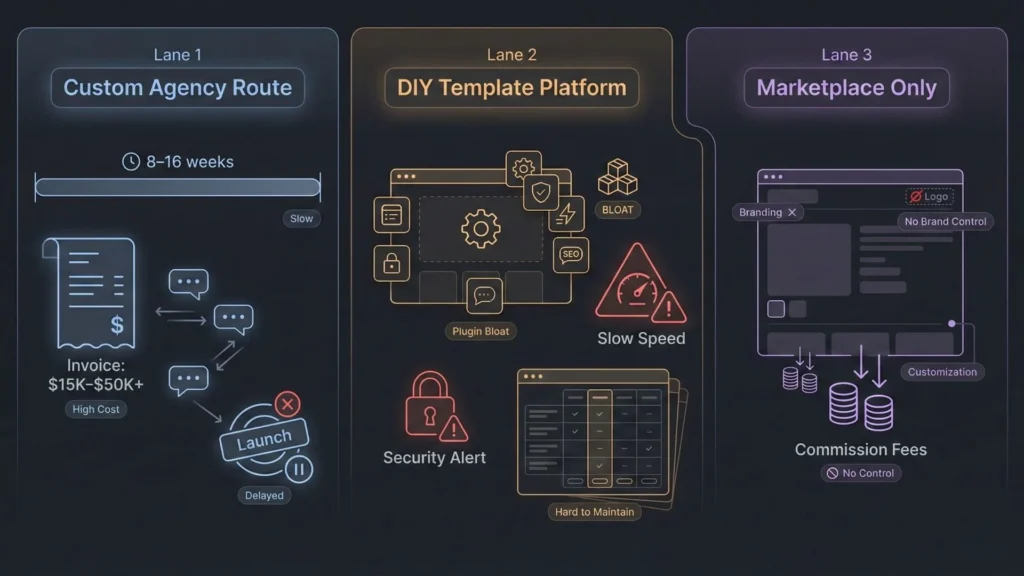
For years, retailers had to choose between three flawed options.
The Custom Agency Route
- Timeline: 8–16 weeks.
- Cost: $15K–$50K+.
- Drawback: While the quality is high, the lead times are too slow for the fast-paced tech world. Plus, expensive retainer fees bleed your margins.
The DIY Template Platform
- Timeline: 2–6 weeks.
- Cost: Monthly subscriptions.
- Drawback: These platforms often suffer from “plugin bloat.” To get the comparison tables and schema markup you need, you install five different plugins, which slows down your site and creates security vulnerabilities.
The Marketplace Only (Amazon/eBay)
- Timeline: Immediate.
- Drawback: You build their brand, not yours. You have no control over the user experience (UX) and pay high commission fees.
Enter Imagine.bo: The AI Reasoning Engine
This is where we see a paradigm shift. We aren’t talking about simple “drag-and-drop” builders anymore. We are talking about AI Reasoning Engines.
Imagine.bo represents a new class of no-code app builders. It doesn’t just paste templates together; it “thinks” through your business logic. It is designed specifically for founders and teams who need to build without developers while maintaining SDE-level (Software Development Engineer) quality.
AI That Builds With Purpose
When you use a platform like Imagine.bo, you start by describing your vision in plain English:
“I sell gaming laptops and accessories. I need a homepage with a hero video, a product catalog with filters for GPU and RAM, comparison tables, and a tech news blog.”
The AI analyzes this input. It understands that “gaming laptops” require heavy image optimization and detailed spec sheets. It understands that “accessories” might need a “frequently bought together” recommendation engine. It generates a blueprint based on business intent, not just visual design.
SDE-Level Architecture
One of the biggest fears retailers have regarding “no-code” tools is the code quality. Is it messy? Is it secure?
Imagine.bo differentiates itself by generating production-grade code. This means the backend logic is scalable, the data handling is secure (GDPR and SOC2-ready), and the architecture follows industry best practices. It’s the kind of code a senior engineer would write, generated automatically.
Human + AI Collaboration
Technology is powerful, but human expertise is irreplaceable. Imagine.bo adopts a “Human-in-the-Loop” approach. While the AI handles the heavy lifting—frontend design, backend workflows, hosting provisioning—senior engineers are available to audit performance and handle complex, bespoke integrations (like connecting to a legacy ERP system).
Essential Features for a Winning Electronics Store
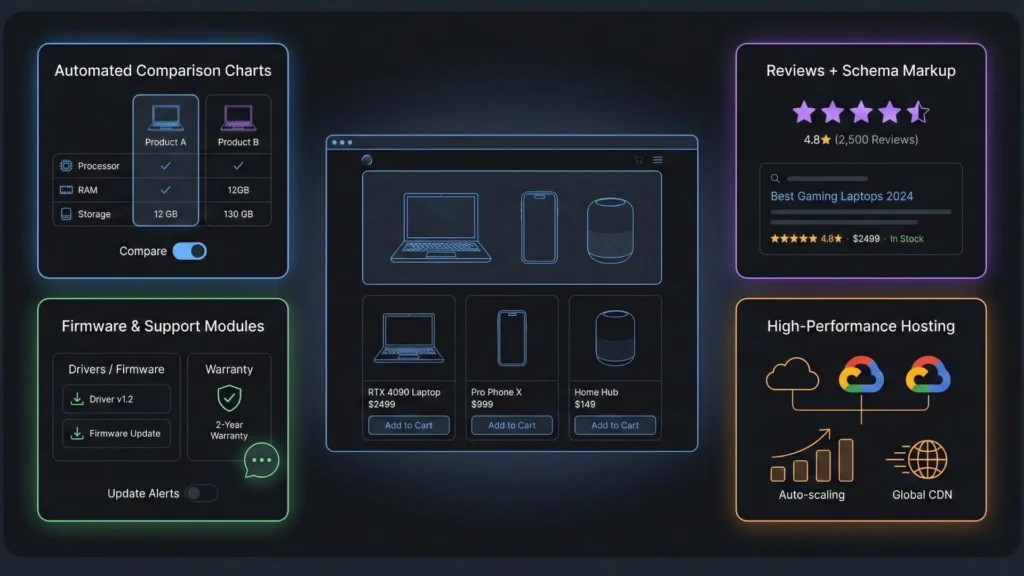
When building your site with an AI builder, you need to ensure specific modules are active to maximize conversion in the electronics niche.
Automated Comparison Charts
Electronics buyers love to compare. They want to see the difference between the iPhone 15 and the 15 Pro side-by-side.
- The AI Advantage: Instead of manually building tables, AI platforms can parse your product descriptions and automatically generate dynamic comparison widgets. This keeps users on your site rather than opening a new tab to Google specs.
Integrated Reviews & Schema Markup
Trust is the currency of the web. For high-ticket items, reviews are non-negotiable.
- The AI Advantage: Imagine.bo can embed review modules that automatically generate Schema Markup. This is code that tells Google, “This product has a 4.8-star rating.” This results in “Rich Snippets” in search results (those yellow stars you see under links), which drastically increases click-through rates.
Firmware & Support Modules
Selling hardware often means supporting software.
- The Feature: You need dedicated sections for driver downloads, firmware update announcements, and warranty information. You may also need real-time chat for technical support.
- The AI Advantage: You can set up subscription modules for update notifications. For example, a “Smart Home” retailer saw a 4x jump in sign-ups by automating firmware update alerts through their site.
High-Performance Hosting
Your site needs to handle traffic spikes during product launches (like Black Friday or a new GPU release). Imagine.bo handles cloud-native deployment (AWS, GCP, Vercel) automatically. It sets up auto-scaling, so your server capacity grows instantly when traffic hits, and shrinks when it subsides, ensuring you never pay for idle server space.
The 5-Step Workflow: From Concept to Revenue
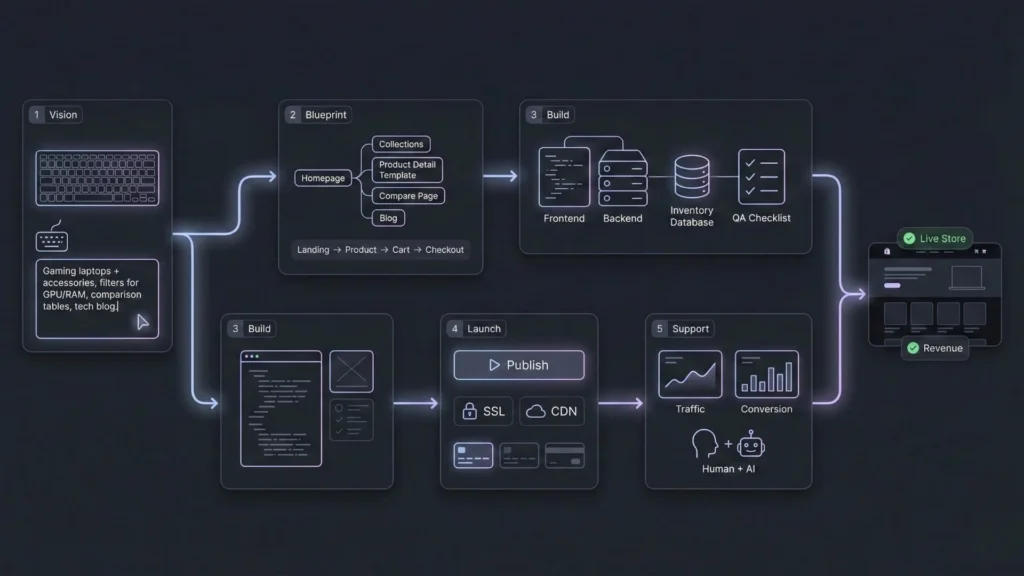
How does this actually look in practice? Here is the workflow for launching an electronics store using Imagine.bo’s methodology.
Step 01: Start With Your Vision
You don’t start with wireframes. You start with a conversation. You describe your product idea, your audience (e.g., “Budget PC Builders”), and your primary goal (Sales? Lead Gen?). The system analyzes this to define the direction.
Step 02: AI Reasoning & Blueprints
The AI applies deep reasoning. It maps user flows—how a customer goes from the homepage to the “Thank You” page. It recommends the tech stack and generates a blueprint. It creates a sitemap that includes collection pages, product detail templates, and blog sections.
Step 03: Seamless Development
This is the “magic” phase. The system generates the frontend (what the customer sees) and the backend (the logic, database, and inventory management). It performs automated QA checks to ensure there are no broken links or logic errors.
Step 04: Launch With Confidence
With one click, the site is deployed. This includes:
- SSL Certificates: For secure transactions.
- CDN Configuration: To ensure images load fast anywhere in the world.
- Payment Gateways: Integration with Stripe, PayPal, or crypto processors.
Step 05: Continuous Support
Post-launch, you aren’t abandoned. The platform provides built-in analytics to monitor usage and growth. If you need to add a complex feature later—say, a 3D product configurator—you can utilize the “Human + AI” support to integrate it.
SEO & Growth: Being Found by Tech Shoppers
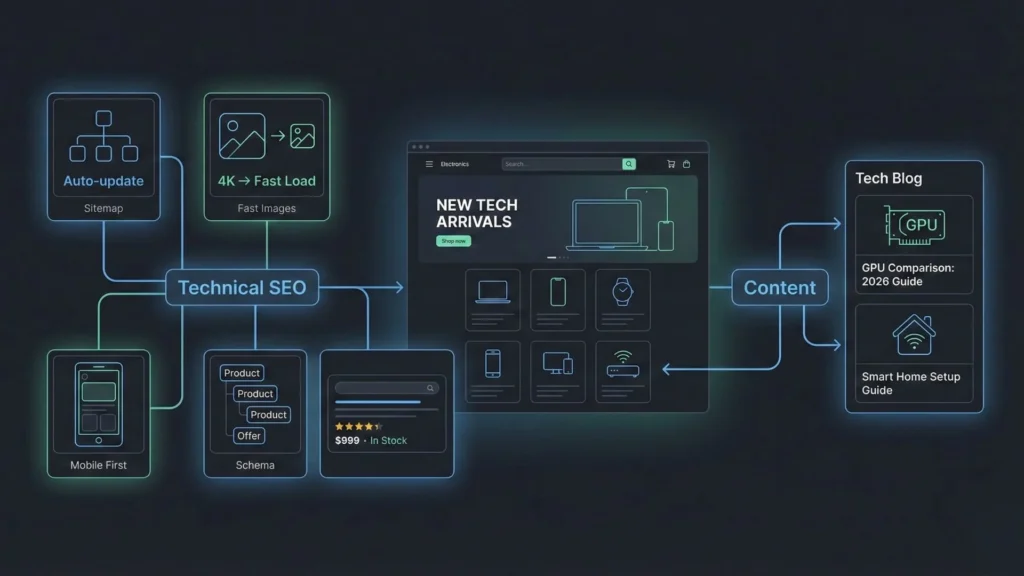
Building the site is half the battle; getting traffic is the other half. An AI builder gives you a massive head start on SEO (Search Engine Optimization).
Technical SEO Automations
Google loves fast, well-structured sites. Imagine.bo handles the “boring” technical stuff that most shop owners forget:
- XML Sitemaps: Auto-generated and updated.
- Image Optimization: Automatically compressing those 4K product photos so they load fast without losing quality.
- Mobile Responsiveness: Ensuring the layout adapts perfectly to smartphones, where over 60% of electronics searches begin.
Content Strategy
Use the blog module to dominate niche keywords.
- Idea: “RTX 4090 vs 4080: Which is best for 4K gaming?”
- Idea: “How to set up your Smart Home Thermostat.”
- By publishing this content, you attract organic traffic. The AI can even help draft these articles based on specs in your catalog.
Real-World Success: AI in Action
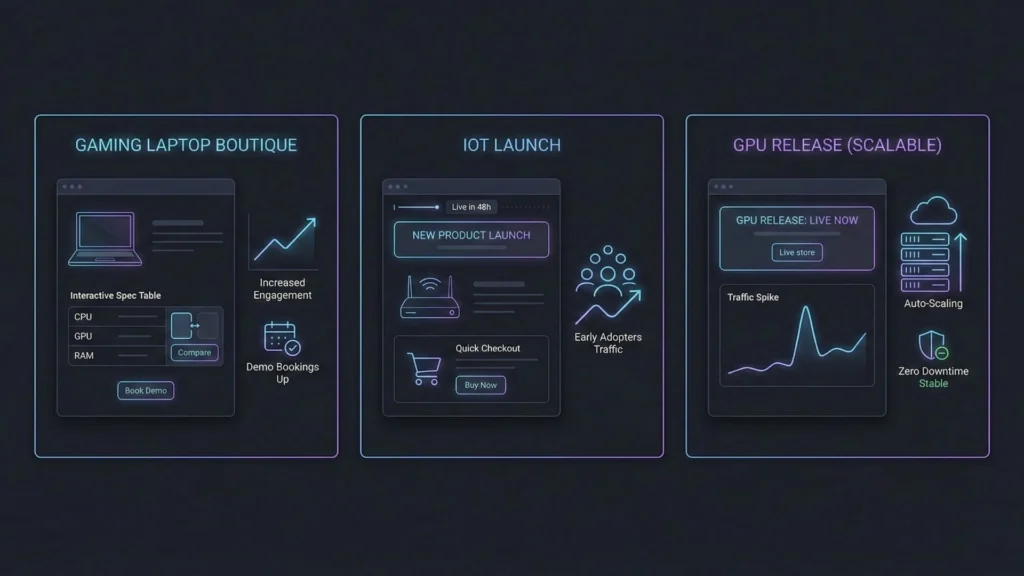
To visualize the impact, let’s look at how this applies to real scenarios in the electronics market.
Use Case 1: The Gaming Laptop Boutique
- Challenge: The retailer struggled to showcase high-end specs in a readable way.
- Solution: They used AI to build interactive spec tables and comparison widgets.
- Result: Bookings for product demos increased by 45%, and the average time users spent on the site rose by 60%.
Use Case 2: The IoT Launch
- Challenge: A startup needed to launch a new Smart Home Hub quickly to beat a competitor to market.
- Solution: Using Imagine.bo’s rapid deployment, they went live in 48 hours.
- Result: They captured the “early adopter” wave, securing a dominant market position before competitors could even finish their wireframes.
Conclusion: The Future is No-Code
The barrier to entry for electronics retail has never been lower, but the standard for quality has never been higher. You cannot afford to be slow, and you cannot afford a buggy website.
Tools like Imagine.bo offer a compelling middle ground: the speed of a template builder with the quality and power of a custom engineering team.
- Speed: Live in under 48 hours.
- Quality: SDE-level code and architecture.
- Scalability: Cloud-native infrastructure that grows with you.
- Cost: A fraction of agency fees (free beta periods often available, followed by reasonable monthly user fees).
For the electronics retailer in 2025, the question isn’t “Should I use AI?” It is “How fast can I start?” By leveraging these tools to streamline your retail operations, you stop worrying about servers and code, and start focusing on what matters: getting the best technology into the hands of your customers.
Ready to power up? Explore the Imagine.bo private beta and witness how your product vision can transform into a revenue-ready reality without writing a single line of code.
Frequently Asked Questions (FAQ)
Do I really need zero coding skills to use Imagine.bo?
Yes. The platform uses natural language processing. You describe your needs in plain English, and the AI handles the coding, hosting, and deployment.
Is the code generated by AI secure enough for ecommerce?
Absolutely. Imagine.bo generates SDE-level code with enterprise-grade security protocols (GDPR, SOC2) and secure backend logic, ensuring customer data is protected.
Can I connect my existing inventory software (ERP)?
Yes. While the AI handles standard integrations, Imagine.bo offers “Human-in-the-Loop” support where senior engineers can help set up custom API connections to your specific ERP or CRM systems.
What happens if my site traffic explodes overnight?
The platform is built on cloud-native infrastructure (like AWS/GCP). It supports auto-scaling, capable of handling up to 1,000 transactions per second, so your site stays up even during flash sales.
Can I build a mobile app with this too?
Yes. Imagine.bo is an App and Website builder. It can help you deploy across platforms to ensure you reach customers wherever they are.
Launch Your App Today
Ready to launch? Skip the tech stress. Describe, Build, Launch in three simple steps.
Build