
Language is perhaps the most human of all skills, yet the tools we use to learn it are becoming increasingly artificial in the best possible way. We are witnessing a quiet revolution in education. It is no longer defined by rigid textbooks or repetitive classroom drills. Instead, it is defined by algorithms that listen, understand, and adapt.
For years, the ability to create these sophisticated language learning tools was gatekept by high costs and the need for elite engineering teams. If you wanted to build an app that could analyze pronunciation or generate dynamic conversations, you needed a team of backend developers, machine learning engineers, and UI/UX specialists.
Launch Your App Today
Ready to launch? Skip the tech stress. Describe, Build, Launch in three simple steps.
BuildThat barrier has crumbled. The convergence of generative AI and advanced no-code platforms has democratized app development. Today, educators, polyglots, and entrepreneurs can build a mobile app without coding in 2026, allowing them to create production-grade language platforms without writing a single line of code. This guide explores how Artificial Intelligence is reshaping language education and provides a practical, step-by-step roadmap for building your own AI-powered platform.
Understanding the Power of AI in Language Learning
The Shift from Static to Dynamic Education
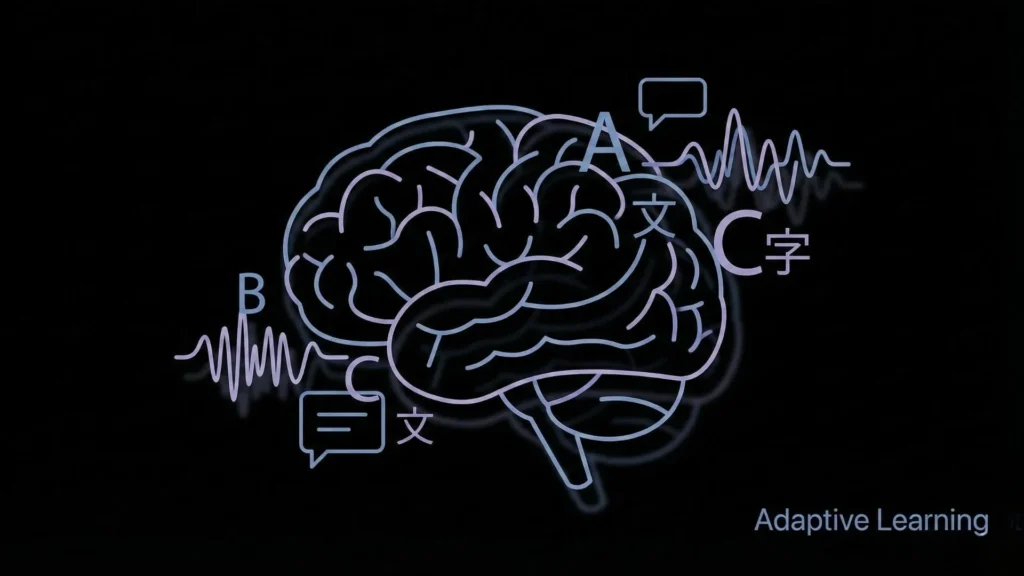
To understand why AI is crucial for your app, you must first understand the limitations of the past. Traditional language apps were essentially digital flashcards. They were static. If you struggled with the subjunctive mood in Spanish or the tonal variations in Mandarin, the app didn’t know. It just served you the next card in the deck.
AI introduces adaptive intelligence. It transforms the learning experience from a monologue into a dialogue. Modern AI algorithms do not just digitize content; they analyze user interaction in real-time. They track variables that human teachers often miss: the hesitation before an answer, the subtle mispronunciation of a vowel, or the recurring grammar mistakes that appear only in specific contexts. For those looking to dive deeper into this shift, checking out an AI language learning apps no-code guide can provide specific industry insights.
Personalization at Scale
The “Holy Grail” of education is one-on-one tutoring. AI makes this scalable. By utilizing Machine Learning (ML), an app can build a unique “knowledge graph” for every user.
- The Struggling Learner: If a user consistently fails listening exercises, the AI automatically simplifies the audio speed or introduces more vocabulary drills before returning to complex sentences.
- The Advanced Learner: For a user who breezes through lessons, the AI skips redundancy, keeping them engaged with higher-level challenges.
This reduces the “churn rate” the number of users who quit because the app is either too hard (frustration) or too easy (boredom).
Key AI Features in Modern Language Apps
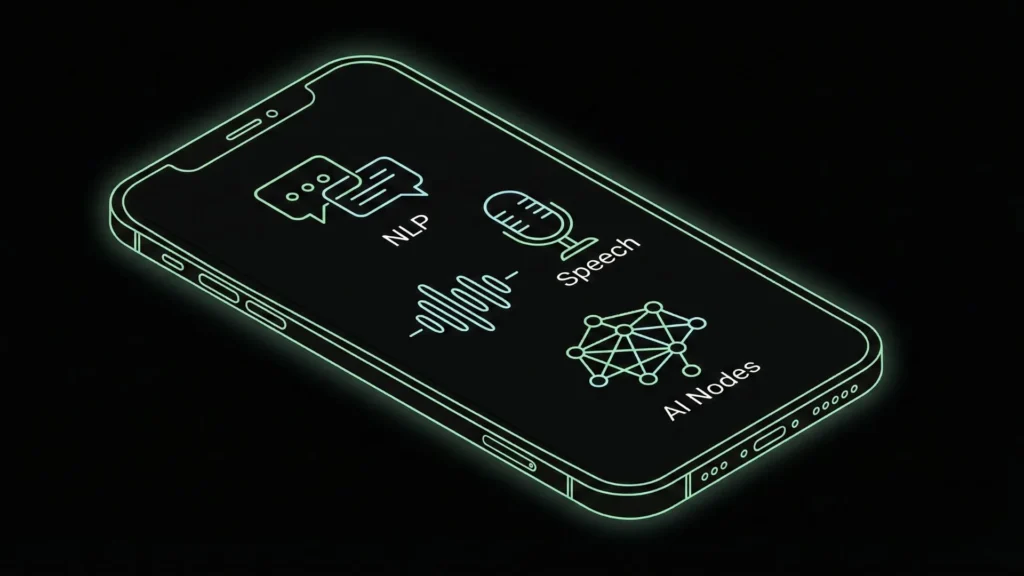
If you are building an app today, you cannot simply offer text and images. Users expect a “smart” interface. Here are the core AI components you need to understand.
1. Natural Language Processing (NLP)
NLP is the brain of your application. It allows the computer to understand, interpret, and generate human language. In a learning context, NLP is what allows a chatbot to hold a conversation with a student. It moves beyond “scripted” dialogues (where the user picks Option A or B) to “open” dialogues, where the user can type or say anything, and the app responds logically. You can learn more about this by following a guide on how to build an AI chatbot to integrate into your platform.
2. Speech Recognition and Pronunciation Modeling
This is often the most critical feature for users. Early apps used simple waveform matching if your sound wave looked like the native speaker’s, you passed. This was often inaccurate. Modern AI uses phoneme-level analysis. It breaks down spoken words into their smallest units of sound.
- Instant Feedback: Instead of a generic “Try again,” the AI can say, “You are pronouncing the ‘r’ too harshly; try curling your tongue back.”
- Accent Reduction: By comparing user speech against thousands of native samples, the AI acts as an accent coach, identifying patterns that impede clarity. To implement this effectively, creators can build your AI voice app no-code to give users hands-free practice.
3. Neural Text-to-Speech (TTS)
Robot voices are a thing of the past. Neural TTS generates audio that includes breath, pitch modulation, and emotional tone. For a learner, this is vital. Hearing a robotic monotone does not prepare you for real-world listening. Hearing a voice that mimics the cadence of a casual coffee shop conversation does.
Benefits and Limitations: Finding the Balance
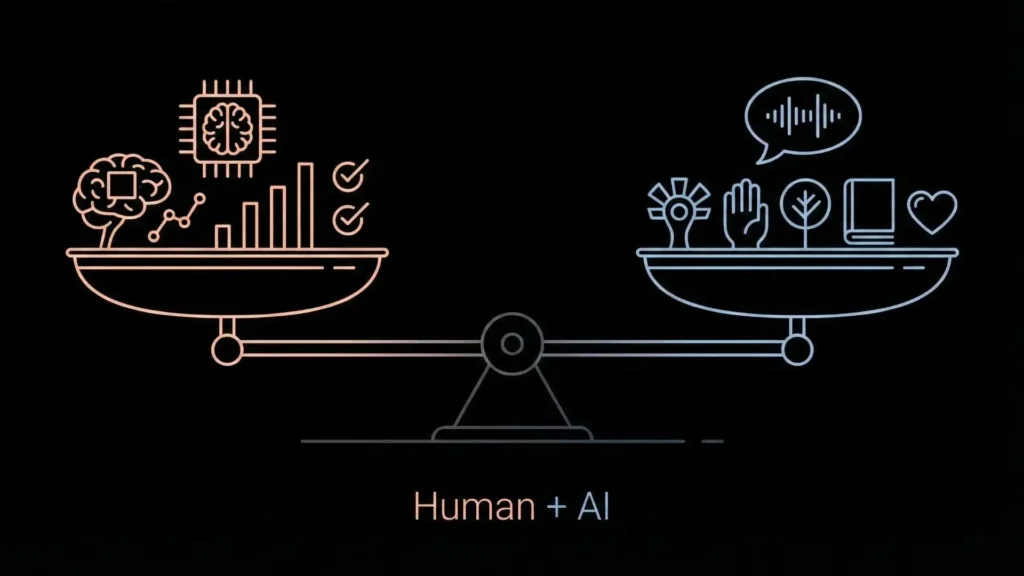
As a founder or creator, you must look at AI objectively. It is a tool, not a magic wand.
Where AI Excels
- Consistency: An AI tutor never gets tired, frustrated, or judgmental. It offers the same level of detailed feedback at 2:00 AM as it does at 2:00 PM.
- Data-Driven Insights: AI can show a user precise metrics: “Your vocabulary has grown by 15% this week, but your grammar accuracy dropped in the past tense.” This gamifies the improvement process.
- Accessibility: AI lowers the cost of education. High-quality tutoring, which was once a luxury service, becomes accessible for a monthly subscription fee.
Where Balance Is Needed AI lacks shared human experience. It can explain how to say a phrase, but it often struggles to explain why a phrase is used in a specific cultural context.
- Idioms and Nuance: AI might translate a phrase literally, missing the slang or cultural subtext that a native speaker would intuitively know.
- Emotional Depth: A machine cannot empathize with the frustration of learning.
The “Human in the Loop” Solution: The best apps use AI for the heavy lifting (drills, vocab, pronunciation) but offer avenues for human interaction, such as community forums or tutor connections, for cultural context. This is part of maintaining ethical AI in no-code, ensuring users are aware of both capabilities and limitations.
Building Your App: The No-Code Route
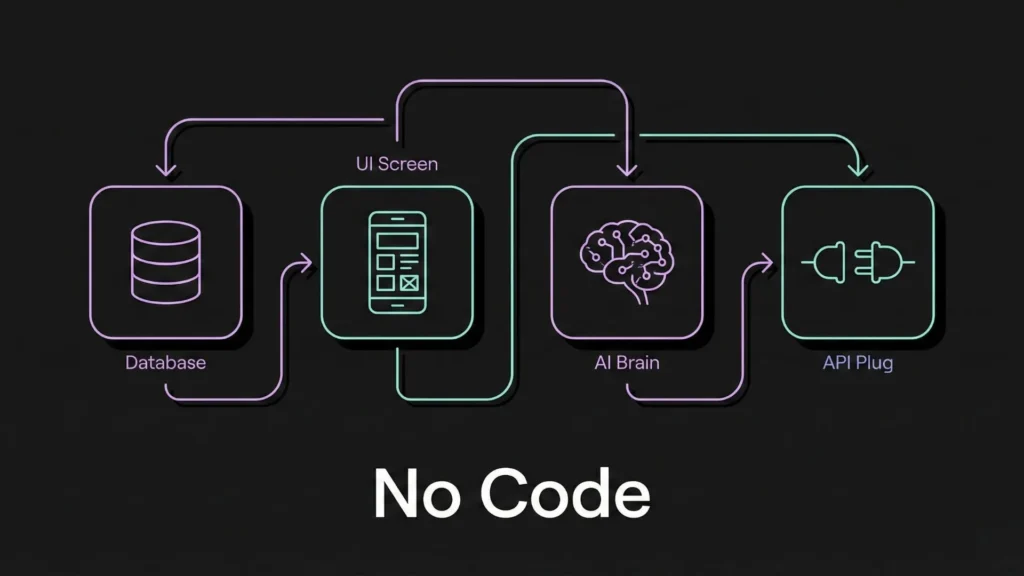
Historically, building an app with these features required funding in the hundreds of thousands of dollars. You needed backend engineers to manage databases, frontend developers for the UI, and data scientists for the AI. No-code development has changed this calculus. It allows visual builders to replace coding. However, the market is flooded with tools. Choosing the right one is the first test of your business strategy.
Popular No-Code Architectures
- Frontend-Focused Tools: These are great for pretty interfaces but often break when you try to add complex logic or heavy databases.
- Database-First Tools: Excellent for managing data but often result in clunky, spreadsheet-looking apps that users hate.
- Enterprise-Grade No-Code: These platforms bridge the gap, offering robust backend logic with high-end design capabilities.
Key Factors to Evaluate
- Scalability: Can your app handle 10 users? Yes. Can it handle 10,000 concurrent users performing voice analysis? Most basic no-code tools will crash. You need an architecture that scales automatically.
- API Integrations: Your app needs to talk to other services (e.g., Google’s Speech-to-Text, OpenAI’s GPT models, Stripe for payments). The platform you choose must handle these “handshakes” securely and efficiently.
- Data Privacy: Language learners share voice data and personal progress. Security is not optional; it is a requirement. Founders should review no-code app security best practices before collecting user data.
Step-by-Step: Building Your AI Language App
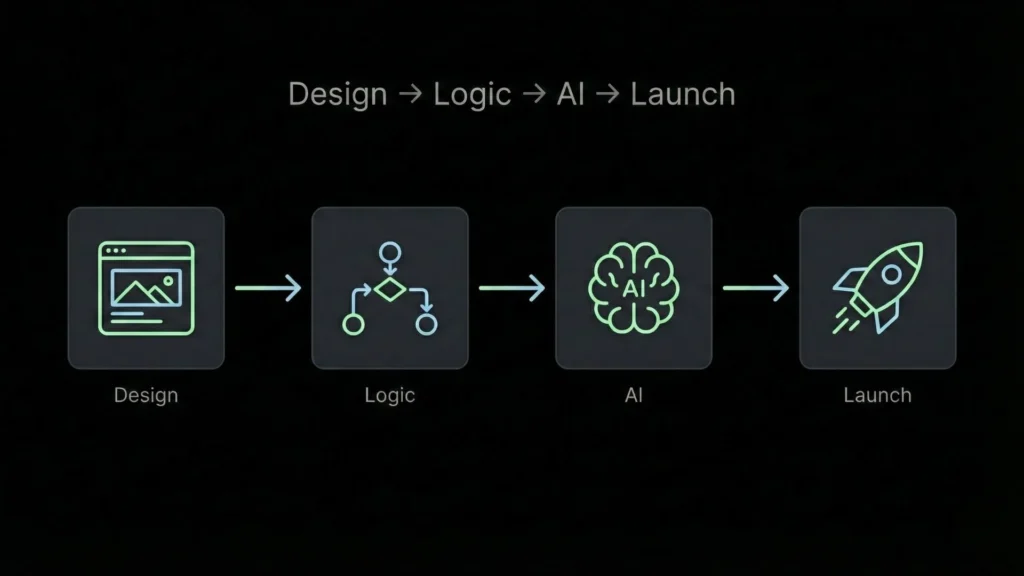
Let’s walk through the actual creation process.
Phase 1: The Blueprint (UI/UX Design)
Before you build, you must design. Language learning imposes a high “cognitive load” the brain is working hard. Your design must minimize distractions.
- Clean Interface: Use whitespace generously. Avoid clutter.
- Progressive Disclosure: Don’t show every feature at once. Reveal advanced tools only as the learner progresses.
- Visual Feedback: When a user gets an answer right, the screen should celebrate (green flashes, subtle animations). When they get it wrong, the feedback should be encouraging, not punitive.
Phase 2: The Core Logic
This is where you define how the app works.
- The Learning Loop: Define the path. User sees word -> User hears word -> User speaks word -> AI analyzes -> AI gives feedback.
- Spaced Repetition System (SRS): You need logic that calculates when to show a flashcard again. If a user answers correctly, show it in 3 days. If incorrect, show it in 10 minutes. This logic must be built into your database. For those moving quickly, you can build your AI app in minutes using prompt-based logic to establish these rules.
Phase 3: Integrating the AI
This used to be the hardest part. Now, it is often just an API connection. If you are ready to turn these concepts into a functional interface, you can start building your AI app for free to see how these integrations look in real-time.
- Chatbot Persona: define your AI tutor. Is it a strict professor or a casual travel buddy? You will feed “system prompts” to the AI to define this behavior.
- Speech Analysis: Connect a voice API. Ensure the app requests microphone permissions gracefully and handles background noise effectively.
Phase 4: Testing and Launching
- Beta Testing: Do not launch to the world immediately. Gather a group of 50 language learners. Watch them use the app. Where do they get stuck? Where do they smile?
- Latency Checks: AI responses must be fast. If a user speaks and waits 5 seconds for feedback, the immersion breaks.
- App Store Optimization (ASO): When you launch, your title, keywords, and screenshots determine if anyone finds you.
Monetization Strategies for Language Apps
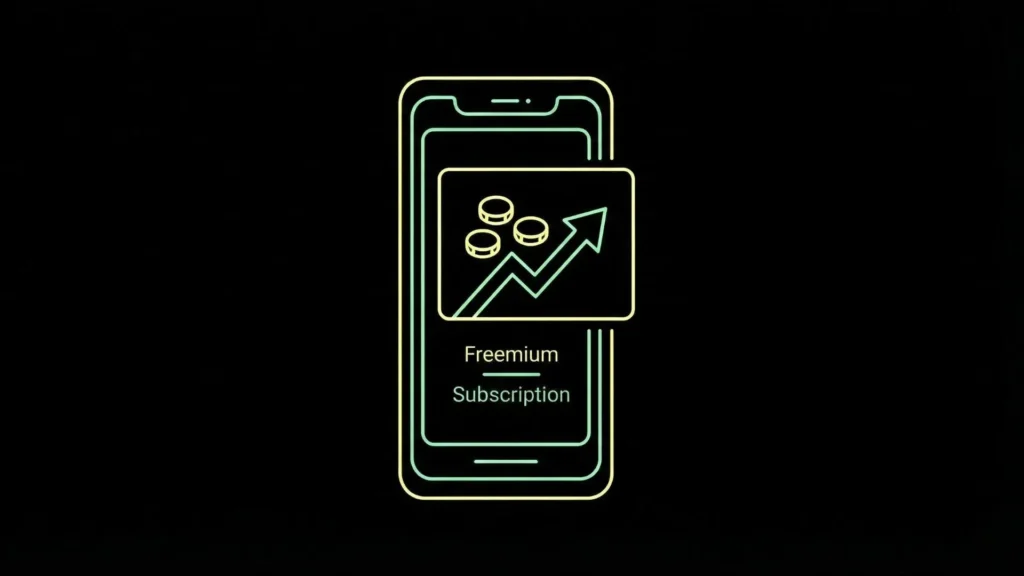
You are building a business, not just a hobby. How will this sustain itself?
1. The Freemium Model
This is the industry standard (think Duolingo). Users get free access to basic lessons, but they pay to remove ads, get unlimited hearts, or access offline mode.
- Pros: huge user acquisition.
- Cons: conversion rates to paid are usually low (1-5%).
2. The Premium Subscription
Users pay a monthly or yearly fee for full access. This works best if your content is highly specialized (e.g., “Medical Spanish” or “Business Mandarin”). To implement this, you can learn how to launch a subscription-based app without developers to manage recurring revenue easily.
3. Usage-Based (Pay-As-You-Go)
Since AI costs money (API fees), you can charge users based on usage. For example, “10 hours of AI conversation practice for $15.” This aligns your costs with your revenue.
Building Smarter, Faster With Imagine.bo
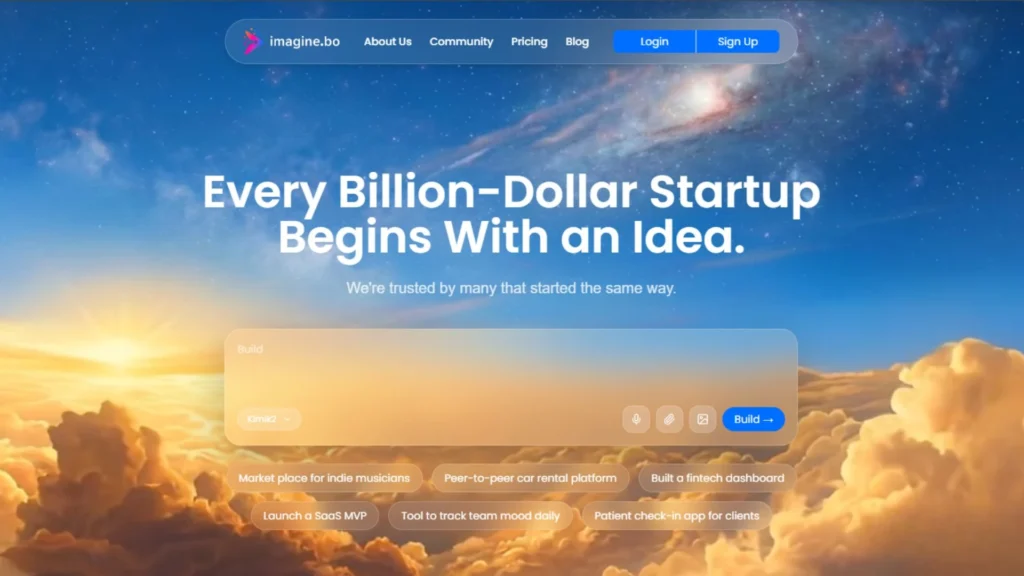
We have discussed what to build. Now, let’s look at how to build it efficiently without getting bogged down in technical debt. This is where a platform like Imagine.bo enters the conversation. Many no-code tools are essentially “toys” great for prototypes but fragile for real businesses. When building an app that processes audio, manages user accounts, and handles recurring subscriptions, you need engineering rigor.
Imagine.bo is different because it is an AI-driven app builder that operates with the standards of a Senior Software Engineer (SDE). It doesn’t just “drag and drop” surface-level elements; it architects the solution. For those starting from scratch, it’s a powerful AI app builder for startups looking to hit the market quickly.
How It Fits the Language Learning Use Case
- Plain English to Code: You don’t need to know how to structure a database for Spaced Repetition. You can simply describe your vision: “I want a language app where users practice speaking, and the difficulty adjusts based on their error rate.” Imagine.bo analyzes this requirement and generates the necessary backend structure.
- Full-Stack Generation: It handles the frontend (what the user sees), the backend (the logic), and the database (the memory). This unifies the development process, eliminating the “Frankenstein” problem of stitching together five different tools.
- Production-Ready Quality: One of the biggest fears with no-code is “lock-in” or “spaghetti code.” Imagine.bo builds with clean, standard code practices. It ensures your app is secure, compliant with data standards (crucial for voice data), and capable of scaling from 100 to 100,000 users.
- AI Integration: Since Imagine.bo is AI-native, integrating things like speech recognition or conversational agents is streamlined. You aren’t fighting the platform to make the AI work; the platform is designed to host it.
Future Trends: What’s Next?
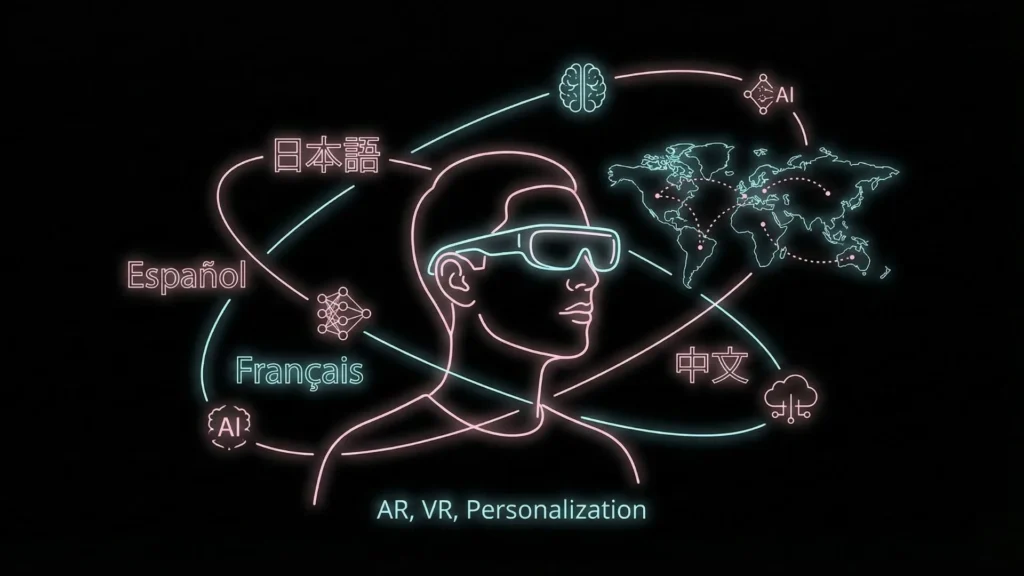
The technology is moving fast. To future-proof your app, keep an eye on these trends.
Immersive and Contextual Learning We are moving toward the Metaverse and AR (Augmented Reality). Soon, language apps will overlay information on the real world. Point your phone at a coffee cup, and the app will display the word in French and pronounce it. Virtual Reality (VR) will allow learners to walk through a simulated Tokyo street, ordering sushi from an AI shopkeeper. You can explore how AI in AR/VR helps build immersive experiences to stay ahead of the curve.
Hyper-Personalization Future apps will know your calendar and your life. If your Google Calendar says you have a flight to Berlin next week, your language app will automatically shift your lessons to “Airport German” and “Emergency Phrases.”
Ethical AI As AI becomes more human-like, ethical responsibility grows. Apps must ensure they do not reinforce biases (e.g., assuming certain jobs are for certain genders in language examples). Transparency about how voice data is used will become a major selling point.
Final Thoughts
The ability to speak another language is a superpower. It opens borders, careers, and minds. For a long time, the ability to teach languages at scale was limited to large institutions. That era is over.
AI has provided the engine for personalized education. No-code platforms like Imagine.bo have provided the vehicle. The only missing piece is the driver. Whether you are a teacher with a unique method, an entrepreneur with a market insight, or a developer looking to move faster, the tools are ready. Launch your AI app today and transform your pedagogical vision into a production-grade reality. Building an AI-powered language app is no longer a distant, multi-million dollar dream. It is a practical, achievable project that you can start today. The revolution is here not just in how we learn languages, but in who gets to build the future of education.
Launch Your App Today
Ready to launch? Skip the tech stress. Describe, Build, Launch in three simple steps.
Build