
A solo founder in 2020 who wanted to build a product, automate their operations, and compete with funded teams needed one of two things: a technical co-founder or a budget large enough to hire engineers. In 2025, they need neither. According to McKinsey, businesses that adopt AI and automation tools are 2.5 times more likely to report above-average revenue growth than those that do not (McKinsey, 2024). The founders who are capturing that growth are not all technical. Many are operators, creatives, and subject matter experts who have learned to describe systems rather than build them. No-code automation has shifted the primary entrepreneurial bottleneck from technical capacity to clarity of thinking. This article covers how that shift is happening, what it means for how businesses are built in 2025, and where the most significant opportunities sit for entrepreneurs who have not yet adopted these tools. For the dedicated guide to how no-code automation is changing the entrepreneurship playbook specifically, this post on no-code automation and entrepreneurship in 2025 covers the specific workflows and tools in depth.
TL;DR No-code automation in 2025 lets entrepreneurs build products, automate operations, and scale customer relationships without engineering teams. According to Gartner, 70% of new applications will use no-code or low-code by 2025 (Gartner, 2021), and the fastest-growing segment is non-technical founders using AI generation to build full-stack products. The transformation is not about replacing developers. It is about removing the development bottleneck from the idea-to-revenue cycle entirely.
The Old Bottleneck and Why It No Longer Applies
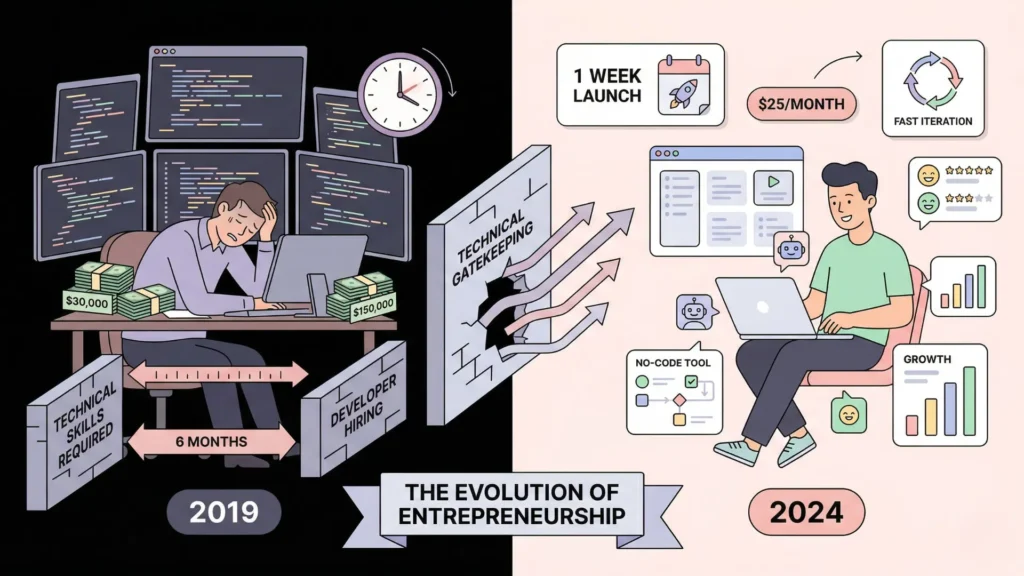
For most of the internet era, the gap between a business idea and a working product was technical. You needed to know how to write code, or you needed to hire someone who did. That meant either a steep personal learning curve, an equity negotiation with a technical co-founder, or a cash outlay of $30,000 to $150,000 for a development agency. Each of those paths was a gatekeeping mechanism that filtered out most potential entrepreneurs before they could test whether their idea had merit.
Launch Your App Today
Ready to launch? Skip the tech stress. Describe, Build, Launch in three simple steps.
BuildNo-code automation has not just made building cheaper. It has restructured the entire cost and time curve of entrepreneurship. A business idea that would have taken six months and $80,000 to reach first user in 2019 now takes a week and $25 per month. The financial risk is so reduced that the decision to build and test is no longer consequential in the way it once was. According to the Kauffman Foundation, new business formation in the United States reached record levels in 2023 and 2024, with a significant portion of new entrants citing low-cost digital tools as a primary enabler (Kauffman Foundation, 2024).
The shift is not purely about cost. Speed matters as much. An entrepreneur who can deploy a working product, put it in front of real customers, collect feedback, and iterate in a week is compressing what used to be a six-month learning cycle into a single sprint. That compression changes the risk calculus of entrepreneurship entirely. For a detailed view of how this shift has elevated non-technical builders into product creators, this post on the rise of citizen developers in the AI era covers the structural change driving this trend.
Three Layers of No-Code Automation That Matter for Entrepreneurs
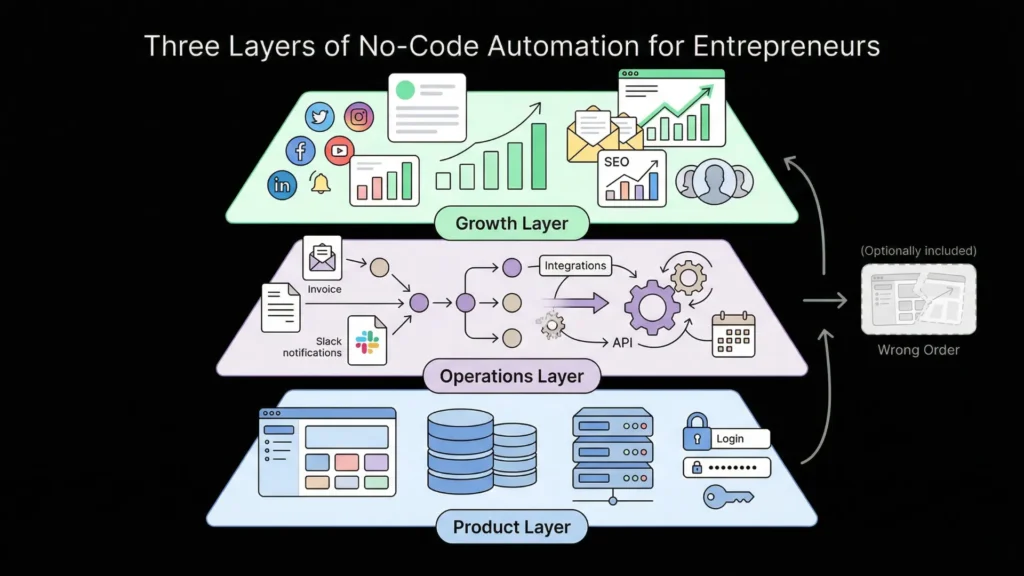
No-code automation operates at three distinct layers for entrepreneurs. Confusing them leads to choosing the wrong tool for the job.
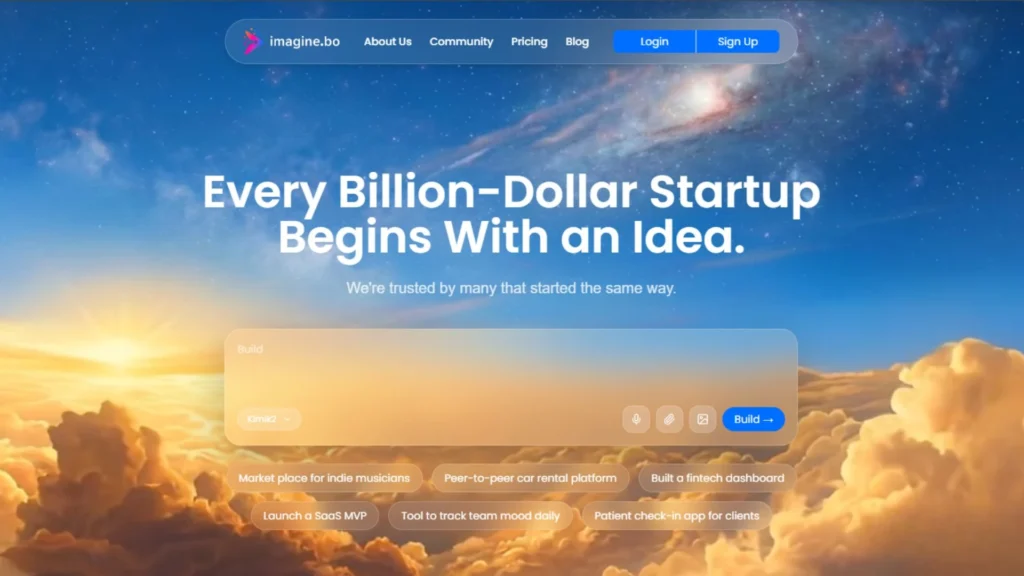
The product layer is where the business itself lives: the web application, the client portal, the marketplace, the SaaS product. This is what imagine.bo’s Describe-to-Build interface generates. A plain English description produces a complete full-stack product with database, backend logic, authentication, and deployment. The product layer is the foundation. Without it, the other layers have nothing to automate.
The operations layer is the workflows that run the business after the product is live: onboarding new customers, sending invoices, scheduling calls, posting content, routing support tickets. Tools like Make, Zapier, and n8n handle this layer by connecting your product’s data to external services and triggering actions based on events. A new customer signs up and a welcome email sequence starts automatically. An invoice is paid and a Slack notification fires. These automations replace the manual tasks that would otherwise consume hours of founder time every week.
The growth layer is how the business acquires and retains customers: social media content, email campaigns, SEO, and community engagement. AI writing tools, social scheduling platforms, and automated reporting tools operate here. The growth layer automates the consistency that most small businesses lack: posting every day, sending newsletters every week, reviewing performance metrics every month.
The entrepreneurs who achieve the most leverage from no-code automation are not those who automate the most tasks. They are those who correctly sequence the three layers. Building the product layer first means there is something worth automating. Automating the operations layer second reduces the time cost of running the product so the founder can focus on growth. Automating the growth layer third compounds the customer acquisition that makes the previous two layers financially worthwhile. Entrepreneurs who start with growth automation before building a product are automating the promotion of something that does not yet work reliably.
What No-Code Automation Looks Like for a Solo Founder in Practice
The best way to understand the transformation is to trace a realistic solo founder’s workflow before and after adopting no-code automation.
Before no-code automation: A consultant wants to launch a client management platform. She spends three weeks writing a brief for a developer. She waits eight weeks for a quote. The quote comes in at $45,000. She negotiates it down to $35,000. She pays a $17,500 deposit. She waits twelve weeks for the first working version. She spends four weeks on corrections. Eighteen months after the original idea, she has a product she cannot afford to change without another development invoice.
After no-code automation: The same consultant describes her client portal in a focused paragraph using imagine.bo’s Describe-to-Build interface. She reviews the AI-Generated Blueprint, corrects two structural issues with follow-up prompts, and confirms the build. One-Click Deployment pushes the frontend to Vercel and the backend to Railway. Within three days she has a working client portal. She uses Make to automate the onboarding email sequence when a new client is added. She uses an AI scheduling tool to handle appointment booking without manual back-and-forth. She uses an AI writing tool to produce her weekly newsletter in 20 minutes instead of two hours. She is running an operation that functions like a small team on a solo budget.
According to Shopify’s Entrepreneurship Index, solo founders using automation tools report spending 65% less time on administrative tasks than those who do not, redirecting that time toward customer relationships and product development (Shopify, 2024). For the specific tools that deliver the most time savings for small teams and solo operators, this post on AI automation for small teams covers the highest-ROI implementations.
The Five Business Functions No-Code Automation Has Transformed
Customer onboarding: Manual onboarding, the welcome emails, the account setup guides, the introductory calls scheduled by hand, used to require dedicated staff time for every new customer. No-code automation turns onboarding into a triggered sequence that fires the moment a new customer signs up. Every customer gets the same quality of first experience regardless of when they join and how many others joined that day. This post on automating customer onboarding with AI covers the specific workflow architecture.
Invoicing and billing: Manually creating and sending invoices, chasing late payments, and reconciling payments against records consumed hours of founder time every month in pre-automation businesses. AI-generated invoicing tools create invoices automatically from time tracking or order data, send them on schedule, send payment reminders at configured intervals, and update payment status without human involvement. For entrepreneurs billing by the hour or by project, this automation alone recovers two to four hours per week. This post on AI invoicing for freelancers without code covers the implementation workflow.
Social media and content distribution: Consistent content publication is one of the highest-leverage growth activities for early-stage businesses and one of the first to be deprioritised when an entrepreneur is busy. No-code automation tools schedule content across platforms, repurpose long-form content into short posts, and track engagement without requiring daily manual attention. For a detailed guide to social media automation with no-code tools, this post on automating social media with AI and no-code tools covers the full workflow.
Internal reporting and analytics: Founders who want to understand their business performance used to build reports manually in spreadsheets or pay for analytics platforms. AI-generated dashboards connected to business data produce automated weekly and monthly reports that surface the metrics that matter without requiring a data analyst. The transition from tracking business data in spreadsheets to having a structured analytics system that updates automatically is one of the most operationally significant changes a founder can make. This post on automating internal tools from spreadsheet to SaaS covers that specific transition.
Customer support: AI chatbots and automated response systems handle the majority of routine customer support queries, routing complex issues to a human and resolving common ones without any intervention. For entrepreneurs who previously spent two to three hours per day answering the same questions, this automation frees significant capacity.
The Competitive Implication: One Person Can Now Compete With Teams
The transformation that no-code automation has produced for entrepreneurship is not just operational efficiency. It is a fundamental change in the competitive structure of many markets. A solo founder using a well-configured no-code automation stack can operate at a quality level that previously required a team of five to ten people.
The most striking aspect of watching no-code automation adoption among first-time entrepreneurs is not the cost savings. It is the confidence change. Founders who previously avoided certain business models because they could not afford the operational overhead to run them at quality now build those businesses because the overhead no longer requires headcount. A subscription product with 200 customers running on automated onboarding, automated billing, and automated support has the same operational cost as one with 20 customers. The unit economics of a solo no-code automated business scale in a way that a manually operated equivalent simply cannot.
According to Deloitte’s 2024 Technology Trends report, solo operators and micro-businesses using AI and automation tools are growing revenue at rates comparable to traditionally staffed businesses twice their size, because the operational leverage of automation allows them to serve more customers at the same quality level without proportional headcount growth (Deloitte, 2024). For the specific strategy of running an entire business at enterprise quality on a single-person budget, this post on single-person startups competing at enterprise scale covers the operational framework in detail.
Where Automation Ends and Judgment Begins
No-code automation does not replace entrepreneurial judgment. It replaces the administrative execution that consumes the time available for judgment. The decision about which customer segment to focus on, which feature to build next, which partnership to pursue, and when to pivot remains entirely human. What automation does is ensure that those decisions are made with reliable data, clean operations, and enough time to think clearly rather than in between answering invoicing emails and chasing late payments.
The practical skill set that creates competitive advantage for entrepreneurs in 2025 is not knowing how to code. It is the ability to describe systems clearly: what data flows through a workflow, what triggers an action, what rules govern an outcome. That description skill is what produces accurate automated systems from no-code tools. According to the World Economic Forum, the most in-demand skills among entrepreneurs who successfully scale businesses are critical thinking, complex problem-solving, and systems design, none of which require technical training (WEF, 2025).
Citation capsule: According to Gartner’s 2025 technology survey, 70% of new applications will be built using no-code or low-code technologies, with the fastest growth concentrated among non-technical founders and operators who use AI-generation tools to build products and automation layers simultaneously rather than sequentially (Gartner, 2021). The convergence of product generation and workflow automation into a single platform capability represents the most significant structural change in entrepreneurship since the advent of cloud hosting.
For a detailed view of how the tools that power this automation stack fit together in a lean startup context, this post on the no-code future for lean startups covers the full toolkit and the sequencing that produces the most leverage.
FAQ
Is no-code automation only for tech-adjacent businesses?
No. The businesses gaining the most from no-code automation are often in traditionally non-technical sectors: professional services, health and wellness, education, creative industries, and local services. Any business that has customers, sends communications, processes payments, tracks data, or manages relationships benefits from automating those functions. According to McKinsey, the highest automation adoption rates are in retail, financial services, and healthcare rather than technology (McKinsey, 2024). This post on AI tools every indie hacker should know covers the full stack of tools that apply across business types.
How much does a complete no-code automation stack cost for a solo entrepreneur?
A full no-code automation stack covering product, operations, and growth typically costs between $50 and $150 per month in 2025. imagine.bo’s Pro plan for the product layer costs $25 per month. Make’s Core plan for workflow automation costs $10.59 per month. An AI writing tool costs $15 to $20 per month. Email marketing automation starts at $0 with generous free tiers on most platforms. The total is less than the cost of a single hour of a developer’s time and replaces what would have been a five-person operations team in a previous generation of business. For a breakdown of which tools deliver the most value at each price point, this post on ways to automate business tasks using AI tools covers the full cost and implementation landscape.
What should entrepreneurs automate first?
The highest-leverage first automation for most entrepreneurs is customer onboarding: the sequence that runs from a new customer signing up through their first successful use of the product. Getting this sequence right means every customer has the same quality of first experience, which directly affects activation rates and early retention. According to Lincoln Murphy, improving activation rates by 10% typically improves monthly recurring revenue by 15 to 20% because activated customers are more likely to retain and expand (Lincoln Murphy, SaaS Growth, 2023). After onboarding, invoicing and billing automation produces the second-highest time savings for most service-based businesses. This post on AI tools versus employees and what to automate in 2025 covers the prioritisation framework in detail.
Conclusion
Three things define the no-code automation transformation in 2025. First, the primary entrepreneurial bottleneck has shifted from technical capacity to systems clarity. The founders who move fastest are those who can describe what they want to build with the specificity a generator needs, not those with the deepest technical knowledge. Second, the cost of testing a business idea has dropped to a level where failure is affordable and iteration is the strategy rather than the fallback. Third, the solo operator running a well-automated business can now match the operational quality of a traditionally staffed team at a fraction of the cost, which changes the competitive dynamics in markets that used to require scale to compete.
imagine.bo’s free plan provides 10 credits per month to build and deploy a first version at zero cost. The Pro plan at $25 per month provides the full product generation, rollover credits, and on-demand engineering support for the business logic that goes beyond what prompts handle alone. For the full strategic picture of how prompt-driven development reshapes the economics of starting and scaling a business, this post on why prompt-driven development transforms the startup equation covers the competitive implications in depth.
Launch Your App Today
Ready to launch? Skip the tech stress. Describe, Build, Launch in three simple steps.
Build