
The software industry is experiencing a seismic shift. For years, the barrier to entry for building a digital product was technical fluency: you either knew how to code, or you had the capital to hire someone who did. Revolutionizing app development isn’t just about making things faster; it is about fundamentally changing who can build and what can be built. We are moving from an era of manual assembly to an era of intelligent generation, where Artificial Intelligence acts not merely as an assistant, but as a technical architect.
This is your guide to understanding how advanced AI app builders are redefining the digital landscape, enabling founders to bypass the “scalability trap” of traditional tools and deploy production-grade software instantly.
Beyond Drag-and-Drop: What Are AI-Based App Builders?
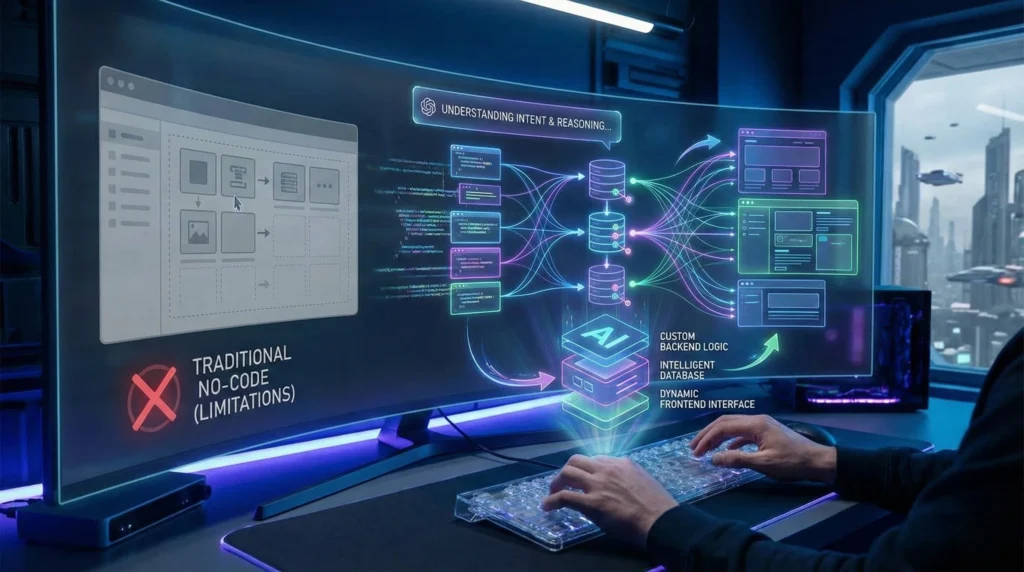
To understand the future, we must first look at the limitations of the recent past. Traditional no-code platforms were essentially visual editors. They allowed you to drag pre-made widgets onto a canvas, which the platform would then translate into static code. While excellent for simple prototypes or landing pages, these tools often hit a hard ceiling when logic became complex or data structures became intricate.
AI-based app builders represent a complete departure from this model. Instead of asking you to manually assemble pieces, these platforms utilize Large Language Models (LLMs) and advanced inference engines to understand the intent behind your application. They don’t just paste code; they reason through the requirements, generating custom backend logic, database schemas, and frontend interfaces that are tailored specifically to your business needs.
The Engineering Gap: AI Reasoning vs. Basic Automation
A critical distinction exists between tools that automate tasks and platforms that engineer solutions.
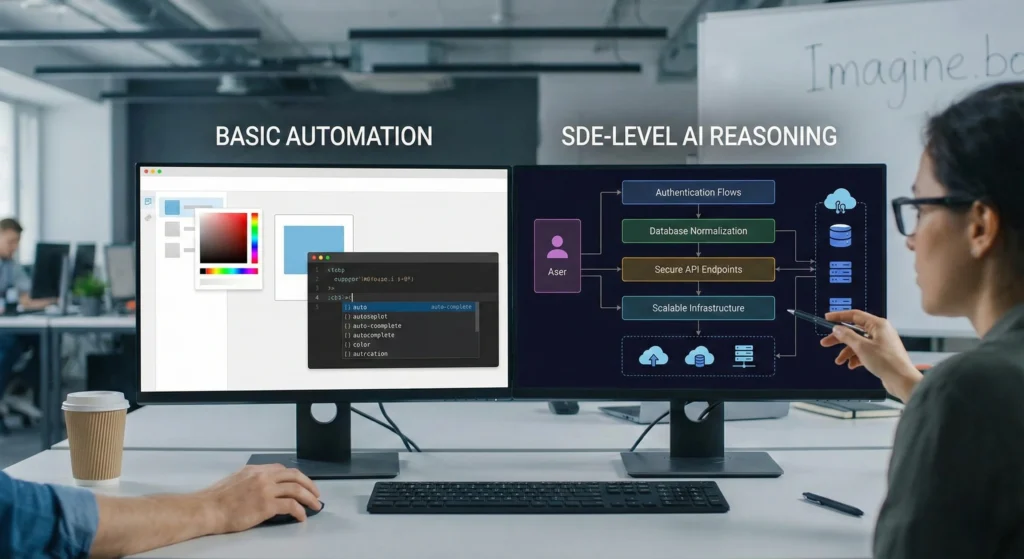
- Basic Automation: A tool that suggests a color palette or auto-completes a line of code. It speeds up manual work but doesn’t replace the need for engineering knowledge.
- SDE-Level AI Reasoning: This is the standard set by platforms like Imagine.bo. Here, the AI mimics the decision-making process of a Senior Software Development Engineer (SDE). It asks the “why” and “how” before writing a single line of code.
For example, if you ask for a “marketplace app,” an SDE-level AI understands that you need more than just a product feed. It inherently knows you need:
- Authentication flows for buyers and sellers.
- Database normalization to handle inventory and transaction history efficiently.
- Secure API endpoints to process payments without exposing sensitive data.
- Scalable infrastructure to handle concurrent users.
This reasoning capability ensures that the apps you build are not just visually appealing, but structurally sound and secure by design.
How Imagine.bo Turns Ideas into Revenue-Ready Apps
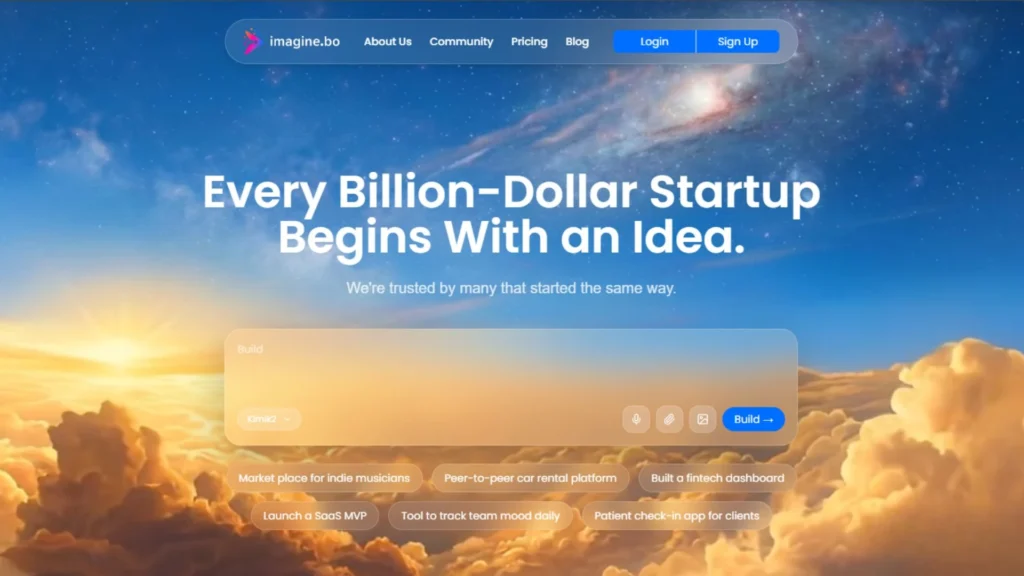
The promise of Imagine.bo is simple: turn natural language into deployed software. The process bridges the gap between a founder’s vision and technical execution.
- Intent Analysis: You describe your idea in plain English. “I want a CRM for freelance photographers to manage bookings and deliver galleries.”
- Architectural Blueprinting: The AI analyzes this prompt to determine the necessary tech stack, database relationships (e.g., linking ‘Clients’ to ‘Galleries’), and user permissions.
- Code Generation & Assembly: unlike generic tools that rely on rigid templates, Imagine.bo generates fresh, semantic code. It builds the backend logic, connects the APIs, and designs the frontend UI simultaneously.
- Cloud-Native Deployment: The application is deployed directly to a scalable cloud environment. This means your app is live, accessible, and ready for users instantly, without you needing to configure servers or manage hosting environments.
The Comparison: Imagine.bo vs. Generic AI Builders
Not all AI tools are created equal. When evaluating your guide to AI-based app builders, it is crucial to look under the hood.
| Feature | Generic AI App Builders | Imagine.bo (Engineering-Grade) |
| Core Technology | Text-to-UI (Visual focus only) | Text-to-App (Full-stack generation) |
| Backend Logic | Limited to basic CRUD operations | complex business logic & data relationships |
| Scalability | Often shared hosting, crashes under load | Scalable SaaS architecture (Cloud-native) |
| Security | Basic SSL; reliance on plugins | Enterprise-grade API security & data privacy |
| Customization | Restricted to template limits | Deep customization via AI reasoning |
| Ownership | Platform lock-in | high exportability and code ownership |
Real-World Use Cases: Who Is This For?
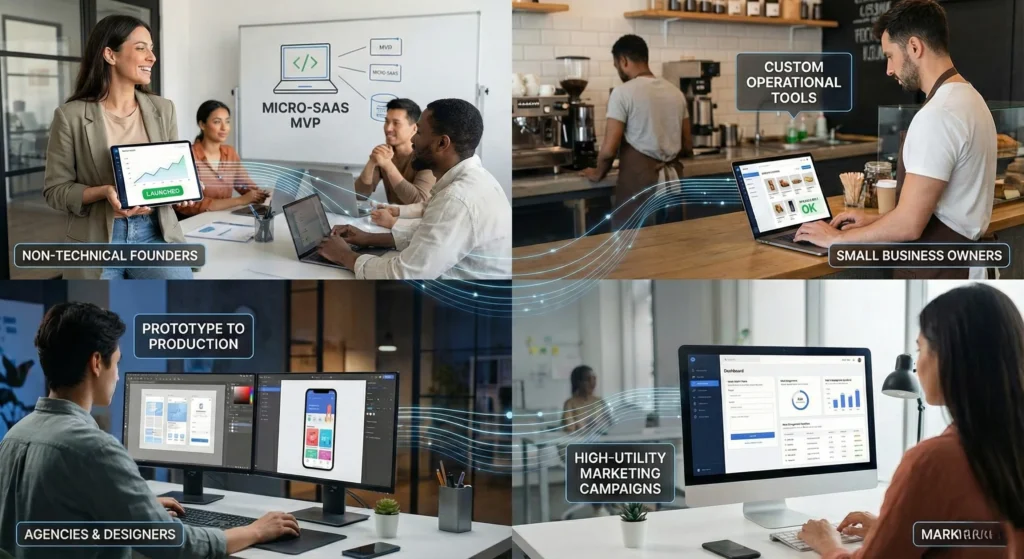
The democratization of SDE-level engineering opens doors for a wide array of innovators:
- Non-Technical Founders: Launch a Micro-SaaS or MVP in days, not months. Test your market hypothesis with a working product rather than a slide deck.
- Small Business Owners: Distinct from generic “website builders,” you can create custom operational tools—like inventory trackers, employee scheduling apps, or client portals—that fit your exact workflow.
- Agencies & Designers: Prototyping becomes production. Deliver fully functional apps to clients faster, increasing your service value and margins.
- Marketers: Spin up high-utility marketing tools or interactive campaigns that go beyond simple landing pages to capture leads and engage users.
Core Benefits of Engineering-First AI Platforms
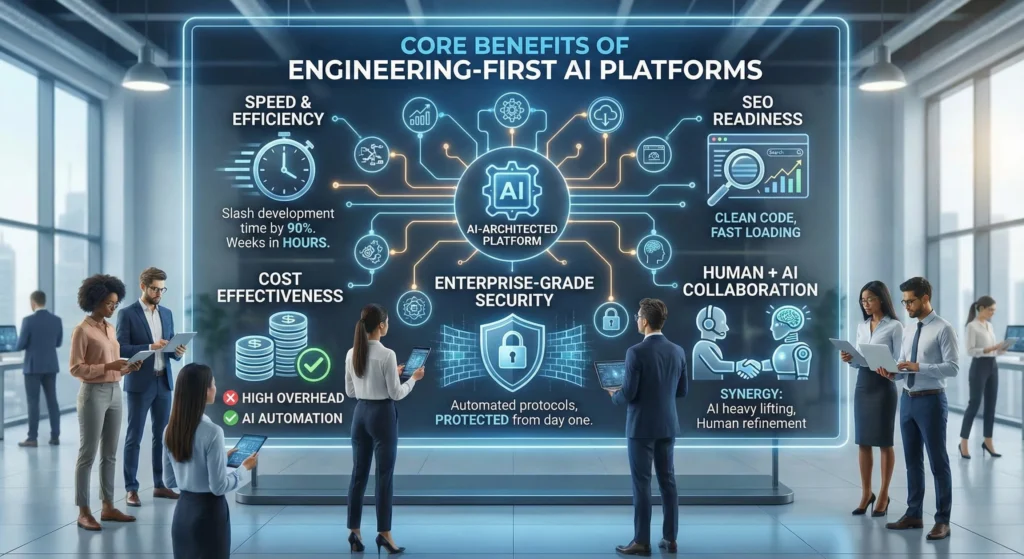
Why make the switch to an AI-architected platform?
- Speed & Efficiency: Slash development time by 90%. What used to take a team of developers weeks can now be accomplished in hours.
- Cost Effectiveness: Remove the high overhead of hiring specialized backend engineers and DevOps staff for early-stage products.
- Enterprise-Grade Security: With automated security protocols, your app is protected against common vulnerabilities from day one.
- SEO Readiness: Clean code structure and fast loading times—Core Web Vitals—are baked in, ensuring your app ranks well on search engines.
- Human + AI Collaboration: The best platforms don’t isolate you. They offer a synergy where AI handles the heavy lifting, and human support helps refine the nuanced edge cases.
The Future of AI-Driven App Development
We are standing at the precipice of a new era. The future of app development will move beyond “prompt-to-app” towards “prompt-to-business.”
In the near future, AI builders will not only generate the code but also continuously monitor user behavior, suggesting feature improvements, optimizing database queries automatically, and even self-healing bugs before users report them. The role of the “creator” will evolve from managing code syntax to managing product vision. As AI reasoning capabilities mature, the line between a “non-technical” founder and a CTO will blur, creating a level playing field where execution speed is the only differentiator.
Conclusion
The revolution in app development is not about replacing developers; it is about empowering visionaries. By leveraging AI that possesses SDE-level reasoning, Imagine.bo eliminates the technical debt and architectural fragility that plagued earlier no-code tools. You no longer need to compromise between ease of use and professional quality. For founders and businesses ready to build scalable, secure, and revenue-generating applications, the path forward is clear.
Stop prototyping and start producing. Build your vision with Imagine.bo.
Related Articles
- Revolutionizing Web Design: The Ultimate Guide to AI Website Builders
- Unlock Android AI Power: Your Guide to the Best AI App Builders
- The Future of App Development: How AI App Builders Are Revolutionizing the Industry
- AI Website Builder for Handmade Products: Craft Your Digital Shop Without Code
- AI Website Builder for Selling Products