
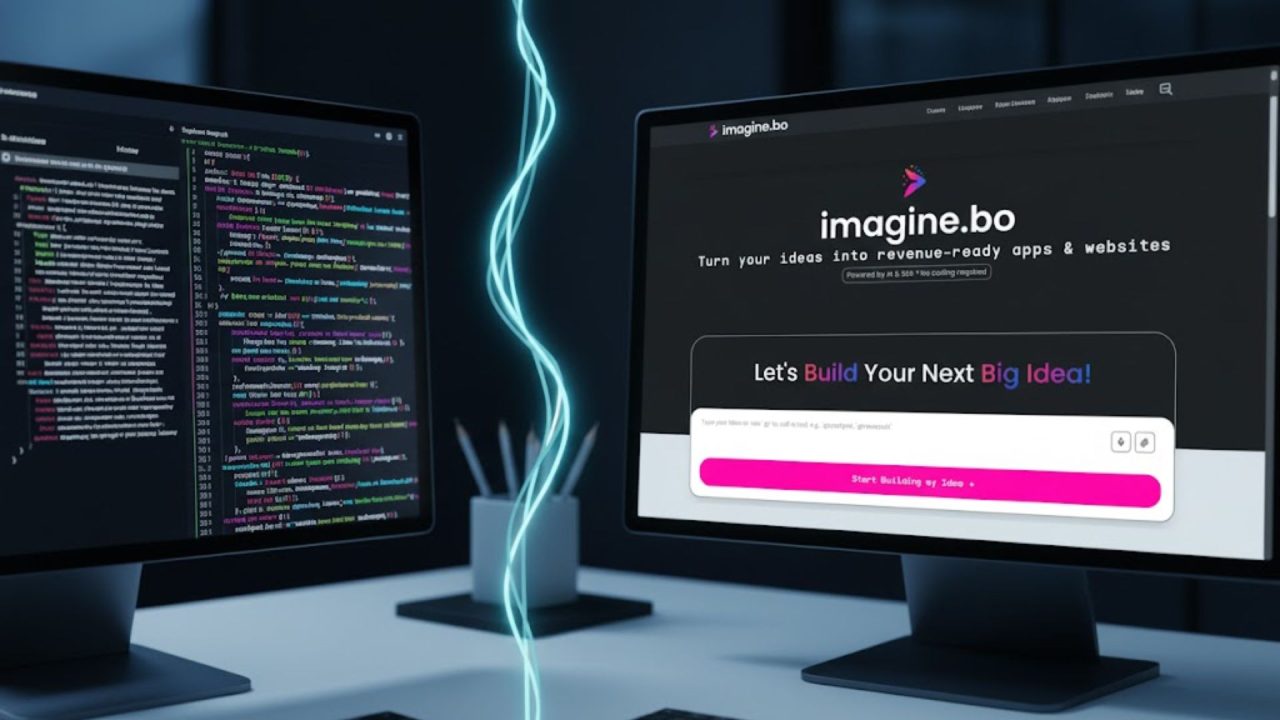
Author’s Note: I’m a professional coder with over six years of experience. I used to think no-code was a toy. This is the story of how a single project proved me wrong and fundamentally changed my workflow. I’m sharing this for other devs who are, rightly, skeptical.
There’s a special kind of purgatory reserved for developers, and it’s paved with boilerplate code.
Launch Your App Today
Ready to launch? Skip the tech stress. Describe, Build, Launch in three simple steps.
BuildI’m a coder. My hands live on a keyboard. My religion is clean code, my sacred texts are written in Python and JavaScript, and my church is a dark-mode IDE. For years, I’ve manually set up databases, wrestled with Webpack configs, written and rewritten user authentication flows, and debugged CI/CD pipelines at 2 AM. It’s the “real work” that you have to do before you can get to the real work.
And for just as long, I’ve scoffed at the “no-code” and “low-code” movement.
To me, those platforms were for “citizen developers” — a term I secretly, and perhaps snobbishly, looked down on. I saw them as toys. Sure, build a simple landing page. But you can’t build a real application. A scalable, secure, multi-tenant SaaS app? Not a chance.
I held this belief right up until three weeks ago, when a friend came to me with an idea. “It’s a simple project management tool for non-profits,” he said. “Just a small MVP to show to investors.”
The catch? He needed it in a week.
A week. To do this “right,” I’d need to:
- Set up a cloud environment (AWS, GCP).
- Configure a database (PostgreSQL, probably).
- Build a REST API with Node/Express or Django.
- Write all the CRUD endpoints for users, projects, and tasks.
- Implement user auth with JWTs, password resets, and email verification.
- Bootstrap a React frontend.
- Style it all.
- Set up a deployment pipeline.
Even working 18-hour days, a week was impossible. I was about to say no when I remembered a tool someone mentioned in a Slack channel: Imagine.bo.
The tagline was something like “AI No-Code App Builder.” I rolled my eyes, but I was desperate. So, I clicked. I figured I’d waste an hour, confirm my biases, and get back to politely telling my friend he was crazy.
Instead, I stumbled on a low-code hack that has fundamentally changed my entire development workflow.
The Wall of Skepticism

Look, my initial assumptions about no-code platforms were built on three core fears, fears that I think every developer shares.
Fear #1: The “Black Box” Problem
As a developer, I need to know what’s happening. I need to see the code, optimize the queries, and control the environment. No-code platforms felt like a black box. You drag a button onto a screen, and… magic? What if the “magic” is just a horribly inefficient, N+1 query that I can’t see or fix? This lack of control was a deal-breaker.
Fear #2: The Scalability Myth
“Sure,” I thought, “it works for 10 users. What happens when you get 10,000?” I was convinced these apps were built on glorified spreadsheets, destined to crash under the slightest load. My reputation is built on writing robust, scalable systems. I wasn’t about to tie my name to something that would melt the second it got a positive review on Product Hunt.
Fear #3: The 90% Brick Wall
This was my biggest fear. I was certain I’d get 90% of the app built in a day, and then I’d hit “The Wall.” It would be one critical, custom feature—like a specific API integration or a complex business logic flow—that the platform simply couldn’t do. I’d be stuck, unable to export the code or the data, and forced to throw everything away and start from scratch with traditional code. All that “saved” time would be lost, and I’d be even further behind.
These fears are valid. And in my experience with older tools, they were often proven true.
But I was desperate, so I signed up. The hack, I was about to learn, wasn’t about replacing me. It was about augmenting me.
The “Describe” Step — Talking to the AI

The first screen on Imagine.bo didn’t show me a drag-and-drop editor. It showed me a text prompt.
“Describe your app in plain English.”
I was skeptical. I’d used AI coding assistants before, and they’re good for writing a function, but not building an entire architecture. Still, I played along.
But I didn’t give it a “simple” prompt. I gave it my developer brain-dump:
“I need to build a web app that’s a multi-tenant SaaS platform for non-profits. It needs user authentication with roles (Admin, Manager, Volunteer). Admins can create projects. Managers can assign tasks. Volunteers can see their assigned tasks on a dashboard. I also need a simple analytics page for the Admin.”
I hit enter, expecting a simple blog template or a generic error.
What I got back a minute later was… the entire foundational architecture.
The AI didn’t just spit out a template. It had:
- Generated the database schema with
Users,Organizations,Projects, andTaskstables. - Correctly identified the foreign key relationships (many-to-one, many-to-many).
- Built the user authentication flows. Not just login/signup, but the password reset, email verification, and JWT-based session logic with role-based access control.
- Stubbed out the key pages: a login page, a registration page, a main dashboard, a “My Tasks” view, and an “Admin Panel.”
I just sat back. This wasn’t a website builder. This was an AI-powered app builder. The entire backend setup—the part that I dread, the part that’s pure, repetitive boilerplate—was done. In less time than it took to make my coffee.
This was the first “hack” realization: Use AI to eliminate 100% of the setup and boilerplate. My job as a developer wasn’t to write the auth system for the 500th time; it was to architect it. And I just did, by writing a single, clear paragraph.
The “Build” Step — Where’s the Code?
Now I was in the visual editor, and my developer brain was buzzing. I could see the components on the left, the properties on the right, and the visual workflow editor.
As I started building, I found myself mapping every action to its code equivalent.
- “Okay, this drag-and-drop ‘Tasks List’ component is clearly just a React component making a
fetchcall to the/api/tasksendpoint.” - “This visual workflow, ‘When User clicks ‘Submit’, create new row in
Projectstable,’ is just an event handler with anasyncfunction.” - “This data-binding on the dashboard is just mapping over a JSON object and passing props.”
I was mentally translating everything… until I realized I didn’t have to. I was just… doing it.
I built the “Create New Project” form. I connected it to the Projects table. I added a “My Tasks” view and filtered it to show only tasks assigned to the current_user.id. I styled the dashboard to look clean and professional.
In two hours, I had a functional, data-driven application. Not a mockup. A working application, connected to a real database, with full user authentication. The same work that would have taken me two days of pure, head-down coding.
I was building at the speed of thought, not the speed of typing. I was focused entirely on the user experience and the business logic, not the syntax, not the semicolons, and not the package.json dependencies.
Addressing My “Developer” Fears (This is the Real Hack)
My little app was working, but my developer-skepticism was still there. “This is great for a prototype,” I thought, “but I still can’t get over my core fears.”
This is where Imagine.bo completely changed the game for me.
On Scalability & Security
I dug into their documentation, expecting the worst. What I found was the opposite. The apps aren’t run on some shared, rickety infrastructure. They’re designed to be cloud-deployable on AWS, GCP, and Vercel. They boast a “1,000 transactions per second guarantee.”
And then I saw the magic words: GDPR/SOC2-ready.
This told me it wasn’t a tool for hobbyists; it was a platform designed for business. The “black box” wasn’t a box of messy code; it was a pre-built, optimized, secure, and scalable container. My fears about security and compliance were based on 2018-era tools. The game has changed. The platform handles the security and infrastructure, abstracting away the part of my job that, while critical, is also a massive, repetitive time-sink.
On The 90% “Brick Wall”
“Okay,” I said to myself, “it’s secure. It’s scalable. But what about my custom feature?”
For this project, my friend needed to import data from a very specific, obscure non-profit management-system API. This was my “Wall.” There’s no way a no-code tool has a pre-built integration for that.
I was right. It didn’t. And this is where I found the real hack.
Imagine.bo has a feature called “Assign to real developer when stuck.”
I stared at that. It’s not a closed garden. It’s not an all-or-nothing proposition. It’s a hybrid platform. The platform acknowledges that you will hit a limit, and it gives you an escape hatch. When I got to the 10% of the app that was truly custom and complex, I didn’t have to throw everything away. I could assign that single task to a human engineer—or, in my case, inject my own custom code block.
This was the “low-code” hack I was looking for.
It’s not “no-code.” It’s “hybrid-code.” It’s “AI-assisted development.” It’s the absolute best of both worlds. I could compare this hybrid AI approach to anything else, and it would win.
My New Workflow: The “Hack” in Practice
That weekend, I finished the entire MVP. In two days. My friend was ecstatic.
But the real change was in me. My entire workflow as a developer has been turned upside down.
For MVPs & Prototypes
I no longer say “give me two weeks.” I say “give me the weekend.” The ability to validate a startup idea at this speed is a superpower. I can build and test five ideas in the time it used to take me to build one.
For Internal Tools
The marketing team needs a custom dashboard to track campaigns? No problem. Finance needs a tool to automate expense reporting? Easy. I’m no longer a bottleneck; I’m an enabler.
For My “Real” Coding
This is the most beautiful part. My “real” coding time is now 100% focused on the really hard stuff. The 20% of the code that provides 80% of the value. The unique business logic, the complex algorithms, the custom API integrations. The part of my job I actually love.
As Martin Fowler, a thought leader in software, discusses the value of throwaway prototypes, they are often meant to be thrown away. But the app I built with Imagine.bo is the real app. It’s the scalable, secure, and production-ready version, built in a fraction of the time.
I’m Still a Coder, Just a Smarter One
The “hack” isn’t about not coding. It’s about knowing when and what to code.
The evolution of developer roles in the age of AI is here, and it’s not as scary as I thought. AI isn’t replacing me. It’s promoting me. It’s taken the repetitive, boilerplate-heavy “junior developer” work off my plate and allowed me to focus exclusively on the “senior architect” problems. My value is no longer in how fast I can type, but in how fast I can solve complex business problems and ship value.
The Pareto Principle, or the 80/20 rule, is a well-known concept in business, as this Forbes article explains—80% of the results come from 20% of the effort. For developers, it’s the other way around: 80% of our time is spent on the 20% of features (like auth, setup, and admin panels) that are just table stakes.
Imagine.bo automates that 80% of grunt work, freeing me to focus on the 20% of unique features that actually make the product special.
So look, if you’re a dev still scoffing at no-code, I get it. I was you. But just try it. Pick a side project and give it a weekend. You won’t become less of a coder. You’ll just become a faster, smarter, and infinitely more valuable one.
Launch Your App Today
Ready to launch? Skip the tech stress. Describe, Build, Launch in three simple steps.
Build