The traditional narrative of starting a tech company usually involves a specific set of ingredients: a computer science degree, a garage in Palo Alto, and several hundred thousand dollars in seed funding. For years, this served as a gatekeeper. If you didn’t know how to navigate a complex codebase or have the capital to hire someone who did, your “big idea” remained exactly that, just an idea.
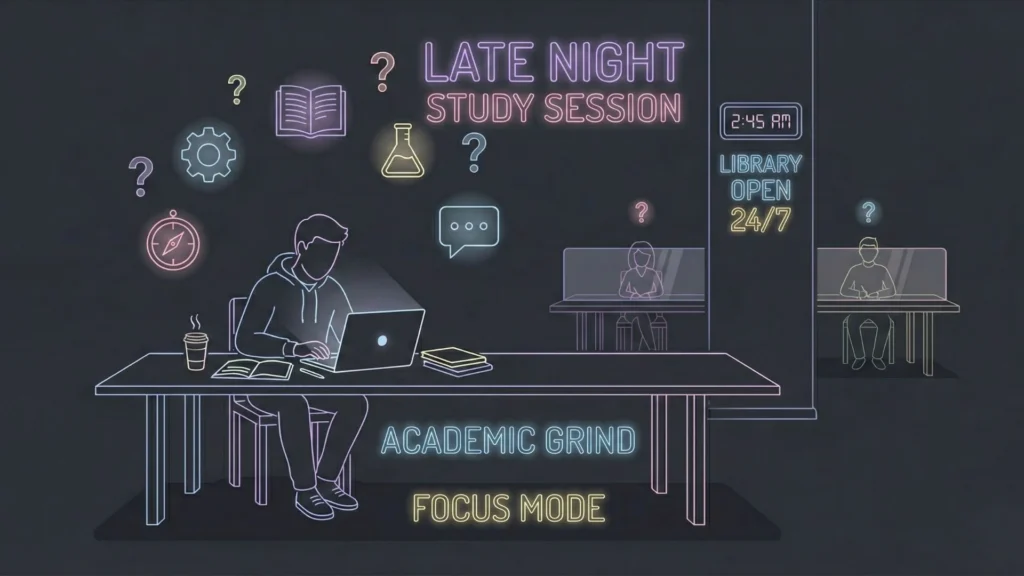
Maya, a junior majoring in Sociology, found herself staring at this exact gate. She didn’t have a technical background, but she had a problem that wouldn’t leave her alone. She noticed that despite dozens of campus apps, there was no centralized, real-time way for students to organize study groups based on immediate, hyper-local needs, like finding someone to review Macroeconomics notes in the library at 10:00 PM on a Tuesday.
Launch Your App Today
Ready to launch? Skip the tech stress. Describe, Build, Launch in three simple steps.
BuildShe was told she’d need a co-founder from the engineering department or $20,000 for an agency. Instead, Maya stayed in her dorm room, opened her laptop, and built a viral platform using the modern stack of AI and no-code app development.
This isn’t a story about a “genius coder.” It’s a blueprint for a new era of innovation where the barrier to entry has finally collapsed. If you have a clear understanding of a problem, the tools now exist to help you build apps without coding yourself.
Finding a Real Problem Worth Solving
The biggest mistake first-time founders make isn’t a technical one; it’s a conceptual one. They try to build “Uber for X” or “Facebook for Y” without asking if anyone actually needs it. Maya’s success didn’t start with a feature list; it started with an observation of daily friction.
Personal Frustration as an Opportunity
Innovation often hides in the “annoying” parts of your day. For Maya, it was the endless, fragmented noise of WhatsApp groups, Discord servers, and Slack channels. Information was buried, and timing was always off. When she looked around the campus coffee shop, she saw dozens of students studying the same subjects in total isolation.
The gap between “people with a need” and “people with a solution” is where the most successful startups are born. If you are experiencing a recurring frustration, chances are hundreds of other people are too. In the world of student startup success, your proximity to the problem is your greatest competitive advantage.
Observing Daily Student Pain Points
To validate her hunch, Maya didn’t write a single line of code. She spent a week observing. She noticed:
- Students posting “Anyone in Bio 101 want to study?” on Instagram stories.
- Handwritten flyers on bulletin boards that were weeks out of date.
- The high “social anxiety” cost of approaching a stranger in the library.
By identifying these specific friction points, she defined her Minimum Viable Product (MVP). She didn’t need a social network; she needed a real-time coordination tool.
Validating Before Building
Most apps fail because they are built in a vacuum. Before Maya even looked at an AI no-code app builder, she created a simple Google Form and a QR code. She posted it in the library with a simple question: “Need a study partner right now? Scan this.”
Within 48 hours, she had 150 sign-ups. This is the “smoke test.” If people are willing to use a clunky, manual process to solve their problem, they will be obsessed with a streamlined app. Validation is about proving demand, not proving your ego. Founders should check out this framework for product-market fit to ensure they are on the right track.
From Coding Barriers to Creator Freedom
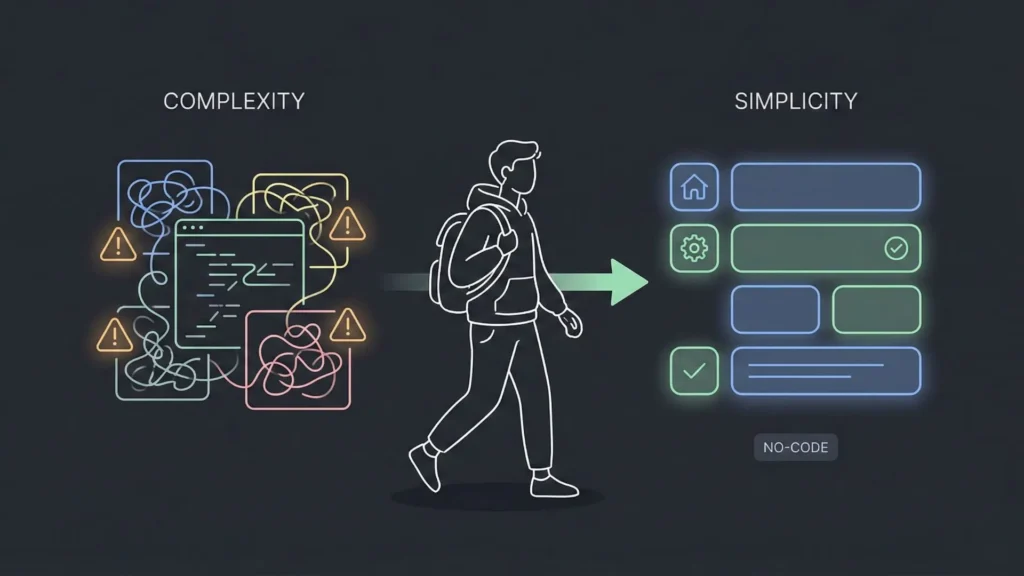
For decades, the “how” of building a product was more difficult than the “what.” You could have a world-changing idea, but if you couldn’t speak Python or Swift, you were sidelined. No-code app development has shifted the power dynamic from the gatekeepers to the creators.
Traditional Dev vs. No-Code
In a traditional development cycle, you have to manage frontend design, backend databases, and complex APIs. For a student, this is a full-time job. No-code platforms abstract these layers. Instead of writing syntax, you are defining logic and designing interfaces.
The time-to-market drops from months to days. This allows for an “experimental” mindset where the cost of failure is so low that there is no reason not to try. You can effectively launch your saas in 30 days or less, focusing on the user rather than the semicolons.
Where AI Fits Into Modern No-Code
While early no-code tools were essentially “visual LEGO sets,” the integration of AI has changed the game. We are moving past simple drag-and-drop. Modern AI can now handle the reasoning behind an app.
When we talk about an AI no-code app builder, we aren’t just talking about a tool that generates a layout. We are talking about an engine that understands the intent of your business logic. If you tell an AI, “I need a system where users can only see study groups within a 5-mile radius,” the AI understands the geographic logic and the database filtering required to make that happen.
Turning an Idea into a Real Product Without Code
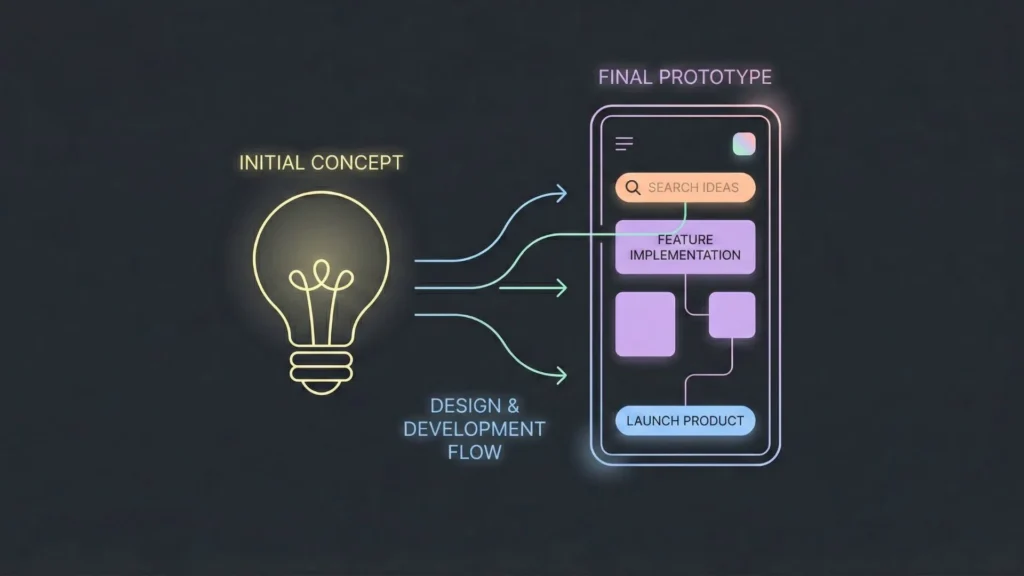
The “MVP mindset” is about brutal prioritization. Maya’s initial vision had dozens of features: tutor marketplaces, textbook exchanges, and integrated video chat. But to launch, she stripped it back to one: The “Join a Table” button.
Iteration Over Perfection
Your first version will be embarrassing. If it isn’t, you launched too late. The goal of an MVP without developers is to start the feedback loop with real users as quickly as possible. Maya launched her app with a simple list of active study sessions.
By focusing on core features, she avoided “feature creep,” the phenomenon where a project never finishes because the creator keeps adding “one more thing.” Many beginners fall into the same traps; learning common mistakes in no-code development can save weeks of wasted effort.
Designing UX Without Being a Designer
User experience (UX) is often mistaken for “looking pretty.” In reality, UX is about “reducing the cognitive load” on the user. Maya followed three rules:
- One Action per Screen: Don’t confuse the user.
- Standard Patterns: Don’t reinvent the wheel.
- Speed to Value: How fast can a student find a study group? (Her goal: under 10 seconds).
How Modern Founders Are Building Faster With Imagine.bo
As Maya’s project grew, she hit a wall common in the no-code world. Many tools are great for simple prototypes but crumble when you need real logic, security, or scale. This is where the landscape is shifting toward more intelligent, integrated platforms.
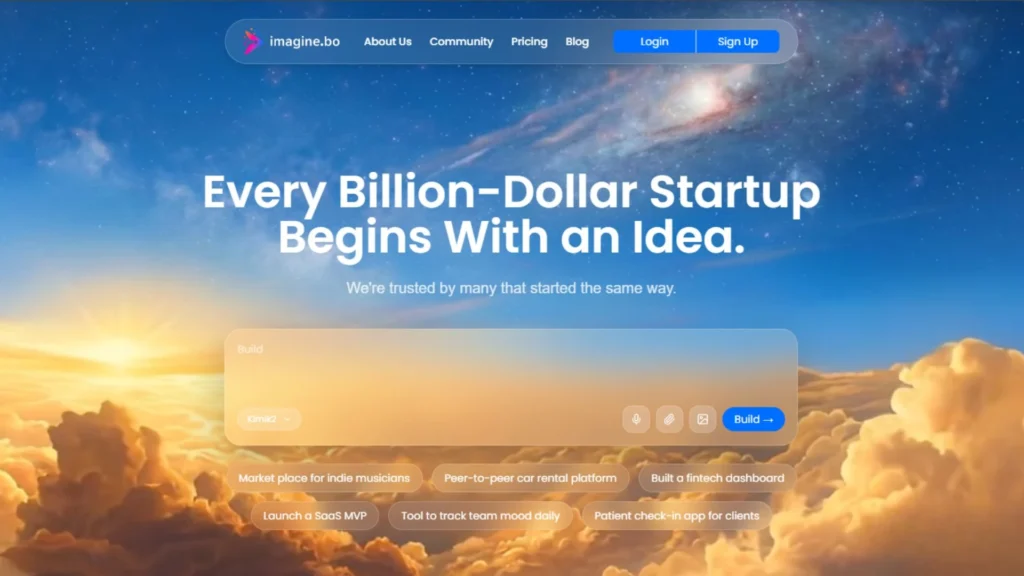
Imagine.bo represents the next evolution of this movement. Rather than forcing a founder to stitch together five different tools, Imagine.bo acts as a comprehensive AI partner that understands how to build a web app without coding in 2025.
Plain-English Idea Input
The most significant hurdle for non-technical founders is translating a “business idea” into “technical requirements.” Imagine.bo bridges this by allowing users to input their vision in plain English. You don’t need to know what a “relational database” is; you just need to be able to describe how your users interact with your service.
AI Reasoning Engine & SDE-Level Architecture
Most no-code tools produce “spaghetti code” under the hood, messy and hard to fix. Imagine.bo uses an AI reasoning engine that thinks like a Senior Software Development Engineer (SDE). It plans the architecture before it builds, ensuring that the backend is robust and the logic is sound.
For someone like Maya, this meant her app didn’t crash when 500 students joined simultaneously during finals week. It provided a level of professional-grade stability that was previously only available to funded startups.
What Makes Imagine.bo Different From Typical No-Code Tools
The difference lies in the “End-to-End” philosophy. Typical no-code requires you to be a “tool orchestrator.” You spend more time connecting integrations than talking to customers. Imagine.bo is designed for the “Product Owner.” It handles the technical heavy lifting, from the initial blueprint to the one-click launch, allowing the founder to stay focused on the user experience and growth strategy.
The 5-Step AI-Driven Product Journey
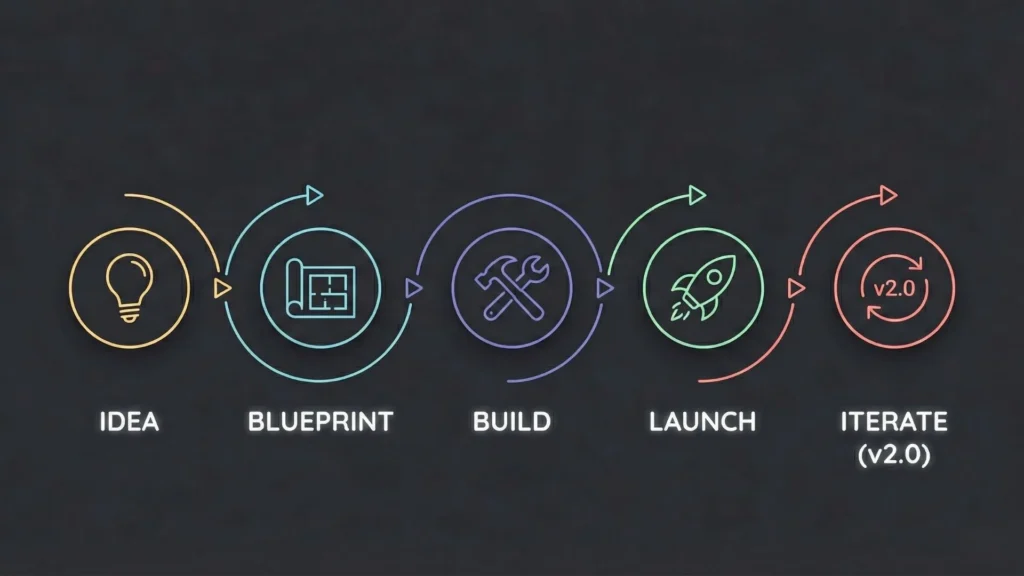
If you’re sitting in a dorm room with an idea, here is the conversational workflow Maya used to turn her concept into a reality:
1. Vision Input
You describe the problem and the solution. This is a conversation about what you want to achieve, much like using AI prompts to build apps from ideas.
2. AI Reasoning & Blueprinting
The system analyzes your input and suggests the best way to structure the data and the user flow. It’s like having a CTO sitting next to you.
3. Development & QA
The AI builds the functional components. This isn’t just a mockup; it’s a working application that undergoes automated checks to ensure stability.
4. One-Click Launch
You don’t have to deal with server configurations. You hit a button, and your app is live. Tie this back to Maya: her app went from an idea to a live URL in a fraction of the time it would take to hire a team.
5. Continuous Support
As your users provide feedback, you iterate. You go back to step one, describe the new feature, and the AI helps you integrate it into the existing structure.
How Student Products Gain Traction Without Big Budgets

Maya didn’t have a marketing budget. She had a campus.
Network Effects and Campus Growth
The best products for students are inherently social. Maya’s app had built-in “network effects”: the more people who used the app, the more valuable it became for everyone else. She used “unscalable” tactics to get her first 100 users, walking up to people in the student union and asking them to try it. For those looking for more inspiration, reading about real-world apps built with prompt-based tools can reveal dozens of similar organic growth strategies.
Using Analytics to Improve the Product
Once the app was live, Maya stopped guessing. She looked at the data. She saw that most people were looking for study groups between 7:00 PM and midnight. Using these insights, she tweaked the app to highlight “Late Night Study” sessions. This kind of data-driven iteration is what separates a hobby project from a successful startup.
Making the Product Sustainable
“Viral” is great, but “sustainable” is better. As Maya’s user base grew to several thousand students, she had to think about the long term.
Freemium Logic and Scaling
Maya kept the core features free but introduced premium placements for campus organizations. Because she built on a platform like Imagine.bo, she didn’t have to worry about her infrastructure costs spiraling out of control. The app was built to be production-ready from day one. You can learn more about how to monetize prompt-built apps to turn a side project into a real business.
Why Scalability Matters Early
Many founders think, “I’ll worry about scaling when I have a million users.” That’s a mistake. If your architecture is brittle, the moment you get a spike in traffic, your app will break. Modern AI builders ensure that your “Dorm Room MVP” has the bones of an enterprise application.
What This Means for Students and Non-Technical Founders
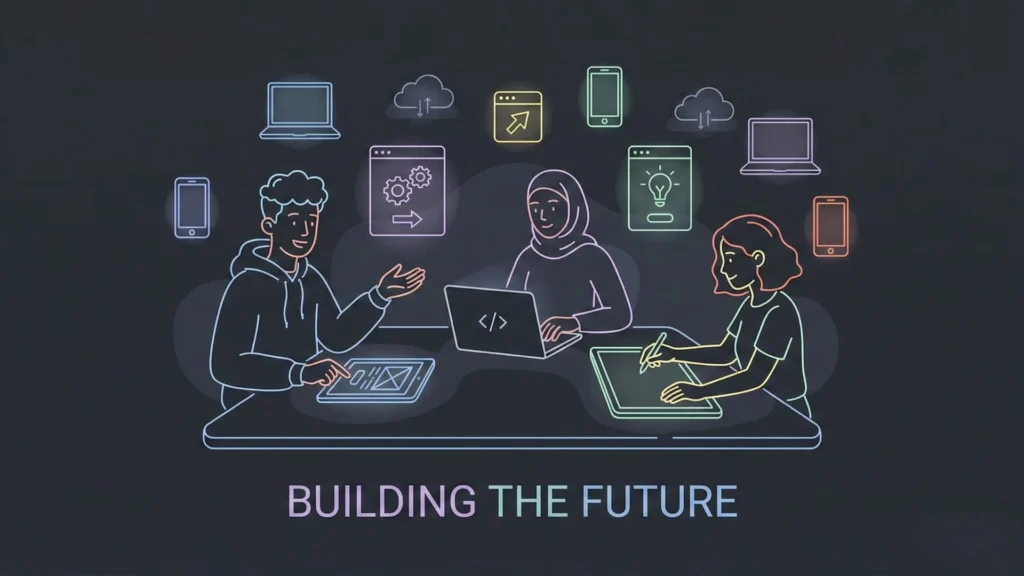
The story of the student founder is no longer an anomaly; it is becoming the standard. We are witnessing a massive shift in how products are created.
Ideas Over Code
When the “how” becomes a commodity, the “why” and the “what” become the most valuable assets. We are entering an era where your ability to empathize with a user, identify a friction point, and design a logical solution is far more important than your ability to debug a syntax error. This democratization of building means that the most creative minds, not just the most technical ones, get to shape the future.
Education Shift
We are moving away from needing to learn the mechanics of coding before being allowed to innovate. Now, students can focus on product management, user research, and market strategy while the AI handles the execution.
Conclusion: Your Dorm Room Could Be the Next Startup Studio
Maya’s app didn’t just help students study; it eventually got acquired by a larger EdTech company. She graduated not just with a degree, but with the experience of a successful exit, all without writing a single line of code herself.
The lesson here is simple: Stop waiting for permission.
You don’t need a technical co-founder to start. You don’t need to spend six months learning JavaScript before you build your first page. You need to identify a problem, validate your startup idea, and leverage tools like Imagine.bo to bring your vision to life.
The tools are ready. The blueprint is right here. The only thing missing is your input.
Launch Your App Today
Ready to launch? Skip the tech stress. Describe, Build, Launch in three simple steps.
Build