
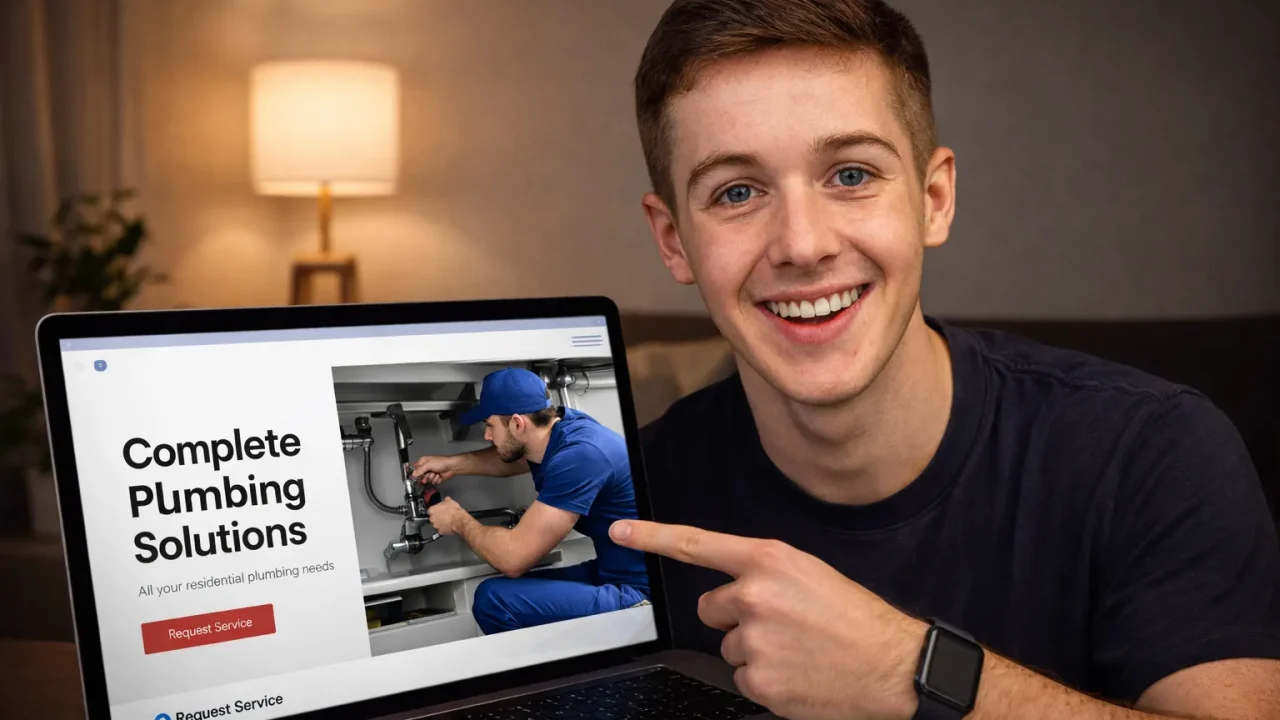
A plumbing website that converts needs five things: a benefit-led headline with a click-to-call button above the fold, dedicated pages for each service and location you cover, verified trust signals like Google reviews and license badges, mobile-first design that loads in under three seconds, and proper local SEO foundations including a complete Google Business Profile. Plumbing Website That Gets More Calls. You can build one through a DIY builder ($100–$1,600), an agency ($3,000–$15,000+), or an AI-powered platform like Imagine.bo. This guide covers each element in detail.
Why Your Plumbing Business Can’t Rely on Word-of-Mouth Alone
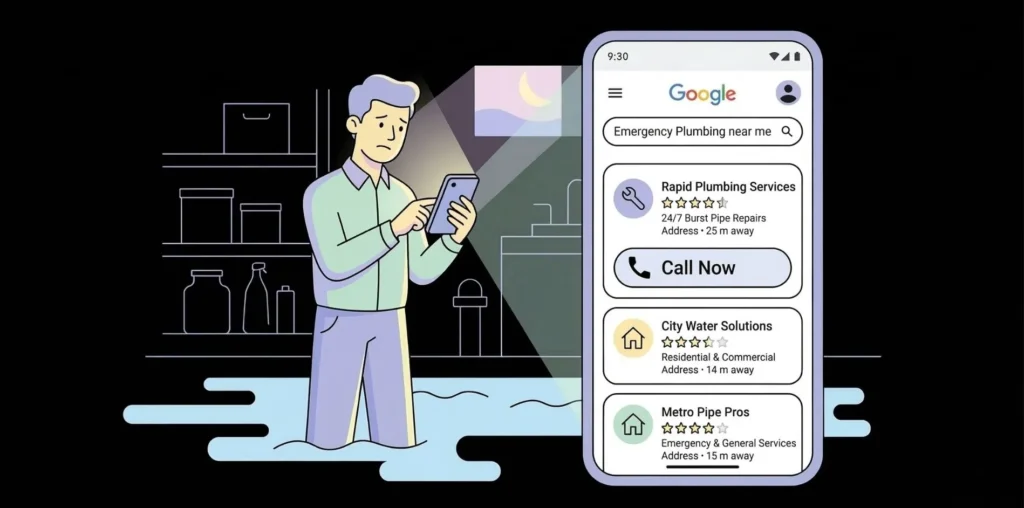
When a homeowner wakes up at 2:00 AM to a flooded basement, they’re reaching for their phone, not a phone book. The question is whether your business appears in that search — and whether your site convinces them to call you instead of a competitor.
Launch Your App Today
Ready to launch? Skip the tech stress. Describe, Build, Launch in three simple steps.
BuildThe data makes this urgency clear. According to BrightLocal’s Local Consumer Review Survey, 98% of consumers now use online search to find local businesses, up from 90% in 2019. Meanwhile, Coalition Technologies reports that 46% of all monthly Google searches carry local intent, and 78% of local mobile searches lead to an offline purchase. If your website isn’t built to capture that demand, you’re handing revenue to competitors who have invested in theirs.
But there’s a crucial difference between having a website and having one that actually converts panicked, trust-seeking homeowners into booked jobs. This guide breaks down the essential conversion elements, the local SEO foundations you need, and the realistic build options available in 2026 — including what we’ve built at Imagine.bo.
What Homeowners Decide in Three Seconds
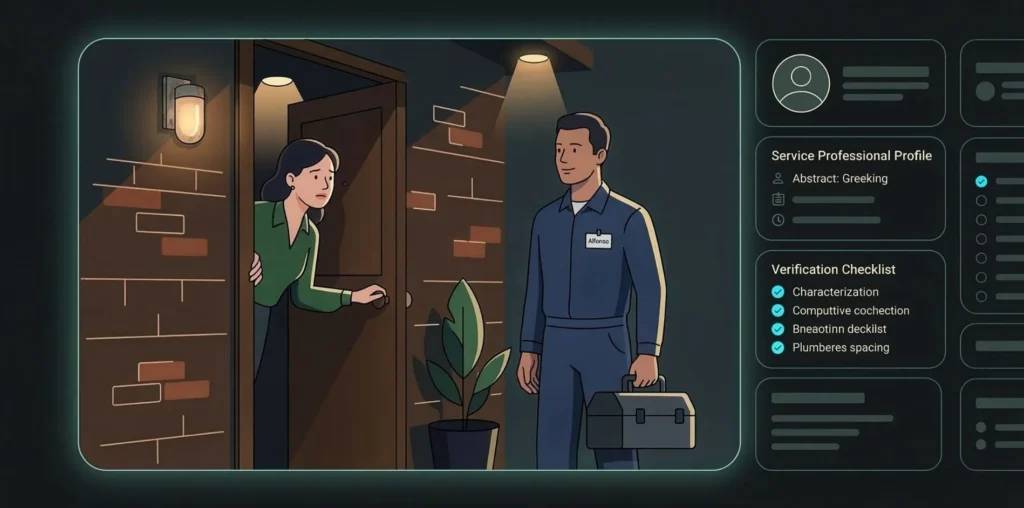
Before a homeowner lets a stranger into their house, they’re evaluating three things almost instantly: Are you local? Can you solve my specific problem? Can I trust you? If your site takes more than three seconds to load, looks dated, or buries the answers to those questions, they’ll bounce. In real terms, that’s a lost $1,500 water heater installation or a $400 emergency drain call.
Think of your website as an investment with a measurable return. If a properly optimized site generates even five additional emergency calls per month, the revenue impact compounds quickly. More importantly, it reduces your dependence on lead-generation platforms where you share every inquiry with three to five other plumbers.
7 Elements of a Plumbing Website That Converts
1. A Benefit-Led Hero Section
The “above the fold” area — everything visible before scrolling — is the most valuable real estate on your site. You have roughly three seconds to earn attention.
Weak: “Joe’s Plumbing. We fix pipes.”
Strong: “Fast, Reliable Plumbing in Austin, TX. 24/7 Emergency Service. We Arrive in 45 Minutes or Less.”
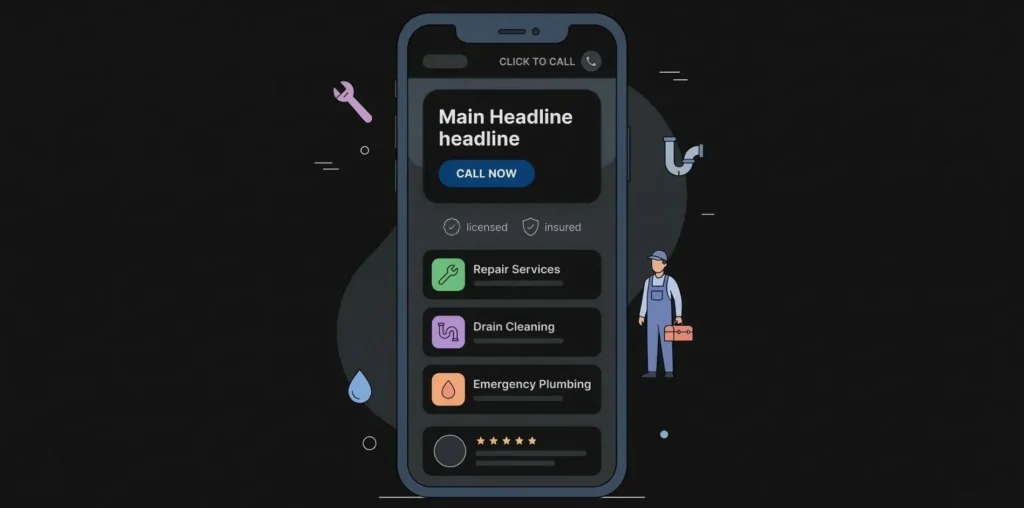
Your hero section needs three things: a clear, benefit-driven headline, a sub-headline explaining your differentiator, and a large, unmissable call-to-action button such as “Call Now for Immediate Dispatch.”
2. Frictionless Contact Options
A stressed homeowner should never have to hunt for your phone number. Place it prominently in the top-right corner of your header, and make it click-to-call for mobile users. According to SeoProfy’s 2026 local SEO research, 88% of consumers who perform a local search on their smartphone visit or call a store within a day. Additionally, Google’s own data shows that 60% of smartphone users contact a business directly from search results using click-to-call. For non-urgent inquiries like scheduling an annual boiler service, offer an online booking form or chat widget as a secondary option.
3. Trust Signals and Social Proof
Anyone can claim to be the best plumber in town. Your website needs to prove it. According to a Podium survey, 93% of consumers say online reviews influence their buying decisions. Effective trust signals include:
- Real customer testimonials pulled from your Google Business Profile or Yelp
- Certification badges: licensed, bonded, insured
- Professional association logos (e.g., Better Business Bureau, PHCC)
- Photos of your actual team and branded trucks — not stock photos of models holding wrenches backwards
4. Dedicated Service Pages
One of the most common mistakes is listing every service on a single page. If you want to rank for specific queries, each service needs its own detailed page with a unique URL:
- /water-heater-repair
- /drain-cleaning
- /emergency-plumbing
- /commercial-plumbing
This structure tells Google exactly what you offer, making it possible to appear when someone searches for that specific service in your area.
5. Location and Service Area Pages
If you serve multiple cities or suburbs, create a page for each one. A page titled “Plumber in Oak Park” with localized content will consistently outrank a generic homepage that says “Serving the Greater Metro Area.” Search engines reward geographic specificity, and so do users.
6. Transparent Pricing (or Clear Expectations)
You don’t have to list exact prices for complex jobs, but explaining your pricing model builds significant trust. A statement like “Flat Rate Pricing — No Hidden Fees” or “$49 Dispatch Fee” addresses the number-one fear homeowners have when hiring a tradesperson: getting overcharged.
7. Mobile-First Design
According to Statista’s 2025 data, mobile devices account for approximately 63% of all Google organic search traffic in the United States, and SeoProfy reports that 84% of local searches are conducted on mobile. Google also uses mobile-first indexing, meaning your mobile site is the primary version used for ranking. If your site requires pinching and zooming to read text, visitors will leave. Design for mobile first, then adapt for desktop — not the other way around.
Step-by-Step: Building Your Plumbing Website
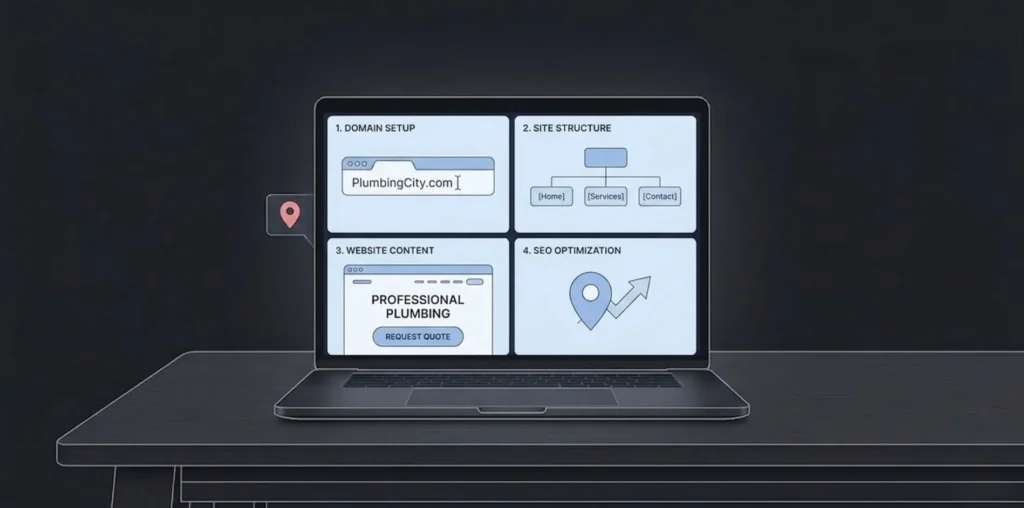
Step 1: Secure Your Domain and Hosting
Your domain name is your address on the internet (e.g., www.JacksonsPlumbing.com). Keep it simple: avoid numbers, hyphens, and unusual spellings. If your business name alone is taken, adding your city can help with local search rankings — something like JacksonsPlumbingChicago.com works well.
Step 2: Map Your Site Architecture
Before touching any design tool, sketch out your site’s structure on paper. A standard high-performing sitemap for a plumbing business includes:
- Home — Your hero section, primary CTA, and trust signals
- About Us — Your story, team photos, guarantees
- Services — Dropdown to individual service pages
- Service Areas — Dedicated pages for each city you operate in
- Reviews / Testimonials — Aggregated from Google and Yelp
- Contact Us — Embedded Google Map, contact form, hours of operation
Step 3: Write Copy That Speaks to Stressed Homeowners
Web copy for plumbers should read like a conversation with a worried homeowner, not a technical manual. Lead with benefits, not features.
Feature-focused: “We use hydro-jetting technology.”
Benefit-focused: “We blast away years of stubborn grease and roots so your drains stay clear — and you don’t have to worry about backups ruining your floors.”
Aim for an 8th-grade reading level. Keep sentences short. Use subheadings to break up long sections, and make sure every page has a clear call-to-action.
Step 4: Lay Your SEO Foundation
Search engine optimization is how you earn visibility on Google without paying for every click. The fundamentals that matter most for local plumbing businesses:
- Title tags: Every page needs a unique, descriptive title. Example: “Emergency Plumber in Seattle | Jackson’s Plumbing.”
- Meta descriptions: A 155-character snippet that convinces searchers to click your link over a competitor’s.
- NAP consistency: Your business Name, Address, and Phone number must be identical across your website, Google Business Profile, Yelp, and every other directory. According to SEMrush, businesses with consistent NAP information across listings receive significantly more calls.
How to Actually Build It: Comparing Your Options
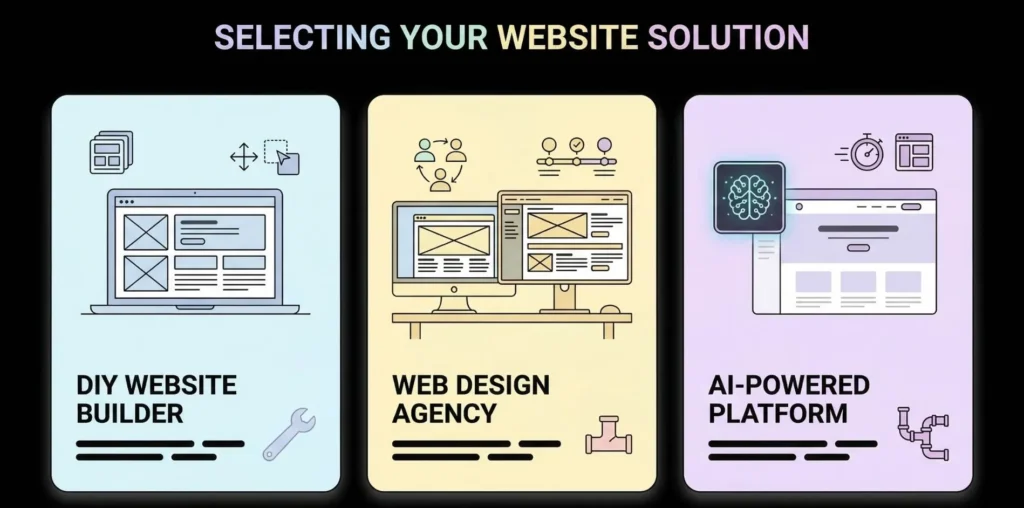
This is where most plumbing business owners get stuck. You know what a good site needs, but how do you physically build one? Here’s an honest comparison of the three main paths available in 2026.
Option A: DIY Website Builders
Platforms like Wix, Squarespace, or basic WordPress templates promise quick, affordable websites. OneLittleWeb’s 2026 pricing research puts the typical range at $100–$1,600 to build, plus $500–$5,000 per year in ongoing costs.
The trade-off: You’ll spend significant personal time learning the platform, fighting design limitations, and working around SEO constraints. The result is often a generic-looking site that loads slower than custom-built alternatives. You save money upfront but pay with your time and potentially lost leads.
Option B: Traditional Web Design Agency
Hiring an agency gives you professional design and development. For small business plumbing sites, CISIN’s 2025 industry survey found that mid-level websites typically cost $3,000–$7,000, while enterprise sites with advanced features start at $8,000 and can exceed $15,000. Many agencies also charge monthly retainers of $200–$500 for ongoing maintenance.
The trade-off: The project can take two to four months from kickoff to launch, and you’re dependent on the agency’s timeline for every update. For plumbers who need to move fast, that lag can be costly.
Option C: AI-Powered Website Platforms (Our Approach)
■ Note: The following section describes Imagine.bo, our platform. We’ve built it to solve the specific problems outlined above, but we encourage you to evaluate it alongside the other options based on your budget and timeline.
A newer category of tools uses AI to generate production-grade websites from plain-language descriptions. At Imagine.bo, we’ve built this specifically for founders and service-business owners who want software-engineering-level quality without learning to code or hiring an agency.
Here’s what differentiates this approach:
- Clean, deployment-ready code: Unlike template builders that often produce bloated markup, the AI generates cloud-native code designed for fast load times on infrastructure like AWS, GCP, or Vercel. Page speed is a direct Google ranking factor.
- Natural-language input: You describe your business, services, and goals in plain English. The AI structures the workflows, recommends the tech stack, and generates both front-end and back-end systems.
- Enterprise-grade security: Customer data, home addresses, and payment information require strict protection. Imagine.bo builds with GDPR and SOC2-ready security protocols by default.
- Scalability: Start with a lead-generation website. When you’re ready for a customer portal, dispatch dashboard, or e-commerce store for water filters, the platform scales with your business without starting over.
- Human + AI support: The AI handles the development, but professional developers are available within the platform for advanced custom logic, debugging, and scaling guidance.
The workflow is straightforward: describe your vision, let the AI map out user flows and generate blueprints, review the built site, launch with one click, and continue refining as your business grows. For plumbers, this typically reduces development timelines from months to days while keeping costs well below traditional agency pricing.
Driving Traffic to Your New Site
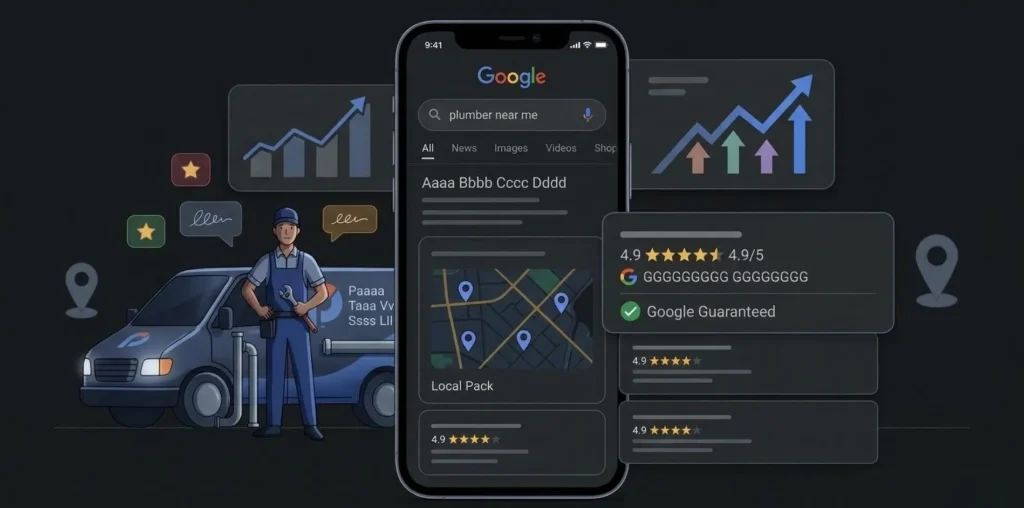
A well-built site needs targeted traffic to generate revenue. Three strategies deliver the strongest ROI for local plumbing businesses in 2026:
1. Dominate the Google Local Pack
When someone searches “plumber near me,” Google displays a map with three local businesses, known as the Local Pack or “3-Pack.” According to a 2025 study reported by RedLocalSEO, 44% of users click on one of those three listings, while only 8% scroll to the organic results below. A major SOCi study found that businesses in the 3-Pack receive 126% more traffic and 93% more conversion actions compared to businesses ranked outside it.
To improve your chances of appearing here:
- Claim and fully complete your Google Business Profile — hours, services, photos, and a link to your website
- Actively generate reviews. Give technicians business cards with QR codes linking directly to your Google review page
- Maintain NAP consistency across every directory and listing
2. Invest in Google Local Services Ads (LSAs)
Local Services Ads appear at the very top of search results, above standard pay-per-click ads. They display your business name, star rating, and a “Google Guaranteed” badge. The cost model is lead-based: you only pay when a customer actually calls or messages through the ad. For plumbing businesses with strong review profiles, LSAs consistently deliver one of the highest returns on ad spend in home services marketing.
It’s worth noting that recent tracking data from Places Scout shows Google has significantly increased paid ad placements within local results since late 2025, making a strong organic presence even more important as a complement to your paid strategy.
3. Track What’s Working with Analytics
You can’t improve what you don’t measure. Use Google Analytics (free) or your platform’s built-in analytics to monitor which pages generate the most calls, how visitors find you, and where they drop off. Track performance monthly and adjust your strategy based on real data, not guesswork.
Stop Losing Jobs to Competitors with Better Websites
The plumbing industry is competitive, but the opportunity is enormous. Homeowners are actively searching for reliable, professional plumbers online. According to AIOSEO’s verified 2026 statistics, 76% of people who perform a local search on their smartphone visit a related business within 24 hours, and 28% of those searches result in a purchase.
If your competitors have fast, trust-building websites and you don’t, they’re capturing your market share — even if you’re the better plumber. The good news: you don’t need to learn code, spend months in development, or hand over five figures to an agency. Whether you choose a DIY builder, an agency, or a platform like Imagine.bo, the important thing is to build a site that earns trust, answers questions fast, and makes it effortless for homeowners to call you.
Launch Your App Today
Ready to launch? Skip the tech stress. Describe, Build, Launch in three simple steps.
Build