Introduction: Don’t Wait for a Breakdown
For small business owners — the plumbers, the local delivery services, the HVAC contractors — your fleet is your lifeline. When a van breaks down, it’s not just an inconvenience; it’s a direct hit to your revenue, reputation, and schedule. Unexpected vehicle downtime is one of the most costly and frustrating realities of running a small fleet.
The solution is simple in theory: proactive maintenance. But in practice, managing the service schedules for even a small fleet of 5 to 15 vehicles quickly becomes a chaotic juggling act. You need a system that moves you from reactive repairs — waiting for a breakdown to happen — to proactive, predictive maintenance that alerts you before a critical service interval is missed.
Launch Your App Today
Ready to launch? Skip the tech stress. Describe, Build, Launch in three simple steps.
BuildThis guide is not about spending thousands on complex, enterprise-level fleet management software (SaaS) that you’ll never fully utilize. Nor is it about hiring a development agency to build a custom app over six months. It is about leveraging the power of AI and no-code development to build your own custom, scalable Fleet Maintenance Service Tracker in a single afternoon. We will show you how to build a solution that is superior to generic no-code forms and error-prone spreadsheets, perfectly tailored to your business needs.
The Spreadsheet Trap: Why Paper Logs and Excel Are Failing Your Fleet
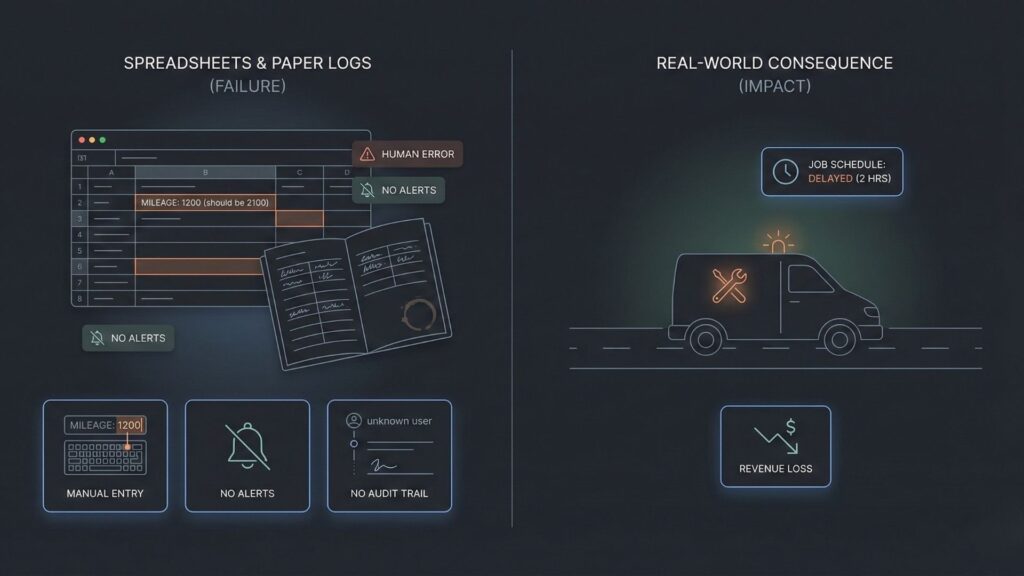
For years, the small fleet owner’s go-to tool has been the spreadsheet. Whether it’s a shared Google Sheet or a local Excel file, this method is fundamentally flawed for managing dynamic assets like vehicles. While simple on the surface, the spreadsheet method creates a hidden chaos that costs you money.
The core problem lies in the reliance on manual data entry and the complete lack of automation.
The Three Fatal Flaws of Manual Tracking
| Flaw | Description | Business Impact |
| 1. Error-Prone Data Entry | Technicians must manually log mileage and service details. A single typo or forgotten entry renders the entire service history unreliable. | Missed service intervals, voided warranties, and unexpected breakdowns. |
| 2. Zero Automated Alerts | Spreadsheets cannot trigger push notifications or emails. Someone must manually check the sheet every day to see if a service is due. | Service is often overdue by hundreds of miles or weeks, leading to accelerated wear and tear. |
| 3. Lack of Accountability | It is difficult to track who logged what and when, making it impossible to audit the service process or hold staff accountable for incomplete records. | Gaps in service history, which significantly lowers the resale value of the vehicle. |
If your current system is a messy spreadsheet, you are not alone. But to truly scale and protect your assets, you must transition from a static document to a dynamic, automated application. This transition, once complex, is now simple with AI-powered no-code platforms.
Predictive vs. Preventative: Making AI-Powered Maintenance Accessible
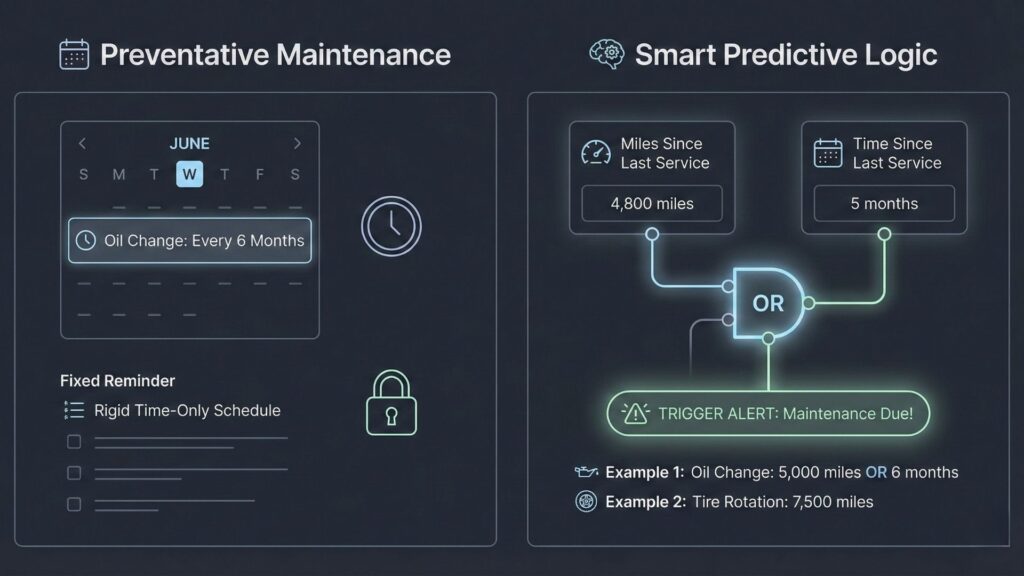
To build a high-performing service tracker, you must understand the difference between preventative and predictive maintenance.
- Preventative Maintenance: This is maintenance based on a fixed, scheduled interval, such as changing the oil every six months. This is the best a spreadsheet can do.
- Predictive Maintenance: This is maintenance based on usage-driven logic and data analysis. True predictive maintenance, as offered by high-end SaaS, uses telematics and sensor data to predict component failure.
For a small fleet, we can achieve “Smart Predictive Logic”—a powerful, accessible middle ground. Instead of fixed schedules, your custom app will use automated logic to check two conditions: mileage or time.
The Logic: The app checks: Is the vehicle over 5,000 miles since the last oil change OR is it over 6 months since the last oil change? If either condition is true, it triggers an immediate, high-priority alert.
This is the crucial difference that outranks generic no-code forms. Simple forms only collect data; a custom app built with Imagine.bo’s AI engine can process that data and act on it, providing the intelligence needed to prevent costly downtime.
Core App Logic: The 3 Essential Features
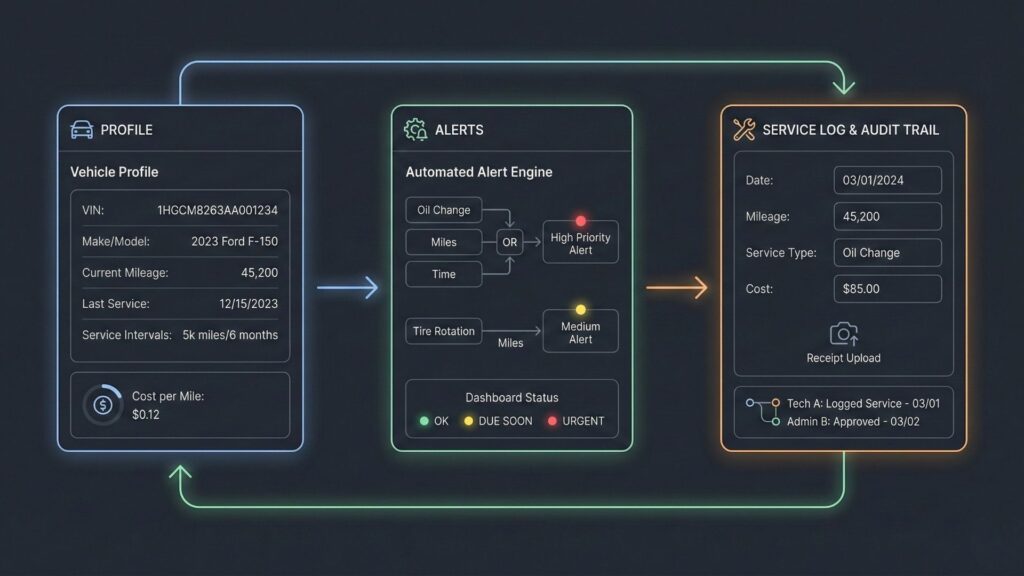
The value of your custom service tracker lies not in its user interface, but in the SDE-level backend logic that Imagine.bo generates. This architecture ensures your app is scalable, secure, and reliable.
Here are the three essential features that must be included in your custom fleet maintenance app:
1. Vehicle Profile & History (The Data Foundation)
This module serves as the central database for all your assets. It stores static data (VIN, Make, Model) and dynamic data (Current Mileage, Last Service Date).
Business Value: This feature allows you to calculate the Cost Per Mile (CPM) for each vehicle. By tracking total expenses against total mileage, you can make data-driven decisions about which vehicles to retire or which models are most reliable.
2. Automated Alert Engine (The Predictive Core)
This is the heart of your application. It replaces manual spreadsheet checks with instant, automated push notifications.
The Logic: The engine runs a simple but powerful conditional check:
- Oil Change Alert: IF (Current Mileage > Last Oil Change Mileage + 5,000) OR (Current Date > Last Oil Change Date + 6 Months) THEN Trigger Alert.
- Tire Rotation Alert: IF (Current Mileage > Last Tire Rotation Mileage + 7,500) THEN Trigger Alert.
This dual-condition logic ensures that vehicles that sit idle (time-based alert) and vehicles that are heavily used (mileage-based alert) are both serviced on time.
3. Service Log & Audit Trail (The Accountability Tool)
This feature provides a simple, mobile-first form for your technicians. When a service is completed, the technician logs the details, including the new mileage, cost, and a photo of the receipt.
Accountability and Scalability: Logging the service automatically updates the vehicle’s profile, resetting the Automated Alert Engine. This closed-loop system ensures that the service history is always accurate, creating a clean, digital audit trail that increases the vehicle’s resale value and simplifies compliance.
The Imagine.bo Blueprint: Build It in Minutes
The greatest competitive advantage of using Imagine.bo is the ability to bypass complex coding and technical setup. You simply describe the application’s logic in plain English, and the AI generates the production-grade application, complete with a scalable backend and secure database.
Prompt for Imagine.bo AI Builder:
Here is the exact Master Prompt you can use to build your custom service tracker app today.
I need a custom, mobile-first Fleet Maintenance Service Tracker app for my small business, a plumbing company with 8 vans.
Goal:
The app must track preventative maintenance and alert me when service is due based on both mileage and time.
Core Features:
- Vehicle Management Module
A database to store each vehicle’s profile, including VIN, make, model, year, current mileage, and service interval settings. - Service Log Module
A simple form for technicians to log completed services, including date, mileage, service type (oil change, tire rotation, inspection), cost, notes, and a photo of the receipt. - Predictive Alert Engine (Logic)
Oil Change Alert: Trigger a high-priority push notification and dashboard alert if the current mileage is greater than the last oil change mileage plus 5,000 miles, OR if the current date is greater than the last oil change date plus 6 months.
Tire Rotation Alert: Trigger a medium-priority alert if the current mileage is greater than the last tire rotation mileage plus 7,500 miles.
- Dashboard for Fleet Manager
A simple view showing all vehicles, color-coded by status:
Green: Good
Yellow: Service due soon (within 500 miles or 1 month)
Red: Service overdue - User Roles
Two roles are required:
Technician: Can only log service entries
Fleet Manager: Can view all data, set service intervals, and receive alerts
Technical Requirement:
The app must be built with a scalable backend using SDE-level architecture so that future features such as parts inventory or telematics integration can be added easily.
Implementation Guide: From Prompt to Production

Once you submit this prompt, the Imagine.bo AI Builder takes over, delivering a fully functional application in minutes. This process is a significant leap beyond traditional no-code platforms .
Step 1: AI Generates the SDE-Level Architecture
The AI doesn’t just create a form; it generates the complete, production-grade architecture:
- Database Schema: A secure, normalized database to handle vehicle, service, and user data.
- Backend Logic: The code to run the complex IF/OR logic for the Predictive Alert Engine.
- User Interface: A mobile-first interface for both the Technician and Fleet Manager roles.
Step 2: Refinement in Plain English
After the initial generation, you can refine the app using conversational prompts. Need to add a field for “Brake Pad Thickness”? Simply tell the AI: “Add a field to the Service Log for Brake Pad Thickness with a required input of 1-10mm.” The AI handles the database and UI updates instantly. This is how you move from a basic tracker to a custom fleet maintenance software that perfectly fits your operations .
Step 3: The Scalability Promise
This is where Imagine.bo truly outranks simple no-code tools. The application is built with SDE-level architecture, meaning it is designed to grow with your business.
| Feature | Simple No-Code Tool | Imagine.bo Custom App |
| Architecture | Form-wrapper around a spreadsheet; limited scalability. | Secure, cloud-native backend; built to handle 1,000+ transactions per second. |
| Future Growth | Requires rebuilding or migrating to a new platform. | Easily integrates with external APIs (e.g., fuel cards, telematics) and scales to hundreds of vehicles. |
| Security | Basic form security. | Enterprise-grade security, GDPR, and SOC2-ready . |
Your custom app is a true piece of software, not a temporary fix.
Conclusion: Focus on the Road, Not the Logs
The era of managing your most valuable assets with error-prone spreadsheets is over. By building your own custom service tracker, you are not just saving money on expensive SaaS subscriptions; you are gaining a competitive edge through efficiency and reliability.
The return on investment is clear: reduced downtime, extended vehicle life, and lower overall maintenance costs.
Stop waiting for a breakdown to force your hand. Start building your custom, scalable fleet maintenance software today with Imagine.bo.
Launch Your App Today
Ready to launch? Skip the tech stress. Describe, Build, Launch in three simple steps.
Build